Showing posts with label ethanol. Show all posts

Thursday, January 5, 2012

Alaska, diesel, refining changes and Venezuelan exports

The Iditarod dog-sled race commemorates the time in 1925 when serum had to be carried from Anchorage to Nome to counter a diphtheria outbreak and dog sleds were the only way of making it through. A different problem is now beginning to face some of the remote villages in that state, as it becomes more difficult and expensive to supply fuel reserves to get them through the winter. With supplies restricted and expensive to deliver, prices can rise as high as $7.15 a gallon, gasoline was $5.44 in Nome earlier this winter. I was reminded of that this morning, as the Russian tanker, the Renda, turned back for minor repairs before essaying the trip from Dutch Harbor in the Aleutian Islands to Nome carrying a million gallons of diesel fuel (which powers the electric generators) and 400,000 gallons of gasoline. The fuel would normally have gone by barge earlier in the winter, but storms led to that delivery being cancelled. Now the tanker is being escorted by an ice-breaker since the last 300 miles of the 700 mile voyage will be through ice that can be 2 ft thick.

In other Alaskan news the November figure for oil flow down the Alaskan pipeline averaged 625 kbd, which gets the flow above the 600 kbd level which becomes a concern in winter, since it can lead to ice and wax build-up in the pipe. The December figure should be released soon.
UPDATE: As of January 9th the Renda is 140 miles from Nome, but is finding it hard to make progress through the ice, which is under considerable pressure. The "dynamic ice" has brought both vessels to an occasional halt, and the ice is thickening.

UPDATE 2: The ice has been more than 4 ft thick in places, and pressure is closing the passage some times before the Renda can make it through. It is difficult enough that the 2 vessels took a 12-hour break on Sunday night. They made 53 miles of progress on Monday, with 100 miles still to go.

Positiion of the ships (the icebreaker is the Healy) relative to Nome at 5 pm Tuesday (Central time)

Diesel fuel prices in the rest of the country are continuing to fall, as the latest TWIP notes, although at $3.70/gallon on average the price is still some $0.50 per gallon higher than last year.

Change in Diesel prices (EIA )

The US is producing around 5 million barrels of distillate (diesel) a day, up almost half a million barrels from last year, with domestic demand running around 4 million barrels. The remaining million barrels is being exported, largely to Europe and Latin America. The EPA requirement for cleaner diesel in the US has, as a perhaps unintended consequence, brought the fuel into compliance with European usage, and opened that market to the industry. Coming at a time when Russia is seeking to lower exports of low-sulfur diesel in order to keep domestic prices down, as the Export Land Model bites again, and with China banning exports, US exports have risen to exceed fuel imports.

Increasing exports is a move of necessity for some refineries since the continued decline in domestic demand for gasoline is hurting refineries. Sunoco, for example, is getting out of the business.

Decline in US gasoline demand over the past two years (EIA )

Note that there hasn’t been as much change in the domestic diesel market.

Demand for diesel in the USA over the past 2 years (EIA )

In fact Valero, one of the Gulf refiners, projects that the diesel market will continue to grow more strongly than that of gasoline.

Anticipated world growth in demand for gasoline and diesel (Valero Investor Presentation 2012 )

It has, as a result, been suggested that the additional diesel which will be generated should the Keystone XL pipeline be approved, will largely go to export. It has been pointed out that the Valero Refinery is in a Foreign Trade Zone, the diesel that is refined and exported will not pay taxes on it.

Export Market for diesel (Oil Change International )

Exports from the Valero Refineries (Valero Investor Presentation 2012 )

In passing I noted that Valero also seems to be doing well with its ethanol operations.

Recent income from ethanol for Valero (Valero Investor Presentation 2012 )

In the past 30 months Valero note that the EBITDA reached 90% of the purchase price of the 10 plants it runs, and which produce an average of 72,000 bd collectively. Collectively, in the USA, ethanol production has continued to increase.
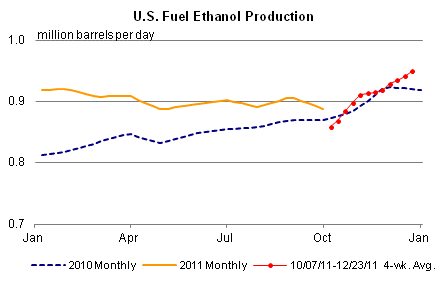
US ethanol production (EIA )

And there was one final graph from Valero that I almost missed, but which is, in its way telling:

Venezuelan exports to the USA (Valero Investor Presentation 2012 )

It should be noted that this plot is just for refinery products, and that Venezuela has continued to export oil to the US over the past year. However the figures for the 4th Quarter show an average of 793 kbd, down 9% on last year, and the three monthly averages were October 916 kbd; November 748 kbd and December 715 kbd all significantly down on last year. In 2010 the US imported an average of 1.24 mbd, about half of Venezuelan production, but since Venezuela has fallen to become the fourth largest supplier to the USA with the average of 760 kbd much of the remaining Venezuelan production goes to China, and India. But should Venezuela continue to decline in overall production, that global shortfall will need to be made up from somewhere else.

Read more!

Friday, May 13, 2011

Coal - a new technology and another look at the TV series

Back in 2008 Robert Rapier wrote a post on using coal in the making of ethanol, in which he referred back to a post he had written in 2006 on the same subject. That earlier post said, in part:
The natural gas input into ethanol production is a serious long-term threat to economic viability. Since natural gas is a fossil fuel, and supplies are diminishing, it will put upward pressure on the price of ethanol over time. However, if the energy inputs could be produced from coal, ethanol prices would be insulated from escalating natural gas prices.

Using coal might also lessen the significance of the EROEI debate. If you take 1 BTU of (cheap) coal, and you get back 0.8 BTUs of (more valuable, liquid) ethanol, then EROEI doesn't have the same significance as when you use natural gas to produce ethanol. You converted the BTUs into a readily usable liquid form. This argument may be valid from an economic point of view, but it ignores the fact that coal is still an inherently dirty energy source. If coal remains abundant and cheap, coal economics will beat natural gas economics, but coal will increase the rate at which we put carbon dioxide into the atmosphere.

In those remarks Robert was writing about the use of coal as a power source for running the ethanol plant, as opposed to the use of natural gas. The feed stock would remain the corn that is fermented, and turned into the beer that is then distilled into the ethanol that can be used as a liquid fuel source. That process still raises the debate over fuel versus food.

In an alternative approach Celanese are now starting to build plants in China that will use coal as the feedstock, without the grain, and they claim that this technology, is a game changer.
The so-called TCX technology can convert coal, petroleum coke or natural gas to ethanol for 25 percent to 35 percent less than alternative processes, Celanese said today in presentation slides posted on its website. The cost of converting coal to ethanol is $1.50 a gallon, equal to making gasoline from crude oil costing $60 a barrel, the Dallas-based company said.

“Fuel with our ethanol technology represents a game- changer for the company,” Chief Executive Officer David Weidman said in a presentation to investors in New York.

Weidman said he is advancing a November plan to build two factories in China that will turn coal into ethanol for industrial uses. The company also may produce ethanol for fuel in China, India, Australia, Colombia and Egypt, he said.
The technology, which is still being held fairly close to the Celanese chest, appears to use some of Celanese technology for the manufacture of acetic acid and involves the gasification of the coal to syngas as an earlier step. That supply will be provided by Wilson.

The use of coal is apparently currently commercial with this technology, while using the same process with a cellulosic feedstock is apparently not as yet that far along.

The two plants will each have a capacity of 400,000 tons of ethanol (134 million gallons) and will produce industrial ethanol rather than, at this stage, the fuel for use in vehicles. In China this is a larger (at 3 million tons/year) market than the fuel market, at half that size. Both are growing at up to 10% pa and the plants are expected to help meet that growth. Fuel ethanol prices in China have been estimated at $950 per tonne.

The most recent announcement comes as China is moving to increase coal imports by perhaps as much as a million tons a week due to drought reducing the output from hydro-electric power plants. Normally the country imports around 10.8 million tons a month, although this is a steadily increasing number. Without the additional imports it is possible that the country may see significant power shortages this summer, since the drought may lower available power by as much as 30 GW.

Speaking of the loss in power I did, eventually start to watch the second episode of Coal. One of the issues in that episode was the drop-out of power that was supplied to the mine. It is one of the ways in which mines can be given a lower price for electricity, if they accept that they will be “shed” if the demand exceeds that which the power generator can supply. The episode showed how that unexpected drop out can affect the men underground. Other power problems arose at the mine because the continuous miner operator was not fully experienced and was running the machine in to take too large an amount of coal or roof rock at one time. This overloaded the switches and tripped power. The necessary methodical restart of the system slows production, since nothing can start producing coal until all the components of the system are back up and running. As they are showing producing coal is not that simple or necessarily pleasant a process.

And a small additional note. In my comment on the first episode I was not that impressed with the way that the miners were bringing down the loose overhead rock. It turns out that I wasn’t the only one unimpressed. MSHA Inspectors, who watched the show, have fined Cobalt coal – for the use of improper barring tools and procedures, as well as a number of other violations.

The series has a considerable value in showing how difficult it can be to run a small mine, and though most of my experience has been in much larger operations (both financially and in terms of seam height) there are a number of different lessons that the series shows on coal mine operation. The problems of ventilation, when the belt drive started smoking and could have caught fire, are illustrative of that, with the telling message two miners died in a not too dissimilar event not that far away.

Read more!

Friday, December 3, 2010

A VMT oddity and the latest TWIP

I have been writing about the use of the monthly reports from the Federal Highway Administration (FHA) on vehicle miles travels, at intermittent intervals over the past couple of years. It provides an informal way of trying to see how fuel demand is going in the United States, and perhaps some indications of the recovery of the economy. The figures are now out for September 2010 and I was looking at the plot I usually use of the rolling 12-month average of miles driven:

Rolling 12-month VMT (Source FHA )

I hadn’t been paying much attention to the lower scale, it shows years and it wasn’t until I tried to see when it was that the driving was last at this level that I realized that the scale does not include years that end in 4 or 9. Which is my oddity for the day.

Other than that the recovery of driving seems to be holding up both in urban and rural areas, and generally across the country. Texas seems to be doing a little better than most, but other than that the picture appears to be, as the plot shows, one of steady growth at a rate similar to that before the great oil price boost.

Moving over to This Week in Petroleum the picture similarly shows nothing particularly out of the ordinary. The EIA is going to take a slightly different look at storage capacity data, and that is their front page story of the week, but as one looks at the plots, other than the slow creep up in oil prices, there is little untoward in them. Domestic production has continued to increase, lowering the need for imports, at a time of year when refinery inputs in general are down.

Source EIA

At the same time ethanol production is continuing its steady climb in production:

Source EIA

At a time when the gilt seems to be wearing off the ethanol gingerbread, the public discussion seems to be having little effect on that reality.

But other than that, nothing much of significance that I can see, (which doesn’t mean that I’m not missing something – perhaps that gasoline demand has dropped to the same level as last year?)


Read more!

Thursday, September 23, 2010

The TWIP and changes in regulations

There has been some talk recently of the current Administration raising taxes on oil and natural gas companies. Specifically the suggestion is that Section 199 of the American Jobs Creation Act and Section 1.901-2 of the Treasury Regulations would be repealed. The API recently hosted a conference call on the topic, which I unfortunately missed. A report on the plan has recently been prepared by Dr. Joseph Mason at Louisiana State University , who succinctly describes the results as:
Section 199 was enacted by President Bush in 2004 to provide taxpayers benefits for production activities in the United States. The provision grants a “deduction equal to a percentage of the lesser of ‘qualified production activities income or taxable income.” Under the provision, labor- intensive corporations are particularly favored by being able to deduct a percentage of domestic production activity each year. The repeal would apply solely to oil and gas firms.

Dual capacity credit, (Section 1.901-2) on the other hand, allows companies to deduct taxes on incomes from abroad, offsetting relatively high U.S. taxes on foreign incomes.3 Hence, the dual capacity regulation is a way for American firms to compete efficiently against foreign competitors.

In repealing the dual capacity credit, however, the current administration would effectively double-tax firms conducting business in many foreign countries
.
With the Australian intent to raise taxes on energy producing companies being one of the causes that led to the collapse of the last Government, this has not deterred the Prime Minister who is now re-committing the Government to a carbon tax. In short, given that governments around the world need to find some new pockets from which to extract the funding to keep their budgets closer to balanced, the energy industry seems to have been chosen as the sacrificial lamb.

In which regard it is interesting to note that the TWIP this week has been looking at the earnings of major oil and natural gas producers. It notes that average earnings were up over the same period last year, albeit still well below the 5-year average. Crude prices are up again, and the major companies have been increasing capital expenditures, with the increased availability of funds again. The oil and gas expenditures for the majors, for example, is not only up over last year, but is 19% over the average for the 2005-2009 timeframe.

Generally in the energy business, industry has to invest an increasingly large amount of money to find and then develop new fields of production. New resources are harder to find, and more expensive to develop, even when things go according to plan. Unfortunately the business is also one where impacts take some time to have an effect. Oil shipped in from the Arabian Gulf takes time to get to the United States, as a trivial example, but more germane, it takes years to find new fields, and then more years to develop them. The problem is that this usually slow response to change means that the impact of changes in the rules don’t always immediately appear to have the consequences that ultimately show up.

I have mentioned before (and will again) the dangers that the UK faces in long term energy supply as power stations are condemned to closure without a surety that there will be power in place and available to meet the evolving gap that this will lead. The world, at present, seems to believe that all will be well thanks to Russia, Turkmenistan and their neighbors who have a plethora of energy to offer. What is usually neglected in that review is the pipeline construction heading from those countries to China. The problem, of course, is that everyone assumes that the energy will be available, not recognizing the growing number of customers who are all bidding for volumes that will not meet global demand over the intermediate time interval. And the frequency with which gas pipelines seem to rupture as it crosses some of those borders is quite remarkable. The latest, between Kazakhstan and Russia occurred early Wednesday.

We are all, I fear, sadly complacent.

Turning just briefly to some of the graphs in the TWIP, and their possible meanings; Refinery inputs have leveled out, a little above last years numbers:

(Source TWIP)

Domestic crude is hovering around where it was at this time last year while imports have fallen from 10 mbd down to about 9.2 mbd since the middle of the summer, but this is a recognition of the change in driving as go go into the Fall. The drop in demand, that was holding off a little when I last commented on the numbers a couple of weeks ago, is now well under way.

(Source TWIP )

Since this is the first year that the EIA is showing ethanol numbers it is worth noting that while ethanol production continues to climb:

(Source TWIP )

the volume in stocks has been declining, though since this is the first year that the record is displayed, it is not yet clear how the seasonal trends will impact the shape of the curve.

(Source TWIP )

Given that, at the end of the month, the EPA is expected to rule on the use of E15 (i.e. 15% ethanol in the mix) ) it is perhaps not wise to make too many comments on the current shape of these graphs, since they are likely to change under that influence.

The anticipated benefit (apart from lowering the amount of crude that has to be imported) is based on an anticipated reduction in pollutants and better burning of the fuel in the engine. It remains to be seen what the unanticipated consequences are.

Since this is the political season our mayor dropped by our service club the other day to comment about the horrors of trying to run a budget as more and more mandates come down from the Federal Government, often written years ago, but only now showing up (so that he was careful to say that both parties share in the blame). His main theme (other than that we are not as bad as we might be, but that street repairs can only fix shorter stretches) was that many of the consequences only show up much later than the legislation, and regulation, and by that time it gets very difficult to correct initial mistakes.

Secure and timely energy supplies are a critical part of the success of industrialized nations. We need to remember that.

Read more!

Wednesday, May 6, 2009

Can politics be removed from biofuel generation?

The Administration has been praised for its move to rely more on science in the generation of policy, and on Tuesday a new group was announced that will work to encourage a new generation of biofuels.
The working group aims to accelerate funding to biofuels producers, in the hopes that they will phase out fossil fuel use at their own plants, instead using biofuels.

The group, which will be headed by the chiefs of the Environmental Protection Agency, the Department of Energy and the Department of Agriculture, also exists to encourage a new generation of biofuels made from biomass and other non-corn feedstocks.
Part of the study will, however, try to create a standard for assessing the GHG costs of producing and using the new fuel.
Mirroring a similar change in California, EPA is proposing to measure carbon emissions that come as a result of biofuel production. This includes a complicated and controversial formula that adds in emissions that occur when overseas farmers respond to higher food prices by converting forest and grassland to cropland.

“Life cycle estimates of the greenhouse gas relate to the fuel cycle and land conversion,” said EPA Administrator Lisa Jackson. “This research will be very important to future policies.”
It may well be that the “controversial” formula may take the discussion out of pure science, and give the opportunity to ease politics back into the discussion.

Certainly the Administration recognizes the financial cost, with some $800 million of DoE stimulus money being directed at research, development and the funding of test projects. However $484 million will go to demonstration projects, some of which are already being funded. The major emphasis seems to remain on generating ethanol, though an algae biofuels consortium will also be funded. This is to be followed by $1.1 billion in DoA funds much of that will go to help producers, through the biofuels credit program, restructure their businesses to survive. At present production is down and there is not enough (if any) profit to be made between the price of the corn feedstock and the sale of the ethanol.

The carbon costs of each process, will be calculated by the “controversial” formula, but the calculation was first subjected to “peer revew.” Though I guess that the validity of that process depends on the peers that were used.

In regard to the algae effort the Univ of New Haven are looking for better strains of algae to use. They note that some $195 million was raised for investment in algae work last year.

One of the greater drivers for algal biofuel development is coming from DoD who are anxious to find a replacement source for the jet fuel, on which an increasing percentage of their mobile systems run. DARPA have been taking a lead in developing this research. One of their advances has just been given some publicity
Researchers at the university (UT) have already developed an electromechanical process for extracting oil from an alga cell that is rapid, energy-efficient, free of solvents and less expensive than competing methods. The technique employs electric fields to break open the cell.

Another group of researchers at the university is focused on the science of separations research and is identifying techniques to separate the oil from the algae biomass once it has been released
.
In another development Richard Sayre at theDanforth Center in St Louis has discussed the use of algae that can be milked instead of being destroyed. The goal of the DARPA program is to reduce the cost of the biofuel to $3 a gallon.

The fact that algae make fuel while consuming CO2 is also being presented to Congress at the same time as a new report on the subject is being released. (pdf).

In perhaps a sign of things to come, an ethanol plant in Iowa is going to add some algal photobioreactors to the plant. The algae will take advantage of the water heat and CO2 generated from the ethanol plant, with hopes to use some 60% of the CO2.


Read more!

Saturday, March 21, 2009

P54. Pick Points

So here it is the weekend, and I would usually be putting up Saturday Pick Points, and the Saturday post, with Sunday’s Tech Talk in the wings. However, since I am still wandering around Europe (tonight I am in London, but leave early in the morning for Dumfries and Burns Country) I am, instead going to take a quick peak around and do sort of an abbreviated Pick Points, looking at some half-a-dozen or so stories that are worth a quick look.

Getting around as I do involves a fair bit of travel by plane, and I’ve noticed that the planes seem to be getting smaller, and thus fuller, as the economy spins away. Of course the increased traffic might be because some travelers, can’t have a new jet of their own, though I doubt it. China is now providing its suppliers with increasing quantities of jet fuel, perhaps suggesting that while the rest of the world is cutting back , they continue to grow. Cutting back is almost the universal cry, and certainly the restaurant business has to be hurting. And I have eaten in a number of places recently where I was one of only few customers. Of course sometimes it is because, when I go to places like the Fem Sma Hus in Stockholm I show up at American dinner times not European (most of my meal I was alone in the cellar, but just before I left it became crowded). This lack of demand hurts chef employment, in NYC the restaurant trade lost more than 10,000 employees in the three months over the end of the year, nationally the drop has been more than 100,000. And with reduced waitstaff, in more popular places this can catch management out when there is an evening surge in demand. Which may “earn” you a free glass of wine as it did for me tonight in London. Sadly, however, sales of alcohol often pick up in troubled times, as they are now in Russia, while the harsher economic environment means that the smaller firms are pushed out of the trade.

Robert Rapier has noted that this is a good time to pick up alcohol – though he is talking of the ethanol variety in his most recent column at R-Squared Energy Blog: Valero Now in the Ethanol Business. As he notes VeraSun, the nations second largest ethanol manufacturer, filed for Chapter 11 at the end of October. The corporate assets are now on the block, and Valero Energy stand to pick up the seven ethanol refineries, at a quarter of the construction costs. Other ethanol companies have already filed for bankruptcy protection, and it appears Aventine may soon be in similar straits. Yet even as these sales start, the scale of the volume that ethanol will contribute, relative to the coming need is small, and while it provides, as Robert notes, an easy way to pick up a fuel that is being mandated as part of future supply, for small change to the oil companies, it is not going to be more than a contributory part to the answer. Yet, at the moment, despite that mandate, farmers are planting a greater fraction of the crop in soy beans this year, anticipating a bust in corn prices (which prophecy might be self-defeating). On the other hand if the import tariffs are reduced, as some in the Senate suggest, we may be able to import all we need. (But wasn’t there this slogan about freeing ourselves from imported fuel dependency?) Even the Wall Street Journal has weighed in against ethanol, though that also gives me the chance to make a small technical note. Unless I am doing something stupidly wrong (not unlikely) American Kindles can’t yet pick up magazines and papers in Europe (neither Sweden nor the UK). So much for my plan to save weight in my carry-on baggage by just loading the papers to it – Rabbits! Though I guess they may have other bigger troubles.

Solar panel advocates can no doubt breathe a sigh (though they said it was rather a shout) as the final Space Station panels were successfully installed. The station now has enough power to allow double the crew. Down on Earth the Administration is making its first Federal loan guarantee for alternative energy. The guarantee is for $535 million and will help construct a PV facility that can generate panels to produce up to 500 MW per year. The panels are designed for use on rooftops. The world’s solar PV installations are stated to have reached a combined total of almost 6 GW by the end of last year with Europe getting 82% of the business to date. (The ranking by country is Spain, Germany, USA, Korea, Italy and Japan). Sales are thus on a positive upward trend, with DuPont estimating a trebling of sales by 2012. First Solar have also just announced that they have now produced 1 GW of their solar modules, so with manufacture gearing up, all we need now is the market growth.

The other major renewable, wind power, is also gaining market, with a new effort to put turbines into South Africa. The country, as you may remember, has had problems with suppling power, not only for its own needs, but that of its neighbors. The first 30 MW farm is not scheduled until 2011, which won’t help the intervening shortages. It will, however, quadruple capacity. Eskom – the main SA power provider needs a rate increase, but is having trouble getting its act together, and having a power failure at a rally to improve their public posture sure doesn’t help. It is frustrating enough to Botswana, who got most of their power from SA, that they have started seeing pink elephants. (Would I lie to you ?). Of course it’s not just the South Africans that can run into infighting over turf relative to wind power, though the new Interior Secretary promises to get it stopped.

And finally (as the clock kicks over here in London) it is 4 years ago that Kyle Saunders and I first posted our collaborative effort that was, and is, The Oil Drum. I have posted a short history of the site, over there, and repeat the very best wishes that I have for the site. It has filled a valuable need, and that will not diminish in the months and years ahead, and so my wish that the site “Live long, and Prosper.”

More stories can be found at The Energy Bulletin and Drumbeat at The Oil Drum.

Read more!

Friday, January 2, 2009

7. The limited Energy Growth Options of the Future

We’re now getting closer to the start of the new Administration, with President-elect Obama having travelled to Washington, to begin his residence there. And, with his arrival, one can start to look forward to the change that his Administration is going to bring, in many of the Departments that form the Federal Government.

Obviously the one that most concerns this site is going to be that of the Department of Energy, although rulings from the EPA on the future of coal power plant emissions, and a number of issues that relate more to the Departments of the Interior and to the Department of Agriculture will also impact the supplies of energy that we will need more critically as the Obama years develop. Given the very clear message that the nominees to head these various divisions have already articulated in regard to the need to move away from technologies that are being blamed for climate change, one might, at first think that their path forward was clear, but I suspect that a harsh dose of reality is going to temper some of the steps that lead into that path.

Consider first of all the options that have prevailed until now, in the basic forms of energy that we use, and how those must change in the future. It was over at The Gristmill just over a week ago, that Sean Casten gave this table on recent power construction:
Our total U.S. electric grid has a peak capacity of just over 1,000 GW. (That's 1 billion kilowatts or, if you prefer, enough to power 10 billion hundred-watt light bulbs.)
Of that total, here's what we've installed just since 1995:
~200 MW of solar PV

~10,000 MW of wind

~45,000 MW of combined heat & power

~200,000 MW of natural gas (about half of which was combined cycle, which runs at almost 2x the fuel efficiency of the U.S. grid)
He then goes on to note that in the same time interval there has been no construction of coal or nuclear power plants.

In the same time interval the amount of ethanol produced from corn in the United States has grown to meet mandated demand, with the stated goal of having this at 15 billion gallons/yr by 2022, by which time ethanol from cellulosic sources is mandated to reach at least 16 billion gallons for a total of 36 billion gallons of renewable fuel a year (that’s 2.3 mbd roughly). By September 2008, the industry was producing 0.64 mbd against a demand of 0.69 mbd. In November the largest ethanol producer, VeraSun, filed for bankruptcy protection.

Cellulosic ethanol, as I noted last week has yet to yield any significant production plant performance.

So here you are with a clean slate, and where would one then start developing future supplies. One could presume that the initial thought would be “more of the same,” particularly given the lack of other alternative options in the immediate future.

That would imply, given the hostility toward coal that is evidenced in at least some of the remarks attributed to Dr. Chu about this being his worst nightmare, that the focus remains on solar power, wind and natural gas.

And that is where the rub comes in, for there are a number of issues that will start to come to the fore as the current technologies move closer to larger-scale adoption.

Consider, for example, solar power, Robert Rapier recently invited Tom Standing to comment on a couple of these, and he looked at An Arizona Plant and a review of plans in France. His conclusions, that a 280 MW plant in Arizona would cover about 6 sq. miles (at 50% collector density) and produce around 1.8 billion kWh per year. This is about 2.3% of the growth in U.S. electrical demand per year. Thus even if the plants could be made sufficiently cost-effective that they can compete with the cheaper electricity from coal and nuclear (in delivered cost/kWh) they are unlikely to be a major player within the next few years. And that perhaps reflects the percentage of the total build of the last decade.

Moving on to wind turbine development, this is very much a question of where to put them to best advantage, and how then to distribute the power.

Montana, for example, has lots of wind potential, but as Ben Arnoldy in the CSM points out there are two problems left unaddressed. The first is the installation of transmission lines to carry the power to where it is going to be used, and the second is the provision of standby power for when the winds don’t blow. And here one comes back to that comment about coal again, because the logical back-up might be a coal powered plant, given all the coal in Montana. However, the resistance of the new Administration might be such, that the development of coal bed methane might be a better alternative, although there is some opposition to the idea.

But that brings us back to natural gas, which is where, in the above table, some 80% of the power growth has been. And this is a real concern, since the presumption is, in much the same way as has been presumed in Europe, that there will be enough natural gas going into the future, not only to supply the existing plants, but also to supply the growth needed in the future. And that is where there has to be concern.

As I pointed out in an earlier post back in my Oil Drum days the current oversupply of natural gas in this country is based on increasing amounts of production from wells in the shales of the country. These wells are expensive to create and relatively short in life. Betting the whole of our energy future on them seems to be highly rash.

Which brings us back to the apparently unacceptable options of coal and nuclear power plants. It will be interesting (since the utility companies seem to think that they are the best option, given that they are planning on installing more than 100 of them) to see how this plays out over the next four years.

Read more!