Showing posts with label Hydrofracing. Show all posts

Friday, July 10, 2009

Trying to legislate technology

Over on Climate Progress there is a note on the 100th coal-fired power station to be cancelled or postponed in recent months. This one is in Utah, and was cancelled as a result of the decision of the City of Los Angeles to be “coal free” by 2020. The Intermountain Power Agency was going to build a third power station, some 900-megawatts, to meet LA’s growing needs, but this is not to be.
Los Angeles Mayor Antonio Villaraigosa announced last week that the city -- which purchases about 45 percent of the IPA's power -- wants to end its use of coal-fired power by 2020. Villaraigosa said that the city will replace its coal-fired electricity with energy from renewable sources, natural gas, nuclear and hydroelectric power.
It will certainly be interesting to watch how this plays out, given that the best wind sites in the state appear to be already in use, and that there has been a slowdown in growth of new farms, to the point that Iowa has now passed California by. Certainly Baja California is getting into the act, with the promise of having 75% of the power needed for public lighting to come from a wind farm by 2011. But there is a considerable difference between the 10-megawatts of that plant, and the 900-megawatts just foregone. Solar continues to be very much more expensive, nuclear is unlikely to be available within the time frame anticipated, and there has been some debate about dismantling dams that provide some of the hydroelectric power. So it will fall on the back of natural gas to make up the shortfall, or so it would appear.

This would seem to give additional impetus to the prospects for the Ruby pipeline.
As proposed, the Project is expected to include approximately 675 miles of 42-inch natural gas transmission pipeline, beginning at the Opal Hub in Wyoming and terminating at interconnects near Malin, Oregon. Contracts for the pipe have been signed and pipeline construction companies have been selected. The Project will have an initial design capacity of up to 1.5 billion cubic feet per day (Bcf/d) and will traverse portions of four states: Wyoming, Utah, Nevada, and Oregon. Four compressor stations are proposed for the project: one near the Opal Hub in southwestern Wyoming; one south of Curlew Junction, Utah; one at the mid-point of the project, north of Elko, Nevada; and one in northwestern Nevada.

The connection of a pipeline from the currently underpriced supplies in Colorado and Utah into the Western market through the connection in Oregon and into the Northwestern gas pipeline will likely reduce the costs of gas in the West, while giving Colorado and Utah markets for their gas, at the time that they are potentially losing the Eastern market that was targeted with the Rockies Express. That pipeline has now reached Ohio and was placed to meet the need for cheaper gas in the North East. (among other things by replacing Canadian gas, which is also now going to lose the market in California). This market is now threatened by the potential of gas supplied from the Marcellus shale.

The role that hydrofracing plays in all this provides an interesting sub-text. As I have recently noted, there is a move by two Coloradan Congressmen and one from New York to tighten the regulation of hydrofracing. However
industry officials claim state regulation of the practice is more than adequate and that the chemicals used in fracking need to be kept secret for competitive purposes.
They also argue that in 60 years of fracking there has never been a case directly linking it to the contamination of drinking water wells because so many precautions are taken.

Interestingly Colorado has recently passed tougher legislation governing drilling in the state, which includes the need to list the components of the fracing fluid, legislation which is said to have increased costs in the state, and reduced the level of drilling (albeit the price of gas might just also have some effect on this).

The desire by the Colorado Congressfolk to make the rest of the nation work to the same rules as their gas industry (which incidentally does not have that much of the gas shale which requires hydrofracing to be economic) has yet to be decided in the national Congress, but should the legislation pass then the costs to the California consumer may be significant.

Unfortunately, at the time that they discover that the costs of switching to the more environmentally friendly power generation system is costing them significant dollars (at a time when California is broke) it may be too late to reverse the decision, in the way that Durango recently did and move back to coal, since the coal plants will not, it would appear, now be there.

Whether, with the increasingly levels of demand for natural gas to replace planned coal-fired plants, the natural gas will be there to meet that increased demand is a tale for another day.

(NOTE: When I originally wrote this piece it had a different end section, the original end section, and the reason for the change are discussed in the section below. My apologies for the error in including that material, and my thanks to Gail for catching the error and drawing my attention to it).


. . . . . . . . . . . . . . . . . . . . . . . . . . . . . .
When I first wrote this piece, the end segment read as follows:
The role that hydrofracing plays in all this provides an interesting sub-text. As I have recently noted, there is a move by two Coloradan Congressmen and one from New York to tighten the regulation of hydrofracing. The fight is now, apparently getting a little rougher. (H/t Prof Goose) A research professor at Colorado School of Mines has run into some unpleasant reactions.
Thyne said he was threatened with termination as a research associate professor at Mines, a position he still holds through the end of the summer, because of pressure put on the state school by powerful players in the oil and gas industry who were upset with his position that federal regulation of hydraulic fracturing may ultimately be necessary if oil companies don’t find other solutions.
In fact he has moved on to another university (Wyoming) but has been working on a site where there is a possible problem.
Thyne contends there needs to be much more rigorous study of fracking to determine the extent to which it can contaminate groundwater supplies. Industry money currently being poured into the aggressive and highly defensive campaign to defeat DeGette’s legislation would be better spent building a credible scientific case for why the exemption was necessary in the first place, he adds.

Industry officials claim state regulation of the practice is more than adequate and that the chemicals used in fracking need to be kept secret for competitive purposes. They also argue that in 60 years of fracking there has never been a case directly linking it to the contamination of drinking water wells because so many precautions are taken.

But Thyne is currently being employed as an independent consultant by Garfield County to study a case near Silt in which a property owner claims fracking contributed to an ongoing gas seep in Divide Creek.

Interestingly Colorado has recently passed tougher legislation governing drilling in the state, which includes the need to list the components of the fracing fluid, legislation which is said to have increased costs in the state, and reduced the level of drilling (albeit the price of gas might just also have some effect on this).

As for the CSM prof, given that the story has popped out only after he had found a position to move on to, I tend to be a bit cynical about the weight of the pressure that might have been applied to him. Having been peripherally involved in a case of our own where a faculty member’s untimely remarks about a company to the press probably cost our University at least one and likely several large contracts, as well as ruining relations between us for several years. It happens. There were several rude exchanges, so I gather, but it all blew over. As this likely would have.

But given the desire by the Colorado Congressfolk to make the rest of the nation work to the same rules as their gas industry (which incidentally does not have that much of the gas shale which requires hydrofracing to be economic) I am not sure that the overall discussion will have as simple an outcome.

. . . . . . . . . . . . . . . .
The reference to Dr. Thyne is innaccurate. It turns out, as Gail discovered and called to my attention that CSM had commented on the situation, with the following statement:
“I want you to know that no one in the Mines administration recalls having anything but cordial conversations with Dr. Thyne this spring. When Dr. Thyne was quoted during that time by the media, the school received inquiries about Dr. Thyne’s association with Mines.

“As a result, Mines officials phoned and e-mailed Dr. Thyne to inform him of the inquiries, and also to remind him of the university policy that people must be clear in public communications that the opinions they express are personal and do not represent institution positions — one way or another — on issues being discussed.

“Also, as a matter of clarification, Dr. Thyne left employment at Mines in August 2006 due to employment at the University of Wyoming. He has remained in a very limited role on a non-paid basis (in an advisory capacity with graduate students) since then, and that contract ends at the end of August 2009.”

Given the dates at which Dr Thyne changed employment, it appears, therefore that there is significantly less to the story than I had described. My thanks again to Gail for catching this, and my apologies that I did not.

Read more!

Wednesday, July 1, 2009

Hydrofracing Natural Gas Wells

Some time ago I wrote a piece for The Oil Drum on Hydrofracing, that explained some of the basic processes involved in the technology. Since then there have been the hearings by the House on the process, with concern being expressed, particularly from Members from New York, and Colorado, about the impact of the process on drinking water. So I thought I would repeat that post here, with a couple of additional opening comments.

Firstly, as I noted in my post on the Congressional Hearings there is a good Primer now available on the Web that contains a lot of the information (including the chemical composition of some of the fracing fluids) that people are concerned to get. Also, (h/t to Jane Van Ryan of API) there is a video which explains the process. Neither, however, explains that the wells typically have a relatively short life, with around 60% of well production coming that first year, a point I have posted on earlier.

To begin with it’s probably best to start with rock pressure. And to explain this I am going to do some simplification, so, as I ask in most of these “techie talks”, to those who do know better please understand that this is trying to explain concepts, but also please do comment on where I may either accidentally or by error, get something wrong.

As we go deeper into the earth, the weight of the ground above us will also increase. For a very simple measure we can assume that this is around a 1 pound per square inch (psi) increase for every foot deeper we go. So if we were, for example, 10,000 ft down then the pressure in the rock due to that weight would, undisturbed, be around 10,000 psi. (This is about 7 times the pressure that you see coming out of a car wash pressure washer for example).

When a oilwell is drilled vertically down into that rock it does not see this pressure, but it does see a part of it. The reason is that the rock on either side of the hole can now expand into the hole, and we’d rather it didn’t. (It’s somewhat as though you step on a rubber eraser – the eraser will bulge out laterally as it compresses vertically under your weight). The resistant pressure in the horizontal direction can be calculated as a function of the vertical pressure through a ratio known as Poisson’s Ratio . Sufficient for our discussion to say that can have a value of about 0.3. So that if we are 10,000 ft down, then the vertical pressure on the rock will be around 10,000 psi, and the horizontal pressure will be around 3,000 psi. If the well is vertical then the casing for the well has to be designed for the 3,000 psi level.

Now, if instead of just drilling the well vertically I turned and drilled it out horizontally through the rock, then the hole would now have the 10,000 psi squeezing down vertically, and the 3,000 psi coming in from the side. So the first thought that we have is that the casing (the lining that we put into the hole to make sure that it stays open) has to be a bit stronger. Life gets, however, a bit more complicated than that. When you put a hole into ground that is under pressure, the first response of the rock is to try and move the weight of the rock over the hole onto the rock on the sides of the hole. This roughly doubles the pressure that is on that thin layer. Before the hole was put there that particular rock was held in place by the rock around it, and collectively the mass could carry the original pressure. But now there is no rock where the hole is, and thus the confining pressure on the rock there is less. (In technical terms you have shifted the load from a triaxial confinement under 10,000 psi to a uniaxial load of 20,000 psi.) The result can be that the rock on the sides of the hole crushes under the load. This then puts crushed rock or sand into the hole, and that interferes with lots of things. Now you can possibly stop that by keeping the pressure high in the liquid that you are using inside the hole to get the drilled rock out (the drilling mud), but if you keep that pressure too high, then the oil/gas won’t flow to the well and so you have to drop it down to a certain level.

Life also gets a bit more complicated in reality, since the presence of the fluid in the rock tends to even out the pressure within it. So that while, relatively close to the surface, and in a dry rock the ratios may be as I gave them earlier, with a fluid saturated rock, and in an over-pressured region, the horizontal pressure can be as high as 80% or more of the vertical value. The values generally get closer to 100% as the wells go even deeper, but that is another story.

So rock pressure is the first problem that you have to deal with. But why do we drill the horizontal holes in the first place, why can’t we just use the old vertical ones. Well the reason is that the old ones didn’t work very well. And to explain that I am gong to try and re-explain a recent article from Penn State . (then I’ll give the relevant quote).

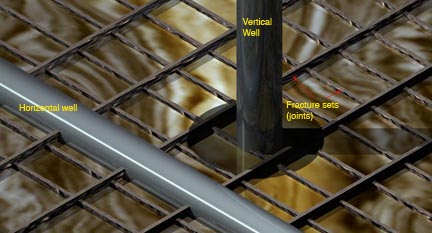
Shale is a very fine grained rock, and though gas can gather in the small pores of its structure, if the gas is to flow to a well, then it has to migrate through passages that are very narrow, and thus very resistive to that flow. However, as the shale has been formed under geological pressure and over time, the pressures not only compressed it from mud into shale, but they also caused it to fracture. In the Marcellus shale, for example, the cracks that occurred in the shale are roughly vertical, and form two sets that are perpendicular to one another.

The first advantage that a horizontal well has, over a vertical one, is that the well can penetrate a long way through the rock that carries the oil or gas (OG). The amount of OG that comes from the rock is, in part, a function of how long the length of well is in the rock that carries it. So that while a vertical well might produce say 800 bd from a well that goes straight through a 200 ft thick layer of oil-bearing rock, when the well is drilled so that it goes out 4 miles horizontally through the oil-bearing rock, then the production per day may go up to 10,000 barrels.

The second advantage relates to the way in which the fractures lie in the rock. Because they are vertical, a vertical well won’t hit very many of them, and so since these fractures provide an easy flow of OG to the well, rather than the difficult path through just the rock, then the well will not show very much production. (And this was the case with many of these shales when tested earlier).

However if the well is horizontal (see figure) then the well will intersect many of these fractures and in drawing the fluid from them will also provide an easy path for fluid to ease out of the rock into the fracture paths, so that the entire rock can be more easily drained.


Now in the picture I have shown one set of joints as being bigger than the other. And that is usually the case, because the horizontal pressure, that earlier I had suggested was the same in each direction, actually usually isn’t. The strongest horizontal pressure will tend to close up those fractures that run perpendicular to it, and tend to open the ones that run parallel with it. Thus it helps to know at the level of the shale, what the pressures in the different directions are (those engineering among us generally refer to them as stresses rather than pressures). The best direction to drill is then perpendicular to the maximum horizontal pressure, if we want to take the best advantage of the fractures in the rock. The only problem with this is that it also increases the pressures on the sides of the borehole, so that if we go that way, and the rock is not that strong, then we may be making the borehole stability worse.

But even with a horizontal well the production may not be that great, because the fractures are still relatively narrow, and so flow won’t be that fast. And so there is another tool that can be used, and that is to deliberately put a crack into the rock on the side of the borehole. On a very small scale, if you look at the picture, you can see a shaded zone around the vertical well. If I could make a crack out from the well at that level and grow it out just a short way you can see that it already intersects two of the better joint sets, whereas at the beginning the well didn’t reach any. And if we could do this from the horizontal well and grow that crack out a goodly distance horizontally, then it would intersect a lot of the vertical fractures and production would become high and useful.

There are, however, three snags to forming and growing that crack, all solvable, but all costing additional money. The first is that if we just grow the crack out and then let the weight of the overlying rock close it up again, then we haven’t made a whole lot of difference. So we have to prop the crack open. For this we need to inject relatively fine grained particles (let’s call it sand, though the technical term is proppant) into the crack in enough quantity that it will fill up the crack and hold it open so that it gives an easy path through the rock to the well for the OG. (We won’t go into what a mess pumping sand at more than 10,000 psi makes of the pump – Halliburton gets paid very nicely to fix those problems).

The second snag is that trying to push sand into a thin crack and get it to go very far can be an exercise in futility. Among other things if you are using plain water the sand tends to settle to the bottom rather fast, and if it fills the crack near the well, it then acts as a filter to stop sand going back further into the slot. So now we change the chemistry of the water by adding what are usually known as long-chain polymers. These chemicals thicken the water so that it will (at relatively low chemical percentages) suspend the sand in the fluid. Because these molecules are also slippery (in another variety they are added to the water in crowd control water cannons to produce what is known as Banana Water – since it makes the street too slippery to stand on) they also reduce the friction between the fluid flow and the walls of the crack, and this also helps carry the sand further back into the crack, and gives the slickwater title to the hydrofrac.

The third snag is a bit more technical. You remember that earlier on I talked about the pressure about the hole causing the sides of the horizontal well to crush. Well at the top and bottom of the well instead of the rock seeing this additional crushing pressure, the shifting of the vertical load to the walls of the hole, can mean that the rock will go into tension, where it is much weaker. As a result cracks can appear in the top and bottom of the horizontal hole. Why is this a problem? Because the easy way to cause a fracture to grow is to fill the well with liquid and increase the pressure of the liquid until the rock breaks. (Hence hydraulic fracture or hydrofrac). But if there is a crack there already then just increasing the pressure in the hole causes that crack to grow. And if the crack is vertical then it won’t grow in the horizontal direction we want. And so it is time to call in the engineers (who also don’t come cheap) to do the interesting things that cause the crack to grow in the right direction.

The benefits to all this for the Marcellus has been described by Engelder.
"Conservatively, we generally only consider 10 percent of gas in place as a potential resource," said Engelder. "The key, of course, is that the Marcellus is more easily produced by horizontal drilling across fractures, and until recently, gas production companies seemed unaware of the presence of the natural fractures necessary for magnifying the success of horizontal drilling in the Marcellus."

The U.S. currently produces roughly 30 trillion cubic feet of gas a year, and these numbers are dropping. According to Engelder, the technology exists to recover 50 trillion cubic feet of gas from the Marcellus, thus keeping the U.S. production up. If this recovery is realized, the Marcellus reservoir would be considered a Super Giant gas field. . . . . These fractures, referred to as J1 fractures by Engelder and Lash, run as slices from the northeast to the southwest in the Marcellus shale and are fairly close together. While a vertical well may cross one of these fractures and other less productive fractures, a horizontally drilled well aimed to the north northwest will cross a series of very productive J1 fractures.

You can see examples of the fracture patterns in the Marcellus here

The upfront money may give some pause to prospectors. A typical well that drills straight down to a depth of about 2,000 to 3,000 feet costs roughly $800,000.

But in the Marcellus Shale, Range and other companies hope a different kind of drilling might yield better results — one in which a well is dug straight down to depths of about 6,000 feet or more, before making a right angle to drill horizontally into the shale. That kind of well could cost a company $3 million to build, not counting the cost of leasing the land, Engelder said.
The company, in a December financial report, estimated that two horizontal wells are producing roughly 4.6 million cubic feet of gas per day. Tests on an additional three recently completed horizontal wells showed potential for a total of 12.7 million cubic feet of gas per day. Industry experts call those results promising.


The benefits have also been projected here.And while they may be considerable, it is only after the wells are in production, and not only initial flows, but also well lifetimes are established, that the true benefit will become apparent.

But until some solid, repeatable well data emerges, the Haynesville will remain more diamond in the rough than diamond ring. As BMO Capital Markets analyst Dan McSpirit rightly noted in a report last week: "The proof (of Haynesville economics) is in how the wells get drilled and the rates of return such operations yield." He added, "These are early innings. Lasting value creation should be revealed later in the game."
.

So there you have a brief explanation of how the new technology is slowing, though it won’t stop, the declining gas reserve in the United States,

.

Read more!