Showing posts with label energy savings. Show all posts
Monday, May 19, 2014
Tech Talk - Closing a coal-fired power plant
Much is made of large schemes to alter the way in which energy is produced in the United States. Large scale wind farms, and great arrays of solar panels attract large interest and funding, yet it is often in the smaller projects, from the individual solar panels to the change in energy sources for individual factories, or in this case a university, that there is at least as much progress, though with less fanfare.
I wrote, some eighteen months ago about the geothermal plans at Missouri University of Science and Technology (MS&T) previously the University of Missouri-Rolla and my academic home for 42 years. At that time the campus was beginning a process that would see the different parking lots and other open areas around campus disrupted while a series of vertical wells and horizontal pipes was laid beneath the ground, prior to its restoration.
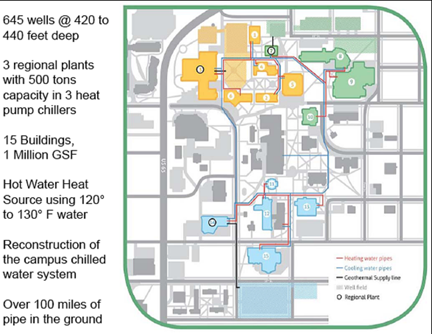
Figure 1. The MS&T Geothermal plan, showing the zoning of the wells and the connection pipe network.
Time has moved on since the initial plans were set in place, the trenches have been dug:
Figure 2. Geothermal trenches on campus, with walkways re-routed around them
Within the lots wells were then drilled roughly 430 ft deep, through which the system fluid will flow, and as these were drilled they were lined and connected by a secondary network.
Figure 3. Drilling the wells in the parking lots at the top right of Figure 1.
The network of wells is connected through plastic pipes that carry the water out to the wells, down and back up and then return to the central heat exchanger systems of the different circuits.
Figure 4. The heat exchange between the water and the ground (inhabitant )
Figure 5. The initial connections to the wells
Larger pipes are required to carry the water to and from the different fields to the processing plants where it is used to heat/chill water in a secondary circuit that is then distributed (depending on season to either warm or cool) through the network to the campus buildings.
Figure 6. The main pipe connections.
The parking lots have since been regraded, tarmac applied, and have, for some time been functioning as before.
Now the project is entering into the final days of installation, as a significant milestone has been reached. This week the coal and wood fired boiler #5 will shut down and all steam production at the campus power plant will permanently cease. Chillers are now operating for the summer to cool the buildings served by three of the regional plantsm which covers most of the air conditioning needs of the campus, and heat is being sent to six of the campus buildings.
Given the age, and change in the nature of the heating and air conditioning service to the buildings some still remain to have their systems upgraded, but most will now be completed while the students are away this summer.
Estimates of the savings that this will bring to the campus are in various forms. The coal and wood that have provided the energy source in the past will no longer be needed (and in time the plant will be removed). As well as the plant itself this will also free up the space where the coal was stored, and will improve the local aesthetic considerably along that side of the campus.
Figure 7. The campus power plant
The change in fuel will also see the overall amount of fuel required reduced, and it is anticipated that the energy use will be cut by 50%. Carbon dioxide emissions will be dropped by 25,000 tons a year (the system will still use significant amounts of natural gas) and water use will be cut by eight million gallons a year.
It is anticipated that the $32 million project will initially yield the campus a saving of around $1 million a year which will rise to more than $3 million a year as energy costs increase, while the system should not need significant maintenance for decades. There is a video of the project here). When completed, sometime next year the system will be serving 15 buildings with around a million square feet of floor space.
As the Missouri system was beginning, the initial phase of a similar system at Ball State was being completed . This will ultimately supply around 5.5 million square feet of campus space, and is expected to yield some $2 million a year in energy cost savings. Following the successful completion of Phase 1 of that project in March 2012, the Phase 2 project, requiring an additional 1,000 boreholes, was started in June of 2013, and is expected to be completed by some time next year. The four coal fired boilers at the plant (which consumed some 36,000 tons of coal a year,) were shut down in March of this year. Power will continue to be supplied from three natural gas boilers on campus. The $80 million project will have drilled a total of around 3,600 wells at the time of completion of Phase 2.
Oregon Tech has a 1.75 MW geothermal power plant, which combined with a solar electric array of panels on a 9-acre site off campus to produce most of the power needs of the campus. The dedication ceremony was on April 18th of this year. It is expected that the plant, which operates on a more conventional use of high-temperature water from the underlying host rock, will save the campus around $400,000 a year in energy. Water is brought up from 5,300 ft below the surface at a temperature of 200 degrees F, and used to spin two turbines, and as source of building heat, before being re-injected.
As the dates suggest this is a very new venture for universities and, as yet, there are not a lot of players in the game. Yet if the savings pan out to be at the level or greater than currently estimated it may well be more popular in the future as overall energy costs continue to rise. (Although in the short term natural gas prices may well rise a little, while coal prices are expected to fall a little).
I wrote, some eighteen months ago about the geothermal plans at Missouri University of Science and Technology (MS&T) previously the University of Missouri-Rolla and my academic home for 42 years. At that time the campus was beginning a process that would see the different parking lots and other open areas around campus disrupted while a series of vertical wells and horizontal pipes was laid beneath the ground, prior to its restoration.
Figure 1. The MS&T Geothermal plan, showing the zoning of the wells and the connection pipe network.
Time has moved on since the initial plans were set in place, the trenches have been dug:
Figure 2. Geothermal trenches on campus, with walkways re-routed around them
Within the lots wells were then drilled roughly 430 ft deep, through which the system fluid will flow, and as these were drilled they were lined and connected by a secondary network.
Figure 3. Drilling the wells in the parking lots at the top right of Figure 1.
The network of wells is connected through plastic pipes that carry the water out to the wells, down and back up and then return to the central heat exchanger systems of the different circuits.
Figure 4. The heat exchange between the water and the ground (inhabitant )
Figure 5. The initial connections to the wells
Larger pipes are required to carry the water to and from the different fields to the processing plants where it is used to heat/chill water in a secondary circuit that is then distributed (depending on season to either warm or cool) through the network to the campus buildings.
Figure 6. The main pipe connections.
The parking lots have since been regraded, tarmac applied, and have, for some time been functioning as before.
Now the project is entering into the final days of installation, as a significant milestone has been reached. This week the coal and wood fired boiler #5 will shut down and all steam production at the campus power plant will permanently cease. Chillers are now operating for the summer to cool the buildings served by three of the regional plantsm which covers most of the air conditioning needs of the campus, and heat is being sent to six of the campus buildings.
Given the age, and change in the nature of the heating and air conditioning service to the buildings some still remain to have their systems upgraded, but most will now be completed while the students are away this summer.
Estimates of the savings that this will bring to the campus are in various forms. The coal and wood that have provided the energy source in the past will no longer be needed (and in time the plant will be removed). As well as the plant itself this will also free up the space where the coal was stored, and will improve the local aesthetic considerably along that side of the campus.
Figure 7. The campus power plant
The change in fuel will also see the overall amount of fuel required reduced, and it is anticipated that the energy use will be cut by 50%. Carbon dioxide emissions will be dropped by 25,000 tons a year (the system will still use significant amounts of natural gas) and water use will be cut by eight million gallons a year.
It is anticipated that the $32 million project will initially yield the campus a saving of around $1 million a year which will rise to more than $3 million a year as energy costs increase, while the system should not need significant maintenance for decades. There is a video of the project here). When completed, sometime next year the system will be serving 15 buildings with around a million square feet of floor space.
As the Missouri system was beginning, the initial phase of a similar system at Ball State was being completed . This will ultimately supply around 5.5 million square feet of campus space, and is expected to yield some $2 million a year in energy cost savings. Following the successful completion of Phase 1 of that project in March 2012, the Phase 2 project, requiring an additional 1,000 boreholes, was started in June of 2013, and is expected to be completed by some time next year. The four coal fired boilers at the plant (which consumed some 36,000 tons of coal a year,) were shut down in March of this year. Power will continue to be supplied from three natural gas boilers on campus. The $80 million project will have drilled a total of around 3,600 wells at the time of completion of Phase 2.
Oregon Tech has a 1.75 MW geothermal power plant, which combined with a solar electric array of panels on a 9-acre site off campus to produce most of the power needs of the campus. The dedication ceremony was on April 18th of this year. It is expected that the plant, which operates on a more conventional use of high-temperature water from the underlying host rock, will save the campus around $400,000 a year in energy. Water is brought up from 5,300 ft below the surface at a temperature of 200 degrees F, and used to spin two turbines, and as source of building heat, before being re-injected.
As the dates suggest this is a very new venture for universities and, as yet, there are not a lot of players in the game. Yet if the savings pan out to be at the level or greater than currently estimated it may well be more popular in the future as overall energy costs continue to rise. (Although in the short term natural gas prices may well rise a little, while coal prices are expected to fall a little).
Read more!
Labels:
Ball State,
energy savings,
geothermal,
geothermal wells,
MST,
Oregon Tech
Monday, October 25, 2010
Electrifying the Railroads - Alan Drake's manual
While I was away Alan Drake sent me his “An American Citizen’s Guide to an Oil-Free Economy -A How-To Manual for Ending Oil Dependency.” It is only now that I am able to review it. His objective is sound
There are two factors that are required to achieve, in the long run, considerable energy savings, as well as a move toward energy independence, rather than our continued, and growing dependence on importing oil. The first is the transition itself, from diesel locomotives to electrically powered engines. It is a change that has already occurred in many parts of the world. He points out that the current system, which relies heavily on diesel-powered truck transport, could reduce energy costs comparatively, from 20 Btu’s of diesel power, to 1 Btu of electrical power, if long-distance haulage was carried out using Double Stacked Trains. In Europe, without the stacking, the trade-off is still 2.5 to 3.0 Btus of refined diesel converted to 1 Btu of electricity, with a slight reduction (circa 10%) in transit times. He cites Switzerland, China and France among those making the change. Roughly 30% of the 10,000 miles of track in the UK is electrified and the system is one of the busiest in Europe. (And on a personal note I have seen the density of passengers increase over the years as I ride the trains from London to Carlisle and beyond. And, in Austria, an off-peak trip from Vienna to Graz last week was made in a train that was close to full.)
Double Stack Train (Source Freephoto.com )
He notes the lower maintenance costs of train over road transport, and given the delays that have been encountered around the country this summer as more highways were repaired under the Stimulus program, that is not a small consideration. I am reminded of a British Rail ad from some years ago, showing a commuter looking at his watch aboard a train running past a highway blocked and stalled with cars, and complaining that the train was running 5 minutes late again. (On the road into St Louis this summer delays of more than half-an-hour have not been uncommon as the highway has been widened near Pacific). Rail is also a safer method of transport (he conjectures the savings in life would be from 4,000 to 5,000 individuals a year).
However the second step that must be made is to increase the capacity of the existing rail system. Even as far back as 1998 Brennan was writing for the USDA of concerns that the existing system was reaching capacity.
We can transfer our economy, bit by bit, to the new, more efficient and oil-free replacement as our present system becomes increasingly more fragile and eventually unsustainable. These plans all rely on mature, proven and economically viable technologies and not the current “Hunt for Miracles” that Secretary of Energy Chu has so aptly described his department’s Advanced Projects Research.Alan is a great believer in the energy savings that can be achieved with a transfer to electrically powered railways. I largely agree with that underlying premise, and in Europe particularly, generally travel by train, where I have a choice. In his manual Alan points out some of the considerable savings that can be achieved if the country were to switch to an enhanced electrically-powered railroad system, relative to the oil-based transportation that we currently enjoy.
As new technologies develop, as they will, and are debugged and scaled up, our plans can be adjusted to incorporate these new solutions. Yet we can make a viable, workable plan with what we have “on the shelf”, ready to go today. We need not gamble our future on “Just-in-Time Technology” appearing at just the right time and with just the right technology. No miracles are required, simply foresight, persistence and hard work.
There are two factors that are required to achieve, in the long run, considerable energy savings, as well as a move toward energy independence, rather than our continued, and growing dependence on importing oil. The first is the transition itself, from diesel locomotives to electrically powered engines. It is a change that has already occurred in many parts of the world. He points out that the current system, which relies heavily on diesel-powered truck transport, could reduce energy costs comparatively, from 20 Btu’s of diesel power, to 1 Btu of electrical power, if long-distance haulage was carried out using Double Stacked Trains. In Europe, without the stacking, the trade-off is still 2.5 to 3.0 Btus of refined diesel converted to 1 Btu of electricity, with a slight reduction (circa 10%) in transit times. He cites Switzerland, China and France among those making the change. Roughly 30% of the 10,000 miles of track in the UK is electrified and the system is one of the busiest in Europe. (And on a personal note I have seen the density of passengers increase over the years as I ride the trains from London to Carlisle and beyond. And, in Austria, an off-peak trip from Vienna to Graz last week was made in a train that was close to full.)
Double Stack Train (Source Freephoto.com ) He notes the lower maintenance costs of train over road transport, and given the delays that have been encountered around the country this summer as more highways were repaired under the Stimulus program, that is not a small consideration. I am reminded of a British Rail ad from some years ago, showing a commuter looking at his watch aboard a train running past a highway blocked and stalled with cars, and complaining that the train was running 5 minutes late again. (On the road into St Louis this summer delays of more than half-an-hour have not been uncommon as the highway has been widened near Pacific). Rail is also a safer method of transport (he conjectures the savings in life would be from 4,000 to 5,000 individuals a year).
However the second step that must be made is to increase the capacity of the existing rail system. Even as far back as 1998 Brennan was writing for the USDA of concerns that the existing system was reaching capacity.
Employment in the industry fell from 532,000 in 1980 to 256,000 in 1996. Similarly, rail mileage fell from 179,000 miles of road in 1980 to 147,210 in 1996. Over the same time period, the number of freight cars fell from 1.7 million to 1.2 million and the number of locomotives dropped from 28,094 to 19,269 units.To overcome this more of the track will have to be converted from single to double tracking. However, as Alan points out, most of the infrastructure is already in place, and the right-of-way established, so that it will not incur the high costs of a totally new development.
Even though their miles of track and number of employees, cars, and locomotives decreased after deregulation, railroad output has increased. Measured by carloads originated, output increased from 22.2 million carloads in 1980 to 24.2 million in 1996. In addition, shipments of intermodal containers and trailers increased from 3.1 million to 8.2 million over the same time period. Measured in terms of revenue ton-miles, the growth has been even more impressive. In 1980, railroads handled 919 billion ton-miles of traffic. By 1996, that number had increased to 1,356 billion ton-miles of traffic. U.S. railroads have been able to move this increased volume of freight by handling larger shipments over a longer distance at a much greater velocity. . . . . . However, the recent rail congestion problems suggest that U.S. railroads may have reached the practical limit of their possible productivity increases without major expansion in the capacity of their basic infrastructure. Increasing the volume of freight movements on a fixed network by handling larger shipments over a longer distance at greater velocities cannot be continued indefinitely. Indeed, one of the lessons of the western railroad crisis is the sensitivity of current railroad operations and the productivity of major sections of the U.S. rail system to even a slight downturn in the velocity of the system.
Good cost estimation is difficult given the variety of issues with the existing infrastructure. However, rail investments can provide superb value for money. An excellent investment example is BNSF double tracked and improved 2,217 miles (Los Angeles to Chicago) for slightly over $2 billion recently. BNSF more than doubled track capacity and now offers 70 mph express container freight service.The arguments that he makes are strong and should be persuasive, after all – as he points out -
A $2 billion investment made BNSF’s Transcon line the world’s busiest container rail line (the Trans-Siberian is #2). By comparison, $2 billion spent on highway expansion projects would have no national and limited local impact. For example, $2.3 billion is proposed to just rebuild the Milwaukee Zoo interchange and $1.2 billion to add two lanes to the Huey Long Bridge outside New Orleans..
Warren Buffett (BNSF Railroad is his largest single investment) and Bill Gates (30% of his non-Microsoft stock portfolio is in CN Railroad) are hardly charity cases.Smart though they may be in foreseeing the benefits of investment, the money is not yet being fully invested to make the transitions that Alan feels are needed.
The following are reasonable cost estimates for what is being proposed, given the available information, in 2010 dollars.Given the investors, it will be interesting to see how this catches on.
• Electrify 36,000 miles of double track railroads - $100 billion.
• Double track 15,000 miles of single track, new rail over rail bridges, better signals, improved curves and grades – $75 to $150 billion.
• Grade Separation (a cost that should be borne by highway budgets) could easily absorb $50 to $100 billion.
• Semi-High Speed “3rd track” on existing ROW - 7,000 to 14,000 miles - $140 to $280 billion.
• Strategic Railcar Reserve – perhaps a couple of billion dollars for mothballed used equipment. New equipment, when used is not available, should be an order of magnitude more expensive.
• Improved Intermodal Centers – a very rough estimate to supplant 85% of existing truck traffic would be $50 billion or so.
Read more!
Subscribe to:
Posts (Atom)