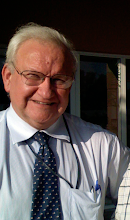
In October of 1965 I started work on a doctoral dissertation that would look at whether streams of high-pressure water could be used to mine minerals, rather than using the mechanical tools that my ancestors had been using for many generations to mine coal. Until the time of my great-grandfather the main tool had been a hand-swung pick, but he had made the transition to become a compressed-air-powered, coal-cutter operator, and worked with my grandfather on running that machine until the first World War, when his son joined the Northumberland Fusiliers and went off to Belgium.
When I started my work, after my mining engineer father had approved, I found that there was little information on hydraulic mining available in the technical literature. The Internet did not exist, and the few books and articles that I could obtain came through the Brotherton Library at Leeds University, where Inter-Library Loans would find a source, and even, on occasion, a translation, but in weeks not days.
Those conditions no longer hold true, and yet, while a computer now makes it easier to get instant access to all the world’s knowledge, filtering through that vast stack to find that needed bit of information still takes time. And there are other factors that have come into play, so that much of the knowledge that has been gained may soon be lost, forgotten or spread into so many distant places as to be effectively gone. And so I am going to put together a new series of posts about this technology. Since this is the first it is more of an explanation of the background, and as the posts continue so the structure and location may change, trying to better serve those who follow me in what has been the truly fascinating development of a new very broad-based industry.
Over the past decades high-pressure waterjets have found a wide variety of different uses around the world. From the small pumps that can be bought at the local hardware store and allow you to clean houses, furniture and cars through the thousands of horsepower used in pumps for the excavation and mining/petroleum industry a quiet revolution has occurred in many industries, beyond the sight of the general public. I was fortunate enough to be a part of the relatively small group of scientists/engineers/technicians who helped bring these changes about. Around the world there were perhaps 50 or so of us, and much of our interaction took place at conferences, where we learned more from each other in bars and restaurants than we did from the formal papers that we all gave. Some changes were fairly dramatic, the use of cleaning jets on oil platforms comes to mind, and were instantly adopted, others were a longer struggle, and yet these tools have yet to find more than 90% of their ultimate market, which will likely be in fields that most of us have not even thought of yet. And the tools that have already been developed are used in many more industries than the general public understands.
I retired a couple of years ago, and followed many of that original group in moving on to other interests. Before I left, however, I had written a book, and taught a class to senior undergraduates dealing with manufacturing use, as well as the earlier mining applications. The class is not taught now, and interest in the topic has also shrunk at the other major universities, as faculty have changed, and other topics bring the “research rain” that is needed to sustain the graduate classes of today.
This does not mean that waterjetting is less valuable, but instead is recognizes that the first flush of development is over, and that the really low-hanging fruit of application has been picked by folks such as myself. The range of applications remains immense, but the rewards are not now as easily obvious, and the research results now are not so dramatic.
The current plan is to begin the series with posts that come from my lecture set. But instead of being of the usual length they will be broken down into a set of sub-topics, so that there may be three or four posts that will cover the material of a single class. This will make each post of around a thousand words, and then the four sub-topics will be combined into a “class” version which will be posted as a pdf, and this will be down-loadable, and could be printed and put into what will, over time, become a somewhat updated version of that earlier book, but in a different format.
Since none of the anticipated readership is yet aware that this is happening, I expect that it will take some time for comments and questions to develop, but as these do they will be added into the mix.
Once the original posts have become established I hope to be joined by some of the folk that are still working in the field – as I said earlier it is one that is still continuing to grow at a fairly steady pace (one of the companies that makes equipment was on the national news recently because it could not get enough trained folk to help it meet demand). New ideas will turn up, and I look forward to giving my opinions. Sadly these may appear a bit negative at first, but there were many things we tried that looked good, but did not pan out. And those were usually not, therefore, the things that we wrote papers about. But knowing something won’t work, and more particularly why not, is also useful.
The early posts will also deal more with the history and general background, since these are likely to have a more general interest, and the more technical parts of the discussion will come later, though I will try and keep that at a relatively simple level for explanation.
I got my last patent this week, it dealt with drilling oilwells – the one before that dealt with treating skin cancer. I have worked on intercontinental ballistic missiles, at nuclear facilities, on land-mine clearance and in blocked caves. So perhaps I could claim to be a surgeon, rocket scientist, nuclear scientist, fire-fighting expert, and hazardous material specialist – and that neglects all the work on manufacturing and the evolution of tools that can cut through an inch of material within an accuracy of a thousandth of in inch.
All because of the power that comes when you push a pint of water through a tiny hole. Who’d a thunkit!!
Showing posts with label nuclear. Show all posts
Showing posts with label nuclear. Show all posts
Sunday, September 9, 2012


Sunday, April 26, 2009
Energy Summit - the last talks
The final part of the Energy Summit in Columbia began with a series of talks from faculty on the four campuses. It was divided into four tracks, Power Generation (which I was at and will write about); Transportation and Biofuels; Energy Infrastructure; and Materials for Energy Applications. Although not up yet, the main site for the Summit is adding videos of the different sections, and I will add those references behind the track titles as they become available. At present the Keynote by Boone Pickens ; the Governor’s remarks and the first day’s speakers after 3 pm (covering my third post) are available. I will list the other posts from earlier in the Summit at the end of this piece.
I was the first of the speakers up in the Power Generation track, and spoke about the predictions that have been made concerning the life of fossil fuels, focusing on that of David Rutledge , which predicts that peak coal will come sooner than is currently anticipated. I expressed some doubt that his predictions are correct, with similar concerns regarding the work of Dr Hall and his students, about the increasing energy cost to mine future coal. To illustrate why I briefly covered the development of three mining machines, that which we call Hydrominer, (a longwall waterjet machine concept that moved from the lab to surface trials to underground trials in Germany); that which we call Rapiers, which was developed in collaboration with folk at the Jet Propulsion Laboratory; and a waterjet assisted auger. By cutting a deep slot around the outer perimeter of the coal mass to be removed, the constraining surrounding pressure is removed, and the coal is more easily removed and fragmented, with lower energy cost.
I was followed by Mark Prelas, of UMC Nuclear Engineering, who talked (the links are to the paper abstracts) about nuclear energy conversion. The basic method of extracting power from nuclear energy has focused on the steam cycle for 150 years, and he is looking to using a photon path to achieve a better efficiency in energy extraction. It is, perhaps, the equivalent of the nuclear light bulb. The concept has been used by the military, and would go through the stages of fuel to fluorescer to photons to either chemical, laser of electrical energy. He discussed various fluorescers which could be matched with PV cells to improve efficiency of transfer. I this way he could move from 50% plant efficiency to 70% (At present the Calloway nuclear power plant at Fulton, MO operates at around 37% efficiency). Even with pebble bed reactors, and higher temperatures a 50% efficiency is likely to be tops conventionally. This new concept would, however, require a new build and is unlikely to be around before 2040.
Anthony Caruso from the Kansas City Campus then talked about the need for neutron generation detection. He showed that it only required less than 1% of waste to go astray and there would be enough plutonium out that could get into the hands of terrorists and provide a major problem. A racquetball sized sphere would hold 2.7 kg of plutonium and would be safe to carry but small enough and easy enough to conceal to cause serious problems. He then elaborated on the potential risk, and the need to develop more effective detectors (which he is doing).
Jimmy Adegoke from Kansas City, then talked about a program that is being run to assess climate change risks commenting that “we are beyond debate that we have global warming!” (If you look at the top right of the three curves shown on the main page of the Climate Research Unit at Hadley (the main British Climate monitoring site), you will see that all three curves – for Northern, Southern and Global temperature – have been trending down (showing global cooling) for about the last ten years). His group does a carbon footprint assessment with the intent of helping local industry both understand the impacts of legislation, at the local level. He discussed work with Congressman Markey’s subcommittee to establish the impact of climate change on the economy of the Midwest. He is assessing the effects of change on agriculture, water, energy and health at the local level. In his regional assessment he found that the carbon footprint broke down to roughly 2 million tons of Residential; 3 million tons of commercial; and 1.5 million tons of industrial generation. He has a carbon footprint calculator which helps identify where savings can occur for individual operations.
We broke for lunch, and then returned to hear first Lea Kosnik, from UMSL, who had accompanied me to the radio station on the first day and whose subject is small and microturbine use to generate hydropower without the need for the dams across the waterways that are a pre-requisite for larger schemes. Their small size makes them easier to install, and to construct using easily available components of proven reliability. As I corrected back at the original post, there are some 5,000 sites, in Missouri alone, that could be used as installation sites for the technology. This gives a more reliable feed, when needed, to backstop some of the more intermittent sources, such as wind and solar. It also does not require the considerable planning of larger systems, and is unlikely to meet the local resistance that dams not generate.
Curt Elmore of MO S&T was next, talking about an emergency method of creating potable water in crisis. He and his colleagues set out to provide another source of water, after a natural disaster, other than military convoys handling out bottled water. He started looking at alternatives and found that UV is an effective disinfectant for water, and so designed a portable system (running at about $40k at the moment) to run from renewable sources. He began with hopes for a wind turbine as part of the package, but came to realize that this did not contribute enough, and that simple solar panels were adequate to provide the power to run the system and provide a clean water supply. Because it does not leave disinfectant in the water it cannot treat a recontamination problem, short of running the water back through the system. By using an ultracapacitor they were also able to get rid of batteries, and by using the pump on a water bowser that would bring water to the unit, it could be made smaller and more inexpensive. It was simple to get to 10 gpm, and with an individual using about 2 liters/day this would be more than adequate for a community. They are currently investigating commercialization.
The final speaker in the track was S.K. Loyalka from Columbia, describing a $3 million program that they have looking at very high temperature nuclear reactors. These are generally either Prismatic or Pebble Bed reactors, with the pebbles being spheres about the size of a tennis ball and stacked at around 400,000 in the reactor itself. In the process of passage they undergo some degradation and the study is looking at the fate of this dust, as well as “ball” behavior.
There was now a break, after which I wandered into the Clean Coal breakout panel, under the Vice Provost for Research at MO S&T, Dr Krishnmurthy. . Although less structured, with the panelists first making short remarks, before engaging in Q&A with the audience, Wandering in after the introductions I missed who was who, but there were some very realistic views presented from venture capitalists, a state senator, and others. After Dr Al-Dahhan had described some of the paths forward to generate clean coal, one of the panelists commented that this is not the sort of environment a venture capitalist likes to work in. He contrasted it with medical investment, where the funds required are reasonable (say $75 million) and the risk and rate of return are acceptable. In contrast CCS is larger by two orders of magnitude and this takes it beyond the interests of the venture capital market. This is a tough space to live in, and there are very few (2 out of 300) who might be interested in playing in this sandbox.
The Navy panelist (John Pazik) noted because of the way military budgets are constructed, rapid rises in fuel prices come out of the operating budgets of the commanders, and thus require sacrifice of something else.
Senator Shaefer, in looking at the political side, commented on how hard it is to get legislation through. Missouri relies on coal for 82-86% of its energy. With EPA mandated to rule on CO2 that leaves the state very vulnerable. And he commented that “scientists may say that this is the right thing to do, but politically it may not be possible.” He thinks that soon it will be impossible to build a coal-fired power station, and that the best CCS injection sites are shallow enough that the CO2 won’t stay liquid.
Vic Svec from Peabody pointed out that natural gas generates carbon dioxide, just as coal does. It is becoming the new method of power generation, but bear in mind that while we pay $0.065 per kWh, CA and NY are paying around $0.15 - $0.20 per kWh. We are going to continue to use coal, it is just going to stop being cheap to do so. He talked of doing CO2 injection to help oil EOR and that Missouri had the potential to do this in the Western part of the state. We have lost a decade however in making progress on this issue, where there are also concerns such as “can I inject CO2 under your house ? How deep? Etc” We need technology and technicians to control and bring down the price to make systems viable.
In the wide ranging Q&A the need for better communication was emphasized but the problems of finding qualified people remain, at all levels. And it was clear that campaigns to wean the country from coal in the next 10 years are unrealistic.
The final panel I went to was on infrastructure under Dr. Mariesa Crow of MO S&T.
Linda Martinez of MO DNR pointed out that with Missouri seeing 261,000 unemployed, the emphasis in getting jobs with green technology is paramount. Retraining is essential but we need to get all stakeholders involved in the planning of that. There are only a limited number of green jobs at the moment and we need to find how to grow them.
Barbara Kenny of NSF spoke of the goals of the Administration, and that the new stimulus money to NSF that would be used to give a higher success rate to proposals sent in to the agency. There is an interest in Renewable Energy Storage and in Green Building Technology.
In discussion the panelists concurred that improving Energy Efficiency is the first priority for moving forward and having a success. The State has just produced a wind may, and thus wind may be the second stage in the process.
Bill Downey of Kansas City Power and Light, looked at building a new plant, and how they assessed viable alternatives. He has been impressed with the speed of growth of renewable sources, and expects that they will generate 20% of power in the future. However getting public policy changed is a long struggle, even with gains in efficiency, though that is a bridge forward.
Brian Clevinger is a Venture Capitalist and he talked of the technologies at Universities and that “it was the worst of times, it was the even worser of times.” Venture Capital is down 40% in general but clean coal investments dropped 80%. New creative money is almost non-existent.
We have failed to focus on replacement energy for the systems that we currently use, so that, since the population has doubled, and is on its way to double again it is going to take all that we have got. Unfortunately many of the answers are yet to be palatable politically.
Given that many of the panel had mentioned efficiency as the logical first step and the low hanging fruit, I raised the question of Jevons Paradox. Which it appeared that no-one had heard of. (Which means that I will try and make it my topic for a tech talk tomorrow).
Similarly raising the question of Peak Oil and oilfield declines such as in Cantarell got no response. Rather they talked to public policy and how to get jobs. They talked of smart metering and some of the complexities of running controls on home energy systems from a central system. The comment was that, to date, the incentives are not enough to drive behavior.
And then we were done.
Earlier posts in this series covered the program; the keynote address by T. Boone Pickens; and the first invited speakers; the end of the first day; and the first part of the second day.
I was the first of the speakers up in the Power Generation track, and spoke about the predictions that have been made concerning the life of fossil fuels, focusing on that of David Rutledge , which predicts that peak coal will come sooner than is currently anticipated. I expressed some doubt that his predictions are correct, with similar concerns regarding the work of Dr Hall and his students, about the increasing energy cost to mine future coal. To illustrate why I briefly covered the development of three mining machines, that which we call Hydrominer, (a longwall waterjet machine concept that moved from the lab to surface trials to underground trials in Germany); that which we call Rapiers, which was developed in collaboration with folk at the Jet Propulsion Laboratory; and a waterjet assisted auger. By cutting a deep slot around the outer perimeter of the coal mass to be removed, the constraining surrounding pressure is removed, and the coal is more easily removed and fragmented, with lower energy cost.
I was followed by Mark Prelas, of UMC Nuclear Engineering, who talked (the links are to the paper abstracts) about nuclear energy conversion. The basic method of extracting power from nuclear energy has focused on the steam cycle for 150 years, and he is looking to using a photon path to achieve a better efficiency in energy extraction. It is, perhaps, the equivalent of the nuclear light bulb. The concept has been used by the military, and would go through the stages of fuel to fluorescer to photons to either chemical, laser of electrical energy. He discussed various fluorescers which could be matched with PV cells to improve efficiency of transfer. I this way he could move from 50% plant efficiency to 70% (At present the Calloway nuclear power plant at Fulton, MO operates at around 37% efficiency). Even with pebble bed reactors, and higher temperatures a 50% efficiency is likely to be tops conventionally. This new concept would, however, require a new build and is unlikely to be around before 2040.
Anthony Caruso from the Kansas City Campus then talked about the need for neutron generation detection. He showed that it only required less than 1% of waste to go astray and there would be enough plutonium out that could get into the hands of terrorists and provide a major problem. A racquetball sized sphere would hold 2.7 kg of plutonium and would be safe to carry but small enough and easy enough to conceal to cause serious problems. He then elaborated on the potential risk, and the need to develop more effective detectors (which he is doing).
Jimmy Adegoke from Kansas City, then talked about a program that is being run to assess climate change risks commenting that “we are beyond debate that we have global warming!” (If you look at the top right of the three curves shown on the main page of the Climate Research Unit at Hadley (the main British Climate monitoring site), you will see that all three curves – for Northern, Southern and Global temperature – have been trending down (showing global cooling) for about the last ten years). His group does a carbon footprint assessment with the intent of helping local industry both understand the impacts of legislation, at the local level. He discussed work with Congressman Markey’s subcommittee to establish the impact of climate change on the economy of the Midwest. He is assessing the effects of change on agriculture, water, energy and health at the local level. In his regional assessment he found that the carbon footprint broke down to roughly 2 million tons of Residential; 3 million tons of commercial; and 1.5 million tons of industrial generation. He has a carbon footprint calculator which helps identify where savings can occur for individual operations.
We broke for lunch, and then returned to hear first Lea Kosnik, from UMSL, who had accompanied me to the radio station on the first day and whose subject is small and microturbine use to generate hydropower without the need for the dams across the waterways that are a pre-requisite for larger schemes. Their small size makes them easier to install, and to construct using easily available components of proven reliability. As I corrected back at the original post, there are some 5,000 sites, in Missouri alone, that could be used as installation sites for the technology. This gives a more reliable feed, when needed, to backstop some of the more intermittent sources, such as wind and solar. It also does not require the considerable planning of larger systems, and is unlikely to meet the local resistance that dams not generate.
Curt Elmore of MO S&T was next, talking about an emergency method of creating potable water in crisis. He and his colleagues set out to provide another source of water, after a natural disaster, other than military convoys handling out bottled water. He started looking at alternatives and found that UV is an effective disinfectant for water, and so designed a portable system (running at about $40k at the moment) to run from renewable sources. He began with hopes for a wind turbine as part of the package, but came to realize that this did not contribute enough, and that simple solar panels were adequate to provide the power to run the system and provide a clean water supply. Because it does not leave disinfectant in the water it cannot treat a recontamination problem, short of running the water back through the system. By using an ultracapacitor they were also able to get rid of batteries, and by using the pump on a water bowser that would bring water to the unit, it could be made smaller and more inexpensive. It was simple to get to 10 gpm, and with an individual using about 2 liters/day this would be more than adequate for a community. They are currently investigating commercialization.
The final speaker in the track was S.K. Loyalka from Columbia, describing a $3 million program that they have looking at very high temperature nuclear reactors. These are generally either Prismatic or Pebble Bed reactors, with the pebbles being spheres about the size of a tennis ball and stacked at around 400,000 in the reactor itself. In the process of passage they undergo some degradation and the study is looking at the fate of this dust, as well as “ball” behavior.
There was now a break, after which I wandered into the Clean Coal breakout panel, under the Vice Provost for Research at MO S&T, Dr Krishnmurthy. . Although less structured, with the panelists first making short remarks, before engaging in Q&A with the audience, Wandering in after the introductions I missed who was who, but there were some very realistic views presented from venture capitalists, a state senator, and others. After Dr Al-Dahhan had described some of the paths forward to generate clean coal, one of the panelists commented that this is not the sort of environment a venture capitalist likes to work in. He contrasted it with medical investment, where the funds required are reasonable (say $75 million) and the risk and rate of return are acceptable. In contrast CCS is larger by two orders of magnitude and this takes it beyond the interests of the venture capital market. This is a tough space to live in, and there are very few (2 out of 300) who might be interested in playing in this sandbox.
The Navy panelist (John Pazik) noted because of the way military budgets are constructed, rapid rises in fuel prices come out of the operating budgets of the commanders, and thus require sacrifice of something else.
Senator Shaefer, in looking at the political side, commented on how hard it is to get legislation through. Missouri relies on coal for 82-86% of its energy. With EPA mandated to rule on CO2 that leaves the state very vulnerable. And he commented that “scientists may say that this is the right thing to do, but politically it may not be possible.” He thinks that soon it will be impossible to build a coal-fired power station, and that the best CCS injection sites are shallow enough that the CO2 won’t stay liquid.
Vic Svec from Peabody pointed out that natural gas generates carbon dioxide, just as coal does. It is becoming the new method of power generation, but bear in mind that while we pay $0.065 per kWh, CA and NY are paying around $0.15 - $0.20 per kWh. We are going to continue to use coal, it is just going to stop being cheap to do so. He talked of doing CO2 injection to help oil EOR and that Missouri had the potential to do this in the Western part of the state. We have lost a decade however in making progress on this issue, where there are also concerns such as “can I inject CO2 under your house ? How deep? Etc” We need technology and technicians to control and bring down the price to make systems viable.
In the wide ranging Q&A the need for better communication was emphasized but the problems of finding qualified people remain, at all levels. And it was clear that campaigns to wean the country from coal in the next 10 years are unrealistic.
The final panel I went to was on infrastructure under Dr. Mariesa Crow of MO S&T.
Linda Martinez of MO DNR pointed out that with Missouri seeing 261,000 unemployed, the emphasis in getting jobs with green technology is paramount. Retraining is essential but we need to get all stakeholders involved in the planning of that. There are only a limited number of green jobs at the moment and we need to find how to grow them.
Barbara Kenny of NSF spoke of the goals of the Administration, and that the new stimulus money to NSF that would be used to give a higher success rate to proposals sent in to the agency. There is an interest in Renewable Energy Storage and in Green Building Technology.
In discussion the panelists concurred that improving Energy Efficiency is the first priority for moving forward and having a success. The State has just produced a wind may, and thus wind may be the second stage in the process.
Bill Downey of Kansas City Power and Light, looked at building a new plant, and how they assessed viable alternatives. He has been impressed with the speed of growth of renewable sources, and expects that they will generate 20% of power in the future. However getting public policy changed is a long struggle, even with gains in efficiency, though that is a bridge forward.
Brian Clevinger is a Venture Capitalist and he talked of the technologies at Universities and that “it was the worst of times, it was the even worser of times.” Venture Capital is down 40% in general but clean coal investments dropped 80%. New creative money is almost non-existent.
We have failed to focus on replacement energy for the systems that we currently use, so that, since the population has doubled, and is on its way to double again it is going to take all that we have got. Unfortunately many of the answers are yet to be palatable politically.
Given that many of the panel had mentioned efficiency as the logical first step and the low hanging fruit, I raised the question of Jevons Paradox. Which it appeared that no-one had heard of. (Which means that I will try and make it my topic for a tech talk tomorrow).
Similarly raising the question of Peak Oil and oilfield declines such as in Cantarell got no response. Rather they talked to public policy and how to get jobs. They talked of smart metering and some of the complexities of running controls on home energy systems from a central system. The comment was that, to date, the incentives are not enough to drive behavior.
And then we were done.
Earlier posts in this series covered the program; the keynote address by T. Boone Pickens; and the first invited speakers; the end of the first day; and the first part of the second day.
Read more!
Wednesday, January 14, 2009
Dr Chu's Hearing leaves me worried.
Looking back a day after watching Dr Steven Chu testify at the hearing before the Senate on his nomination to be Secretary of Energy, I think my overall reaction is “We’d better not be right!’ Yes, from the point of view of those that are seriously concerned about the climate, and the control of carbon, there is no question but that, to quote Andrew Leonard “listening to Chu is like listening to a dream.” Unfortunately, for those of us more concerned with how we get through the coming shortages of oil and natural gas, the message was not nearly as encouraging.
As I noted in my initial reaction yesterday, Dr Chu sees the role of the National Labs and the scientists within them, as a critical part of the answer, and fully expects that it will be they that lead us into that golden future. To which I think I am tempted to respond, that so far all the trust and money we have given to those “best and brightest” to get us to nuclear fusion hasn’t yet worked out. And I think it might similarly be the case in regard to the major effort that he anticipates putting into cellulosic ethanol as the saving technology to provide for us all.
And the other message that I clearly picked up differed from the perception that others had of him renouncing his earlier opposition to coal. What I heard and saw him saying was that unless there is an acceptable CCS (carbon capture and storage) technology, then he is still very strongly concerned about coal use. Further that in the near term there may well be no need to install any new coal-fired power plants since, just as in California, we can adopt significant conservation, load shifting, and increasingly efficient appliances and buildings, and keep the current load stable.
He pointed out that while power demand had risen in the rest of the country by 50%, the power demand per capita in California had remained stable for a considerable time (I think he said 35 years). This is something, therefore, that the rest of the country should adopt, given that it is the lowest hanging, and easiest fruit to pick. (Plus in relative terms it is not as expensive as some of the alternatives).
My take on this is that it is very theoretical, and perhaps easier to consider those steps if you live in Southern California than if you are battling 20 degrees below temperatures and the bad weather that is currently meandering along our northern borders.
He does recognize that one of the major steps that should be taken is through the development of more nuclear power plants. And he recognized the serious problems that still hang around the cleanup operations at Hanford (though whether he will give them an additional $2 billion or so to accelerate the process was left open to question). He dodged the long-term storage of nuclear waste issue, but was positive about taking a longer and perhaps in light of current perceptions, more rational review of the recycling of nuclear fuel. But certainly one of the resources for the future will be the construction and use of more nuclear power stations, ho pointed out that it provides 70% of the non-carbon electricity generating base load today. The only concern with that is the time that it will take to get them installed and contributing to the national supply. Certainly it will be long after he has left the Department before their impact will be felt.
And that is where I started to feel the concerns. He seemed very much of the mind that “the best and the brightest” scientists, if persuaded by money and their interest in working on problems of national interest, could be retrained and redirected to come up with answers. He sees as a major resource to help with this the 30,000 scientists and engineers that currently staff the National Labs (and just might put another one up in New England). It is around that nucleus that he expects the answers to come.
His current work has been supervising teams that have, among other things, been looking at the way bacteria inside termites for example, convert woody material into the fuels that can be used to displace gasoline, diesel fuel and jet fuel. Thus he sees cellulosic ethanol as a major contributor (it is mandated to be half of the 36 billion gallons of ethanol that must be produced and used).
This is still very much a lab bench type of study, the Hirsch report, Dixie Lee Ray and I have all at one time or another pointed out that it will take over 20 years, even without any slip-ups or glitches along the way, to get something from the bench to where it is making a significant contribution to the national need.
But I have two other worries that go along with this. The first may seem trivial, but I was at a meeting where we were discussing the harvesting and collection of products for a cellulosic plant. It turned out that the costs were about $60 a ton. Come the scientist working on cellulosic and he retorted that all it would take would be some of the "best and brightest” working on the problem for a year or two and they could get it down to the $4 a ton that he had used in his model.
Um! Man (and woman) has been harvesting crops for a rather long time. To suggest that a bunch of scientists/engineers can suddenly look at the problem and in virtually no time learn all that there is to know and bingo produce a new method that will cut costs of production 15-fold displays an attitude that is really worrisome, because it is totally unrealistic.
The other thing that I felt was not really addressed in the hearing was the factor of time. I did not feel that he had any sense of the imminence of the gasoline and oil shortages that will come to pass, nor what to do when they do. And so I just hope we are wrong, but sadly, I really don't think that we are.
.
As I noted in my initial reaction yesterday, Dr Chu sees the role of the National Labs and the scientists within them, as a critical part of the answer, and fully expects that it will be they that lead us into that golden future. To which I think I am tempted to respond, that so far all the trust and money we have given to those “best and brightest” to get us to nuclear fusion hasn’t yet worked out. And I think it might similarly be the case in regard to the major effort that he anticipates putting into cellulosic ethanol as the saving technology to provide for us all.
And the other message that I clearly picked up differed from the perception that others had of him renouncing his earlier opposition to coal. What I heard and saw him saying was that unless there is an acceptable CCS (carbon capture and storage) technology, then he is still very strongly concerned about coal use. Further that in the near term there may well be no need to install any new coal-fired power plants since, just as in California, we can adopt significant conservation, load shifting, and increasingly efficient appliances and buildings, and keep the current load stable.
He pointed out that while power demand had risen in the rest of the country by 50%, the power demand per capita in California had remained stable for a considerable time (I think he said 35 years). This is something, therefore, that the rest of the country should adopt, given that it is the lowest hanging, and easiest fruit to pick. (Plus in relative terms it is not as expensive as some of the alternatives).
My take on this is that it is very theoretical, and perhaps easier to consider those steps if you live in Southern California than if you are battling 20 degrees below temperatures and the bad weather that is currently meandering along our northern borders.
He does recognize that one of the major steps that should be taken is through the development of more nuclear power plants. And he recognized the serious problems that still hang around the cleanup operations at Hanford (though whether he will give them an additional $2 billion or so to accelerate the process was left open to question). He dodged the long-term storage of nuclear waste issue, but was positive about taking a longer and perhaps in light of current perceptions, more rational review of the recycling of nuclear fuel. But certainly one of the resources for the future will be the construction and use of more nuclear power stations, ho pointed out that it provides 70% of the non-carbon electricity generating base load today. The only concern with that is the time that it will take to get them installed and contributing to the national supply. Certainly it will be long after he has left the Department before their impact will be felt.
And that is where I started to feel the concerns. He seemed very much of the mind that “the best and the brightest” scientists, if persuaded by money and their interest in working on problems of national interest, could be retrained and redirected to come up with answers. He sees as a major resource to help with this the 30,000 scientists and engineers that currently staff the National Labs (and just might put another one up in New England). It is around that nucleus that he expects the answers to come.
His current work has been supervising teams that have, among other things, been looking at the way bacteria inside termites for example, convert woody material into the fuels that can be used to displace gasoline, diesel fuel and jet fuel. Thus he sees cellulosic ethanol as a major contributor (it is mandated to be half of the 36 billion gallons of ethanol that must be produced and used).
This is still very much a lab bench type of study, the Hirsch report, Dixie Lee Ray and I have all at one time or another pointed out that it will take over 20 years, even without any slip-ups or glitches along the way, to get something from the bench to where it is making a significant contribution to the national need.
But I have two other worries that go along with this. The first may seem trivial, but I was at a meeting where we were discussing the harvesting and collection of products for a cellulosic plant. It turned out that the costs were about $60 a ton. Come the scientist working on cellulosic and he retorted that all it would take would be some of the "best and brightest” working on the problem for a year or two and they could get it down to the $4 a ton that he had used in his model.
Um! Man (and woman) has been harvesting crops for a rather long time. To suggest that a bunch of scientists/engineers can suddenly look at the problem and in virtually no time learn all that there is to know and bingo produce a new method that will cut costs of production 15-fold displays an attitude that is really worrisome, because it is totally unrealistic.
The other thing that I felt was not really addressed in the hearing was the factor of time. I did not feel that he had any sense of the imminence of the gasoline and oil shortages that will come to pass, nor what to do when they do. And so I just hope we are wrong, but sadly, I really don't think that we are.
.
Read more!
Monday, January 12, 2009
Should Soviet-style nuclear plants be reactivated?
Providing fuel is critical to generate power that keeps people warm, cooks their food, provides them light, and runs the tools they need to hold a job. But what happens when the fuel source they all rely on is no longer there? This is a growing problem around the world, both in underdeveloped and developed nations. The most recent examples show up on Energy Shortage, but the one that is currently drawing increasing attention is the fallout from the shut-off of gas by Russia. The government of Slovakia, given their responsibility for the welfare of their people, have decided to go ahead and re-start a nuclear power plant that had been mothballed. The European Union is concerned, and has said that it will “take action”, if the reactor is re-started.
The problem is a little complicated, since back when Slovakia applied for membership of the EU, one of the entry conditions was that this reactor at the Jaslovske Bohunice nuclear plant be closed. The plant was closed at the end of last year and, as the Austrian Environment Minister stated:
Now this raises an interesting question – how else are the Slovaks going to be able to provide power to the people? Is the European Union telling them to freeze to death in the dark?
One presumes that there is not a whole lot of choice out there – and although this could be a case of the “Admiral’s Barge syndrome?” (In which, when the Navy is told to cut their budget, they never get rid of the barge, but always propose getting rid of a critical element such as an aircraft carrier battle group, and everyone says “gosh we can’t do that” and so the budget, and the barge, survive) the press stories seem to tell a different tale.
Clearly in Bulgaria and other Eastern European countries it is hard to deny that there is considerable hardship, since all gas was cut off to the country last Tuesday. To help the EU has offered them funds to put in a 70-km pipeline to tie the Bulgarian grid into the networks of Greece and Rumania. But that pipeline won’t be built in a day! So what are the people supposed to do in the interim?
In this particular case Ukraine has offered Bulgaria some 2.5 million cu m per day of the gas that is stored in Ukraine to help, but apparently there is not enough driving pressure in the pipeline to allow the gas to get through. In Bulgaria, in the meanwhile they are using the last remaining amounts that were in storage, and that is expected to run out this week. The small remaining gas producing field has virtually ceased production, and was planning on re-using the reservoir to store imported gas, but that change has been postponed. However the Galata field can only produce about 5% of that needed and hundreds of thousands of people have no power.
Bulgaria is also talking about re-opening a nuclear reactor, though again EU pressure may well keep it closed. There will be a small gas field, Kavarna, brought on stream at the end of this year, but that will not be enough, although with the addition of the Kaliakra field, which may also to come on stream this year, production may be sustained at around 20% of the country’s needs. (Though there may be some environmental issues).
Those developments are however a sidetrack from the original question of how a government deals with the lack of fuel that it populace has to have if it is not to start dying off. And that brings me back to the issue of the nuclear reactors, whether Bulgarian or Slovakian.
Slovakia anticipates that the re-start of their reactor can be completed this week, and power restored.
The question of providing adequate power is thus likely to become more of an issue over the next year, since once the reactor is shut down again it will likely take more effort to start it next time, and the EU in the interim might require some steps that would make it impractical for future restarts to occur. And they are certainly pressuring Bulgaria already not to follow this example.
But should a government have a fall-back energy source in case the primary supply fails? And if it should, what, and how much should there be, and who is going to pay for it? The Bulgarian reactor was closed down two years ago, but can be brought back to power in a month. If the crisis lasts that long, then by that point I expect that the power will be well received and the unpopularity of the government might be a little appeased. But what if those preventing the availability of power were shown to be doing so purely on environmental grounds? This may be a situation that strikes closer to home in the years ahead.
The problem is a little complicated, since back when Slovakia applied for membership of the EU, one of the entry conditions was that this reactor at the Jaslovske Bohunice nuclear plant be closed. The plant was closed at the end of last year and, as the Austrian Environment Minister stated:
"We cannot accept the reopening of this unsafe reactor . . . Now it's up to the European Commission to strongly urge compliance with the accession agreement," said Nikolaus Berlakovich, Austrian environment minister.
In Brussels, officials made clear there could be "no legal basis" for Slovakia to reopen the plant.
Now this raises an interesting question – how else are the Slovaks going to be able to provide power to the people? Is the European Union telling them to freeze to death in the dark?
One presumes that there is not a whole lot of choice out there – and although this could be a case of the “Admiral’s Barge syndrome?” (In which, when the Navy is told to cut their budget, they never get rid of the barge, but always propose getting rid of a critical element such as an aircraft carrier battle group, and everyone says “gosh we can’t do that” and so the budget, and the barge, survive) the press stories seem to tell a different tale.
Clearly in Bulgaria and other Eastern European countries it is hard to deny that there is considerable hardship, since all gas was cut off to the country last Tuesday. To help the EU has offered them funds to put in a 70-km pipeline to tie the Bulgarian grid into the networks of Greece and Rumania. But that pipeline won’t be built in a day! So what are the people supposed to do in the interim?
In this particular case Ukraine has offered Bulgaria some 2.5 million cu m per day of the gas that is stored in Ukraine to help, but apparently there is not enough driving pressure in the pipeline to allow the gas to get through. In Bulgaria, in the meanwhile they are using the last remaining amounts that were in storage, and that is expected to run out this week. The small remaining gas producing field has virtually ceased production, and was planning on re-using the reservoir to store imported gas, but that change has been postponed. However the Galata field can only produce about 5% of that needed and hundreds of thousands of people have no power.
Bulgaria is also talking about re-opening a nuclear reactor, though again EU pressure may well keep it closed. There will be a small gas field, Kavarna, brought on stream at the end of this year, but that will not be enough, although with the addition of the Kaliakra field, which may also to come on stream this year, production may be sustained at around 20% of the country’s needs. (Though there may be some environmental issues).
Those developments are however a sidetrack from the original question of how a government deals with the lack of fuel that it populace has to have if it is not to start dying off. And that brings me back to the issue of the nuclear reactors, whether Bulgarian or Slovakian.
Slovakia anticipates that the re-start of their reactor can be completed this week, and power restored.
(Prime Minister) Fico told reporters that reneging on the terms of its EU membership was better than taking the risk that his country's electricity grid would collapse.The situation was made easier for Slovakia since the plant had only just been shut down at the end of last year. Opinions in the EU are more divided.
"We are facing a blackout here, therefore we have to act fast," said Fico, adding that the government would shut the reactor down again "as soon as the situation is stabilized."
In Brussels, the European Commission said there was "no legal basis" for the nuclear re-launch, but conceded that Slovakia had a "real problem" with the gas shortage.
The Czech Republic, which was the other half of the former Czechoslovakia and just kicked off its current six month EU presidency, was even more sympathetic to Slovakia's plight.
Czech Prime Minister Mirek Topolanek rejected all criticism on Sunday, pointing out the shortcomings of the EU's energy and security policies.
"At the moment, I take it rather as a demonstration of (Fico's) readiness to tackle an issue that the European Union cannot resolve for Slovakia -- a looming blackout," he said in Prague.
The question of providing adequate power is thus likely to become more of an issue over the next year, since once the reactor is shut down again it will likely take more effort to start it next time, and the EU in the interim might require some steps that would make it impractical for future restarts to occur. And they are certainly pressuring Bulgaria already not to follow this example.
But should a government have a fall-back energy source in case the primary supply fails? And if it should, what, and how much should there be, and who is going to pay for it? The Bulgarian reactor was closed down two years ago, but can be brought back to power in a month. If the crisis lasts that long, then by that point I expect that the power will be well received and the unpopularity of the government might be a little appeased. But what if those preventing the availability of power were shown to be doing so purely on environmental grounds? This may be a situation that strikes closer to home in the years ahead.
Read more!
Subscribe to:
Posts (Atom)

 Posts
Posts