Showing posts with label Ball State. Show all posts
Monday, May 19, 2014
Tech Talk - Closing a coal-fired power plant
Much is made of large schemes to alter the way in which energy is produced in the United States. Large scale wind farms, and great arrays of solar panels attract large interest and funding, yet it is often in the smaller projects, from the individual solar panels to the change in energy sources for individual factories, or in this case a university, that there is at least as much progress, though with less fanfare.
I wrote, some eighteen months ago about the geothermal plans at Missouri University of Science and Technology (MS&T) previously the University of Missouri-Rolla and my academic home for 42 years. At that time the campus was beginning a process that would see the different parking lots and other open areas around campus disrupted while a series of vertical wells and horizontal pipes was laid beneath the ground, prior to its restoration.
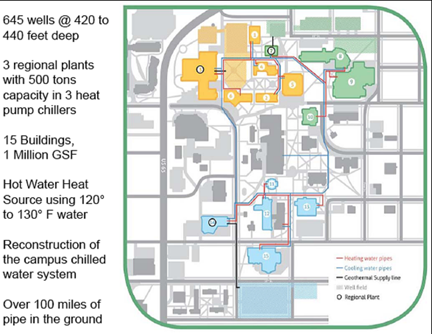
Figure 1. The MS&T Geothermal plan, showing the zoning of the wells and the connection pipe network.
Time has moved on since the initial plans were set in place, the trenches have been dug:
Figure 2. Geothermal trenches on campus, with walkways re-routed around them
Within the lots wells were then drilled roughly 430 ft deep, through which the system fluid will flow, and as these were drilled they were lined and connected by a secondary network.
Figure 3. Drilling the wells in the parking lots at the top right of Figure 1.
The network of wells is connected through plastic pipes that carry the water out to the wells, down and back up and then return to the central heat exchanger systems of the different circuits.
Figure 4. The heat exchange between the water and the ground (inhabitant )
Figure 5. The initial connections to the wells
Larger pipes are required to carry the water to and from the different fields to the processing plants where it is used to heat/chill water in a secondary circuit that is then distributed (depending on season to either warm or cool) through the network to the campus buildings.
Figure 6. The main pipe connections.
The parking lots have since been regraded, tarmac applied, and have, for some time been functioning as before.
Now the project is entering into the final days of installation, as a significant milestone has been reached. This week the coal and wood fired boiler #5 will shut down and all steam production at the campus power plant will permanently cease. Chillers are now operating for the summer to cool the buildings served by three of the regional plantsm which covers most of the air conditioning needs of the campus, and heat is being sent to six of the campus buildings.
Given the age, and change in the nature of the heating and air conditioning service to the buildings some still remain to have their systems upgraded, but most will now be completed while the students are away this summer.
Estimates of the savings that this will bring to the campus are in various forms. The coal and wood that have provided the energy source in the past will no longer be needed (and in time the plant will be removed). As well as the plant itself this will also free up the space where the coal was stored, and will improve the local aesthetic considerably along that side of the campus.
Figure 7. The campus power plant
The change in fuel will also see the overall amount of fuel required reduced, and it is anticipated that the energy use will be cut by 50%. Carbon dioxide emissions will be dropped by 25,000 tons a year (the system will still use significant amounts of natural gas) and water use will be cut by eight million gallons a year.
It is anticipated that the $32 million project will initially yield the campus a saving of around $1 million a year which will rise to more than $3 million a year as energy costs increase, while the system should not need significant maintenance for decades. There is a video of the project here). When completed, sometime next year the system will be serving 15 buildings with around a million square feet of floor space.
As the Missouri system was beginning, the initial phase of a similar system at Ball State was being completed . This will ultimately supply around 5.5 million square feet of campus space, and is expected to yield some $2 million a year in energy cost savings. Following the successful completion of Phase 1 of that project in March 2012, the Phase 2 project, requiring an additional 1,000 boreholes, was started in June of 2013, and is expected to be completed by some time next year. The four coal fired boilers at the plant (which consumed some 36,000 tons of coal a year,) were shut down in March of this year. Power will continue to be supplied from three natural gas boilers on campus. The $80 million project will have drilled a total of around 3,600 wells at the time of completion of Phase 2.
Oregon Tech has a 1.75 MW geothermal power plant, which combined with a solar electric array of panels on a 9-acre site off campus to produce most of the power needs of the campus. The dedication ceremony was on April 18th of this year. It is expected that the plant, which operates on a more conventional use of high-temperature water from the underlying host rock, will save the campus around $400,000 a year in energy. Water is brought up from 5,300 ft below the surface at a temperature of 200 degrees F, and used to spin two turbines, and as source of building heat, before being re-injected.
As the dates suggest this is a very new venture for universities and, as yet, there are not a lot of players in the game. Yet if the savings pan out to be at the level or greater than currently estimated it may well be more popular in the future as overall energy costs continue to rise. (Although in the short term natural gas prices may well rise a little, while coal prices are expected to fall a little).
I wrote, some eighteen months ago about the geothermal plans at Missouri University of Science and Technology (MS&T) previously the University of Missouri-Rolla and my academic home for 42 years. At that time the campus was beginning a process that would see the different parking lots and other open areas around campus disrupted while a series of vertical wells and horizontal pipes was laid beneath the ground, prior to its restoration.
Figure 1. The MS&T Geothermal plan, showing the zoning of the wells and the connection pipe network.
Time has moved on since the initial plans were set in place, the trenches have been dug:
Figure 2. Geothermal trenches on campus, with walkways re-routed around them
Within the lots wells were then drilled roughly 430 ft deep, through which the system fluid will flow, and as these were drilled they were lined and connected by a secondary network.
Figure 3. Drilling the wells in the parking lots at the top right of Figure 1.
The network of wells is connected through plastic pipes that carry the water out to the wells, down and back up and then return to the central heat exchanger systems of the different circuits.
Figure 4. The heat exchange between the water and the ground (inhabitant )
Figure 5. The initial connections to the wells
Larger pipes are required to carry the water to and from the different fields to the processing plants where it is used to heat/chill water in a secondary circuit that is then distributed (depending on season to either warm or cool) through the network to the campus buildings.
Figure 6. The main pipe connections.
The parking lots have since been regraded, tarmac applied, and have, for some time been functioning as before.
Now the project is entering into the final days of installation, as a significant milestone has been reached. This week the coal and wood fired boiler #5 will shut down and all steam production at the campus power plant will permanently cease. Chillers are now operating for the summer to cool the buildings served by three of the regional plantsm which covers most of the air conditioning needs of the campus, and heat is being sent to six of the campus buildings.
Given the age, and change in the nature of the heating and air conditioning service to the buildings some still remain to have their systems upgraded, but most will now be completed while the students are away this summer.
Estimates of the savings that this will bring to the campus are in various forms. The coal and wood that have provided the energy source in the past will no longer be needed (and in time the plant will be removed). As well as the plant itself this will also free up the space where the coal was stored, and will improve the local aesthetic considerably along that side of the campus.
Figure 7. The campus power plant
The change in fuel will also see the overall amount of fuel required reduced, and it is anticipated that the energy use will be cut by 50%. Carbon dioxide emissions will be dropped by 25,000 tons a year (the system will still use significant amounts of natural gas) and water use will be cut by eight million gallons a year.
It is anticipated that the $32 million project will initially yield the campus a saving of around $1 million a year which will rise to more than $3 million a year as energy costs increase, while the system should not need significant maintenance for decades. There is a video of the project here). When completed, sometime next year the system will be serving 15 buildings with around a million square feet of floor space.
As the Missouri system was beginning, the initial phase of a similar system at Ball State was being completed . This will ultimately supply around 5.5 million square feet of campus space, and is expected to yield some $2 million a year in energy cost savings. Following the successful completion of Phase 1 of that project in March 2012, the Phase 2 project, requiring an additional 1,000 boreholes, was started in June of 2013, and is expected to be completed by some time next year. The four coal fired boilers at the plant (which consumed some 36,000 tons of coal a year,) were shut down in March of this year. Power will continue to be supplied from three natural gas boilers on campus. The $80 million project will have drilled a total of around 3,600 wells at the time of completion of Phase 2.
Oregon Tech has a 1.75 MW geothermal power plant, which combined with a solar electric array of panels on a 9-acre site off campus to produce most of the power needs of the campus. The dedication ceremony was on April 18th of this year. It is expected that the plant, which operates on a more conventional use of high-temperature water from the underlying host rock, will save the campus around $400,000 a year in energy. Water is brought up from 5,300 ft below the surface at a temperature of 200 degrees F, and used to spin two turbines, and as source of building heat, before being re-injected.
As the dates suggest this is a very new venture for universities and, as yet, there are not a lot of players in the game. Yet if the savings pan out to be at the level or greater than currently estimated it may well be more popular in the future as overall energy costs continue to rise. (Although in the short term natural gas prices may well rise a little, while coal prices are expected to fall a little).
Read more!
Labels:
Ball State,
energy savings,
geothermal,
geothermal wells,
MST,
Oregon Tech
Friday, November 2, 2012
OGPSS - The quiet steps of a Geothermal movement
The election is now less than a week away, with two entirely different paths possible for our future as we move past the election into next year. The two approaches to energy are particularly different, but it is pointless to do any further comparison, since the airwaves have (on the rare occasion that these differences are explored) discussed these from all points on the spectrum. But nevertheless it gives an occasion to step aside from Iran, for a week, and to draw your attention to something you may have missed in all this debate, and yet is starting to happen on University campuses that are scrambling to meet that ever rising fuel bill.
In the current debate both sides seem to anticipate that the energy future is rosy. As an illustration, I was struck by a comment just this last week:
"Peak oilers have become almost extinct, destroyed by the arrival of new technologies with the U.S. leading the oil supply change," said David Hufton of oil brokerage PVM.And yet, in the same week I received another newsletter from Go Haynesville Shale predicting (from Seeking Alpha) that 2013 will see the decline in Hanesville production. Figure 1. Production from the Haynesville Shale in Louisiana (Go Haynesville Shale ) Now there are a variety of reasons for the decline, a significant one being that the number of wells being drilled has fallen dramatically, as the article recognizes. But that is itself, in part, a recognition of the current economics of the business. I had a discussion, just this past week, with the daughter of an investor who had “lost his shirt” over a natural gas well investment. The difference between the hype and the reality is disturbing, and does not bode well for a stable future. Which poses the question as to what the reality of that future might be? I live in Missouri, and a number of years ago colleagues of mine evaluated the potential benefits of renewable energy and were left severely unimpressed with the potential for wind and solar in this state. At the time I was not sure what the answer for our state was. The campus where I worked until I retired, (Missouri University of Science and Technology – the new UMR) had been quite revolutionary some decades ago in starting to burn wood with coal, both as a way of controlling emissions and costs. Now those benefits were disappearing and the campus faced the prospect of finding about $25 million for a new boiler, at a time when state funds are not likely to be available, and which philanthropist wants to fund a boiler? So the campus had to be creative. And it was! Figure 2. Old Campus Power Plant - the question of what to do with the stacks is unresolved. Starting in the summer of 2010 the campus proposed the use of a ground-source heat pump system as a method of using the Geothermal potential under the campus to lower the overall operating costs of generating power, while at the same time addressing issues regarding the generation of carbon dioxide, and the use of large volumes of water that are one of the costs of conventional coal-fired boiler use. The initial proposal was approved in remarkable time and over the past summer drilling crews moved in for the initial drilling of the wells. Unfortunately (but realistically) the greatest amount of open space around campus that can be used are the parking lots. And so s number of drilling rigs appeared as the students left for the summer, and proceeded to drill a series of roughly 600 wells, each around 400 ft deep. The last was completed last month, and the wells were then lined with piping and are currently being connected into a triad of networks. Figure 3. Simplified illustration of the geothermal circuit. Basically the system works on the idea that the ground, in depth, is at a relatively constant temperature. (For those of us who have mined in depth the old rule of thumb in the Northern UK was 60 deg at 60 ft and 1 degree rise per 60 ft thereafter – but the geothermal gradient varies around the world). Given this relatively consistent temperature, in winter the cool water (the blue line) can be pumped underground, heated and returned through the red line, from which it passes through a heat exchanger system that provides heat to the campus, while then being returned via the blue line to repeat the process. In the summer the flow is reversed. The hot water from the heat exchanger/chiller is returned to the wells through the red lines, releasing the heat into the ground and cooling before it returns back to the surface through the blue line, and into the chiller/heat exchanger to provide a cooling source for the campus. Current estimates are that the initial costs (paid for with a bond issue) will be no more than the cost of that boiler (which wasn’t going to be funded, yet was needed), but that the campus will save, in the beginning, some $1 million in energy costs (the remaining energy will be supplied with natural gas and the boilers will be retired in 2014) and this will service the bond. The funds only allow some 60% of the campus to be initially served, through three separate plants that are set around the campus. In time, as savings mount, it is likely that other buildings will be brought into the loop (though some have sufficiently antiquated heating and cooling systems that the entire building will need renovation first. Over the lifetime of the system (and there is not a lot of fragile equipment in the loop, so this may be more than 50-years) energy savings are likely to rise to more than $3 million a year, as the energy crisis that we are currently pretending isn’t coming finally comes to pass. Given the benefits that the system will develop it is not surprising that MS&T are not alone in this approach. In fact they learned of the concept at the time that Ball State was beginning their project. That project has just been dedicated and anticipates, being larger than ours, that it will save that campus around $2 million a year. It also includes some 3,600 wells by the time that the second phase of the program is completed. The idea is beginning to catch on, and there are a small but growing number of campuses now that are in the throes of the same type of effort, though in each case tailored to the individual needs of the different campuses. Hampton University in Virginia is heating their Multi-Purpose Building, Indiana Tech has restored and powered a Civil War era building, Montana Tech will use the heat from mine waters underneath the campus. In Boise, ID the ground water temperature is a little higher (around 170 degrees) and the city has used geothermal energy since 1983, and now Boise State is joining in with its own plant. As with the Montana project, so the program at New Mexico Tech has also been funded as part of the Recovery Act. Some of the potential benefits of that program have been described by the Department of Energy. However that presentation also illustrates the transience of the funding opportunity. Figure 4. The budget for the Geothermal Technologies Program (DOE) Given that drop in funding, it is yet still possible, given the savings projected not only here but elsewhere, that this technology may still catch on and become more widely adopted. I’ll keep you posted (among other things with more technical details).
Read more!
Subscribe to:
Posts (Atom)