Showing posts with label ground source heat. Show all posts

Monday, November 10, 2014

Tech Talk - Geothermal Plant Opens

The Missouri University of Science & Technology Geothermal system was officially opened last Thursday, some months after the coal and wood fired power plant that had previously warmed the campus had been shut down.


Figure 1. Chancellor Schrader cutting the ribbon to officially open the system.

The operation ended up being a little larger than originally anticipated, although the receipt of several grants kept the need for external funding bonds down to $30 million. Overall, as the old heating and cooling system was replaced around campus, deferred maintenance costs of some $60 million disappeared as the new system eliminated those needs, and is anticipated to generate fuel overall savings of some $1 million initially rising to $2.8 million a year as future fuel prices rise over the years.

In the end some 645 wells were drilled to feed three different geothermal plants located around the campus. Well depths ranged from 420 to 440 ft., and with a background temperature around the wells averaging around 60 deg F.

The installed system is, to a large extent, computer controlled, so that it was necessary to find employment for the fifteen workers at the power plant who would otherwise have been laid off. Given that some took retirement, the University was able to absorb the rest into the workforce in various ways. But it does point out that, now that the system is installed, the number of jobs associated with this new sustainable energy system are significantly below that required at the power plant, and the coal mine and forestry products supplier that previously supplied the fuel. Maintenance of the system, which is largely built around pumps, pipes and valves can, in the main, be carried out by the normal trades staff at the campus.


Figure 2. Overview board for the individual geothermal flow loops

To illustrate the degree of control that the new system exerts on the Heating and Air Conditioning (HAC) network, consider a simplified circuit for one building.


Figure 3. Illustrated circuit for a single building

Hot water is fed into the building from the network (top left) at a temperature of 118.7 degF, and is mixed with a portion of the previously circulated fluid to give a starting temperature of 113.6 degF entering the building. (The values are in the small boxes over the sensing valve emulations). The hot water circulates around the building providing heat as needed. At the point where the water would exit back to the network for reheating the temperature of the returning water is measured (in this case 102.3 degF). Depending on that temperature a control valve opens or closes to send more (or less) water back for reheating, while the remainder stays in the circuit, with make-up from the main network. (with the valve 41.3% open some 3% of the returning water is being recycled). The computer also calculates the heating load being fed to the building (327.5 kBtu/hr).


Figure 4. Details of the control valve and instrumented values.

By using a similar circuit for cooling the components of the system are largely similar, reducing the inventory costs for maintenance supplies, and the two circuits are simply monitored through instrumentation around the circuit.

This is similarly true for the three geothermal plants, the status of each of which is also represented by a monitoring screen.


Figure 5. Control circuit monitoring the performance of the heat exchangers between the field circulation water and that being used in the building circuit.

The heat exchanges between the ground water and the heating/cooling circuits is through use of three screw type heat recovery chillers, the operation of which is described as:
A heat recovery chiller operates on the basis of a refrigeration cycle: the same basic cycle that is used for refrigerators, air conditioners, and heat pumps you find in your homes. It is designed to provide both useful cooling and useful heating energy from the machine. The work or energy put into the machine through the compressor is used to simply transfer heat from evaporator to the condenser, which makes it a more efficient use of energy than combusting fuel for heat.

As seen in the diagram below, the refrigerate, R-134a in our chiller, is first compressed using a screw-type compressor. This hot gas is then condensed to a liquid as it travels in a circuit through the condenser, and heat is transferred to the water flowing through the condenser tube bundle. The pressure and temperature of the refrigerant is reduced as it flows through the throttling valve. The refrigerant next passes through the evaporator where heat is transferred from the water flowing through the evaporator tube bundle back to the refrigerant. Then the cycle repeats as the refrigerant goes back to the compressor. The refrigerant is confined inside of the heat pump chiller for the entire process.

Figure 6. Operation of the heat exchanger.


Figure 7. Overview of the three chiller units in the McNutt plant

Manually readable gages provide back-up to the computer monitoring instruments.


Figure 8. Monitoring gages for the chilled water loop.

When additional heat is needed, this is provided by a bank of natural gas heaters for the water that can be engaged as needed, and that are similarly monitored.


Figure 9. Overall monitoring board for the natural gas boiler system

While the system may get an early test of effectiveness this week as a Polar Vortex brings an early taste of winter to town, with temperatures predicted to drop to a high of 34 and a low of 19 on Thursday.


Figure 10. Natural gas boiler to provide additional heat as needed.

Since I won't be able to take advantage of those boilers, I’m glad I have my wood stacked, and that I swept my chimney this morning.

Read more!

Friday, November 9, 2012

OGPSS - More on the MS&T Geothermal Project

Ah, the election is over! Those outside the United States might not understand the relief, but as a minor example we had 6 different phone calls urging us to support Todd Akin for the Senate, in the 24-hours before our polling station closed. I am not sure that there will be much in the way of new information on Energy Policies out of Washington for a while, as they debate the fiscal cliff, but one does wonder whether we might get a new Secretary of Energy. And so, with Iranian oil production very much a function of how effective sanctions remain, and with the new OPEC Monthly Oil Market Report due, I am going to return for a second week to discuss the geothermal operations at MS&T, with a little more detail than last time, since some of the numbers might be of interest. (And I am grateful to Jim Packard at MS&T for providing the information).

Universities move generally very slowly. However they are, on occasion, willing to accept new ideas that resolve a problem quite quickly. (We once had to build a small plant to recover explosive and repackage it – not something that was possible on the surface, but by driving a new set of tunnels underground at the Experimental Mine we could create space for the plant and then operate it for the required demonstration without needing any of the permissions that would have been required had we tried to build a facility on the surface. (This was about 20-years ago, and we would likely still be moving the paperwork seeking permission). (Perhaps another argument for the accelerated use of underground space).

The case for a change in thinking, and, perhaps, a hint of its urgency, can be seen by looking at the energy balance, before the new system is installed.


Figure 1. Comparison of the useful energy (upper circled numbers) to the input energy at the MST Power Plant. (MST)

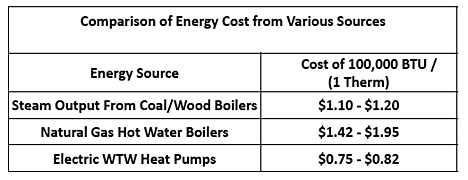
Given that fuel costs will likely only continue to rise, but that, while a new boiler was needed, there was no obvious source of funds to pay for it, a number of options were considered. It is interesting to note, in the following table, the costs of the current coal:wood system. (60% coal), relative to those of the proposed water to water (WTW) heat pumps that are being proposed.


Figure 2. Comparative Energy costs relative to the current system. (MST)

To digress a little, for their part in addressing a similar problem, the University of Missouri at the Columbia campus is installing a bubbling fluidized bed boiler. The boiler will use biomass to be to displace about 25% of the coal use on campus. The $75 million project has just been completed. However, as I noted in an earlier post, there may be unrecognized processing costs for the biomass which may eat into the campus savings. And while MS&T are looking for ways of handling the now unnecessary smoke stacks, the biomass facility in Columbia has just added three 110-ft tall silos to handle the feed.
The new boiler, which was retrofitted to the university’s existing heating duct system, is expected to produce 150,000 pounds of steam per hour, increasing the 67-year-old power plant’s steam output by 30,000 pounds per hour, and use an estimated 100,000 tons of in-state renewable energy sources such as chipped hardwoods and wood waste.
Back at MS&T the number for the heat pump came in part from a WTW heat recovery chiller that the campus had installed in October 2007, and which was saving the campus some $1,500 a day by allowing some of the recovered heat to be produced in useful form.

When the campus first looked at the potential they were also able to look at the experience of places such as the Richard Stockton College of New Jersey, which installed a system in 1996. Their installation pioneered many of the decisions made in subsequent operations.
The wells are located on a grid and spaced roughly 15 feet apart. Within each four inch borehole, the installers placed two 1.25 inch diameter high density polyethylene pipes with a U-shaped coupling at the bottom.

After the pipes were installed, the boreholes were backfilled with clay slurry to seal them and to enhance heat exchange. In total, the loop system includes 64 miles of heat exchange pipe. In addition, 18 observation wells were located in and around the well field for long-term observation of ground water conditions.

The individual wells are connected to 20 four inch diameter lateral supply and return pipes. The laterals, in turn, run to a building at the edge of the field where they are combined into 16 inch primary supply and return lines. These lines are connected to the heat pumps which serve Stockton’s buildings. In the heating mode, the loop serves as a heat source and, in the cooling mode, as a heat sink. The heat pumps range in size from 10 to 35 tons. All are equipped for with air economizers. The equipment is controlled by a building management system using 3,500 data points. This allows the College to take advantage of energy saving options such as duty cycling, night setback and time of day scheduling. The building management system also identifies maintenance needs in the system. . . . . .

The system immediately demonstrated that it could carry the entire planned heating load. In the first few years of operation, the average temperature of the well field has drifted upward by several degrees. This occurred because the buildings use more air conditioning than heating. . . . . .

Because of the constant changes to the system, and other energy conservation steps, it was difficult to verify energy savings exactly. Based on extensive monitoring, the predictions turned out to be quite accurate.


Figure 3. The polyethylene tubing and the metal end fixtures for insertion into the MS&T boreholes. (MST)

With this encouragement there was an initial discussion of the system in Mid-September 2010, the scheme was approved by the Board of Curators in November 2010, and 2011 was spent in bidding and awarding the contracts and pre-ordering materials. The first day of drilling was on June 4, 2012, just after the Spring Semester. In order to complete the parking lots – to the degree possible – several drill rigs were used at once:


Figure 4. The use of multiple rigs to speed operations (how many?) (MST)

Once a well had been drilled, and the pipes installed, the holes were backfilled with a grout that included significant quantities of sand, to improve the heat transfer. And the two pipes were all that were left protruding.


Figure 5. After pipe installation (MST)

Trenches were then cut across the lot to allow the distribution and collection network of pipes to be installed. Once the field connections were fused together, the lines were connected to larger transport pipes at the end of the field, and set into a deeper trench.


Figure 6. The connections between the wells and the distribution network. (MST)

The larger pipes were used to carry the water from each field to the heat exchanger/chiller plant, with three plants being located around the campus. All that then remained was to backfill the trenches, tarmac the lots again, and the campus began to return to normal. The last well did not get drilled until half-way through this semester, but the lots are now coming back into use.


Figure 7. Overall layout of the three circuits being used on campus (MST)

With most of the work done on the fields, the remaining work involves the integration of the system into the existing infrastructure, and the necessary changes to the hardware in the various buildings to handle the different ways in which energy is used within them. Much of this change is required since the heating has been, in the past, using steam lines, and these have now to be replaced with the hot water circuit.

Read more!

Friday, November 2, 2012

OGPSS - The quiet steps of a Geothermal movement

The election is now less than a week away, with two entirely different paths possible for our future as we move past the election into next year. The two approaches to energy are particularly different, but it is pointless to do any further comparison, since the airwaves have (on the rare occasion that these differences are explored) discussed these from all points on the spectrum. But nevertheless it gives an occasion to step aside from Iran, for a week, and to draw your attention to something you may have missed in all this debate, and yet is starting to happen on University campuses that are scrambling to meet that ever rising fuel bill.

In the current debate both sides seem to anticipate that the energy future is rosy. As an illustration, I was struck by a comment just this last week:
"Peak oilers have become almost extinct, destroyed by the arrival of new technologies with the U.S. leading the oil supply change," said David Hufton of oil brokerage PVM.
And yet, in the same week I received another newsletter from Go Haynesville Shale predicting (from Seeking Alpha) that 2013 will see the decline in Hanesville production.


Figure 1. Production from the Haynesville Shale in Louisiana (Go Haynesville Shale )

Now there are a variety of reasons for the decline, a significant one being that the number of wells being drilled has fallen dramatically, as the article recognizes. But that is itself, in part, a recognition of the current economics of the business. I had a discussion, just this past week, with the daughter of an investor who had “lost his shirt” over a natural gas well investment. The difference between the hype and the reality is disturbing, and does not bode well for a stable future. Which poses the question as to what the reality of that future might be?

I live in Missouri, and a number of years ago colleagues of mine evaluated the potential benefits of renewable energy and were left severely unimpressed with the potential for wind and solar in this state. At the time I was not sure what the answer for our state was.

The campus where I worked until I retired, (Missouri University of Science and Technology – the new UMR) had been quite revolutionary some decades ago in starting to burn wood with coal, both as a way of controlling emissions and costs. Now those benefits were disappearing and the campus faced the prospect of finding about $25 million for a new boiler, at a time when state funds are not likely to be available, and which philanthropist wants to fund a boiler? So the campus had to be creative. And it was!


Figure 2. Old Campus Power Plant - the question of what to do with the stacks is unresolved.

Starting in the summer of 2010 the campus proposed the use of a ground-source heat pump system as a method of using the Geothermal potential under the campus to lower the overall operating costs of generating power, while at the same time addressing issues regarding the generation of carbon dioxide, and the use of large volumes of water that are one of the costs of conventional coal-fired boiler use.

The initial proposal was approved in remarkable time and over the past summer drilling crews moved in for the initial drilling of the wells. Unfortunately (but realistically) the greatest amount of open space around campus that can be used are the parking lots. And so s number of drilling rigs appeared as the students left for the summer, and proceeded to drill a series of roughly 600 wells, each around 400 ft deep. The last was completed last month, and the wells were then lined with piping and are currently being connected into a triad of networks.


Figure 3. Simplified illustration of the geothermal circuit.

Basically the system works on the idea that the ground, in depth, is at a relatively constant temperature. (For those of us who have mined in depth the old rule of thumb in the Northern UK was 60 deg at 60 ft and 1 degree rise per 60 ft thereafter – but the geothermal gradient varies around the world). Given this relatively consistent temperature, in winter the cool water (the blue line) can be pumped underground, heated and returned through the red line, from which it passes through a heat exchanger system that provides heat to the campus, while then being returned via the blue line to repeat the process.

In the summer the flow is reversed. The hot water from the heat exchanger/chiller is returned to the wells through the red lines, releasing the heat into the ground and cooling before it returns back to the surface through the blue line, and into the chiller/heat exchanger to provide a cooling source for the campus.

Current estimates are that the initial costs (paid for with a bond issue) will be no more than the cost of that boiler (which wasn’t going to be funded, yet was needed), but that the campus will save, in the beginning, some $1 million in energy costs (the remaining energy will be supplied with natural gas and the boilers will be retired in 2014) and this will service the bond. The funds only allow some 60% of the campus to be initially served, through three separate plants that are set around the campus. In time, as savings mount, it is likely that other buildings will be brought into the loop (though some have sufficiently antiquated heating and cooling systems that the entire building will need renovation first.

Over the lifetime of the system (and there is not a lot of fragile equipment in the loop, so this may be more than 50-years) energy savings are likely to rise to more than $3 million a year, as the energy crisis that we are currently pretending isn’t coming finally comes to pass.

Given the benefits that the system will develop it is not surprising that MS&T are not alone in this approach. In fact they learned of the concept at the time that Ball State was beginning their project. That project has just been dedicated and anticipates, being larger than ours, that it will save that campus around $2 million a year. It also includes some 3,600 wells by the time that the second phase of the program is completed.

The idea is beginning to catch on, and there are a small but growing number of campuses now that are in the throes of the same type of effort, though in each case tailored to the individual needs of the different campuses. Hampton University in Virginia is heating their Multi-Purpose Building, Indiana Tech has restored and powered a Civil War era building, Montana Tech will use the heat from mine waters underneath the campus. In Boise, ID the ground water temperature is a little higher (around 170 degrees) and the city has used geothermal energy since 1983, and now Boise State is joining in with its own plant. As with the Montana project, so the program at New Mexico Tech has also been funded as part of the Recovery Act. Some of the potential benefits of that program have been described by the Department of Energy. However that presentation also illustrates the transience of the funding opportunity.


Figure 4. The budget for the Geothermal Technologies Program (DOE)

Given that drop in funding, it is yet still possible, given the savings projected not only here but elsewhere, that this technology may still catch on and become more widely adopted. I’ll keep you posted (among other things with more technical details).

Read more!

Saturday, March 14, 2009

Stockholm, district heating and Warren Buffett

In Stockholm, even the guards at the palace are looking cold, and there is still ice floating down the river.

Guard at the Royal Palace in Stockholm.

The plane arrived this morning through low clouds and into a light spatter of snow and rain. The formalities were relatively easily dealt with and there is a fast and comfortable commuter train that took 20 minutes to get into the city, and then into the hotel, which is still pleasantly quiet, and comfortably warm. Though like most European hotel rooms it is small. Passing through the airport we missed a coming attraction, which is going to be one of the largest ground-source heat pump establishments. In essence the airport, which plans on being carbon neutral by 2012, has to find a way to control an energy demand that is equivalent to that of a city of 25,000 folk (though there aren’t nearly that many around). The plan is therefore, as with most ground-source heat pumps (English) (International) (FAQ ), to drill pipes down into a large undergound aquifer and draw the cool water out of that storage in the summer, returning it as a slightly warmer source that builds up heat, that can then be used in the winter for melting the snow from runways and similar energy intensive operations. It is expected, when it is finished later this year, to save 4 GWh of energy directly, and an additional 15 GWh will be provided for district heating.

Source Arlanda


There were not a lot of folk on the streets for a Saturday, but then I was wandering around above ground, so it wasn’t until I got into the Old Town (the Gamla Stan) that the streets became full of tourists, and the café’s and restaurants busy. There was something going at the art galleries, which were serving wine to willing patrons, but I missed why. And it was only on the way back, that I found where folks were. Because, like many other Northern Cities, there is an under-layer to the city, with large, well lit, shop lined concourses between the mall-like stores that lie around the center of the city. Anyone with any sense could have wandered around in comfort, beneath the streets, instead of having to duck into the Royal Shop to buy a scarf.

Stockholm, as with many of the Nordic Cities uses district heating. As this is explained
District heating meets the diverse thermal energy needs of residential, commercial and industrial users. Thermal energy needs or demands include space heating for maintaining human comfort, domestic hot water requirements, manufacturing plant process heating, etc.
District heating can be combined with electricity generation to create a more efficient total energy utility. Conventional condensing power stations generally utilize less than 40% of the fuel they burn for electricity generation (over 60% is lost in flue gases and in cooling tower or cooling water). Much of this waste energy can be reclaimed by recirculating hot water or steam to buildings, for space heating or industrial processes giving an overall efficiency of about 85%. Waste heat can also be used to drive chillers for cooling.

The difference in fuel efficiency between combined heat and power plants and condensing power plants can be illustrated with the following example:
For each EIGHT "barrels of energy" consumed in a combustion plant:
ONE "barrel of energy" is lost through the chimney or in the plant.
THREE "barrels of energy" are converted to useful electricity.
FOUR "barrels of energy" are wasted in cooling systems 
OR 
FOUR "barrels of energy" is converted to useful district heating.


Because Stokholm is build on a series of islands it is more practical to have more “districts” for the heating than a single source, and this city of 1.9 million folk started with district heat in 1953. Because of where it is, it has problems with lack of sun, and not a huge amount of wind, and so is limited in what it can use. The country gets slightly more than half its power from nuclear and hydro-electricity but also uses a lot of biofuels, with pellets being one of the domestic resources. It has become one of the largest systems that combine district heating with power generation in this part of the world, with new power plants focusing to use 70% biofuel, and with a current user demand of 12 GWh/yr. They are also using the biomass to provide biogas, which is being introduced as a fuel for buses, with a target of 130 bio-fueled buses this year. They are also using ethanol to drive some 380 buses out of their total fleet of 1,800. They also found that imposing a congestion charge for downtown worked, dropping traffic by 20% while increasing access and lowering pollution.

In short the city would be considered green, apart from the winter plumage it currently wears.

There won’t be a Pick Points, tonight, but had there been, then the piece that follows, would have been in it.
“So here I am at Newark Airport with a four-hour layover, and while the airport was relatively quiet when I arrived, the part we are in is where some of the larger aircraft leave, including ours that is heading for Europe, and so, as the afternoon wears on the seats are filling up. Coming to St Louis I subscribed to Newsweek on my Kindle, since I usually pick one up to read on the ‘plane and the Kindle cost for the magazine is a fraction of the paper price. So now, in Newark, I am glancing through the March 9th edition and I come to the letter that Warren Buffett sent to his shareholders this month. It contains the following:
Last year I made a major mistake of commission (and maybe more; this one sticks out). I bought a large amount of ConocoPhilips stock when oil and gas prices were near their peak. I in no way anticipated the dramatic fall in energy prices that occurred in the last half of the year. I still believe the odds are good that oil sells far higher in the future than the current $40 - $50 price. But so far I have been dead wrong. Even if prices should rise, moreover, the terrible timing of my purchase has cost Berkshire several billion dollars . . . .”
Well at least I wasn’t the only one making mistakes.

And so to dinner.

Stockholm from the Royal Palace

Read more!