Showing posts with label Chevron. Show all posts

Thursday, February 14, 2013

OGPSS - Ukraine moves to escape Gazprom's grip

You know it is winter when Russia and Ukraine publically row about supplies of natural gas. On Tuesday Ukraine completed the signing of an agreement with Turkmenistan for the supply of natural gas. In the past the purchases have been for up to 36 billion cu m per year, although this was historically through Russian intermediaries. That deal ended in 2006, and Turkmenistan has been able to find a customer in China that now provides an alternate sale that does not leave it dependent on whatever price Russia was willing to provide.

But this does not mean that Ukraine has been able to escape having to pay whatever price Russia wished to impose, since to get from Turkmenistan to Ukraine the natural gas still requires passage through a pipeline that runs through Kazakhstan and Russia. There is no prize for guessing that Gazprom owns those pipelines.


Figure 1. The Central Asia Center pipeline and the route of the projected Pre-Caspian pipeline – both owned by Gazprom. (Gazprom).

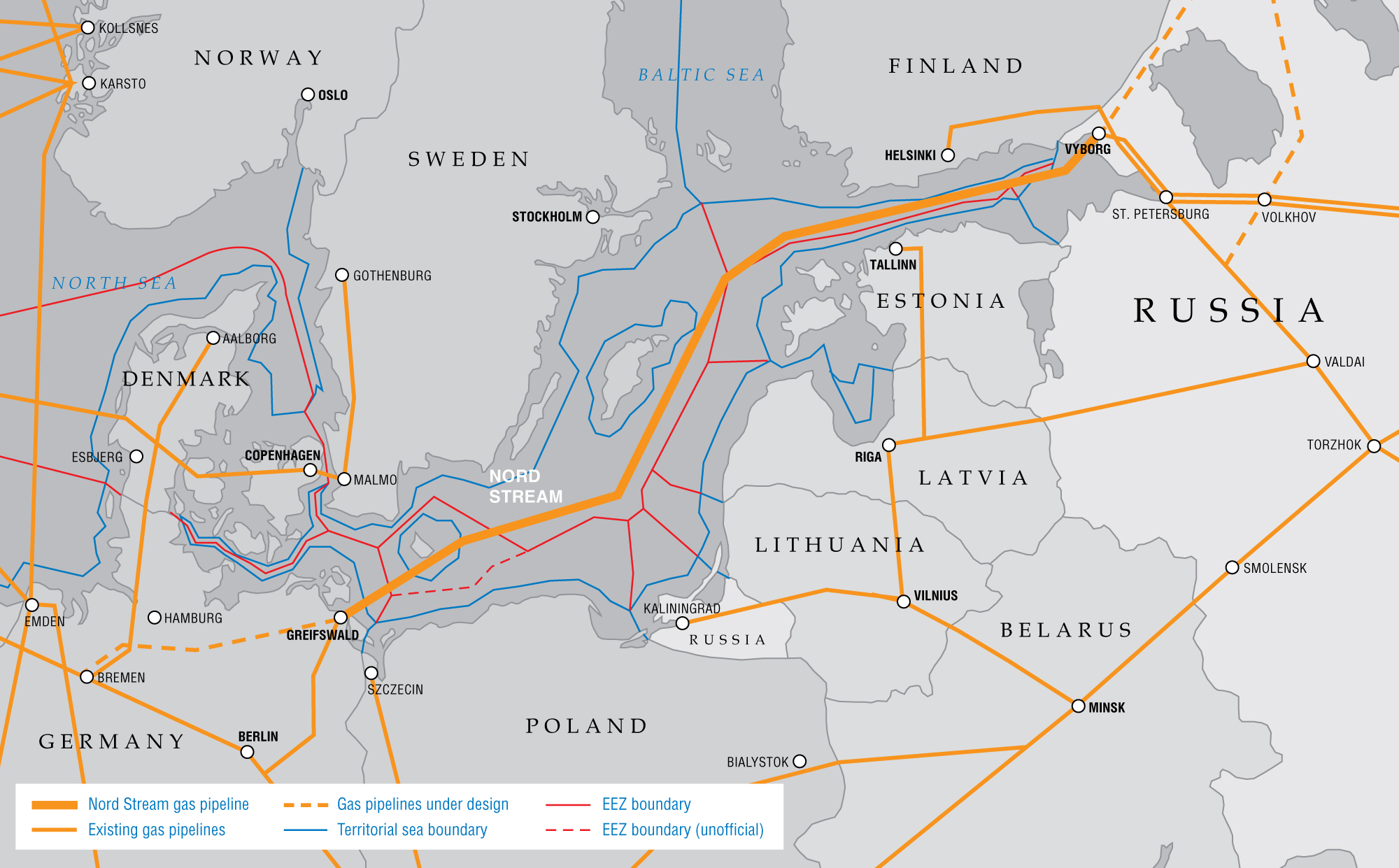
This continues to give Gazprom leverage over Ukraine, and with the North Stream pipeline now approaching its full potential after the second string was commissioned last October, Europe can receive up to 55 billion cu m per year without the gas having to pass through Ukraine.


Figure 2. Path of the North Stream (NordStream) pipeline from Russia to Germany (Gazprom)

There is now talk of adding additional capacity so that there can be a direct feed from Russia to the UK. BP is taking the lead on this, apparently with Gazprom support, although previous experience would suggest that Gazprom may end up as the major shareholder in the end, after all the bills have been paid. And speaking of which, their current dispute with Ukraine involves payment for $7 billion worth of natural gas,that Ukraine contracted for but did not, in the end use during 2012. Ukraine is paying $430 per thousand cubic meters ($12.18 per thousand cu ft) for a fixed volume per year, whether they use it or not, under an agreement signed in 2009.

There is some implication that this pressure may be related to the recent 50-year production sharing agreement that Ukraine signed with Shell to develop natural gas from shale deposits. The country is believed to have the third largest shale-bound natural gas resource in Europe (behind France and Norway ) estimated at around 42 trillion cu ft (1.2 trillion cu m).

The deposits are centered around the Yuzivskaya region, with production anticipated to start in 2017, rising to levels of around 8 – 10 bcm in ten years. Although there is some domestic opposition to the development, the schedule is aggressive.
Shell is to work with Nadra Yuzivska, a joint venture in which the state-owned resources company Nadra Ukrayiny owns 90%. SPK-Geoservice, a small private company, owns the remaining 10% in Nadra Yuzivska.

Shell is expected to invest $410 million to drill the first 15 wells, Oleh Proskuriakov, the environment and natural resources minister, said earlier in January.

The total area of the Yuzivska field is 7,886 sq km. The deposit could hold 4.05 Tcm of gas, according to the government. Proskuriakov has also projected output from Yuzivska could hit 10 Bcm/year in 10 years and 20 Bcm/year in 15. Ukraine's Stavytskiy characterized the latter figure as representing the "optimistic scenario."

"We can project that in an optimistic scenario, the project will produce 20 Bcm/year of gas, while under a pessimistic scenario, 7-8 Bcm/year," Stavytskiy said.
An adjacent well drilled by Hutton has shown promising signs of “interpreted pay in three intervals.”

Chevron is expected to develop deposits in the Olesska region with start dates of around the same time. Opposition to their plans seems to be growing, and they have yet to sign a production sharing agreement. They are, however hoping to get the same sort of deal that Shell negotiated.

It is worth injecting a note of caution into this optimistic view of the future. Just a year ago Poland was anticipating a similar bonanza from the natural gas in its shale deposits. Events have limited that dream. Although a 2011 EIA report stated that Poland had 187 tcf of technically recoverable natural gas, the Polish Geological Institute has now cut the estimates of the viable size of the resource by 90%, and there are other problems.
Difficult geology, an uncompetitive service sector, poor infrastructure, and lack of rigs have hampered development. Poland has a venerable oil and gas sector, but most of the transmission pipelines are based in the southwest, while major shale gas areas are in the northeast. Strict EU environmental laws, as well as unclear regulatory and tax frameworks have further eroded prospects. And while exploration has been going on for a few years now, only 33 wells have been drilled, with just eight of them fracked (at least 200 would have to be drilled in the exploratory stage, just to assess the actual size of reserves).

Preliminary results have not been encouraging, either: This summer, resource giant ExxonMobil withdrew from Poland after the failure of commercial gas flows, while its competitor ConocoPhillips decided not to exercise its 70 percent option in three concessions in northern Poland. Overall, costs per well have increased to $15 million, according to interviews with industry officials, roughly three times the cost in the United States.
And there are two more factors that should be considered. Ukraine is planning an LNG plant on the Black Sea to be ready by 2015, but even this is controversial. To reach the Black Sea tankers will have to pass through the Bosphorus and Dardanelles straits, and Turkey has intimated that it may not allow LNG tankers rights to that passage. That is because the terminal would compete with two that already exist in Turkey.

Secondly Ukraine is working with the Chinese to gasify some of their coal from their large deposits, with the intent of producing the equivalent of 4 bcm of natural gas to displace Russian imports.
The projects are two-fold: first, heat-producing facilities will be converted to use coal-water slurry as fuel; second, new plants will be built to enable the gasification of brown and bituminous coal in three regions: Luhansk, Donetsk and Odessa. While most of the media reports claim that Ukraine will be using Chinese coal-slurry technology, it’s actually Shell’s technology.
How soon Ukraine (and Poland) can stop imports of energetic fuels from Russia is not clear, but obviously this should happen before long, and the winters of their discontent may well disappear from the headlines.

Read more!

Friday, February 27, 2009

The OCS, Chevron and an API Conference

Every so often the American Petroleum Institute (API) hosts a conference call for interested bloggers to talk to folk in the industry. Today they had Gary Luquette who has been President of Chevron North America Exploration and Production Company since 2006. He was in Washington to testify before the House Committee on Natural Resources, and copies of his opening statement were available. This was my first visit to one of these events, and I am grateful to Jane Van Ryan for the invitation. The transcript won’t be out until next week, and I did not catch the names of other participants that well, so I will put that information up when I get it. The questions were focused largely on the testimony, which dealt with access to the outer continental shelf (OCS) of the United States, to allow drilling and production of oil and gas. (API has also just released a primer on the topic.) It is a region where access is currently not available, and so in a sense this was perhaps a move towards the “drill, baby, drill” rhetoric of the last election. The current areas that are off limits are shown on this map that I borrowed from the API primer.

Source API
UPDATE I will add links to the posts of the others that were in the call as I get them, and at the bottom of the post.

Some of the most productive recent discoveries have occurred in the deep waters of the OCS in the Gulf of Mexico, (for example Thunder Horse at 250,000 bd, and the Chevron Tahiti project. The region falls under the Minerals Management Service of Interior, and they recently published their 2008 review of the region. Currently their purview includes the gridded bit of the map below, and the report contains detailed information on wells and production in that region. For example the following figure shows how, over time, companies have had to go to deeper and deeper waters to find new reserves, but that in doing so that they are finding larger fields.
Source MMS
Average field size in the GOM showing discovery date and depth of water (Source MMS ).

It is this trend in discoveries that were an underlying part of the message that Chevron (and the other companies) were trying to convey. As Gary pointed out in his response to a question from “The Bear”, the assumption in the 1960’s, based on MMS surveys, was that the deepwater Gulf would hold 6 – 8 billion barrels of oil, and to date more than 45 billion barrels have been found. Thus estimates, such as an overall yield of only 200,000 bd from new discoveries, are likely to be considerably too low, and his estimate is that production could ramp up to over 1 mbd. New technologies are continually being evolved to deal with the challenges of producing oil from the increasingly more complex reservoirs that are being found, and thus current estimates of ultimate production are likely to be considerable underestimates when oil finally starts to flow. Staying on message relative to current Administration (and national) priorities, he pointed to the increase of over 160,000 jobs that just granting access could bring as this development moved forward. (Though it takes a long time to bring this all to pass, bear in mind that Tahiti was found in 2002, and is expected to come on line at 125,000 bd this year). The ultimate revenue to the government was projected at over $1.7 trillion.

Geoff Styles of Energy Outlook asked about the impact of the current estimate of tax changes (Pick Points 44) which Gary responded to by pointing out that the tax changes were still just a proposal, and while he felt that they were in the wrong direction and more of a challenge in the current climate (Geoff thinks the timing is wrong for cap and trade, he was optimistic for the future.)

Someone from Copious Dissent asked about the impact of climate change, obviously a current hot topic, and Gary responded that you have to accept that there is a perception in the minds of the people, and these for a time create a reality you have to live with. And that, at the moment, is where the climate change situation lies.

He went on to answer another question on AGW and corporate profits by noting that the scale of investments that the company must make each year (around $22 billion) requires that they generate large amounts of capital, and even as profits fall with the price drop for oil, they must continue to invest that amount if they were to have a future. (Tahiti, for example, cost $6 billion and they have yet to earn a penny on the investment).

Steve Rhodes of the Republican Temple asked about possible gas taxes, and the possibility of taxing folk per mile driven. The API position on this has been that taxes are not opposed, as long as they go for the support of infrastructure, but that this would be a very regressive tax, and since it will include a GPS element also carries elements of Big Brother. (My own sense on this is that it is already a dead issue).

Gail (the Actuary at TOD) has already a post up today on the impact of taxes on the industry and was curious as to the impact of proposed legislation on the smaller producers, particularly for the natural gas industry. She then went on to ask as to how $40 oil, and $4 (per mcf) gas prices would impact production. Gary pointed out that it wasn’t too long ago that those would have been very good numbers, and that, were it not for production costs which have recently gone up dramatically, the industry would be happy to work in that environment. Since prices are up it has brought a number of projects closer to the margin of profitability. But with open access to the OCS (which was the underlying message of the call) the industry could live and profit with those prices. He was less definitive in regard to gas production, admitting that while $4 might work in some rich shales, others would need $8 to be viable.

In regard to a small question I had on biofuels (since it was included in his opening statement) he felt that these were already making an impact, mentioned the food vs fuel dilemma, and that they were working with Weyerhauser on generating fuel from wood products.

On a more general note Gary closed by noting that last year the gap between possible supply and demand dropped from 4 mbd to 2 mbd. While current demand in the US is down because of the recession, and will likely continue so, in the rest of the world demand is likely to continue to grow, so that overall production needs to keep up. When the recession ends, then growth, particularly in countries like China and India will return to double digits, with the equivalent increases in demand, and we must be ready to meet that.

Well those are my notes from the conference call. Again my thanks to Jane and API for the invite.
UPDATE: Others who posted on the call are:
Bob McCarty


Read more!