Showing posts with label Russia. Show all posts
Wednesday, December 31, 2014
Tech Talk - Projections 2
It is the end of another year, or more optimistically the start of a new one. Last year I was tempted to make a couple of predictions for the future. And while I can make the case that they were not too wrong, they did not include the drop in oil prices, which has now taken the price of our local gas to below $1.85 a gallon. China has, in recent months, seemed less belligerent about claiming large sections of the China Seas. Whether this has anything to do with the relative success of rigs that have drilled in those waters is something that still remains an unknown.
But it is the changing price of gasoline, itself reflective of the drop in oil prices that is the big news. WTI closed at $53.56 today, and Brent at $57.50 a barrel. Predictions include some who would suggest that the price will continue to fall, until it reaches $20 a barrel, and there it may stay for some time. Well it certainly grabs a headline, but that is about all the value that particular forecast contains. The futures prices suggest that the price has yet to bottom out, though it may be getting close to that value.
Figure 1. Crude oil futures prices (EIA TWIP)
None of the recent news suggests that there will be a further increase in supply to sustain the current imbalance between available supply and demand. Libya is descending even further into a mess, with the oil facilities at the port of Es Sider now being destroyed. The likelihood of significant increases in production and the return to export levels achieved earlier this summer seems increasingly nonexistent. Neither Russia nor Saudi Arabia are likely to increase production, although the latter are continuing to produce the increased volume that they originally put on the market to replace Libyan losses. And so this leaves Iraq and the United States as the key producers who can significantly change the current supply:demand balance in any significant way.
It is probable that, with the agreement between the Kurds and the Central Government now having generated a second payment of $500 million to the KRG that the agreement may be sustained and grow. At present the Kurds are to supply about 550 kbd, of which 300 kbd will travel through the new pipeline to Turkey and thence onto the world market. The rest will be supplied to Baghdad. Meanwhile production in the south (which gets exported through Basra) has seen some increase.
Whether the Kurdish production can increase to over 1 mbd by the end of next year remains open to some doubt, given the ongoing conflict, and the target 6 mbd by the end of the decade for the entire country will likely require changes that the current conflict, which shows no signs of ending, will inhibit.
One of my responses, when the drop in price first started, was to note that the oil supply system has a certain inertia to it. And here I am not talking about the fluctuations in price that one sees in the stock market, and in the price of the crude, but rather in the time that it takes to stop current drilling, postpone future plans and to reduce the production from existing and new developments.
Thus the drop in investment in new production, whether in Russia, Iraq or the United States takes some time to have an impact. Unfortunately for those expecting the price to continue to fall, in the face of the overabundant supply, the situation has changed since historic times, where well production was relatively stable and the oversupply situation was corrected by shutting in production (mainly by Saudi Arabia). Even then it was the perception of the response that drove price rebounds, rather than the immediate reality of the changes.
The system this time is different. The increase in production in the United States has been sustained, and over the last two years has produced more than 2 mbd more than at the start of that period.
Figure 2. US crude oil production over the past two years. (EIA TWIP)
The rig count in North Dakota has already fallen to 170 rigs compared with 187 at this time last year. Concern about the oil price has led companies to cut their investment plans for next years, in some case by 20% so that the rig count is likely to continue to fall. And with the short life at high production values for most wells that will soon affect production. The North Dakota Oil and Gas Division of DMR shows the consequences of this:
Figure 3. Future production estimates from the ND DMR Oil and Gas Division.
The blue line requires about 225 rigs in continuous action, so that won’t happen. By the same token the black line is with no more drilling, and that won’t happen either. The result will be somewhere in between, probably moving the peak out beyond the current projection, but also lowering it as the existing baseline drops with less wells significantly contributing. (Bear in mind it is taking 11,892 wells to sustain current production levels.) But in the short term the line will likely dip down until the price rebounds.
The question now becomes how soon that drop in US production will become evident, and have some impact. I doubt that it will be before June of 2015.
On which note may I wish all readers a Happy, Healthy, Successful and Prosperous 2015.
But it is the changing price of gasoline, itself reflective of the drop in oil prices that is the big news. WTI closed at $53.56 today, and Brent at $57.50 a barrel. Predictions include some who would suggest that the price will continue to fall, until it reaches $20 a barrel, and there it may stay for some time. Well it certainly grabs a headline, but that is about all the value that particular forecast contains. The futures prices suggest that the price has yet to bottom out, though it may be getting close to that value.
Figure 1. Crude oil futures prices (EIA TWIP)
None of the recent news suggests that there will be a further increase in supply to sustain the current imbalance between available supply and demand. Libya is descending even further into a mess, with the oil facilities at the port of Es Sider now being destroyed. The likelihood of significant increases in production and the return to export levels achieved earlier this summer seems increasingly nonexistent. Neither Russia nor Saudi Arabia are likely to increase production, although the latter are continuing to produce the increased volume that they originally put on the market to replace Libyan losses. And so this leaves Iraq and the United States as the key producers who can significantly change the current supply:demand balance in any significant way.
It is probable that, with the agreement between the Kurds and the Central Government now having generated a second payment of $500 million to the KRG that the agreement may be sustained and grow. At present the Kurds are to supply about 550 kbd, of which 300 kbd will travel through the new pipeline to Turkey and thence onto the world market. The rest will be supplied to Baghdad. Meanwhile production in the south (which gets exported through Basra) has seen some increase.
Whether the Kurdish production can increase to over 1 mbd by the end of next year remains open to some doubt, given the ongoing conflict, and the target 6 mbd by the end of the decade for the entire country will likely require changes that the current conflict, which shows no signs of ending, will inhibit.
One of my responses, when the drop in price first started, was to note that the oil supply system has a certain inertia to it. And here I am not talking about the fluctuations in price that one sees in the stock market, and in the price of the crude, but rather in the time that it takes to stop current drilling, postpone future plans and to reduce the production from existing and new developments.
Thus the drop in investment in new production, whether in Russia, Iraq or the United States takes some time to have an impact. Unfortunately for those expecting the price to continue to fall, in the face of the overabundant supply, the situation has changed since historic times, where well production was relatively stable and the oversupply situation was corrected by shutting in production (mainly by Saudi Arabia). Even then it was the perception of the response that drove price rebounds, rather than the immediate reality of the changes.
The system this time is different. The increase in production in the United States has been sustained, and over the last two years has produced more than 2 mbd more than at the start of that period.
Figure 2. US crude oil production over the past two years. (EIA TWIP)
The rig count in North Dakota has already fallen to 170 rigs compared with 187 at this time last year. Concern about the oil price has led companies to cut their investment plans for next years, in some case by 20% so that the rig count is likely to continue to fall. And with the short life at high production values for most wells that will soon affect production. The North Dakota Oil and Gas Division of DMR shows the consequences of this:
Figure 3. Future production estimates from the ND DMR Oil and Gas Division.
The blue line requires about 225 rigs in continuous action, so that won’t happen. By the same token the black line is with no more drilling, and that won’t happen either. The result will be somewhere in between, probably moving the peak out beyond the current projection, but also lowering it as the existing baseline drops with less wells significantly contributing. (Bear in mind it is taking 11,892 wells to sustain current production levels.) But in the short term the line will likely dip down until the price rebounds.
The question now becomes how soon that drop in US production will become evident, and have some impact. I doubt that it will be before June of 2015.
On which note may I wish all readers a Happy, Healthy, Successful and Prosperous 2015.
Read more!
Sunday, July 20, 2014
Tech Talk - and things continue to get worse
It is difficult to see any positive interpretation of the changes and conflicts that are increasingly filling the headlines of the press. Fluctuating optimism over the return to credible export production from Libya, to take but one example, is no sooner reported when the news comes of increased fighting in Tripoli, including the international airport. At the same time violence is spreading towards Egypt. Without a strong central government it is likely that the conflicts in that country will continue into the foreseeable future, with continued negative impacts on the export of oil from the country.
Transient attempts to maintain a cease-fire and stabilize South Sudan have apparently failed again. The fighting has shut down local oil production, while overall production from South Sudan has been cut to 165 kbd.
Capital continues to leave Russia (h/t Nick) and that flight is only likely to accelerate as the tensions over the shooting down of the Malaysia Airlines plane continue to grow. Given that investment continues to be required to sustain Russian oil production against the current transition into decline, and that such cash is not being spent only magnifies the concern that Russian export decline will be faster and sooner than the world anticipates. (And given the critical value of Russian oil and gas exports to their economy – it provides about half the budget revenue - President Putin desperately needs a scapegoat to blame as the economic gains of the past, and future growth targets of over 5% become unrealistic dreams for that future).
With the emphasis on the daily events in all these countries (not forgetting Iraq) it is more difficult to discern the overall medium term impact that this is likely to have on oil availability, and consequently on oil and gas prices. Europe cannot function at current economic levels without the 30% of its energy that it gets from Russian natural gas, which has to be a big consideration as they discuss whether to impose more sanctions on Russia. While a recent Total study shows that, with Gazprom co-operation, Europe could cope if flows through Ukraine were stopped, without that co-operation the EU would not be able to adequately replace the lost fuel. And the conflict in Ukraine is unlikely to be resolved fairly soon, so the degree of co-operation that Western Europe can expect from Gazprom next winter is likely to lead to some fairly tense negotiations over the next few months.
One of the frustrations with watching TV pundits muse on this is that there seems to be an assumption that wells, pipelines and other necessary infrastructure will magically appear to provide immediate solutions should things start to get worse. One such today commented that President Putin is now in total control, since should the west decide not to take all of the Russian oil and natural gas that they currently consume, that he could immediately increase sales to China to replace the lost income.
That neglects the time that it is going to take to get the wells drilled in Siberia, the pipeline connections made and the receiving network in place to meet the current amount that has been sold. Even with the current agreement to increase Russian exports to China it is going to take some four years for the new gas to flow, and it took years for this agreement to be signed.
By the same token Europe can’t turn around and expect the US to be able to replace any significant amount of Russian natural gas for about a similar period of time. Facilities cannot be created overnight, and permitting and construction take finite amounts of time.
I would expect that, if anything, the price that is charged for Russian oil and gas is going to go up for the Europeans, even as the oil supply starts to decline. As Euan Mearns has noted all the significant producers of natural gas in Western Europe are seeing declines in production and while the fall last year was not that significant, overall the continued cumulative decline will make the need for Russian gas that more critical, given that the pipelines are in place to deliver it.
Unfortunately as oil and natural gas supplies continue to tighten, the natural consequence is going to be an increase in price. And this will, in turn, affect the economic growth of the different countries around the world. The current price has slowed economic growth, but as it continues to ratchet up then the impact on global growth will become rapidly obvious, although differentiated by country depending on how dependent they are on fuel imports.
Complacency within the United States, given the assumptions of indigenous supply availabilities, is likely to be shaken as internal oil supplies stop there unsustainable growth rates, while the current low prices for natural gas will disappear as the available funds for future wells reduce on the increasing evidence that most of these wells are unprofitable at current gas prices.
It is difficult – well, to be honest, impossible - for most of us to be able to see how almost any of the growing conflicts around the world can be resolved in any short-term period. The consequent impact on oil production in the countries of the Middle East and North Africa (MENA) is going to lead to a tightening of the surplus between available supply and demand, particularly at current levels. And, unfortunately, when economic circumstances grow colder political rhetoric gets hotter, and there is less chance for negotiation and diplomacy to resolve the situation.
The main surprise, at the moment, is how rapidly the situation is deteriorating in so many of the countries that supply oil and gas to the world. Sadly the headlines will only cover one or two of these at a time. As a result the overall trends are missed as headlines instead focus on the very small changes driven more by sentiment and political perspective than by the realities of the medium, and even short-term oil and gas supply situation.
Transient attempts to maintain a cease-fire and stabilize South Sudan have apparently failed again. The fighting has shut down local oil production, while overall production from South Sudan has been cut to 165 kbd.
Capital continues to leave Russia (h/t Nick) and that flight is only likely to accelerate as the tensions over the shooting down of the Malaysia Airlines plane continue to grow. Given that investment continues to be required to sustain Russian oil production against the current transition into decline, and that such cash is not being spent only magnifies the concern that Russian export decline will be faster and sooner than the world anticipates. (And given the critical value of Russian oil and gas exports to their economy – it provides about half the budget revenue - President Putin desperately needs a scapegoat to blame as the economic gains of the past, and future growth targets of over 5% become unrealistic dreams for that future).
With the emphasis on the daily events in all these countries (not forgetting Iraq) it is more difficult to discern the overall medium term impact that this is likely to have on oil availability, and consequently on oil and gas prices. Europe cannot function at current economic levels without the 30% of its energy that it gets from Russian natural gas, which has to be a big consideration as they discuss whether to impose more sanctions on Russia. While a recent Total study shows that, with Gazprom co-operation, Europe could cope if flows through Ukraine were stopped, without that co-operation the EU would not be able to adequately replace the lost fuel. And the conflict in Ukraine is unlikely to be resolved fairly soon, so the degree of co-operation that Western Europe can expect from Gazprom next winter is likely to lead to some fairly tense negotiations over the next few months.
One of the frustrations with watching TV pundits muse on this is that there seems to be an assumption that wells, pipelines and other necessary infrastructure will magically appear to provide immediate solutions should things start to get worse. One such today commented that President Putin is now in total control, since should the west decide not to take all of the Russian oil and natural gas that they currently consume, that he could immediately increase sales to China to replace the lost income.
That neglects the time that it is going to take to get the wells drilled in Siberia, the pipeline connections made and the receiving network in place to meet the current amount that has been sold. Even with the current agreement to increase Russian exports to China it is going to take some four years for the new gas to flow, and it took years for this agreement to be signed.
By the same token Europe can’t turn around and expect the US to be able to replace any significant amount of Russian natural gas for about a similar period of time. Facilities cannot be created overnight, and permitting and construction take finite amounts of time.
I would expect that, if anything, the price that is charged for Russian oil and gas is going to go up for the Europeans, even as the oil supply starts to decline. As Euan Mearns has noted all the significant producers of natural gas in Western Europe are seeing declines in production and while the fall last year was not that significant, overall the continued cumulative decline will make the need for Russian gas that more critical, given that the pipelines are in place to deliver it.
Unfortunately as oil and natural gas supplies continue to tighten, the natural consequence is going to be an increase in price. And this will, in turn, affect the economic growth of the different countries around the world. The current price has slowed economic growth, but as it continues to ratchet up then the impact on global growth will become rapidly obvious, although differentiated by country depending on how dependent they are on fuel imports.
Complacency within the United States, given the assumptions of indigenous supply availabilities, is likely to be shaken as internal oil supplies stop there unsustainable growth rates, while the current low prices for natural gas will disappear as the available funds for future wells reduce on the increasing evidence that most of these wells are unprofitable at current gas prices.
It is difficult – well, to be honest, impossible - for most of us to be able to see how almost any of the growing conflicts around the world can be resolved in any short-term period. The consequent impact on oil production in the countries of the Middle East and North Africa (MENA) is going to lead to a tightening of the surplus between available supply and demand, particularly at current levels. And, unfortunately, when economic circumstances grow colder political rhetoric gets hotter, and there is less chance for negotiation and diplomacy to resolve the situation.
The main surprise, at the moment, is how rapidly the situation is deteriorating in so many of the countries that supply oil and gas to the world. Sadly the headlines will only cover one or two of these at a time. As a result the overall trends are missed as headlines instead focus on the very small changes driven more by sentiment and political perspective than by the realities of the medium, and even short-term oil and gas supply situation.
Read more!
Sunday, July 13, 2014
Tech Talk - Here we go again, again
A couple of posts or so ago I mentioned that there are three major problems sitting relatively un-noticed as we head into the mess of Peak Oil. Of these, perhaps the one that gets the least attention is the steady decline in production from existing wells. We are just about at the point where the Alaskan Pipeline will tip over into feeding less than half-a-million barrels a day down from the North Slope. (It sent 501 kbd down the pipe in June with a 98.6% reliability factor). At the same time those in control of the oilfields in the Russia are reporting that Russian exports have fallen to the lowest level in 6 years. This brings back the relatively unrecognized reality of the Export Land Model which Jeffrey Brown first introduced on The Oil Drum back in 2007.
It is worth resurrecting that thinking (which time has proven to be only too true) as we look at the continued declines in production from the UK, as an example. It is not easily discernable from the official Department of Energy and Climate Change, which plots oil production on a monthly basis (with different months having a variety of days):
Figure 1. Monthly production of oil from the fields of the UK continental shelf (DECC ).
Euan Mearns has, however, done the necessary arithmetic and clearly shows the reality of the situation once one converts it back to barrels per day:
Figure 2. UK production of oil and natural gas over the past decade (Euan Mearns)
The steady decline has also been noted by the EIA who commented that UK production fell by 9% from 2012 to 2013. There was a time, back in the days of The Oil Drum, where we debated whether an estimate of 5% for field decline rates was or was not too high. Obviously those days are now behind us, and reality is starting to show numbers that far exceed the rates that, at the time, some thought rather pessimistic. To continue the UK numbers, as OPEC recently anticipated, the decline this year will take the total down to 800 kbd with an 8% decline expected for this year.
The Export Land Model, in its simplest form, can be illustrated with the following plot:
Figure 3. A simplified illustration of the changing production, internal use and exports for an oil producing country, once it reaches a peak in production (Sam Foucher )
The argument that produces the above plot goes along the lines that, as an oil producer (think for a moment of Russia for eg) produces larger volumes of oil, so the economy of that country starts to grow. As that growth continues it demands an increasing amount of energy to sustain the increased internal demand (the green line). However, once production stabilizes or starts to decline (the blue line above) so the amount available for export becomes reduced (the red line).
The three top producers of petroleum products in the world are the United States, Russia and the Kingdom of Saudi Arabia. The United States consumes far more than it produces, and thus is already a net importer of petroleum products, although in the short term, as I noted earlier production gains from the Bakken and Eagle Ford are hiding the problems of decline rate. It is increasingly unlikely that any significant volume of US oil will make it onto the world market.
Saudi Arabia has, for years, controlled the amount of oil that it puts on the market, based on the anticipated global demand, and the supply available from the rest of the world - so that the global price remains at a level to sustain OPEC economies. That has been illustrated over the past couple of years by the increase in production from the KSA to cover the decline from Libya as about a million barrels a day disappeared from the global market. The gains in production from the US helped in meeting global demand and the strain in supply was thus relatively easily hidden. But the KSA has an imminent problem that has largely disappeared from public view now that the eyes of The Oil Drum correspondents have lost that focus.
The major oilfields of the Kingdom are old, and to sustain production perimeter wells were located around the oilfields that injected millions of barrels of seawater a day, to drive the oil towards the center of the fields, where it could be relatively easily recovered from Maximum Reservoir Contact wells drilled along the very top of the reservoirs. But as folk such as JoulesBurn have noted, those wells slowly change in nature, over time, as the oil migration continues, and water injection must move inwards to ensure continued production.
Figure 4. Layout of initial wells at the Haradh III development in the Ghawar oilfield in Saudi Arabia (JoulesBurn at The Oil Drum)
He noted, in the original post, that Aramco had to drill some 52 wells, rather than the estimated 32, to get the production they needed, and that was back in 2010. Since then Ghawar has continued to produce for the Kingdom, but with daily levels of up around 10 mbd, the volumes in the crests of the anticlines along which the oil wells sit within the Ghawar field have been steadily contracting, and although they have carried out some of the most advanced oilwell engineering to sustain production from the attic oil in the older parts of the fields, there are only so many ways you can squeeze a rock before you get out all the oil that you will – and those days are approaching fast.
At the same time (relating back to the ELM) while Saudi production has remained at just under 10 mbd for the past few years, internal demand has been rising at a steadily more rapid rate.
Figure 5. Internal consumption of oil in Saudi Arabia (Index Mundi ).
Hoping to transition some of the current internal demands to natural gas, the KSA has been looking for internal resources to allow it to move away from oil. However the search has not been as successful as hoped, particularly with the search for natural gas, Shell having backed out of the program as a result of the poor results to date.
With internal consumption continuing to rise at more than twice the rate anticipated by the ELM shown in Figure 3, and, at best, stable production, global exports from the Kingdom are of increasing concern.
Which brings us back to Russia, where the new fields that must be exploited to sustain production are in remote parts of Eastern Siberia and the Yamal Peninsula – if not offshore in the Arctic.
Russian oil production has been peaking for some time (falling from 3.4% growth in 2012 to 1.3% in 2013) and is now reported to likely fall by 6.3% over the next two years. Since this implies that Russia is now at peak, the decline in overall production initially will fall below that of Figure 3, though likely only for a year or so, before the rate will be, at minimum, that shown. (The reason for this conclusion comes from the lack of enough investment in the fields where growth can be expected). At the same time internal demand is rising at around 100 kbd or 3% pa slightly above the value assumed for Figure 3.
If none of the three largest producers can even sustain exports, and the ELM explains why they can’t, and world demand continues to rise at the rates projected, then, in even the short-term, something is going to have to give. The logical weakest link is price, with the consequence, that invalidates a lot of the other arguments, of a significant impact on global economic health. As we have seen before, significant increases in price lowers the demand for oil, and thus demand from the various nations will become even more skewed.
The only problem, with this next iteration, is that there isn’t another Bakken or Eagle Ford conveniently sitting waiting to be tapped.
It is worth resurrecting that thinking (which time has proven to be only too true) as we look at the continued declines in production from the UK, as an example. It is not easily discernable from the official Department of Energy and Climate Change, which plots oil production on a monthly basis (with different months having a variety of days):
Figure 1. Monthly production of oil from the fields of the UK continental shelf (DECC ).
Euan Mearns has, however, done the necessary arithmetic and clearly shows the reality of the situation once one converts it back to barrels per day:
Figure 2. UK production of oil and natural gas over the past decade (Euan Mearns)
The steady decline has also been noted by the EIA who commented that UK production fell by 9% from 2012 to 2013. There was a time, back in the days of The Oil Drum, where we debated whether an estimate of 5% for field decline rates was or was not too high. Obviously those days are now behind us, and reality is starting to show numbers that far exceed the rates that, at the time, some thought rather pessimistic. To continue the UK numbers, as OPEC recently anticipated, the decline this year will take the total down to 800 kbd with an 8% decline expected for this year.
The Export Land Model, in its simplest form, can be illustrated with the following plot:
Figure 3. A simplified illustration of the changing production, internal use and exports for an oil producing country, once it reaches a peak in production (Sam Foucher )
The argument that produces the above plot goes along the lines that, as an oil producer (think for a moment of Russia for eg) produces larger volumes of oil, so the economy of that country starts to grow. As that growth continues it demands an increasing amount of energy to sustain the increased internal demand (the green line). However, once production stabilizes or starts to decline (the blue line above) so the amount available for export becomes reduced (the red line).
The three top producers of petroleum products in the world are the United States, Russia and the Kingdom of Saudi Arabia. The United States consumes far more than it produces, and thus is already a net importer of petroleum products, although in the short term, as I noted earlier production gains from the Bakken and Eagle Ford are hiding the problems of decline rate. It is increasingly unlikely that any significant volume of US oil will make it onto the world market.
Saudi Arabia has, for years, controlled the amount of oil that it puts on the market, based on the anticipated global demand, and the supply available from the rest of the world - so that the global price remains at a level to sustain OPEC economies. That has been illustrated over the past couple of years by the increase in production from the KSA to cover the decline from Libya as about a million barrels a day disappeared from the global market. The gains in production from the US helped in meeting global demand and the strain in supply was thus relatively easily hidden. But the KSA has an imminent problem that has largely disappeared from public view now that the eyes of The Oil Drum correspondents have lost that focus.
The major oilfields of the Kingdom are old, and to sustain production perimeter wells were located around the oilfields that injected millions of barrels of seawater a day, to drive the oil towards the center of the fields, where it could be relatively easily recovered from Maximum Reservoir Contact wells drilled along the very top of the reservoirs. But as folk such as JoulesBurn have noted, those wells slowly change in nature, over time, as the oil migration continues, and water injection must move inwards to ensure continued production.
Figure 4. Layout of initial wells at the Haradh III development in the Ghawar oilfield in Saudi Arabia (JoulesBurn at The Oil Drum)
He noted, in the original post, that Aramco had to drill some 52 wells, rather than the estimated 32, to get the production they needed, and that was back in 2010. Since then Ghawar has continued to produce for the Kingdom, but with daily levels of up around 10 mbd, the volumes in the crests of the anticlines along which the oil wells sit within the Ghawar field have been steadily contracting, and although they have carried out some of the most advanced oilwell engineering to sustain production from the attic oil in the older parts of the fields, there are only so many ways you can squeeze a rock before you get out all the oil that you will – and those days are approaching fast.
At the same time (relating back to the ELM) while Saudi production has remained at just under 10 mbd for the past few years, internal demand has been rising at a steadily more rapid rate.
Figure 5. Internal consumption of oil in Saudi Arabia (Index Mundi ).
Hoping to transition some of the current internal demands to natural gas, the KSA has been looking for internal resources to allow it to move away from oil. However the search has not been as successful as hoped, particularly with the search for natural gas, Shell having backed out of the program as a result of the poor results to date.
With internal consumption continuing to rise at more than twice the rate anticipated by the ELM shown in Figure 3, and, at best, stable production, global exports from the Kingdom are of increasing concern.
Which brings us back to Russia, where the new fields that must be exploited to sustain production are in remote parts of Eastern Siberia and the Yamal Peninsula – if not offshore in the Arctic.
Russian oil production has been peaking for some time (falling from 3.4% growth in 2012 to 1.3% in 2013) and is now reported to likely fall by 6.3% over the next two years. Since this implies that Russia is now at peak, the decline in overall production initially will fall below that of Figure 3, though likely only for a year or so, before the rate will be, at minimum, that shown. (The reason for this conclusion comes from the lack of enough investment in the fields where growth can be expected). At the same time internal demand is rising at around 100 kbd or 3% pa slightly above the value assumed for Figure 3.
If none of the three largest producers can even sustain exports, and the ELM explains why they can’t, and world demand continues to rise at the rates projected, then, in even the short-term, something is going to have to give. The logical weakest link is price, with the consequence, that invalidates a lot of the other arguments, of a significant impact on global economic health. As we have seen before, significant increases in price lowers the demand for oil, and thus demand from the various nations will become even more skewed.
The only problem, with this next iteration, is that there isn’t another Bakken or Eagle Ford conveniently sitting waiting to be tapped.
Read more!
Monday, June 16, 2014
Tech Talk - Thatcher, Putin, Coal and Gas
Back some forty years odd years ago when Edward Heath was Prime Minister of the United Kingdom, and the coal industry was still nationalized, the miner’s union went on strike, just after the Christmas Season. This followed an overtime ban that had started the previous November. The strike began on January 9, 1972 and lasted 7 weeks. Tellingly, just after it began some 17 schools had to close, as they had no heat in their buildings, without coal. Within a month the Government had to declare a state of emergency, and factories began to close due to a lack of power. Sensibly the Government of the day gave in to miners’ demands and they went back to work at the end of February.
Two years later there was a relatively similar series of events, with an overtime ban, followed by a three-day workweek as power cuts and blackouts developed, but this time Edward Heath also called a General Election, assuming he had the national sympathy. He was wrong, he lost.
These lessons were not lost on Margaret Thatcher, who had noted that it was not smart to offend the miners when the nation still relied on coal for much of its power, and when, in the winter, there was not a lot of coal in reserve at the power stations (because of the preceding overtime bans leading into winter). Thus, in 1984 when she, in turn, had to face the wrath of the National Union of Mineworkers (NUM), she had made sure that the situation was much different. Prior to the strike she had arranged for coal stockpiles to be built up over a period of three years. In addition the strike began on March 5th. It started because of the Coal Board decision to close 20 mines (since the earlier strike the number of miners had already fallen from 250,000 to 187,000 and the closures would cut another 20,000 from that number). It crumbled a year later, with a vote to return to work on March 3, 1985. The mining industry never recovered, and by the turn of the century the NUM was down to around 5,000 members.
I was reminded of those days by the latest clash between Gazprom and the Ukrainian government. In the past, when the Russians demanded that Ukraine pay its gas bill, the timing usually took place at the beginning or in the heart of winter. The problem that this gave the Russians was that they were supplying Western Europe through Ukraine, and any shut-off in the supply of natural gas to Ukraine had immediate consequences in Europe, which has become increasingly dependant on that gas. The result of the timing of the disputes was, therefore, generation of considerable diplomatic pressure leading to a relatively rapid resolution, without Russia getting all the deals that it wanted.
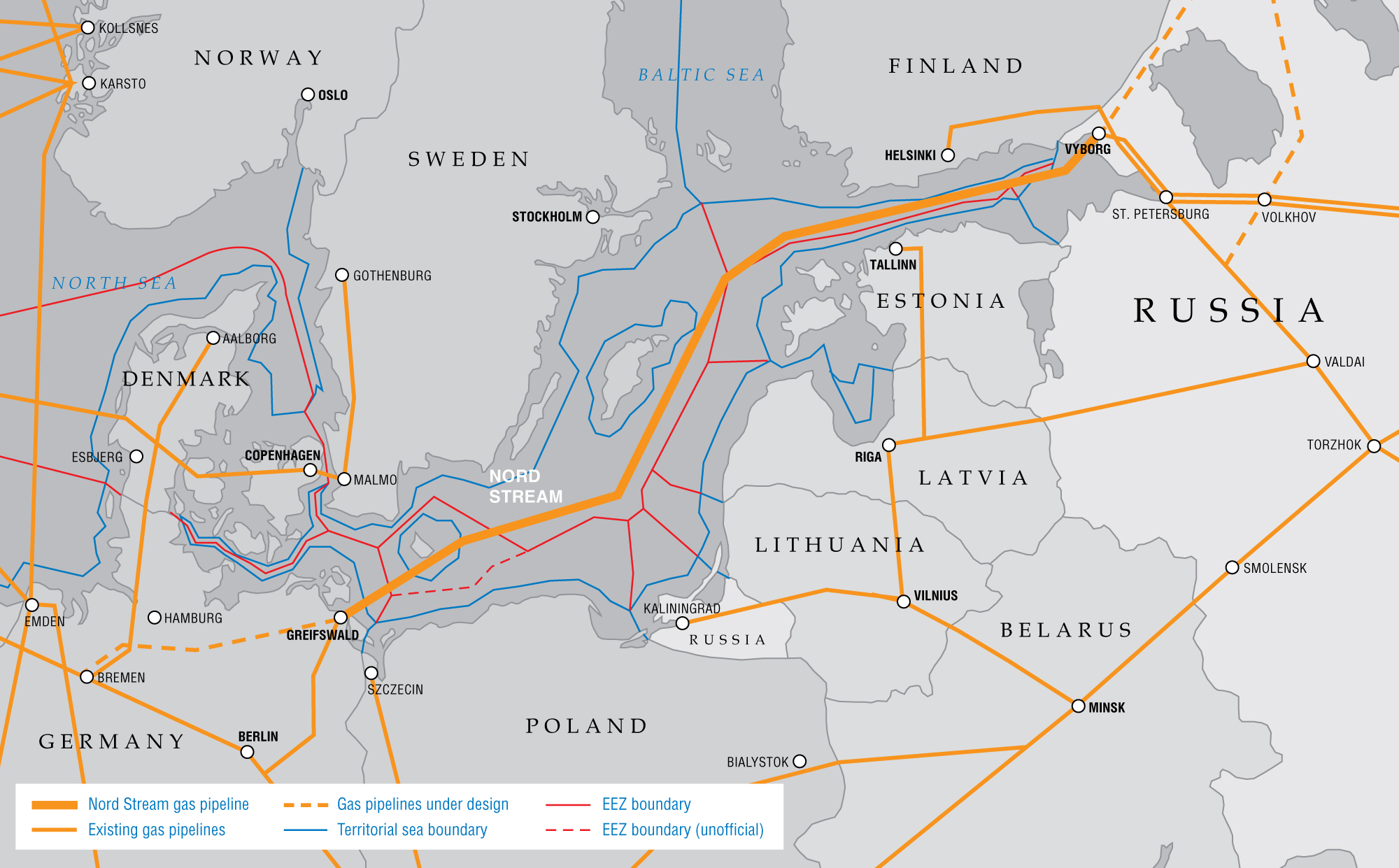
This time, however, it may be that Russia has learned, as Margaret Thatcher did, that timing is critical in this type of situation. Instead of waiting to November to call in the bill, Gazprom has presented it in June, when European demand for natural gas is lower. In addition the Nord-Stream gas pipeline is in place. This carries roughly 2 trillion cu. ft. a year of natural gas 760 miles into Germany, without passing through Ukraine. The twin pipes were completed and on line by October 2012.
Figure 1. Nord-Stream (Baltic Sea pipeline) bypassing Ukraine with 55 billion cu m of natural gas a year, (Daily Mail), out of a total sale of 262 billion cu m.(Spiegel)Note a second major pipeline from Yamal goes through Poland.
And while there has been talk about bringing in natural gas through Nabucco, that has slowly faded in the face of reality. Gazprom (as Brenda Shaffer has noted) has done remarkably well in gaining control of the different feeds and pipelines that come out of the East and head west into Europe. For example:
So Gazprom can now wait while Ukraine exhausts its own reserves. It is reported to have some 13.5 billion cu m on hand, but it needs to have 18-20 billion at the start of the winter, if it is to get through. By stopping the flow now, Russia is having Ukraine burn those reserves between now and winter, while keeping the nations further west supplied. This means that the pressure will become that much more intense on Ukraine as winter starts to approach, and there is no alternate source of supply.
Gazprom has not hesitated to profit from this in the past, and is already in a position to demand whatever price it sees fit.
Two years later there was a relatively similar series of events, with an overtime ban, followed by a three-day workweek as power cuts and blackouts developed, but this time Edward Heath also called a General Election, assuming he had the national sympathy. He was wrong, he lost.
These lessons were not lost on Margaret Thatcher, who had noted that it was not smart to offend the miners when the nation still relied on coal for much of its power, and when, in the winter, there was not a lot of coal in reserve at the power stations (because of the preceding overtime bans leading into winter). Thus, in 1984 when she, in turn, had to face the wrath of the National Union of Mineworkers (NUM), she had made sure that the situation was much different. Prior to the strike she had arranged for coal stockpiles to be built up over a period of three years. In addition the strike began on March 5th. It started because of the Coal Board decision to close 20 mines (since the earlier strike the number of miners had already fallen from 250,000 to 187,000 and the closures would cut another 20,000 from that number). It crumbled a year later, with a vote to return to work on March 3, 1985. The mining industry never recovered, and by the turn of the century the NUM was down to around 5,000 members.
I was reminded of those days by the latest clash between Gazprom and the Ukrainian government. In the past, when the Russians demanded that Ukraine pay its gas bill, the timing usually took place at the beginning or in the heart of winter. The problem that this gave the Russians was that they were supplying Western Europe through Ukraine, and any shut-off in the supply of natural gas to Ukraine had immediate consequences in Europe, which has become increasingly dependant on that gas. The result of the timing of the disputes was, therefore, generation of considerable diplomatic pressure leading to a relatively rapid resolution, without Russia getting all the deals that it wanted.
This time, however, it may be that Russia has learned, as Margaret Thatcher did, that timing is critical in this type of situation. Instead of waiting to November to call in the bill, Gazprom has presented it in June, when European demand for natural gas is lower. In addition the Nord-Stream gas pipeline is in place. This carries roughly 2 trillion cu. ft. a year of natural gas 760 miles into Germany, without passing through Ukraine. The twin pipes were completed and on line by October 2012.
Figure 1. Nord-Stream (Baltic Sea pipeline) bypassing Ukraine with 55 billion cu m of natural gas a year, (Daily Mail), out of a total sale of 262 billion cu m.(Spiegel)Note a second major pipeline from Yamal goes through Poland.
And while there has been talk about bringing in natural gas through Nabucco, that has slowly faded in the face of reality. Gazprom (as Brenda Shaffer has noted) has done remarkably well in gaining control of the different feeds and pipelines that come out of the East and head west into Europe. For example:
Moscow has taken steps to block the entrance of Iran into European gas markets; in 2006, the Russian company Gazprom bought a pipeline from Iran to Armenia and limited its size to ensure that it could be not be used to carry Iranian gas into Europe.Consistently supplies have been confined to pipes that are under Russian control. It has a percentage of the Interconnector that carries natural gas into the UK and there has been little regard paid as it stepped in and took interests in other national pipeline companies across Europe.
So Gazprom can now wait while Ukraine exhausts its own reserves. It is reported to have some 13.5 billion cu m on hand, but it needs to have 18-20 billion at the start of the winter, if it is to get through. By stopping the flow now, Russia is having Ukraine burn those reserves between now and winter, while keeping the nations further west supplied. This means that the pressure will become that much more intense on Ukraine as winter starts to approach, and there is no alternate source of supply.
Gazprom has not hesitated to profit from this in the past, and is already in a position to demand whatever price it sees fit.
Ukrainian and Russian officials have been fighting about gas pricing since Yanukovych was ousted. After Russia annexed the Crimean Peninsula, it hiked gas prices for Ukraine 81 percent, from $269 per 1,000 cubic meters of gas to $485. That price was the highest in Europe, and Ukrainian officials refused to pay, calling it politically-motivated retaliation.Don’t hold your breath waiting for this to be resolved.
Gazprom has since lowered its price demand to $385, broadly in line with prices for other European countries. Ukrainian officials have sought to pay less and have said the way Russia was structuring the deal meant they would remain vulnerable to price hikes if they did anything to displease the Kremlin.
“Any price they offer is in the form of a discount that can be undone at any time,” said Pierre Noel, an energy security expert at the International Institute for Strategic Studies.
Read more!
Labels:
1974,
1984,
Edward Heath,
Gazprom,
Margaret Thatcher,
miners' strike,
Nabucco,
Natural gas,
Nord Stream,
power costs,
Russia,
UK,
Ukraine,
Yamal
Monday, May 26, 2014
Tech Talk - China, Russia and East Siberian natural gas
The recent agreement between Russia and China for the sale of some 38 billion cu m of natural gas a year for 30 years, at a reported price of $400 billion ends a long-going negotiation between the two countries over the price of that supply. (Which works out at roughly $10 a thousand cubic feet, just over double current US prices). The price apparently includes some $25 billion to help with construction of the pipelines that will start feeding gas into the Chinese networks within four years. It is less than the price of LNG in the Pacific, and thus will likely lead to market adjustments for that product.
Figure 1. Potential interconnections to bring Russian gas into China (Washington Post )
It is equally of interest to see where the other ends of the potential pipelines lie, since this locates the natural gas fields that will be used to provide the supply. Looking at the distribution of pipelines and fields, the current preponderance of connections into Europe is hard to miss, at the same time as is the large gap in development in the Eastern side of the country.
Figure 2. Natural gas basins in Russia (Oil Peak )
Thus while the potential connection from Urumqi to Gorno-Altaisk allows the Chinese pipeline into a feed from the network that supplies Europe, that market is not going to go away. Yet the two towns are just 560 miles apart and the connection has been known as the Altai project, or Western connection, since it was first planned over 10 years ago, extending a new pipe up towards Yamal and the basins that feed Europe.
Figure 3. The Altai pipeline project (Gazprom )
Developments that reach up into Eastern Siberia, above Lake Baykal and Mongolia into the fields of Kovyktinskoe and Chayandinskoye through the “Power of Siberia” pipeline will allow gas from those fields to also feed Western China.
Figure 4. The connecting fields and pipelines for natural gas from Eastern Siberia (Gazprom )
The gas fields will feed into gas production facilities in Irkutsk and Yakutsk with oil production scheduled to start from Chayandinskoye this year, and natural gas production to follow by 2017. The field is expected to yield 25 billion cu m of natural gas and 1.5 million tons of oil a year at full production, and is estimated to hold 1.2 trillion cu m of natural gas. Kovyktinskoe was licensed to Gazprom in 2011 for exploration and production and is estimated to hold natural gas reserves of 1.5 trillion cu m. Smaller local fields at Bratsk and Chikanskoye have been developed since 2007, with the gas being used locally to supply the region.
Figure 5. Developing natural gas fields in Eastern Siberia (Gazprom )
These two fields alone therefore seem capable of meeting the current sales volume that is to be needed for China, given that the time to delivery is some four years, and both fields are anticipated to be on line, with the gas production facilities, within three years.
Pipeline construction is already underway. The “Power of Siberia” will initially connect into Vladivostock, taking the natural gas to the higher demand industrial Eastern China, but likely the additional funding that China is now providing will also help the Westward expansion to the Western gateway.
Figure 6. The Power of Siberia natural gas pipeline as planned. (Gazprom )
The natural gas pipeline is being routed along with the East Siberia – Pacific Ocean (ESPO) oil pipeline to simplify logistics, the second section of which was opened by President Putin at the end of 2012, a year ahead of schedule. The two sections will have a capacity of handling 80 million tons of oil a year (roughly 1.6 mbd) as supplies increase from the different fields to achieve that target. (The largest current contributor is the Vankor field producing slightly more than 500 kbd).
Yorubcheno-Tokhomskoye is expected to come on line in 2017, reaching full production of around 100 kbd by 2019, as the field develops the natural gas associated with the field will also be brought into the network.
There is anticipated to somewhere around 60 trillion cu. m of natural gas in Eastern Siberia (about 23% of the Russian reserve in 2009) and as this is only now being developed and the infrastructure put in place, it can be expected to last for some considerable time.
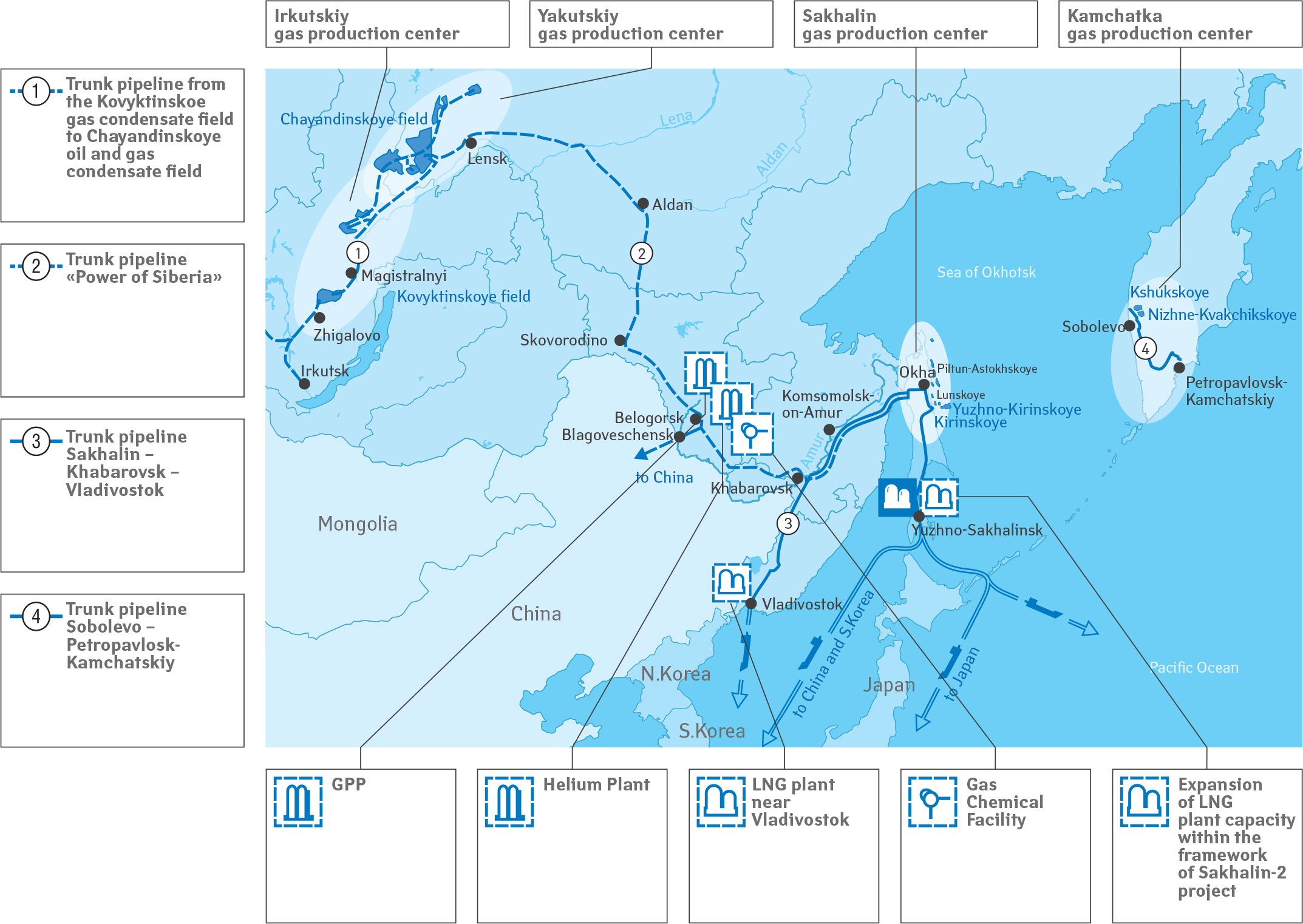
So far I have not mentioned the reserves that are now on line at Sakhalin Island. Gazprom built the Sakhalin–Khabarovsk–Vladivostok pipeline in 2011and this carries the natural gas down to Vladivostok, and thence largely into China and other Asian markets. The island also has an LNG facility which supplies that fuel to Japan and North Korea.
Figure 7. Natural gas pipeline from Sakhalin Island (Gazprom )
The pipeline is intended to carry up to 30 bcm per year of natural gas from Sakhalin fields, particularly those offshore.
Given the size of the fields that are thus available to Russia and that will feed into pipelines that will be in place at the time called for in the new agreement it is clear that the new market will not likely require any input from the fields that are currently supplying Europe and other markets.
As industries switch out of coal and into natural gas, however, a change driven partly by environmental and partly by cost considerations, so the demand for natural gas may potentially increase significantly. (As a minor indication of this the primary fossil fuel at the university in town is now natural gas and the coal fired plant just closed). There is less capacity to store natural gas than other fuels, which can raise some concerns over available supply in particularly cold days of the year. Such factors may change the situation somewhat, but realistically I would suspect that natural gas will play an increasing role in global fuel supplies for at least another decade.
Figure 1. Potential interconnections to bring Russian gas into China (Washington Post )
It is equally of interest to see where the other ends of the potential pipelines lie, since this locates the natural gas fields that will be used to provide the supply. Looking at the distribution of pipelines and fields, the current preponderance of connections into Europe is hard to miss, at the same time as is the large gap in development in the Eastern side of the country.
Figure 2. Natural gas basins in Russia (Oil Peak )
Thus while the potential connection from Urumqi to Gorno-Altaisk allows the Chinese pipeline into a feed from the network that supplies Europe, that market is not going to go away. Yet the two towns are just 560 miles apart and the connection has been known as the Altai project, or Western connection, since it was first planned over 10 years ago, extending a new pipe up towards Yamal and the basins that feed Europe.
Figure 3. The Altai pipeline project (Gazprom )
Developments that reach up into Eastern Siberia, above Lake Baykal and Mongolia into the fields of Kovyktinskoe and Chayandinskoye through the “Power of Siberia” pipeline will allow gas from those fields to also feed Western China.
Figure 4. The connecting fields and pipelines for natural gas from Eastern Siberia (Gazprom )
The gas fields will feed into gas production facilities in Irkutsk and Yakutsk with oil production scheduled to start from Chayandinskoye this year, and natural gas production to follow by 2017. The field is expected to yield 25 billion cu m of natural gas and 1.5 million tons of oil a year at full production, and is estimated to hold 1.2 trillion cu m of natural gas. Kovyktinskoe was licensed to Gazprom in 2011 for exploration and production and is estimated to hold natural gas reserves of 1.5 trillion cu m. Smaller local fields at Bratsk and Chikanskoye have been developed since 2007, with the gas being used locally to supply the region.
Figure 5. Developing natural gas fields in Eastern Siberia (Gazprom )
These two fields alone therefore seem capable of meeting the current sales volume that is to be needed for China, given that the time to delivery is some four years, and both fields are anticipated to be on line, with the gas production facilities, within three years.
Pipeline construction is already underway. The “Power of Siberia” will initially connect into Vladivostock, taking the natural gas to the higher demand industrial Eastern China, but likely the additional funding that China is now providing will also help the Westward expansion to the Western gateway.
Figure 6. The Power of Siberia natural gas pipeline as planned. (Gazprom )
The natural gas pipeline is being routed along with the East Siberia – Pacific Ocean (ESPO) oil pipeline to simplify logistics, the second section of which was opened by President Putin at the end of 2012, a year ahead of schedule. The two sections will have a capacity of handling 80 million tons of oil a year (roughly 1.6 mbd) as supplies increase from the different fields to achieve that target. (The largest current contributor is the Vankor field producing slightly more than 500 kbd).
Yorubcheno-Tokhomskoye is expected to come on line in 2017, reaching full production of around 100 kbd by 2019, as the field develops the natural gas associated with the field will also be brought into the network.
There is anticipated to somewhere around 60 trillion cu. m of natural gas in Eastern Siberia (about 23% of the Russian reserve in 2009) and as this is only now being developed and the infrastructure put in place, it can be expected to last for some considerable time.
So far I have not mentioned the reserves that are now on line at Sakhalin Island. Gazprom built the Sakhalin–Khabarovsk–Vladivostok pipeline in 2011and this carries the natural gas down to Vladivostok, and thence largely into China and other Asian markets. The island also has an LNG facility which supplies that fuel to Japan and North Korea.
Figure 7. Natural gas pipeline from Sakhalin Island (Gazprom )
The pipeline is intended to carry up to 30 bcm per year of natural gas from Sakhalin fields, particularly those offshore.
Given the size of the fields that are thus available to Russia and that will feed into pipelines that will be in place at the time called for in the new agreement it is clear that the new market will not likely require any input from the fields that are currently supplying Europe and other markets.
As industries switch out of coal and into natural gas, however, a change driven partly by environmental and partly by cost considerations, so the demand for natural gas may potentially increase significantly. (As a minor indication of this the primary fossil fuel at the university in town is now natural gas and the coal fired plant just closed). There is less capacity to store natural gas than other fuels, which can raise some concerns over available supply in particularly cold days of the year. Such factors may change the situation somewhat, but realistically I would suspect that natural gas will play an increasing role in global fuel supplies for at least another decade.
Read more!
Monday, October 7, 2013
Tech Talk - complacency does not see the slow erosion of supply
There has been some talk this week over the volumes of oil and natural gas that is being produced in America, with the WSJ, for example, noting that the US is on track to surpass the volumes produced by Russia. Given that Russia is the leading producer of crude oil at the moment, in August OPEC noted that their production was running at 10.51 mbd, in which month they noted that Saudi Arabia was producing 9.96 mbd. OPEC carefully give two numbers for US oil production, total production is given, for August, as 10.88 mbd, but of this only around 7.2 mbd is crude oil. (While the 9.96 mbd of Saudi production is their crude output, and they also produce some NGL’s from their gas production, as well as seeing some refineries gains as their processing capacity increases). However the WSJ notes that the grand total for the US also contains oil, natural gas and other related fuels to reach the 22 mbdoe, relative to the 21.8 mbdoe that Russia is estimated to be producing.
While the overall impression that is being bandied about, that the US will become energy independent, has been shot down more than enough times (see for example Chris Nelder, last year) there remains, however, a broad complacency that, with increasing production from tight rock, in both oil and natural gas, there is no reason to have concern over future supplies.
If one looks at the make-up of the US supply of energy, natural gas has been steadily increasing its share, as has crude oil, to the cost of the coal market.
Composition of the US energy supply sources, supply shown in quadrillion Btu’s (EIA )
The break-out for June gives more explicit figures:
Figure 2. US Energy supply by Source for June, 2013.
The gap between supply and demand for petroleum products (particularly for transportation) can then be assessed by looking at the consumption side of the equation.
Figure 3. US energy consumption by sector (in quads, EIA )
The bull stirring in our China shop (pottery variety) continues to be the levels of petroleum that we need, and that is unlikely to decline all that much in the intermediate term.
The problem that the world faces is that the balance between available supply of crude oil and the demands for it now lie within very narrow range of production. It is still not that much more of a concern that additional oil this month comes from the US, rather than the Kingdom of Saudi Arabia (KSA) since, give or take a few weeks, supplies can still be purchased from different sources and rapidly shipped by tanker to where it is needed. But if the US were to be asked to meet an additional production need of 1 mbd over existing supply, because of even a short-term failure of supply from another country, it would not be able to meet that demand. (Short, that is, of draining the strategic supply).
Most of the other countries in the world are in a similar predicament. And that includes Russia. Russia gets more than half of its budget from oil and gas revenues, and with their economy flattening out it needs more revenue. It would help considerably if that help came in increasing volumes of oil and gas for export. But the remaining oil and gas deposits are being found in more remote parts of the country, where the expense of not only drilling the wells, but also of getting the product to market, requires a very large capital and time investment. Thus, while it would be nice if they could, they can’t be expected to meet an upsurge in external demand by turning the odd tap on an oilfield to produce additional supply.
And if one goes around the world, as I have been noting recently, outside of the KSA, there is virtually no-one else who can relatively rapidly respond to bring the global market into balance. But even the KSA capabilities to meet that demand are limited. I would suspect that they would get uncomfortable if they had to produce over 10 mbd for any length of time.
And this is where the kicker in the story lies, because, if that is the case, and conflicts around the globe continue to nibble away at the production capabilities in places such as Sudan, Iraq, Libya and their neighbors, then the additional global reserve between available supply and demand is going to increasingly tighten. It is a relatively imperceptible change every month. A little less oil flows down the Alaskan pipeline (439,686 bd in August against the average ytd of 528,572 bd); South Sudan is running about 100 kbd behind the figures for January 2012; Libya continues to suffer from the actions of the militia that control two of their oilfields to the point that production is now around 1 mbd below normal production for the country. There are some indications that the situation is now improving, with flows returning to around 700 kbd but this is still only half of the original volumes. And while the problem is political, rather than technical, the optimism of the Libyan oil minister who projects a return to production levels of 1.6 mbd is perhaps difficult to justify realistically.
Figure 4. Recent changes in Libyan oil production (WSJ )
Libya is, perhaps, with Iran, an exemplar of the nations with the potential to produce more, but who are constrained by immediate political problems. Iraq, who might otherwise also be in the group, is challenged also to develop the fields that are required for it to bring in the additional volumes of oil to the world market.
If these countries remain at their current levels of production, and there is little to indicate any positive change in the near term, then the narrow band over which KSA production fluctuates to keep the balance may not be enough for much longer.
Complacency that there is currently enough oil and natural gas to go around, at current levels of price, lets the market focus on other, more immediately pressing issues. But the slow erosion of the remaining global production surplus continues, and accumulates, and the time when this becomes evident may only be when that reserve no longer exists. And that may not be nearly as far into the future as most seem to expect.
While the overall impression that is being bandied about, that the US will become energy independent, has been shot down more than enough times (see for example Chris Nelder, last year) there remains, however, a broad complacency that, with increasing production from tight rock, in both oil and natural gas, there is no reason to have concern over future supplies.
If one looks at the make-up of the US supply of energy, natural gas has been steadily increasing its share, as has crude oil, to the cost of the coal market.
Composition of the US energy supply sources, supply shown in quadrillion Btu’s (EIA )
The break-out for June gives more explicit figures:
Figure 2. US Energy supply by Source for June, 2013.
The gap between supply and demand for petroleum products (particularly for transportation) can then be assessed by looking at the consumption side of the equation.
Figure 3. US energy consumption by sector (in quads, EIA )
The bull stirring in our China shop (pottery variety) continues to be the levels of petroleum that we need, and that is unlikely to decline all that much in the intermediate term.
The problem that the world faces is that the balance between available supply of crude oil and the demands for it now lie within very narrow range of production. It is still not that much more of a concern that additional oil this month comes from the US, rather than the Kingdom of Saudi Arabia (KSA) since, give or take a few weeks, supplies can still be purchased from different sources and rapidly shipped by tanker to where it is needed. But if the US were to be asked to meet an additional production need of 1 mbd over existing supply, because of even a short-term failure of supply from another country, it would not be able to meet that demand. (Short, that is, of draining the strategic supply).
Most of the other countries in the world are in a similar predicament. And that includes Russia. Russia gets more than half of its budget from oil and gas revenues, and with their economy flattening out it needs more revenue. It would help considerably if that help came in increasing volumes of oil and gas for export. But the remaining oil and gas deposits are being found in more remote parts of the country, where the expense of not only drilling the wells, but also of getting the product to market, requires a very large capital and time investment. Thus, while it would be nice if they could, they can’t be expected to meet an upsurge in external demand by turning the odd tap on an oilfield to produce additional supply.
And if one goes around the world, as I have been noting recently, outside of the KSA, there is virtually no-one else who can relatively rapidly respond to bring the global market into balance. But even the KSA capabilities to meet that demand are limited. I would suspect that they would get uncomfortable if they had to produce over 10 mbd for any length of time.
And this is where the kicker in the story lies, because, if that is the case, and conflicts around the globe continue to nibble away at the production capabilities in places such as Sudan, Iraq, Libya and their neighbors, then the additional global reserve between available supply and demand is going to increasingly tighten. It is a relatively imperceptible change every month. A little less oil flows down the Alaskan pipeline (439,686 bd in August against the average ytd of 528,572 bd); South Sudan is running about 100 kbd behind the figures for January 2012; Libya continues to suffer from the actions of the militia that control two of their oilfields to the point that production is now around 1 mbd below normal production for the country. There are some indications that the situation is now improving, with flows returning to around 700 kbd but this is still only half of the original volumes. And while the problem is political, rather than technical, the optimism of the Libyan oil minister who projects a return to production levels of 1.6 mbd is perhaps difficult to justify realistically.
Figure 4. Recent changes in Libyan oil production (WSJ )
Libya is, perhaps, with Iran, an exemplar of the nations with the potential to produce more, but who are constrained by immediate political problems. Iraq, who might otherwise also be in the group, is challenged also to develop the fields that are required for it to bring in the additional volumes of oil to the world market.
If these countries remain at their current levels of production, and there is little to indicate any positive change in the near term, then the narrow band over which KSA production fluctuates to keep the balance may not be enough for much longer.
Complacency that there is currently enough oil and natural gas to go around, at current levels of price, lets the market focus on other, more immediately pressing issues. But the slow erosion of the remaining global production surplus continues, and accumulates, and the time when this becomes evident may only be when that reserve no longer exists. And that may not be nearly as far into the future as most seem to expect.
Read more!
Labels:
Alaska pipeline,
crude oil,
Iran,
Iraq,
KSA,
Libya,
Russia,
South Sudan,
US energy
Sunday, September 29, 2013
Tech Talk - Iran and a slight cough toward CNN
There has been considerable comment this week over the telephone call between President Obama and the President Rouhani of Iran. Certainly the election of a new President in Iran gives the opportunity for a fresh start, particularly given the belligerent attitudes of his predecessor. However the cynical side of me does wonder if there is more driving this than simply the change of personalities.
There are two points that need to be considered, as a possible new relationship between the two countries might slowly coalesce out of the mists of diplomatic effort. Firstly the major driver seen in moving Iran toward a more positive position is said to be the increasing bite that sanctions, and particularly oil sanctions, are having on their economy. As sanctions have tightened, so Iranian oil production has fallen, with reports suggesting that oil exports have fallen from 2.2 mbd to May’s value of 0.7 mbd. The reduction in income that this has had on the Iranian economy is significant, with the currency officially devalued to half, though the effect has been more of an 80% fall from peak, as inflation has reached 42%.
Easing sanctions to allow more oil flow would significantly improve the situation, although there is concern, expressed for example at CNN, that the increase in oil flow would weaken the positions of the Kingdom of Saudi Arabia and Iraq. They suggest that the advent of Iranian oil (presuming that they can bring 1.5 mbd to the market relatively quickly) is foreseen as having a potential impact on the United States in that it may, at least transiently, produce a glut in the market. That would drive down prices, until such time as KSA could drop production and bring the supply and demand back into balance, raising prices back to around $100.
In a peaceful world such a scenario might have some viability, but consider what is really happening in the world of global supply. Instead of the KSA moving toward a supply of 12.5 mbd (which was only a capacity number in the first place) they have backed this down to 12 mbd and have talked recently as lowering that number further as they hire more and more rigs to help sustain existing production at just under 10 mbd. Iraq, which was promising to rapidly increase production toward a target of 11 mbd, is instead considered by the IEA likely to reach no more than 6 mbd by 2020. Further with the ongoing increase in violence in the country being able to sustain current production at around 3 mbd and increase it beyond 3.5 mbd as the Majnoon field comes on line. However Shell’s target for the field is already below initial estimates for this year, and it is discussing lowering the 2017 target from 1.8 mbd to 1.0 mbd. There has recently been an outbreak of violence in Kurdistan, which might portend that even in this relatively stable part of the country oil production and security is becoming a greater target.
These events suggest that future increases in production from around the region are not as assured as one might hope. At the same time, while there are those who continue to expect the United States to become oil-independent in the next few years, the reality is somewhat different, and further increases in production much above current figures become more difficult to justify. If Russia, similarly, is unlikely to increase production – which it is not – then the questions that should be asked are rather where is the world going to get the additional 1 mbd that it requires every year to balance increasing demand against supply.
Over the course of this year Saudi Arabia has had to increase production from 9.1 to 9.96 mbd to keep supply in balance, and prices stable. At the same time production from Libya, which has run at around 1.6 mbd had fallen to 150 kbd at the beginning of this month. Hopes that this could be increased back up to 700 kbd rely on tribal militias that control strategic parts of the country, and their long term co-operation is dubious, while the fields and pipelines in the east remain shut down. It seems reasonable to anticipate that there will be at least a million barrels a day of Libyan production held off the market for some time.
If one goes around the world one sees that Brazilian promises of production increase are behind schedule, as are promises of production increases from countries such as Veneuela. And suddenly one is left with not much in the way of places left to balance off the current declines in supply and increases in demand.
At this point that 1.5 mbd of potential supply from Iran starts to look a little more promising as an answer. It might allow KSA to ease back on production levels that might be starting to impose a little strain on their infrastructure. It would help to provide balance if production increases around the world fail to show on time. One should recognize that negotiations to bring Iran back into the fold are going to take at least a year or two before it is realistic to anticipate full return to supply, but even the easing of sanctions a little might cause the flow to China, India and Asia to increase to meet the burgeoning demands that they have, and oil is still to some degree fungible.
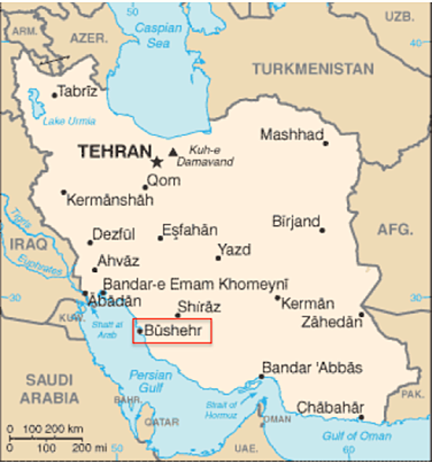
But in that regard, Iran has also just recently reached 100% output from the first of the nuclear power stations at Bushehr and is about to start construction of the second unit. Nuclear fuel will be provided by Russia, and spent fuel returned to Russia. It is a 1,000-megawatt unit, and since the unit was built under supervision by the International Atomic Energy Agency it is not subject to sanctions.
Figure 1. Bushehr Nuclear Plant
If the protocols that worked to make this happen can be expanded, then it is possible that, though negotiation, the tension in the region can be eased. This could well have benefits all around, most particularly for ensuring that, for at least a sadly few more years, there will be enough oil on the market to meet demand at a reasonable price.
Figure 2. Location of the Bushehr Plant
There are two points that need to be considered, as a possible new relationship between the two countries might slowly coalesce out of the mists of diplomatic effort. Firstly the major driver seen in moving Iran toward a more positive position is said to be the increasing bite that sanctions, and particularly oil sanctions, are having on their economy. As sanctions have tightened, so Iranian oil production has fallen, with reports suggesting that oil exports have fallen from 2.2 mbd to May’s value of 0.7 mbd. The reduction in income that this has had on the Iranian economy is significant, with the currency officially devalued to half, though the effect has been more of an 80% fall from peak, as inflation has reached 42%.
Easing sanctions to allow more oil flow would significantly improve the situation, although there is concern, expressed for example at CNN, that the increase in oil flow would weaken the positions of the Kingdom of Saudi Arabia and Iraq. They suggest that the advent of Iranian oil (presuming that they can bring 1.5 mbd to the market relatively quickly) is foreseen as having a potential impact on the United States in that it may, at least transiently, produce a glut in the market. That would drive down prices, until such time as KSA could drop production and bring the supply and demand back into balance, raising prices back to around $100.
In a peaceful world such a scenario might have some viability, but consider what is really happening in the world of global supply. Instead of the KSA moving toward a supply of 12.5 mbd (which was only a capacity number in the first place) they have backed this down to 12 mbd and have talked recently as lowering that number further as they hire more and more rigs to help sustain existing production at just under 10 mbd. Iraq, which was promising to rapidly increase production toward a target of 11 mbd, is instead considered by the IEA likely to reach no more than 6 mbd by 2020. Further with the ongoing increase in violence in the country being able to sustain current production at around 3 mbd and increase it beyond 3.5 mbd as the Majnoon field comes on line. However Shell’s target for the field is already below initial estimates for this year, and it is discussing lowering the 2017 target from 1.8 mbd to 1.0 mbd. There has recently been an outbreak of violence in Kurdistan, which might portend that even in this relatively stable part of the country oil production and security is becoming a greater target.
These events suggest that future increases in production from around the region are not as assured as one might hope. At the same time, while there are those who continue to expect the United States to become oil-independent in the next few years, the reality is somewhat different, and further increases in production much above current figures become more difficult to justify. If Russia, similarly, is unlikely to increase production – which it is not – then the questions that should be asked are rather where is the world going to get the additional 1 mbd that it requires every year to balance increasing demand against supply.
Over the course of this year Saudi Arabia has had to increase production from 9.1 to 9.96 mbd to keep supply in balance, and prices stable. At the same time production from Libya, which has run at around 1.6 mbd had fallen to 150 kbd at the beginning of this month. Hopes that this could be increased back up to 700 kbd rely on tribal militias that control strategic parts of the country, and their long term co-operation is dubious, while the fields and pipelines in the east remain shut down. It seems reasonable to anticipate that there will be at least a million barrels a day of Libyan production held off the market for some time.
If one goes around the world one sees that Brazilian promises of production increase are behind schedule, as are promises of production increases from countries such as Veneuela. And suddenly one is left with not much in the way of places left to balance off the current declines in supply and increases in demand.
At this point that 1.5 mbd of potential supply from Iran starts to look a little more promising as an answer. It might allow KSA to ease back on production levels that might be starting to impose a little strain on their infrastructure. It would help to provide balance if production increases around the world fail to show on time. One should recognize that negotiations to bring Iran back into the fold are going to take at least a year or two before it is realistic to anticipate full return to supply, but even the easing of sanctions a little might cause the flow to China, India and Asia to increase to meet the burgeoning demands that they have, and oil is still to some degree fungible.
But in that regard, Iran has also just recently reached 100% output from the first of the nuclear power stations at Bushehr and is about to start construction of the second unit. Nuclear fuel will be provided by Russia, and spent fuel returned to Russia. It is a 1,000-megawatt unit, and since the unit was built under supervision by the International Atomic Energy Agency it is not subject to sanctions.
Figure 1. Bushehr Nuclear Plant
If the protocols that worked to make this happen can be expanded, then it is possible that, though negotiation, the tension in the region can be eased. This could well have benefits all around, most particularly for ensuring that, for at least a sadly few more years, there will be enough oil on the market to meet demand at a reasonable price.
Figure 2. Location of the Bushehr Plant
Read more!
Labels:
Brazil,
Bushehr nuclear plant,
China,
CNN,
crude oil production,
Iran,
Iraq,
KSA,
Libya,
Majnoon,
oil demand,
Russia
Monday, September 9, 2013
Gas shortage in Murmansk
Now that the Drumbeat has disappeared with The Oil Drum, I must needs seek a little more diligently to find the stories that are of interest. One that seems to have slipped the general press is the shortage of gas in Murmansk.
The shortage was sufficiently severe that the "eternal flame" at the war memorial was allowed to go out, as domestic supplies ran short. The region has pinned great hopes on the development of the Shtokman field, but this has been postponed.
The situation is sufficiently bad that trains are being used to bring in natural gas from St. Petersburg, and while a solution has been promised for tomorrow (Sept 10th) there is no explanation as yet as to the answer forthcoming. I'll update the story s I find out more.
The shortage was sufficiently severe that the "eternal flame" at the war memorial was allowed to go out, as domestic supplies ran short. The region has pinned great hopes on the development of the Shtokman field, but this has been postponed.
The situation is sufficiently bad that trains are being used to bring in natural gas from St. Petersburg, and while a solution has been promised for tomorrow (Sept 10th) there is no explanation as yet as to the answer forthcoming. I'll update the story s I find out more.
Read more!
Labels:
Murmansk,
natural gas shortage,
rail transportation,
Russia,
Shtokman
Sunday, August 18, 2013
Tech Talk - Where to look for more oil this year.
The news that Saudi Arabia is planning to employ 200 drilling rigs next year (up from 20 back in 2005) suggests that there is a recognition that future reserves may not measure up to the planned volumes needed. Plans now include exploration of the shale deposits in the country, looking primarily for natural gas. There are estimates that this resource could run as high as 600 trillion cubic ft. Current plans are to drill seven exploratory wells in the Red Sea, off Tabuk.
Figure 1. Location of Tabuk in the Kingdom of Saudi Arabia (WikiMedia )
This is across the country from the major oil fields currently in use, which lie more along the Persian Gulf coast, centered perhaps around Damman. It therefore suggests that they are looking for extensions of the Israeli and Egyptian fields into northern KSA. (Minister Al-Naimi said that they still “had to find them.”)
In discussing the venture Saudi Minister of Petroleum and Mineral Resources Ali Al-Naimi also noted that, choosing to look for – and presumably finding - natural gas, would take the pressure off the country to maintain its oil reserve.
Now over the years KSA has lowered the volume it has projected that it can produce from 12.5 mbd to 12 mbd, and this is, perhaps, an early indication that they intend (whether by policy or natural reserve availability) to lower that maximum further.
This has to be of at least a little concern, since the number of places with significant flexibility to increase production are getting closer to zero every year. The gains in global production that are foreseen by OPEC in the next year, for example come in dribs and drabs.
OPEC notes that in May the 8,915 producing wells in North Dakota collectively produced over 800 kbd. (The Department of Mineral Resources reports 821 kbd in June, over the 811 kbd in May with well numbers of 8,932 in May and 9,071 in June. Production per well is thus running an average of 90 barrels a day, with a well cost of $9 million.) There are 187 rigs plus/minus working and this is still enough to keep production rising at a rate of 1.3% per month. One of the maps I find interesting is this, from the Department.
Figure 3. Location and production values for wells in North Dakota (Department of Mineral Resources )
It is this illustration of the relatively heavy drilling already in the “sweet spots” and the poorer performance in the less well drilled regions that gives me concern for the longer term prospects for the formations. And as an aside note that crude from Alaska is declining, July output was 498 kbd against the year-to-date average of 542 kbd. The EIA is noting that, since there aren’t any major oil pipelines running into California from the East, that there is an increase in rail traffic to make up the difference. The EIA is suggesting that the traffic is already at a level of around 100 kbd.
And this in happening in the most promising region to increase production (though it includes Canada, for which OPEC projects a growth over the year of around 40 kbd, which is set against Mexican production, for which OPEC sees a decline of around 60 kbd).
Malaysia is projected to increase production by 50 kbd, from the Gumusut field. This is a Deepwater project, and one can get some estimate of the shape of the field from the well pattern. The production gain is viewed by OPEC as likely being the highest in the region.
Figure 4. Planned Well pattern for the GUMUSUT KAKAP project in Malaysia (Rawingbadi)
In Latin America Colombia is expected to increase production by 80 kbd, though the country is having some issues with pipe damage from terrorism. There have been more than 30 attacks this year. OPEC also looks for an increase in Brazilian production of 10 kbd over the year, this gain coming after some 14 months of decline, which drop hopefully will be recovered before the end of the year.
Oman will grow production by 20 kbd, but it is in Sudan and Southern Sudan that OPEC anticipates the greatest growth, of 90 kbd. However the two countries are not the best of friends, with oil from Southern Sudan having to ship by pipeline to Sudan, for shipment onwards. At present oil, at an average rate of 75 kbd is continuing to flow up the pipe, but Sudan continues to threaten to halt shipments, leading Southern Sudan, in turn, to plan to shut-in the wells. The OPEC projection seems to be best defined therefore as “iffy.”
OPEC expect Russia to increase production by 80 kbd in 2013, yet there is some caution in that estimate, with other numbers suggesting that Russia is reaching a modern peak in production. Kazakhstan is projected to increase production by 50 kbd (coming from the startup of Kashagan, now expected at the end of September). The 100 kbd production will more than offset declines in the rest of the country. And China may increase production over the year by 60 kbd.
I have listed the countries that OPEC anticipates will grow production by more than 10 kbd, and have not listed the many countries that will see production decline by more than that amount. It is remarkable that listing the increases in production outside of OPEC can be done with just a few paragraphs. And it is a little disturbing that the threats to pipeline security throw questions over the reliability of some of the numbers. And yet this only addresses the possible growth in production, declining producers would require a much longer list. Combined it becomes a little more difficult, as turmoil in MENA continues to grow, to remain optimistic over the OPEC projections.
Figure 1. Location of Tabuk in the Kingdom of Saudi Arabia (WikiMedia )
This is across the country from the major oil fields currently in use, which lie more along the Persian Gulf coast, centered perhaps around Damman. It therefore suggests that they are looking for extensions of the Israeli and Egyptian fields into northern KSA. (Minister Al-Naimi said that they still “had to find them.”)
In discussing the venture Saudi Minister of Petroleum and Mineral Resources Ali Al-Naimi also noted that, choosing to look for – and presumably finding - natural gas, would take the pressure off the country to maintain its oil reserve.
Al-Naimi said that prospects for global production of shale gas and oil – including in China, Ukraine, Poland and Saudi Arabia – were so promising that the Kingdom might not need to continue with its decades-long policy of maintaining an oil-output cushion for use in global supply disruptions. “It is not a question whether Saudi Arabia has spare (oil) capacity. It is a question of whether we need to spend billions maintaining it at all,” Al-Naimi said.
Now over the years KSA has lowered the volume it has projected that it can produce from 12.5 mbd to 12 mbd, and this is, perhaps, an early indication that they intend (whether by policy or natural reserve availability) to lower that maximum further.
This has to be of at least a little concern, since the number of places with significant flexibility to increase production are getting closer to zero every year. The gains in global production that are foreseen by OPEC in the next year, for example come in dribs and drabs.
OPEC notes that in May the 8,915 producing wells in North Dakota collectively produced over 800 kbd. (The Department of Mineral Resources reports 821 kbd in June, over the 811 kbd in May with well numbers of 8,932 in May and 9,071 in June. Production per well is thus running an average of 90 barrels a day, with a well cost of $9 million.) There are 187 rigs plus/minus working and this is still enough to keep production rising at a rate of 1.3% per month. One of the maps I find interesting is this, from the Department.
Figure 3. Location and production values for wells in North Dakota (Department of Mineral Resources )
It is this illustration of the relatively heavy drilling already in the “sweet spots” and the poorer performance in the less well drilled regions that gives me concern for the longer term prospects for the formations. And as an aside note that crude from Alaska is declining, July output was 498 kbd against the year-to-date average of 542 kbd. The EIA is noting that, since there aren’t any major oil pipelines running into California from the East, that there is an increase in rail traffic to make up the difference. The EIA is suggesting that the traffic is already at a level of around 100 kbd.
And this in happening in the most promising region to increase production (though it includes Canada, for which OPEC projects a growth over the year of around 40 kbd, which is set against Mexican production, for which OPEC sees a decline of around 60 kbd).
Malaysia is projected to increase production by 50 kbd, from the Gumusut field. This is a Deepwater project, and one can get some estimate of the shape of the field from the well pattern. The production gain is viewed by OPEC as likely being the highest in the region.
Figure 4. Planned Well pattern for the GUMUSUT KAKAP project in Malaysia (Rawingbadi)
In Latin America Colombia is expected to increase production by 80 kbd, though the country is having some issues with pipe damage from terrorism. There have been more than 30 attacks this year. OPEC also looks for an increase in Brazilian production of 10 kbd over the year, this gain coming after some 14 months of decline, which drop hopefully will be recovered before the end of the year.
Oman will grow production by 20 kbd, but it is in Sudan and Southern Sudan that OPEC anticipates the greatest growth, of 90 kbd. However the two countries are not the best of friends, with oil from Southern Sudan having to ship by pipeline to Sudan, for shipment onwards. At present oil, at an average rate of 75 kbd is continuing to flow up the pipe, but Sudan continues to threaten to halt shipments, leading Southern Sudan, in turn, to plan to shut-in the wells. The OPEC projection seems to be best defined therefore as “iffy.”
OPEC expect Russia to increase production by 80 kbd in 2013, yet there is some caution in that estimate, with other numbers suggesting that Russia is reaching a modern peak in production. Kazakhstan is projected to increase production by 50 kbd (coming from the startup of Kashagan, now expected at the end of September). The 100 kbd production will more than offset declines in the rest of the country. And China may increase production over the year by 60 kbd.
I have listed the countries that OPEC anticipates will grow production by more than 10 kbd, and have not listed the many countries that will see production decline by more than that amount. It is remarkable that listing the increases in production outside of OPEC can be done with just a few paragraphs. And it is a little disturbing that the threats to pipeline security throw questions over the reliability of some of the numbers. And yet this only addresses the possible growth in production, declining producers would require a much longer list. Combined it becomes a little more difficult, as turmoil in MENA continues to grow, to remain optimistic over the OPEC projections.
Read more!
Labels:
Alaska,
Bakken,
Colombia,
Kazakhstan,
Malaysia,
non-OPEC production,
North Dakota,
oil production,
Oman,
OPEC,
Russia,
Saudi Arabia,
South Sudan,
Sudan
Thursday, March 28, 2013
OGPSS - future natural gas supplies and Cyprus
This post began as a view on the developments in Cyprus, and I am grateful to Gail for the suggestion, and it is my fault that it morphed a little from that simple original objective.
One of the problems that one faces in marketing natural gas is that there is so much of it coming onto the market that it makes it difficult to set a price for future production. Even when the fields and reserves are estimated to be large, having some confidence in the price that the gas will bring helps provide confidence, in turn, with investors that there will be a positive return on the cost of bring that gas to the market. However, once that initial commitment is made to invest the money, then the need for a return often drives an expeditious program to bring in revenue, even if the market is already reasonably well supplied. Prices may then fall, and the investment becomes a losing one.
The current cold weather in the United Kingdom, and the threat of gas rationing has raised the price some 30% this month and the market appears lucrative. But the UK market, in the short term, can be rescued by 3 tankers of LNG from Qatar with more available if needed. (Provided it is ordered soon.) And then, though there remains a need to refill storage, the crisis will be over for now, and the price will likely fall back. (Although likely not completely since the UK is in process of shutting down coal-fired power stations to comply with EU edicts and natural gas is the replacement fuel of the moment.) Looking further down the road Centrica, a major energy supplier in the UK, has agreed to a 20-year agreement with a US supplier to buy LNG from the US (out of the Sabine Pass terminal). This would take a fifth LNG train, at a facility where the first train is expected to come on line in 2015, and the second in 2016. Each train has a liquefaction capacity of 4.5 million tons pa or 220 bcf of NG, and customers have already been found for the first four trains – again for a 20-year period. The UK supply is therefore not anticipated to start until 2018.
In the meantime Qatar has no plans to increase production in the face of the overall growing glut in supply, although it potentially could. And this availability of alternate supply is not good news for the Big Daddy of natural gas exporters, those in Russia. Russia has already seen Turkmenistan sell its natural gas to China directly, rather than through Russian middlemen. To date this has reached 1.7 tcf with further expansion in the works.
To make the situation more volatile the natural gas discoveries in the eastern end of the Mediterranean over the course of the last five years have been found to be of increasing size, as exploration continues.

Figure 1. Relative location of the gas fields (the green region) being explored in the Eastern Mediterranean (Google Earth)
Three of these fields, Leviathan, Tamar and Dalit are in Israeli waters, while the fourth, Cyprus A, belongs to Cyprus.

Figure 2. The location of the different fields that are being developed by Noble Energy in the Eastern Mediterranean.
In terms of relative size, Cyprus A is at 7 tcf, Leviathan was initially projected at 17 tcf, Tamar at 9 tcf and Dalit is at 0.6 tcf. Since the original projection Leviathan has now been increased to 15 to 21 tcf, with a likely value of 18 tcf.
The Russian natural gas heavyweight, Gazprom has not been neglectful of these developments, occurring as they do in a region where it would not be difficult to challenge their supplies into Southern Europe. Thus Gazprom has been the high bidder in a project to float an LNG plant over the Tamar field and to liquefy that gas so that it can be sold into Asia. The goal for the start of that project is in 2017.
Turning to Leviathan, which is expected to come on line in 2016, with 750 mcfd being supplied to Israel. The interesting question is what to do with the rest. There is talk of a pipeline to run up into Turkey and thence on into Europe. This would have the advantage of further diminishing the European dependence on Gazprom and Russian gas, but there are some political problems. One is that the pipeline would run through the Greek controlled waters off Cyprus, another is that Turkey gets most of its natural gas from Russia and Iran, and they would be displeased. (Though it would help Turkey over the difficult problem of Iranian sanctions).

Figure 3. A pipeline to send the natural gas to Turkey (Mining.com)
When one looks at the Cyprus field, with these ramifications going on in the rest of the global gas market, it becomes a little more evident why Russia has not been willing to dash into the financial scene and bail the Cyprus economy out by buying a future stake in the Cyprus natural gas.
There was an alternative proposal (H/t Gail) for the pipeline to run instead through Cypriot waters and then on up into Europe directly.

Figure 4. An alternate route for the natural gas to reach Europe. (John Galt )
With Cyprus in a financial mess they offered their natural gas to Russia, as part of the security for immediate help. In the end Russia did not bail out the Cypriots. At the same time that Cyprus was talking to the Russians they were also talking with the European Union, and it appears that perhaps the threat of Russian control of Cypriot gas helped expedite an EU rescue move.
There is, I believe, more in this for the EU than for Russia. The benefit to Russia would come more from controlling a relatively small amount of competitive natural gas, at a time when they are trying to maintain the market for their own. And while they likely did not anticipate the hit that Russian bank deposits are taking, the overall cost to them does not translate into an adequate return on the investment that they would have had to make to keep Cyprus stable.
On the other hand this has benefits for the EU if it can further expand the availability of an alternate source of supply to that from Gazprom, then they can possibly lower future projected prices for natural gas. Set against which is the history of Gazprom sitting on the sidelines waiting for an investment opportunity later in the game, and then stepping in and gaining control for a lower price. It will be interesting to see how this one plays out.
One of the problems that one faces in marketing natural gas is that there is so much of it coming onto the market that it makes it difficult to set a price for future production. Even when the fields and reserves are estimated to be large, having some confidence in the price that the gas will bring helps provide confidence, in turn, with investors that there will be a positive return on the cost of bring that gas to the market. However, once that initial commitment is made to invest the money, then the need for a return often drives an expeditious program to bring in revenue, even if the market is already reasonably well supplied. Prices may then fall, and the investment becomes a losing one.
The current cold weather in the United Kingdom, and the threat of gas rationing has raised the price some 30% this month and the market appears lucrative. But the UK market, in the short term, can be rescued by 3 tankers of LNG from Qatar with more available if needed. (Provided it is ordered soon.) And then, though there remains a need to refill storage, the crisis will be over for now, and the price will likely fall back. (Although likely not completely since the UK is in process of shutting down coal-fired power stations to comply with EU edicts and natural gas is the replacement fuel of the moment.) Looking further down the road Centrica, a major energy supplier in the UK, has agreed to a 20-year agreement with a US supplier to buy LNG from the US (out of the Sabine Pass terminal). This would take a fifth LNG train, at a facility where the first train is expected to come on line in 2015, and the second in 2016. Each train has a liquefaction capacity of 4.5 million tons pa or 220 bcf of NG, and customers have already been found for the first four trains – again for a 20-year period. The UK supply is therefore not anticipated to start until 2018.
In the meantime Qatar has no plans to increase production in the face of the overall growing glut in supply, although it potentially could. And this availability of alternate supply is not good news for the Big Daddy of natural gas exporters, those in Russia. Russia has already seen Turkmenistan sell its natural gas to China directly, rather than through Russian middlemen. To date this has reached 1.7 tcf with further expansion in the works.
To make the situation more volatile the natural gas discoveries in the eastern end of the Mediterranean over the course of the last five years have been found to be of increasing size, as exploration continues.

Figure 1. Relative location of the gas fields (the green region) being explored in the Eastern Mediterranean (Google Earth)
Three of these fields, Leviathan, Tamar and Dalit are in Israeli waters, while the fourth, Cyprus A, belongs to Cyprus.

Figure 2. The location of the different fields that are being developed by Noble Energy in the Eastern Mediterranean.
In terms of relative size, Cyprus A is at 7 tcf, Leviathan was initially projected at 17 tcf, Tamar at 9 tcf and Dalit is at 0.6 tcf. Since the original projection Leviathan has now been increased to 15 to 21 tcf, with a likely value of 18 tcf.
The Russian natural gas heavyweight, Gazprom has not been neglectful of these developments, occurring as they do in a region where it would not be difficult to challenge their supplies into Southern Europe. Thus Gazprom has been the high bidder in a project to float an LNG plant over the Tamar field and to liquefy that gas so that it can be sold into Asia. The goal for the start of that project is in 2017.
Turning to Leviathan, which is expected to come on line in 2016, with 750 mcfd being supplied to Israel. The interesting question is what to do with the rest. There is talk of a pipeline to run up into Turkey and thence on into Europe. This would have the advantage of further diminishing the European dependence on Gazprom and Russian gas, but there are some political problems. One is that the pipeline would run through the Greek controlled waters off Cyprus, another is that Turkey gets most of its natural gas from Russia and Iran, and they would be displeased. (Though it would help Turkey over the difficult problem of Iranian sanctions).

Figure 3. A pipeline to send the natural gas to Turkey (Mining.com)
When one looks at the Cyprus field, with these ramifications going on in the rest of the global gas market, it becomes a little more evident why Russia has not been willing to dash into the financial scene and bail the Cyprus economy out by buying a future stake in the Cyprus natural gas.
There was an alternative proposal (H/t Gail) for the pipeline to run instead through Cypriot waters and then on up into Europe directly.

Figure 4. An alternate route for the natural gas to reach Europe. (John Galt )
With Cyprus in a financial mess they offered their natural gas to Russia, as part of the security for immediate help. In the end Russia did not bail out the Cypriots. At the same time that Cyprus was talking to the Russians they were also talking with the European Union, and it appears that perhaps the threat of Russian control of Cypriot gas helped expedite an EU rescue move.
There is, I believe, more in this for the EU than for Russia. The benefit to Russia would come more from controlling a relatively small amount of competitive natural gas, at a time when they are trying to maintain the market for their own. And while they likely did not anticipate the hit that Russian bank deposits are taking, the overall cost to them does not translate into an adequate return on the investment that they would have had to make to keep Cyprus stable.
On the other hand this has benefits for the EU if it can further expand the availability of an alternate source of supply to that from Gazprom, then they can possibly lower future projected prices for natural gas. Set against which is the history of Gazprom sitting on the sidelines waiting for an investment opportunity later in the game, and then stepping in and gaining control for a lower price. It will be interesting to see how this one plays out.
Read more!
Labels:
Cyprus,
EU,
Gazprom,
Israel,
Kingsnorth,
Leviathan,
Russia,
Turkey,
UK Energy future
Friday, March 8, 2013
OGPSS - Venezuela after Hugo Chavez
With the death of the Venezuelan President Hugo Chavez the future production, and exports of Venezuelan crude are gaining a little new attention. I had noted in the last post that there is a difference of around 400 kbd between the 2.379 mbd that outside observers report to OPEC that the country is producing, and the 2.768 mbd that Venezuela itself reported. The question now becomes one as to whether the new President will be able to resurrect an industry that has overseen a slow decline in overall production, with a more rapid decline in exports.

Figure 1. Venezuelan oil statistics (Energy Export Databrowser)
My short answer to that question is No! It is based on a number of reasons, and may be swamped by the voices that note that the country has a vast remaining pool of oil in the Orinoco Basin, that the USGS has estimated to be more than a trillion barrels in size, of which some 513 billion barrels are technically recoverable. But there have been a number of posts about those numbers and the more critical number which is that of the rate of oil production.
Colin Campbell reminded us in his 2006 Review of the country that the Venezuelan Government was one of those urging the creation of OPEC, back in 1960. Back when that piece was written Colin expected that production, which had been falling as the reserves in the Lake Maracaibo region declined, would start to wind back up, as the heavy and extra heavy oils of the Orinoco were brought into a higher level of production. And he anticipated that, by now, the country would be producing around 3 mbd, which it is not.
One of the requirements before one can market the heavy oil is to have refineries that can process the oil. The United States, which imports around 1 mbd of Venezuelan crude, has the Citgo refineries, which are wholly owned by PDVSA (the Venezuelan oil company). Whether that will influence their switch to Canadian crude if the Keystone pipeline is put in place is an open question. But easing the American demand might help with Venezuelan relations with China.

Figure 2. US Monthly imports of crude and Petroleum Products from Venezuela (EIA )
China, which has refineries that Sinopec built that can also handle the crude, has stepped in here and spent over $40 billion with much of this in loans to be repaid through increased oil exports. Back in 2007 China had made the decision to pull out of Canada, and to concentrate its investments in Venezuela instead. Since that time they loaned Venezuela over $20 billion, in return for a commitment for oil exports that were to reach 1 mbd in 2012. The date to reach that target has now slipped to 2015 as overallproduction has continued to decline.
Last August President Chavez announced a $130 billion plan for investment in the Orinoco.
Last September two joint ventures came on stream. That at Petromiranda, where PDVSA has Russian partners began producing 1,500 bd, after an investment of $800 million, with a goal of eventually reaching 45,000 bd. At the same time Petromacareo, where PDVSA is partnering with the Vietnamese, came on line at 800 bd, with an initial target production of 4,000 bd. (The project has slipped from a target start date of early 2011, and the ultimate goal of 200 kbd from Petrimacareo is in more doubt.)
The crude has to be upgraded, and TNK-BP is partnering to double the capacity of the Petromangas upgrader from 120 to 250 kbd. Until that capacity is increased Orinoco production may be limited.
There is thus a history of project slippage and missed targets that is unlikely to improve in the short term. New plans for further investment either by the Chinese, Indians or Russia are now on hold, while the Presidential election to replace President Chavez is decided, but the experience in the last couple of years is likely indicative that progress in increasing production will be difficult to achieve and when set against a rising domestic consumption (as the Export Land Model predicted) is already leading to a fall in exports.
One of the drivers for that increase in domestic consumption is that the price of gasoline in Venezuela is $0.04 per gallon (four cents). In contrast, in Saudi Arabia it is around $0.61. The low price of gas means that there has been a significant increase in demand, exceeding that domestically available. As a result the country has been importing gas at up to $100 a barrel to sell it for $5 – you can’t balance those books by increasing the volume of sales!!
Yet cutting back on domestic consumption, or increasing prices could prove difficult for the incoming President. So maybe it would be a good idea to invest in the Keystone pipeline, as a simple precaution??

Figure 1. Venezuelan oil statistics (Energy Export Databrowser)
My short answer to that question is No! It is based on a number of reasons, and may be swamped by the voices that note that the country has a vast remaining pool of oil in the Orinoco Basin, that the USGS has estimated to be more than a trillion barrels in size, of which some 513 billion barrels are technically recoverable. But there have been a number of posts about those numbers and the more critical number which is that of the rate of oil production.
Colin Campbell reminded us in his 2006 Review of the country that the Venezuelan Government was one of those urging the creation of OPEC, back in 1960. Back when that piece was written Colin expected that production, which had been falling as the reserves in the Lake Maracaibo region declined, would start to wind back up, as the heavy and extra heavy oils of the Orinoco were brought into a higher level of production. And he anticipated that, by now, the country would be producing around 3 mbd, which it is not.
One of the requirements before one can market the heavy oil is to have refineries that can process the oil. The United States, which imports around 1 mbd of Venezuelan crude, has the Citgo refineries, which are wholly owned by PDVSA (the Venezuelan oil company). Whether that will influence their switch to Canadian crude if the Keystone pipeline is put in place is an open question. But easing the American demand might help with Venezuelan relations with China.

Figure 2. US Monthly imports of crude and Petroleum Products from Venezuela (EIA )
China, which has refineries that Sinopec built that can also handle the crude, has stepped in here and spent over $40 billion with much of this in loans to be repaid through increased oil exports. Back in 2007 China had made the decision to pull out of Canada, and to concentrate its investments in Venezuela instead. Since that time they loaned Venezuela over $20 billion, in return for a commitment for oil exports that were to reach 1 mbd in 2012. The date to reach that target has now slipped to 2015 as overallproduction has continued to decline.
Last August President Chavez announced a $130 billion plan for investment in the Orinoco.
He said that there are 150 different clusters of oil wells in the Belt, but the goal in the next six years is to increase that number to 500. Before the nationalization of the Belt, there were just 37 clusters.Because the Orinoco crude is very heavy, to an API gravity of 9 degrees, it is difficult to produce and requires a considerable energy investment to extract and process the crude.
The clusters are comprised of 24 separate oil wells, each of which extract around 1,200 barrels per day. At these facilities, hydrocarbons are extracted using 45-meter drills purchased in Venezuela and assembled in Venezuela.
“All this has been nationalized, which before was the property of multinationals, and production has also been increased,” the president said. He recalled that before the government took control of the Belt, there were just 2,800 wells, while now there are more than 4,000.
Last September two joint ventures came on stream. That at Petromiranda, where PDVSA has Russian partners began producing 1,500 bd, after an investment of $800 million, with a goal of eventually reaching 45,000 bd. At the same time Petromacareo, where PDVSA is partnering with the Vietnamese, came on line at 800 bd, with an initial target production of 4,000 bd. (The project has slipped from a target start date of early 2011, and the ultimate goal of 200 kbd from Petrimacareo is in more doubt.)
The crude has to be upgraded, and TNK-BP is partnering to double the capacity of the Petromangas upgrader from 120 to 250 kbd. Until that capacity is increased Orinoco production may be limited.
There is thus a history of project slippage and missed targets that is unlikely to improve in the short term. New plans for further investment either by the Chinese, Indians or Russia are now on hold, while the Presidential election to replace President Chavez is decided, but the experience in the last couple of years is likely indicative that progress in increasing production will be difficult to achieve and when set against a rising domestic consumption (as the Export Land Model predicted) is already leading to a fall in exports.
One of the drivers for that increase in domestic consumption is that the price of gasoline in Venezuela is $0.04 per gallon (four cents). In contrast, in Saudi Arabia it is around $0.61. The low price of gas means that there has been a significant increase in demand, exceeding that domestically available. As a result the country has been importing gas at up to $100 a barrel to sell it for $5 – you can’t balance those books by increasing the volume of sales!!
Yet cutting back on domestic consumption, or increasing prices could prove difficult for the incoming President. So maybe it would be a good idea to invest in the Keystone pipeline, as a simple precaution??
Read more!
Labels:
China,
heavy crude,
Keystone XL,
Orinoco Basin,
Russia,
upgrader,
Venezuela,
Vietnam
Thursday, February 14, 2013
OGPSS - Ukraine moves to escape Gazprom's grip
You know it is winter when Russia and Ukraine publically row about supplies of natural gas. On Tuesday Ukraine completed the signing of an agreement with Turkmenistan for the supply of natural gas. In the past the purchases have been for up to 36 billion cu m per year, although this was historically through Russian intermediaries. That deal ended in 2006, and Turkmenistan has been able to find a customer in China that now provides an alternate sale that does not leave it dependent on whatever price Russia was willing to provide.
But this does not mean that Ukraine has been able to escape having to pay whatever price Russia wished to impose, since to get from Turkmenistan to Ukraine the natural gas still requires passage through a pipeline that runs through Kazakhstan and Russia. There is no prize for guessing that Gazprom owns those pipelines.

Figure 1. The Central Asia Center pipeline and the route of the projected Pre-Caspian pipeline – both owned by Gazprom. (Gazprom).
This continues to give Gazprom leverage over Ukraine, and with the North Stream pipeline now approaching its full potential after the second string was commissioned last October, Europe can receive up to 55 billion cu m per year without the gas having to pass through Ukraine.

Figure 2. Path of the North Stream (NordStream) pipeline from Russia to Germany (Gazprom)
There is now talk of adding additional capacity so that there can be a direct feed from Russia to the UK. BP is taking the lead on this, apparently with Gazprom support, although previous experience would suggest that Gazprom may end up as the major shareholder in the end, after all the bills have been paid. And speaking of which, their current dispute with Ukraine involves payment for $7 billion worth of natural gas,that Ukraine contracted for but did not, in the end use during 2012. Ukraine is paying $430 per thousand cubic meters ($12.18 per thousand cu ft) for a fixed volume per year, whether they use it or not, under an agreement signed in 2009.
There is some implication that this pressure may be related to the recent 50-year production sharing agreement that Ukraine signed with Shell to develop natural gas from shale deposits. The country is believed to have the third largest shale-bound natural gas resource in Europe (behind France and Norway ) estimated at around 42 trillion cu ft (1.2 trillion cu m).
The deposits are centered around the Yuzivskaya region, with production anticipated to start in 2017, rising to levels of around 8 – 10 bcm in ten years. Although there is some domestic opposition to the development, the schedule is aggressive.
Chevron is expected to develop deposits in the Olesska region with start dates of around the same time. Opposition to their plans seems to be growing, and they have yet to sign a production sharing agreement. They are, however hoping to get the same sort of deal that Shell negotiated.
It is worth injecting a note of caution into this optimistic view of the future. Just a year ago Poland was anticipating a similar bonanza from the natural gas in its shale deposits. Events have limited that dream. Although a 2011 EIA report stated that Poland had 187 tcf of technically recoverable natural gas, the Polish Geological Institute has now cut the estimates of the viable size of the resource by 90%, and there are other problems.
Secondly Ukraine is working with the Chinese to gasify some of their coal from their large deposits, with the intent of producing the equivalent of 4 bcm of natural gas to displace Russian imports.
But this does not mean that Ukraine has been able to escape having to pay whatever price Russia wished to impose, since to get from Turkmenistan to Ukraine the natural gas still requires passage through a pipeline that runs through Kazakhstan and Russia. There is no prize for guessing that Gazprom owns those pipelines.

Figure 1. The Central Asia Center pipeline and the route of the projected Pre-Caspian pipeline – both owned by Gazprom. (Gazprom).
This continues to give Gazprom leverage over Ukraine, and with the North Stream pipeline now approaching its full potential after the second string was commissioned last October, Europe can receive up to 55 billion cu m per year without the gas having to pass through Ukraine.

Figure 2. Path of the North Stream (NordStream) pipeline from Russia to Germany (Gazprom)
There is now talk of adding additional capacity so that there can be a direct feed from Russia to the UK. BP is taking the lead on this, apparently with Gazprom support, although previous experience would suggest that Gazprom may end up as the major shareholder in the end, after all the bills have been paid. And speaking of which, their current dispute with Ukraine involves payment for $7 billion worth of natural gas,that Ukraine contracted for but did not, in the end use during 2012. Ukraine is paying $430 per thousand cubic meters ($12.18 per thousand cu ft) for a fixed volume per year, whether they use it or not, under an agreement signed in 2009.
There is some implication that this pressure may be related to the recent 50-year production sharing agreement that Ukraine signed with Shell to develop natural gas from shale deposits. The country is believed to have the third largest shale-bound natural gas resource in Europe (behind France and Norway ) estimated at around 42 trillion cu ft (1.2 trillion cu m).
The deposits are centered around the Yuzivskaya region, with production anticipated to start in 2017, rising to levels of around 8 – 10 bcm in ten years. Although there is some domestic opposition to the development, the schedule is aggressive.
Shell is to work with Nadra Yuzivska, a joint venture in which the state-owned resources company Nadra Ukrayiny owns 90%. SPK-Geoservice, a small private company, owns the remaining 10% in Nadra Yuzivska.An adjacent well drilled by Hutton has shown promising signs of “interpreted pay in three intervals.”
Shell is expected to invest $410 million to drill the first 15 wells, Oleh Proskuriakov, the environment and natural resources minister, said earlier in January.
The total area of the Yuzivska field is 7,886 sq km. The deposit could hold 4.05 Tcm of gas, according to the government. Proskuriakov has also projected output from Yuzivska could hit 10 Bcm/year in 10 years and 20 Bcm/year in 15. Ukraine's Stavytskiy characterized the latter figure as representing the "optimistic scenario."
"We can project that in an optimistic scenario, the project will produce 20 Bcm/year of gas, while under a pessimistic scenario, 7-8 Bcm/year," Stavytskiy said.
Chevron is expected to develop deposits in the Olesska region with start dates of around the same time. Opposition to their plans seems to be growing, and they have yet to sign a production sharing agreement. They are, however hoping to get the same sort of deal that Shell negotiated.
It is worth injecting a note of caution into this optimistic view of the future. Just a year ago Poland was anticipating a similar bonanza from the natural gas in its shale deposits. Events have limited that dream. Although a 2011 EIA report stated that Poland had 187 tcf of technically recoverable natural gas, the Polish Geological Institute has now cut the estimates of the viable size of the resource by 90%, and there are other problems.
Difficult geology, an uncompetitive service sector, poor infrastructure, and lack of rigs have hampered development. Poland has a venerable oil and gas sector, but most of the transmission pipelines are based in the southwest, while major shale gas areas are in the northeast. Strict EU environmental laws, as well as unclear regulatory and tax frameworks have further eroded prospects. And while exploration has been going on for a few years now, only 33 wells have been drilled, with just eight of them fracked (at least 200 would have to be drilled in the exploratory stage, just to assess the actual size of reserves).And there are two more factors that should be considered. Ukraine is planning an LNG plant on the Black Sea to be ready by 2015, but even this is controversial. To reach the Black Sea tankers will have to pass through the Bosphorus and Dardanelles straits, and Turkey has intimated that it may not allow LNG tankers rights to that passage. That is because the terminal would compete with two that already exist in Turkey.
Preliminary results have not been encouraging, either: This summer, resource giant ExxonMobil withdrew from Poland after the failure of commercial gas flows, while its competitor ConocoPhillips decided not to exercise its 70 percent option in three concessions in northern Poland. Overall, costs per well have increased to $15 million, according to interviews with industry officials, roughly three times the cost in the United States.
Secondly Ukraine is working with the Chinese to gasify some of their coal from their large deposits, with the intent of producing the equivalent of 4 bcm of natural gas to displace Russian imports.
The projects are two-fold: first, heat-producing facilities will be converted to use coal-water slurry as fuel; second, new plants will be built to enable the gasification of brown and bituminous coal in three regions: Luhansk, Donetsk and Odessa. While most of the media reports claim that Ukraine will be using Chinese coal-slurry technology, it’s actually Shell’s technology.How soon Ukraine (and Poland) can stop imports of energetic fuels from Russia is not clear, but obviously this should happen before long, and the winters of their discontent may well disappear from the headlines.
Read more!
Labels:
BP,
Chevron,
coal gasification,
gas shale,
Gazprom,
Nord Stream,
Poland,
Russia,
Shell,
Turkey,
Turkmenistan,
Ukraine
Subscribe to:
Posts (Atom)