Showing posts with label Sakhalin Island. Show all posts
Monday, May 26, 2014
Tech Talk - China, Russia and East Siberian natural gas
The recent agreement between Russia and China for the sale of some 38 billion cu m of natural gas a year for 30 years, at a reported price of $400 billion ends a long-going negotiation between the two countries over the price of that supply. (Which works out at roughly $10 a thousand cubic feet, just over double current US prices). The price apparently includes some $25 billion to help with construction of the pipelines that will start feeding gas into the Chinese networks within four years. It is less than the price of LNG in the Pacific, and thus will likely lead to market adjustments for that product.
Figure 1. Potential interconnections to bring Russian gas into China (Washington Post )
It is equally of interest to see where the other ends of the potential pipelines lie, since this locates the natural gas fields that will be used to provide the supply. Looking at the distribution of pipelines and fields, the current preponderance of connections into Europe is hard to miss, at the same time as is the large gap in development in the Eastern side of the country.
Figure 2. Natural gas basins in Russia (Oil Peak )
Thus while the potential connection from Urumqi to Gorno-Altaisk allows the Chinese pipeline into a feed from the network that supplies Europe, that market is not going to go away. Yet the two towns are just 560 miles apart and the connection has been known as the Altai project, or Western connection, since it was first planned over 10 years ago, extending a new pipe up towards Yamal and the basins that feed Europe.
Figure 3. The Altai pipeline project (Gazprom )
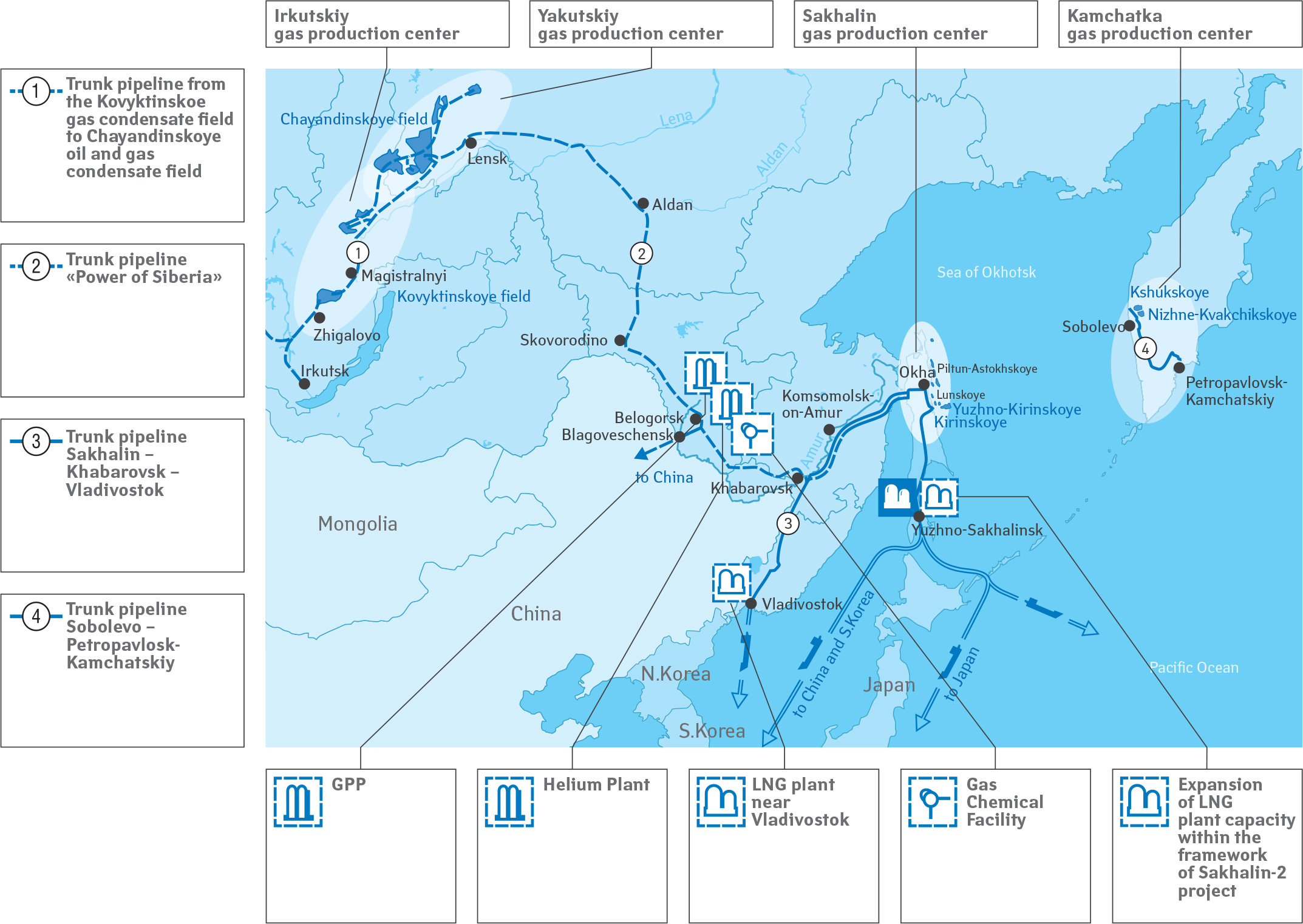
Developments that reach up into Eastern Siberia, above Lake Baykal and Mongolia into the fields of Kovyktinskoe and Chayandinskoye through the “Power of Siberia” pipeline will allow gas from those fields to also feed Western China.
Figure 4. The connecting fields and pipelines for natural gas from Eastern Siberia (Gazprom )
The gas fields will feed into gas production facilities in Irkutsk and Yakutsk with oil production scheduled to start from Chayandinskoye this year, and natural gas production to follow by 2017. The field is expected to yield 25 billion cu m of natural gas and 1.5 million tons of oil a year at full production, and is estimated to hold 1.2 trillion cu m of natural gas. Kovyktinskoe was licensed to Gazprom in 2011 for exploration and production and is estimated to hold natural gas reserves of 1.5 trillion cu m. Smaller local fields at Bratsk and Chikanskoye have been developed since 2007, with the gas being used locally to supply the region.
Figure 5. Developing natural gas fields in Eastern Siberia (Gazprom )
These two fields alone therefore seem capable of meeting the current sales volume that is to be needed for China, given that the time to delivery is some four years, and both fields are anticipated to be on line, with the gas production facilities, within three years.
Pipeline construction is already underway. The “Power of Siberia” will initially connect into Vladivostock, taking the natural gas to the higher demand industrial Eastern China, but likely the additional funding that China is now providing will also help the Westward expansion to the Western gateway.
Figure 6. The Power of Siberia natural gas pipeline as planned. (Gazprom )
The natural gas pipeline is being routed along with the East Siberia – Pacific Ocean (ESPO) oil pipeline to simplify logistics, the second section of which was opened by President Putin at the end of 2012, a year ahead of schedule. The two sections will have a capacity of handling 80 million tons of oil a year (roughly 1.6 mbd) as supplies increase from the different fields to achieve that target. (The largest current contributor is the Vankor field producing slightly more than 500 kbd).
Yorubcheno-Tokhomskoye is expected to come on line in 2017, reaching full production of around 100 kbd by 2019, as the field develops the natural gas associated with the field will also be brought into the network.
There is anticipated to somewhere around 60 trillion cu. m of natural gas in Eastern Siberia (about 23% of the Russian reserve in 2009) and as this is only now being developed and the infrastructure put in place, it can be expected to last for some considerable time.
So far I have not mentioned the reserves that are now on line at Sakhalin Island. Gazprom built the Sakhalin–Khabarovsk–Vladivostok pipeline in 2011and this carries the natural gas down to Vladivostok, and thence largely into China and other Asian markets. The island also has an LNG facility which supplies that fuel to Japan and North Korea.
Figure 7. Natural gas pipeline from Sakhalin Island (Gazprom )
The pipeline is intended to carry up to 30 bcm per year of natural gas from Sakhalin fields, particularly those offshore.
Given the size of the fields that are thus available to Russia and that will feed into pipelines that will be in place at the time called for in the new agreement it is clear that the new market will not likely require any input from the fields that are currently supplying Europe and other markets.
As industries switch out of coal and into natural gas, however, a change driven partly by environmental and partly by cost considerations, so the demand for natural gas may potentially increase significantly. (As a minor indication of this the primary fossil fuel at the university in town is now natural gas and the coal fired plant just closed). There is less capacity to store natural gas than other fuels, which can raise some concerns over available supply in particularly cold days of the year. Such factors may change the situation somewhat, but realistically I would suspect that natural gas will play an increasing role in global fuel supplies for at least another decade.
Figure 1. Potential interconnections to bring Russian gas into China (Washington Post )
It is equally of interest to see where the other ends of the potential pipelines lie, since this locates the natural gas fields that will be used to provide the supply. Looking at the distribution of pipelines and fields, the current preponderance of connections into Europe is hard to miss, at the same time as is the large gap in development in the Eastern side of the country.
Figure 2. Natural gas basins in Russia (Oil Peak )
Thus while the potential connection from Urumqi to Gorno-Altaisk allows the Chinese pipeline into a feed from the network that supplies Europe, that market is not going to go away. Yet the two towns are just 560 miles apart and the connection has been known as the Altai project, or Western connection, since it was first planned over 10 years ago, extending a new pipe up towards Yamal and the basins that feed Europe.
Figure 3. The Altai pipeline project (Gazprom )
Developments that reach up into Eastern Siberia, above Lake Baykal and Mongolia into the fields of Kovyktinskoe and Chayandinskoye through the “Power of Siberia” pipeline will allow gas from those fields to also feed Western China.
Figure 4. The connecting fields and pipelines for natural gas from Eastern Siberia (Gazprom )
The gas fields will feed into gas production facilities in Irkutsk and Yakutsk with oil production scheduled to start from Chayandinskoye this year, and natural gas production to follow by 2017. The field is expected to yield 25 billion cu m of natural gas and 1.5 million tons of oil a year at full production, and is estimated to hold 1.2 trillion cu m of natural gas. Kovyktinskoe was licensed to Gazprom in 2011 for exploration and production and is estimated to hold natural gas reserves of 1.5 trillion cu m. Smaller local fields at Bratsk and Chikanskoye have been developed since 2007, with the gas being used locally to supply the region.
Figure 5. Developing natural gas fields in Eastern Siberia (Gazprom )
These two fields alone therefore seem capable of meeting the current sales volume that is to be needed for China, given that the time to delivery is some four years, and both fields are anticipated to be on line, with the gas production facilities, within three years.
Pipeline construction is already underway. The “Power of Siberia” will initially connect into Vladivostock, taking the natural gas to the higher demand industrial Eastern China, but likely the additional funding that China is now providing will also help the Westward expansion to the Western gateway.
Figure 6. The Power of Siberia natural gas pipeline as planned. (Gazprom )
The natural gas pipeline is being routed along with the East Siberia – Pacific Ocean (ESPO) oil pipeline to simplify logistics, the second section of which was opened by President Putin at the end of 2012, a year ahead of schedule. The two sections will have a capacity of handling 80 million tons of oil a year (roughly 1.6 mbd) as supplies increase from the different fields to achieve that target. (The largest current contributor is the Vankor field producing slightly more than 500 kbd).
Yorubcheno-Tokhomskoye is expected to come on line in 2017, reaching full production of around 100 kbd by 2019, as the field develops the natural gas associated with the field will also be brought into the network.
There is anticipated to somewhere around 60 trillion cu. m of natural gas in Eastern Siberia (about 23% of the Russian reserve in 2009) and as this is only now being developed and the infrastructure put in place, it can be expected to last for some considerable time.
So far I have not mentioned the reserves that are now on line at Sakhalin Island. Gazprom built the Sakhalin–Khabarovsk–Vladivostok pipeline in 2011and this carries the natural gas down to Vladivostok, and thence largely into China and other Asian markets. The island also has an LNG facility which supplies that fuel to Japan and North Korea.
Figure 7. Natural gas pipeline from Sakhalin Island (Gazprom )
The pipeline is intended to carry up to 30 bcm per year of natural gas from Sakhalin fields, particularly those offshore.
Given the size of the fields that are thus available to Russia and that will feed into pipelines that will be in place at the time called for in the new agreement it is clear that the new market will not likely require any input from the fields that are currently supplying Europe and other markets.
As industries switch out of coal and into natural gas, however, a change driven partly by environmental and partly by cost considerations, so the demand for natural gas may potentially increase significantly. (As a minor indication of this the primary fossil fuel at the university in town is now natural gas and the coal fired plant just closed). There is less capacity to store natural gas than other fuels, which can raise some concerns over available supply in particularly cold days of the year. Such factors may change the situation somewhat, but realistically I would suspect that natural gas will play an increasing role in global fuel supplies for at least another decade.
Read more!
Sunday, October 13, 2013
Tech Talk - life gets more difficult at Gazprom
There was a time, not that long ago, when if I was short of a topic for a post, I could Google “Gazprom” and there was sure to be a story out there about another expansion, or take over of a national pipeline – or some other sign of the companies growth and power. But in the natural gas industry there has always been a certain volatility. In the United States Chesapeake, the second-largest natural gas producer in the US, is laying off 800 workers as it completes its plans to re-organize by the end of the month. The price for natural gas is around $3.79 per kcf which still falls below the price required to make many wells in tight shale adequately profitable. I have written about gas price problems a number of times in the past, dating back to at least 2009 and though the price is now up over $1 per kcf from those times, as the recent report in the OGJ noted, Chesapeake had, in estimating returns, anticipated it would be up around $7.21.
Gazprom’s problems however relate more than just to the price of natural gas, and the continuing difficulties in defining future price, although those too still exist. In the agreement that the company signed with China last month, for example, although it says:
Gazprom had been hoping to market the liquefied natural gas (LNG) from the ExxonMobil fields at Sakhalin Island as well as from their own wells, but that discussion has now fallen through so that this becomes a competitive rather than complimentary source of supply. Concurrently China has just confirmed the increase in purchases of natural gas from Turkmenistan.
Not that many years ago all the exported natural gas from Turkmenistan had to run through Gazprom pipes, and thus the company could charge a hefty premium in carrying the gas to Europe and elsewhere. With the opening of pipelines from Turkmenistan to China, that monopoly disappeared, and now the Chinese have agreed to take some 2.3 trillion cubic feet (Tcf) (65 billion cubic meters) of Turkmen natural gas per year, increasing their take by 882 bcf and requiring an additional pipeline to carry this new volume. Given that the country already supplies over half of Chinese natural gas imports, this will continue to squeeze Gazprom’s ability to control prices in Asia.
This new volume will come from a new field in Turkmenistan, the Galkynysh, which is expected to hold a reserve of 900 Tcf. China is investing $8 billion in the development of the field, and the new pipeline to China.
Figure 1. The location of the Galkynysh field within Turkmenistan (Trend)
And Gazprom’s problems don’t end in Asia. Part of the problem that they ran into at Sakhalin Island is that ExxonMobil is working with Rosneft to build an LNG plant through which to market their product by tanker. This circumvents the pipeline monopoly which has allowed Gazprom to dictate terms in the past. The plant is expected to handle 5 million tons of LNG per year, and is anticipated to come on line in 2018. Initial construction contracts have now been signed.
Roseneft, and Novatek have both now been given permission to export LNG, overturning the Gazprom monopoly, and Novatek has the deposits in the Yamal Peninsula that could be more conveniently marketed to Europe, but with LNG tankers that could also reach Asia and beyond. The natural gas will initially come from the South Tambeyskoye field, which has an anticipated reserve of 17 Tcf, with an expected production of around 1 Tcf per year.
Figure 2. Location of the South Tambeyskoye natural gas field, and the planned site of the LNG plant (Novatek )
The plant will operate three trains, each with a capacity of some 5 – 5.5 mmt. It is perhaps no surprise that China is backing the plan with a 20% investment, for which it anticipates being able to purchase at least 3 million tons of LNG pa. An additional 10% of the funding is likely to come from either Japanese or Indian investors. Total of France also has a 20% investment and presumably will gain a proportionate share of the shipments.
As if these challenges to Gazprom’s dominance were not enough trouble, Gazprom is seeking to have two German companies EON SE and BASF SE pony up another billion dollars because Gazprom has been able to increase the reserves at the Yuzhno-Russkoye field in Siberia.
Figure 3. The Yuzhno-Russkoye gas plant in Siberia that feeds into the Nord Stream pipeline (Nord Stream )
Figure 4. Location of the Yuzhno-Russkoye field (Wikipedia)
And just to rub it in, the European Union is planning on hitting the company with anti-trust charges. Given that the company has been able to dominate natural gas sales into Europe though pipelines, and thus has also been able, in the past, to control prices, this new step could prove expensive to the company, just as it faces greater competition in all its export markets. (This does not even consider the potential for LNG competition out of the United States).
The company is getting its supplies from increasingly expensive locations (hence the need for the cash from the German companies) and the income losses that it has seen in the market due to Turkmen competition are already hurting – but it needs more money if it is to be able to keep up its market share.
Before leaving there is an intriguing graph that Ron Patterson has posted at his site.
Figure 5. Process gain in refineries around the world and in the United States (Peak Oil Barrel )
The plot is at the end of a discussion on the difference between counting all the oil produced in a country and the break-down into crude and other sources that add into the total. One part of this is the gain in volume, process gain, that comes when crude is refined. It therefore acts as a marker of the volume of crude that is running through refineries, and as Ron notes, this has now plateaued for the past few years. Interesting!!!
Gazprom’s problems however relate more than just to the price of natural gas, and the continuing difficulties in defining future price, although those too still exist. In the agreement that the company signed with China last month, for example, although it says:
All the major terms and conditions of future Russian natural gas supplies to the Chinese market via the eastern route were agreed on, namely, the export volume and starting date, the take-or-pay level, the period of supply buildup, the level of guaranteed payments, the gas delivery point on the border as well as other basic conditions of gas offtake. The price conditions will not be linked to the Henry Hub index.It turns out that the price has yet to be determined. Gazprom is expected to sell its gas into Europe this winter at around $10.62 per kcf, which is down about 7.5% over last year. Nevertheless the Chinese are hoping to pay no more than $7.10 per kcf. And they have more than a little leverage.
Gazprom had been hoping to market the liquefied natural gas (LNG) from the ExxonMobil fields at Sakhalin Island as well as from their own wells, but that discussion has now fallen through so that this becomes a competitive rather than complimentary source of supply. Concurrently China has just confirmed the increase in purchases of natural gas from Turkmenistan.
Not that many years ago all the exported natural gas from Turkmenistan had to run through Gazprom pipes, and thus the company could charge a hefty premium in carrying the gas to Europe and elsewhere. With the opening of pipelines from Turkmenistan to China, that monopoly disappeared, and now the Chinese have agreed to take some 2.3 trillion cubic feet (Tcf) (65 billion cubic meters) of Turkmen natural gas per year, increasing their take by 882 bcf and requiring an additional pipeline to carry this new volume. Given that the country already supplies over half of Chinese natural gas imports, this will continue to squeeze Gazprom’s ability to control prices in Asia.
This new volume will come from a new field in Turkmenistan, the Galkynysh, which is expected to hold a reserve of 900 Tcf. China is investing $8 billion in the development of the field, and the new pipeline to China.
Figure 1. The location of the Galkynysh field within Turkmenistan (Trend)
And Gazprom’s problems don’t end in Asia. Part of the problem that they ran into at Sakhalin Island is that ExxonMobil is working with Rosneft to build an LNG plant through which to market their product by tanker. This circumvents the pipeline monopoly which has allowed Gazprom to dictate terms in the past. The plant is expected to handle 5 million tons of LNG per year, and is anticipated to come on line in 2018. Initial construction contracts have now been signed.
Roseneft, and Novatek have both now been given permission to export LNG, overturning the Gazprom monopoly, and Novatek has the deposits in the Yamal Peninsula that could be more conveniently marketed to Europe, but with LNG tankers that could also reach Asia and beyond. The natural gas will initially come from the South Tambeyskoye field, which has an anticipated reserve of 17 Tcf, with an expected production of around 1 Tcf per year.
Figure 2. Location of the South Tambeyskoye natural gas field, and the planned site of the LNG plant (Novatek )
The plant will operate three trains, each with a capacity of some 5 – 5.5 mmt. It is perhaps no surprise that China is backing the plan with a 20% investment, for which it anticipates being able to purchase at least 3 million tons of LNG pa. An additional 10% of the funding is likely to come from either Japanese or Indian investors. Total of France also has a 20% investment and presumably will gain a proportionate share of the shipments.
As if these challenges to Gazprom’s dominance were not enough trouble, Gazprom is seeking to have two German companies EON SE and BASF SE pony up another billion dollars because Gazprom has been able to increase the reserves at the Yuzhno-Russkoye field in Siberia.
Figure 3. The Yuzhno-Russkoye gas plant in Siberia that feeds into the Nord Stream pipeline (Nord Stream )
Figure 4. Location of the Yuzhno-Russkoye field (Wikipedia)
And just to rub it in, the European Union is planning on hitting the company with anti-trust charges. Given that the company has been able to dominate natural gas sales into Europe though pipelines, and thus has also been able, in the past, to control prices, this new step could prove expensive to the company, just as it faces greater competition in all its export markets. (This does not even consider the potential for LNG competition out of the United States).
The company is getting its supplies from increasingly expensive locations (hence the need for the cash from the German companies) and the income losses that it has seen in the market due to Turkmen competition are already hurting – but it needs more money if it is to be able to keep up its market share.
Before leaving there is an intriguing graph that Ron Patterson has posted at his site.
Figure 5. Process gain in refineries around the world and in the United States (Peak Oil Barrel )
The plot is at the end of a discussion on the difference between counting all the oil produced in a country and the break-down into crude and other sources that add into the total. One part of this is the gain in volume, process gain, that comes when crude is refined. It therefore acts as a marker of the volume of crude that is running through refineries, and as Ron notes, this has now plateaued for the past few years. Interesting!!!
Read more!
Tuesday, February 7, 2012
OGPSS - The oil and natural gas of Sakhalin Island
The EIA Short-Term Energy Outlook (STEO) for February 2012 included a chart for anticipated changes in production for countries outside OPEC over the next two years.
Changes in liquid fuels production from NON-OPEC nations (EIA ) (Note the change from January moves Mexico past Sudan where over 200 kbd have been shut-in through conflict, and that Russia is showing negative and is towards the back of the pack).
The January STEO commented, in regard to Russian production:
Location of Sakhalin Island (Rational Preparedness)
At the time that we first began writing about the island, back in 2005, it was still being developed and could only produce and ship product for six months a year when the weather allowed. The first phase of development, Sakhalin 1 began production of natural gas in 2005, with oil production being ramped up from the seasonal production at the start in 1996 to 250 kbd by 2010. The major gas production came with Sakhalin 2.
The locations for the fields for Sakhalin 1, and the pipeline to the mainland (Exxon Neftgas Ltd)
At present production from the Chayvo and Odoptu fields are feeding the Chayvo Onshore Processing facility, which can handle up to 250 kbd of oil, and 800 million cu ft of natural gas per day. As Chayvo declines into 2014 then Arkutun-Dagi will be brought on stream to sustain production levels. The oil feeds through the pipeline to an ice-free terminal where it is loaded onto dedicated Aframax tankers each moving 100,000 tons (720 kb) of oil at a time, and with the terminal it is possible to load year-round. A new pipeline is also being installed to carry natural gas to Vladivostok. However it is being run by Gazprom, who have found that it cannot be filled with the natural gas supplied from Sakhalin 2 and Sakhalin 3, and so Gazprom is negotiating with Exxon Neftgas to purchase all the natural gas (which will, in time, include more from Chayvo in Phase 2) that is produced from Sakhalin 1. Exxon, on the other hand, would prefer, because of the profit, to sell the natural gas to China, rather than to domestic Russian consumers, but they are going to be over-ruled. The fields of Sakhalin 1 are considered to have reserves of 2.25 billion barrels of oil and 17 Tcf of natural gas.
Location of the main production and transport facilities for Sakhalin 2 (hydrocarbons-technology)
As with other regions of Russia, the interplay and conflict between the government and their agencies and the Western oil companies brought in to develop the reserves has also been evident over the past few years. By 2006, when development of the total estimated 45 billion barrels of oil and natural gas oil equivalent, was moving into the second phase of production, Shell, who was running this part of the program, ran into an environmental problem. It had actually started with the initial agreement signed back in 1996.:
The LNG terminal, supposed to come on line in 2008, was targeted to supply 156 tankers a year, with the output pre-sold for the next 20-years. The terminal did not come on stream until 2009 when the first 67,000 tons of LNG were shipped to Sodegaura, Japan. Japan is taking some 60% of production, with the remainder initially going to South Korea and the United States. This was followed by shipments to Tohuko in May 2010, and while production still lagged the original delivery volumes, it was increased in 2010 to a total volume of 10 million tons of LNG. Additional volumes are now being shipped to South Korea and the shortfall appears to have been abated. However, such is the demand for LNG in the Pacific that the partners are now considering the addition of a third gas train for another 5 million tons/yr at the terminal in order to meet the increased demand from Japan, following the closure of some nuclear plants following last year’s tsunami. The reserves in the Piltun-Astokhoye and Lunskoye fields (Sakhalin 2) are estimated at 1.3 billion barrels of oil, and 33 Tcf of natural gas.
First LNG shipment to Japan, April 7, 2009 (Japan Times )
There will be additional projects carried out over time, going all the way up to Sakhalin-7, with Gazprom having the largest share of Sakhalin-3. That project contains an estimated 3.3 billion barrels of oil and 25 Tcf of natural gas with the natural gas estimated to come into the pipeline in 2014. (Note that the reserve figures come from the Minister of Investment and Internal Affairs of the Sakhalin Region on Jan 30, 2012).
The phases of Sakhalin Island (EIA)
Even with those phases included, and they reach far into the out years, it is difficult to see much increase being achieved over the 310 kb of production that was achieved in 2009. There will be increases in natural gas production, and this will be of benefit to Japan and South Korea, being a resource that it not that far away, but with a declining crude oil production from Western Siberia it is hard to see how Sakhalin Island production will do much to sustain overall Russian production, let alone increase it.
Changes in liquid fuels production from NON-OPEC nations (EIA ) (Note the change from January moves Mexico past Sudan where over 200 kbd have been shut-in through conflict, and that Russia is showing negative and is towards the back of the pack).The January STEO commented, in regard to Russian production:
EIA expects Russia's crude oil and liquid fuels production to fall by about 190,000 bbl/d in 2012 and an additional 12,000 bbl/d in 2013. These declines follow production of 10.3 million bbl/d in 2011, a post-Soviet record-high that positioned Russia as the world's top producer. Russia's government introduced tax decreases on some petroleum exports, which seems to have affected total exports in the last quarter of 2011. Additionally, production in the eastern part of the country offset the Western Siberia declines to some extent. EIA expects, however, that absent meaningful tax structure reform, investment will remain scarce, contributing to the projected drop in Russia's production in 2012 and 2013.Having discussed the production declines in the Western Siberian Basin, and the increasing production from the smaller Eastern Siberian region, it’s time to move further East, as Russian exploration has, to find and discuss the oil and gas resources found around Sakhalin Island. The Island lies just north of Japan and off the Amur River, within the Sea of Okhotsk.
Location of Sakhalin Island (Rational Preparedness) At the time that we first began writing about the island, back in 2005, it was still being developed and could only produce and ship product for six months a year when the weather allowed. The first phase of development, Sakhalin 1 began production of natural gas in 2005, with oil production being ramped up from the seasonal production at the start in 1996 to 250 kbd by 2010. The major gas production came with Sakhalin 2.
The locations for the fields for Sakhalin 1, and the pipeline to the mainland (Exxon Neftgas Ltd) At present production from the Chayvo and Odoptu fields are feeding the Chayvo Onshore Processing facility, which can handle up to 250 kbd of oil, and 800 million cu ft of natural gas per day. As Chayvo declines into 2014 then Arkutun-Dagi will be brought on stream to sustain production levels. The oil feeds through the pipeline to an ice-free terminal where it is loaded onto dedicated Aframax tankers each moving 100,000 tons (720 kb) of oil at a time, and with the terminal it is possible to load year-round. A new pipeline is also being installed to carry natural gas to Vladivostok. However it is being run by Gazprom, who have found that it cannot be filled with the natural gas supplied from Sakhalin 2 and Sakhalin 3, and so Gazprom is negotiating with Exxon Neftgas to purchase all the natural gas (which will, in time, include more from Chayvo in Phase 2) that is produced from Sakhalin 1. Exxon, on the other hand, would prefer, because of the profit, to sell the natural gas to China, rather than to domestic Russian consumers, but they are going to be over-ruled. The fields of Sakhalin 1 are considered to have reserves of 2.25 billion barrels of oil and 17 Tcf of natural gas.
Location of the main production and transport facilities for Sakhalin 2 (hydrocarbons-technology) As with other regions of Russia, the interplay and conflict between the government and their agencies and the Western oil companies brought in to develop the reserves has also been evident over the past few years. By 2006, when development of the total estimated 45 billion barrels of oil and natural gas oil equivalent, was moving into the second phase of production, Shell, who was running this part of the program, ran into an environmental problem. It had actually started with the initial agreement signed back in 1996.:
most observers agree (it) was inherently unfair to Russia - a deal signed in 1996, when oil was $22 a barrel and Russia was on its knees, that gave the Shell-controlled Sakhalin Energy Investment Corp. the right to recoup all its costs plus a 17.5% rate of return before Russia would get a 10% share of the hydrocarbons coming out of the ground.The end result was that while Shell had initially 55% of the shares, with Mitsui and Mitsubishi having 25% and 20% each, Gazprom stepped in to buy, for a total of $7.5 billion, half the shares of each partner so that Sakhalin Energy is now owned by Gazprom (50%) Royal Dutch Shell (27.5%), Mitsui (12.5%) and Mitsubishi Corp (10%).
Then there was the cost of the second phase of the project, which ballooned from $10 billion in 1997 to $20 billion in 2005, fueling a perception that the company was profligate while Russians picked up the tab. The chapters in between include a calamitous safety record, a failure to meet local expectations for new roads and schools, a fuel spill in Sakhalin's third-largest city, and environmental concerns that caused anger and resentment toward Shell's leadership, earning it a reputation for stubbornness and for consistently misreading political realities.
The LNG terminal, supposed to come on line in 2008, was targeted to supply 156 tankers a year, with the output pre-sold for the next 20-years. The terminal did not come on stream until 2009 when the first 67,000 tons of LNG were shipped to Sodegaura, Japan. Japan is taking some 60% of production, with the remainder initially going to South Korea and the United States. This was followed by shipments to Tohuko in May 2010, and while production still lagged the original delivery volumes, it was increased in 2010 to a total volume of 10 million tons of LNG. Additional volumes are now being shipped to South Korea and the shortfall appears to have been abated. However, such is the demand for LNG in the Pacific that the partners are now considering the addition of a third gas train for another 5 million tons/yr at the terminal in order to meet the increased demand from Japan, following the closure of some nuclear plants following last year’s tsunami. The reserves in the Piltun-Astokhoye and Lunskoye fields (Sakhalin 2) are estimated at 1.3 billion barrels of oil, and 33 Tcf of natural gas.
First LNG shipment to Japan, April 7, 2009 (Japan Times )There will be additional projects carried out over time, going all the way up to Sakhalin-7, with Gazprom having the largest share of Sakhalin-3. That project contains an estimated 3.3 billion barrels of oil and 25 Tcf of natural gas with the natural gas estimated to come into the pipeline in 2014. (Note that the reserve figures come from the Minister of Investment and Internal Affairs of the Sakhalin Region on Jan 30, 2012).
The phases of Sakhalin Island (EIA)Even with those phases included, and they reach far into the out years, it is difficult to see much increase being achieved over the 310 kb of production that was achieved in 2009. There will be increases in natural gas production, and this will be of benefit to Japan and South Korea, being a resource that it not that far away, but with a declining crude oil production from Western Siberia it is hard to see how Sakhalin Island production will do much to sustain overall Russian production, let alone increase it.
Read more!
Subscribe to:
Posts (Atom)