Showing posts with label Turkey. Show all posts

Tuesday, June 10, 2014

Tech Talk - Optimism is becoming harder to sustain

For some time the nations of OPEC have been suggesting that demand for their oil will remain relatively stable in the near future, as increased production from the non-OPEC nations is expected to more than meet demand increases. Thus, for example, in the May Monthly Oil Market Report OPEC anticipates that global oil demand will increase by 1.14 mbd this year, while non-OPEC production will increase by 1.38 mbd, allowing a slight reduction in the volumes OPEC market, which continues to fluctuate around 30 mbd. In the longer term, however, as previous annual oil company prognostications of future supply have emphasized, the MENA countries are going to be pulling an increased weight in supply. For example ExxonMobil has noted:
The Middle East is expected to have the largest absolute growth in liquids production over the Outlook period — an increase of more than 35 percent. This increase will be due to conventional oil developments in Iraq, as well as growth in NGLs and rising production of tight oil toward the latter half of the Outlook period.
At the same time BP pointed out that in just a couple of years demand for OPEC oil is likely to start to steadily increase.


Figure 1. BP view of the increased demands to be made on OPEC oil with time. (BP Energy Outlook 2035)

A large part of that increase has been expected to come from Iraq. With the end of the Iraq war, and the government encouraging development there were some claims that production might eventually rise to over 13 mbd (ahead of both Russia and Saudi Arabia). But those optimistic views had to be measured against the reality that the country has taken a long time to recover back to the 3 mbd levels of exports that it had achieved before conflict.


Figure 2. The fall and recovery of Iraq’s oil production. (EIA)

At present OPEC reports that Iraq was producing at 3.298 mbd in April, making it second only to Saudi Arabia (at 9.579 mbd) among the OPEC nations. There still seemed to be some chance that the country might be able to reach some lower target figures, such as those suggested in the OGJ.


Figure 3. Anticipated Iraqi exports and their market region (OGJ)

Regrettably violence is now significantly increasing in the country, with Mosul being over-run by Sunni militants. This puts them in charge of the main pipeline to Turkey, as well as giving them potential control of some of the adjacent oilfields.


Figure 3. Known Iraqi oilfields in 2010.

Euan Mearns has written of the potential for oil from the Kurdish regions and Turkey has just allowed a second tanker to sail from Ceyhan carrying oil from that region to the market, without Bagdad’s permission. The oil is being delivered through a new pipeline capable of carrying 100 kbd from Kurdistan into Turkey. The main pipeline (shown in Figure 3) can carry as much as 600 kbd and runs from Kirkuk and perilously close to Mosul. The new pipeline runs through Kurdish territory until it reaches Turkey.

The declining influence of the central government over the northern territories of Iraq does not bode well for future production gains. Conflicts are getting worse, and the country is approaching the point where it could well be partitioned, since the government forces seem unwilling to take on the insurgency. Violence has already spread to the Al-Bayji refinery some 130 miles north of the capital. This is the largest refinery in the country, and currently produces below its 300 kbd capacity, all of which is used for domestic consumption.

The problems that this reveals are unlikely to be resolved soon, it is much more likely that they will continue to escalate over the next months, if not years. The impact on Iraqi oil production should not be underestimated. While the oil in the Kurdish region can make its way through the smaller pipeline that is under Kurdish control, the greater flow rates needed to sustain future growth in supply cannot be met by that pipe.

In the South developments in the Mesopotamian region around Basra from the fields of Rumaila and Majnoon will likely continue, with production being shipped out from the new facility offshore, although this is already quite significantly behind schedule.


Figure 4. Oil fields of Southern Iraq (IEA )

One has only to look at the degrading situation in Libya, where production has fallen from 1.6 mbd to a current level of less than 200 kbd, with no path forward now evident for production levels to be restored. Those familiar with the region doubt that there will be much improvement in the situation this year, and if the country follows the Iraqi path (figure 1) then it is unlikely that the world will see significant Libyan production for this decade.

That loss of a million barrels a day is likely to become increasingly evident as world demand continues to grow at greater than that level each year. When this is combined with the increasingly inability of Iraq to increase production as it moves back into more vicious internal strife, then one has to ask from where can future gains in oil production be anticipated?

The major oil companies have urged complacency having bet on Iraq and OPEC coming through (and in the process assumed that Saudi Arabia would also increase production significantly above 10 mbd, something that they have consistently declined to commit to doing). As Libya and Iraq remove that surplus from the table then the question becomes where else can it come from?

It is increasingly unlikely that US increases in production can be sustained for long, given the very short high-level life of the new wells completed in shale, and as the sweet spots in the current fields are consumed. Thus within a couple of years we are now likely to see an increasingly desperate search for new reserves. But those reserves take years to find and develop (as well as large amounts of money), and if the crisis comes at a faster pace than most now expect, then $100 a barrel oil may seem an absurdly cheap price to have had to pay. It may even have an effect on the next Presidential election.

Read more!

Tuesday, December 3, 2013

Tech Talk - Falling gas prices and Iraq

Filling up at the local gas station yesterday I noted that prices are still below $3.00 a gallon, though at $2.99 only just below. Going back to the BBC Calculator this is still $2.04 less per tank than the regional average, and $86 less than I would pay in Italy. So even though the costs are rising over the last time I looked, they are still relatively low.


Figure 1. Relative fuel costs ($/gal) in different locations around the world. (BBC Calculator)

The orange line in figure 1 shows what I paid, and the darker grey horizontal line the regional cost here in the MidWest.

The EIA have noted in last week’s TWIP that the national price is as low as it has been since the beginning of 2011.


Figure 2. Average US retail prices for gasoline (EIA).

The EIA continues to describe the causes of these relatively low prices:
Lower global crude oil prices, high profitability for diesel fuel that has been encouraging refiners to increase throughput, high inventories, and the switch to less-costly winter grades of gasoline are among the factors currently driving gasoline prices.
The OPEC Monthly Oil Market Report (MOMR) reports that global oil prices have fallen $2.04 a barrel (to $106.69) – the first decline in five months, as stocks increase and the Northern Hemisphere moves into winter. The estimate for global demand growth this year remains at 0.9 mbd, with the growth for next year anticipated to be at 1.04 mbd. This steady growth in global demand of a million barrels a day keeps raising the question as to where the increase is likely to come from. This is particularly germane given the disturbed conditions in a number of the MENA countries that provide a significant amount of baseline production, as well as anticipated increases.

The problems in Iraq, for example, have now reached the point that the Turkish government is directly working with the Kurds in Northern Iraq, to develop the oil in the Kurdish northern part of Iraq. This comes at a time that Iraq has been negotiating with the different major oil companies that had contracted to help Iraq reach an overall production target of 12 mbd by 2017. There have been considerable doubts cast on that original estimate, with the IEA producing a report, reviewed in an earlier post that concluded that the country would be lucky to achieve a production goal of 6 mbd by 2020, with an out year estimate that the country would be able to reach 8.3 mbd only by 2035.

Recognizing some of the difficulties in gearing up oil production at the different oilfields around Iraq (some of which were discussed in another post last June) production targets for 2017 had already been scaled back to a goal of 9 mbd by 2017, a drop of 25%. Now there has been discussion between Iraq and its partners for the various fields to drop those target values further, despite the large scale of the reserves that are considered available.


Figure 3. Oil reserves by field (Financial Times)

Exxon Mobil had 60% of the stake in the West Qurna oil field, but after it had started to work with the Kurds independently of Baghdad it found that relations with the Central Government rather chilled. Exxon Mobil has thus sold 25% of their stake to Petro China, and 10% to Pertamina of Indonesia, bringing the EM stake down to 25%. The current discussions between the companies and the Iraqi government are aimed at reducing the production target of the field by around 1 mbd..

Oil has just started to be produced at West Qurna Two, but the initial target is to have commercial production by the end of the year has suffered from local disruptions and the initial goal to reach a production of 400 kbd by the end of 2014 is now also in doubt. Commercial production is now not estimated to begin until perhaps the end of the first quarter of 2014. Initially the field was to be producing 1.9 mbd by 2017. That goal had been lowered to 1.2 mbd at the end of 2012. How the current disruptions will play into that target is difficult to estimate yet, but a year ago the parties were assuming that production would have already reached 150 kbd.

Earlier this year ENI had agreed with the Ministry of Oil to lower the target peak production from the Zubair field from 1.2 mbd to 850 kbd with that goal to be reached in 2016.

Discussions are not yet complete on new target production to be achieved from the Majnoon field. Shell has just announced the start of production from the field with the intent of raising production to over 175 kbd by the end of the year. However the long term target of raising production to 1.8 mbd is now in question. Shell is reportedly suggesting that the 2017 target be lowered to 1 mbd.

Similarly over at the Rumaila field BP is in discussion over long-term production, although earlier last month Schlumberger stopped work at the field because of local disturbances. With the field producing 1.4 mbd the disturbance was short-lived and is not reported to have affected current production, though it is indicative of tensions within the country. Current discussions are aimed at lowering the 2017 target production by around 800 kbd.

When these cuts are combined the total reduction is around 3.65 mbd, taking 2017 production down to 5.35 mbd, which is below the earlier best case scenario envisaged by the IEA.

OPEC notes that, after reaching a peak recent production of 3.194 mbd in August, production has fallen back below 3 mbd in September and October, and with Saudi Arabia also cutting back below 10 mbd in October the Organization is lowering production to meet the reduced winter demand, albeit the reduction from Iraq might not have been anticipated.


Figure 4. OPEC production figures through Oct 13, 2013 as reported by others to OPEC (OPEC MOMR )

This means, unfortunately, that if the world was anticipating that the roughly 4 mbd increase in global demand by 2017 would be met largely by increased oil production from Iraq then they are likely to be sadly disappointed. Enjoy the lower gas prices while you may.

Read more!

Thursday, June 20, 2013

OGPSS - Insecurity in the Middle East

The continuing conflict in Syria, and the slow spread of violence in the region around it, continue to make it difficult to make accurate predictions about the future of oil exports from the region. Within Syria itself production had fallen into decline about ten years ago, before the current struggle began. The precipitate drop over the last two years has, however, been much more dramatic. As Energy Export Databrowser noted from the BP statistic review, production fell by 49% last year.


Figure 1. Syrian oil production showing the recent fall in volume. (Energy Export Databrowser ).

As with most oil-producing nations oil consumption had, on the other hand, been steadily rising with net exports (some is exported as crude and re-imported as refined product) falling to around 100 kbd. The conflict has, however, also reduced internal consumption at similar rates earlier in the conflict.


Figure 2. Syrian production and consumption until 2011. (EIA )

At the same time that Syrian exports have sensibly disappeared, the exports from Iran have continued to fall. Data through the end of last year shows that sanctions continued to bite, with exports falling 31% last year.


Figure 3. Oil production, consumption and exports for Iran (Energy Export Databrowser)

Much of the oil from Iran goes to China, India and Turkey. In May 2013 the total exports are reported to have fallen to 700 kbd although individual monthly numbers fluctuate given the complexity of now getting oil into the hands of customers. (H/t Gail - that report may only cover Chinese imports, since Bloomberg reports a different set of numbers, and an IEA estimate that Iran is averaging 1 mbd of exports this year.) India is hoping that the change in the Iranian Presidency will lead to an easing of sanctions. In the interim, the exemptions that China, India and Turkey are receiving to some of the sanctions have just been extended another six months. Part of this comes from the cuts those countries have already made. India, for example is now down to around 117 kbd around half that of a year ago.

Oil imports into China are reported to have increased, perhaps because the Chinese have just agreed to buy a number of Chinese drilling rigs. Total exports are projected to fall to 1.3 mbd over the current Iranian fiscal year (which started in March). If Iran is having to store more of its oil in off-shore tankers, this may explain the fall in regional tanker availability over the past month.

In a recent post I discussed my concern over the likelihood of Iraq being able to achieve the increased volumes of production within the time frame that their Central Government has suggested. However, as Leanan caught recently, Kurdish Iraq is moving more and more toward independent action in regards to their oil. From the Turkish side a pipeline will be allowed, that can go to the border, but not cross it. Mysteriously it will likely then fill, over time, with a flow of 1 mbd. Turkey is working with BP to develop the resources of Kurdish Iraq. In the interim Turkish demand has stabilized to a greater degree than it has in its southern neighbors.


Figure 4. Oil imports and consumption in Turkey (Energy Export Databrowser)

To a degree the instability is feeding off itself. Egypt continues to have problems in ensuring an adequate supply of fuel, and while Iraq and Libya have agreed to help, they prefer cash up front for the delivery, and that is proving to be a bone of contention. The country has reached the point where domestic production can no longer keep up with consumer demand, and these imports are going to become more critical to the budget, and, as a follow-on, national stability.


Figure 5. Change in oil consumption and the need for more imports for Egypt (Energy Export Databrowser)

The hope is that a pipeline can be built from Iraq, through Jordan, but that requires that a mutually acceptable line of credit be established, and that appears to be a problem. Egypt has the same soft-credit deal with Libya for a supply of a million barrels a month. The price, however, will be at that of the world market.

Unfortunately as the level of violence continues to grow one starts to get into an almost inevitable snowball effect, and there is a consequent negative impact on much industry, likely including that of oil production. The most likely consequence will be a further fall in the regional export of oil, which has a follow-on consequence in that the customers who have lost this supply (Japan has given up all Iranian oil for example) must then go onto the world market to find an alternate source of supply.

As those sources become even scarcer than they are already, marginal amounts of oil become more critical to maintaining a global balance. But such supplies don’t become available at the drop of a hat.

It seems to be a drum that I beat perhaps a bit often, but it is a message that bears repeating. Without significant and ongoing investment in the more difficult regions of the world, funds to identify the necessary availability of resource, and then to drill, in a timely manner, to prove the resource and start the process of turning it into a reserve, the oil balance cannot be sustained at a viable and acceptable price. It does not matter how glowing a set of reports are put out about how we can all relax because the world has plenty of oil in shale.

The largest of those resource sites is in Russia, where there may be as much as 75 billion barrels. But two things should be remembered. The first is that peak oil is reached, not when we run out of oil, but when we start producing less each year than in the previous. And the second is that getting much of the oil in the shale into the proven reserve category is going to take a fair amount of time, after which production rates, going from the results seen, for example, in the Bakken will decline at such a rate that a continued and expansive program of expensive drilling will be required to sustain production. And all this time the flow of oil from existing reservoirs will continue to fall.


Figure 6. A pretty wall hanging . (EIA)

Editorial Note: Because of one of those delightful family events that occur from time to time, this series will be on hiatus for a couple of weeks, since we will be traveling, when I would otherwise be writing.

Read more!

Thursday, March 28, 2013

OGPSS - future natural gas supplies and Cyprus

This post began as a view on the developments in Cyprus, and I am grateful to Gail for the suggestion, and it is my fault that it morphed a little from that simple original objective.

One of the problems that one faces in marketing natural gas is that there is so much of it coming onto the market that it makes it difficult to set a price for future production. Even when the fields and reserves are estimated to be large, having some confidence in the price that the gas will bring helps provide confidence, in turn, with investors that there will be a positive return on the cost of bring that gas to the market. However, once that initial commitment is made to invest the money, then the need for a return often drives an expeditious program to bring in revenue, even if the market is already reasonably well supplied. Prices may then fall, and the investment becomes a losing one.

The current cold weather in the United Kingdom, and the threat of gas rationing has raised the price some 30% this month and the market appears lucrative. But the UK market, in the short term, can be rescued by 3 tankers of LNG from Qatar with more available if needed. (Provided it is ordered soon.) And then, though there remains a need to refill storage, the crisis will be over for now, and the price will likely fall back. (Although likely not completely since the UK is in process of shutting down coal-fired power stations to comply with EU edicts and natural gas is the replacement fuel of the moment.) Looking further down the road Centrica, a major energy supplier in the UK, has agreed to a 20-year agreement with a US supplier to buy LNG from the US (out of the Sabine Pass terminal). This would take a fifth LNG train, at a facility where the first train is expected to come on line in 2015, and the second in 2016. Each train has a liquefaction capacity of 4.5 million tons pa or 220 bcf of NG, and customers have already been found for the first four trains – again for a 20-year period. The UK supply is therefore not anticipated to start until 2018.

In the meantime Qatar has no plans to increase production in the face of the overall growing glut in supply, although it potentially could. And this availability of alternate supply is not good news for the Big Daddy of natural gas exporters, those in Russia. Russia has already seen Turkmenistan sell its natural gas to China directly, rather than through Russian middlemen. To date this has reached 1.7 tcf with further expansion in the works.

To make the situation more volatile the natural gas discoveries in the eastern end of the Mediterranean over the course of the last five years have been found to be of increasing size, as exploration continues.


Figure 1. Relative location of the gas fields (the green region) being explored in the Eastern Mediterranean (Google Earth)

Three of these fields, Leviathan, Tamar and Dalit are in Israeli waters, while the fourth, Cyprus A, belongs to Cyprus.


Figure 2. The location of the different fields that are being developed by Noble Energy in the Eastern Mediterranean.

In terms of relative size, Cyprus A is at 7 tcf, Leviathan was initially projected at 17 tcf, Tamar at 9 tcf and Dalit is at 0.6 tcf. Since the original projection Leviathan has now been increased to 15 to 21 tcf, with a likely value of 18 tcf.

The Russian natural gas heavyweight, Gazprom has not been neglectful of these developments, occurring as they do in a region where it would not be difficult to challenge their supplies into Southern Europe. Thus Gazprom has been the high bidder in a project to float an LNG plant over the Tamar field and to liquefy that gas so that it can be sold into Asia. The goal for the start of that project is in 2017.

Turning to Leviathan, which is expected to come on line in 2016, with 750 mcfd being supplied to Israel. The interesting question is what to do with the rest. There is talk of a pipeline to run up into Turkey and thence on into Europe. This would have the advantage of further diminishing the European dependence on Gazprom and Russian gas, but there are some political problems. One is that the pipeline would run through the Greek controlled waters off Cyprus, another is that Turkey gets most of its natural gas from Russia and Iran, and they would be displeased. (Though it would help Turkey over the difficult problem of Iranian sanctions).


Figure 3. A pipeline to send the natural gas to Turkey (Mining.com)

When one looks at the Cyprus field, with these ramifications going on in the rest of the global gas market, it becomes a little more evident why Russia has not been willing to dash into the financial scene and bail the Cyprus economy out by buying a future stake in the Cyprus natural gas.

There was an alternative proposal (H/t Gail) for the pipeline to run instead through Cypriot waters and then on up into Europe directly.


Figure 4. An alternate route for the natural gas to reach Europe. (John Galt )

With Cyprus in a financial mess they offered their natural gas to Russia, as part of the security for immediate help. In the end Russia did not bail out the Cypriots. At the same time that Cyprus was talking to the Russians they were also talking with the European Union, and it appears that perhaps the threat of Russian control of Cypriot gas helped expedite an EU rescue move.

There is, I believe, more in this for the EU than for Russia. The benefit to Russia would come more from controlling a relatively small amount of competitive natural gas, at a time when they are trying to maintain the market for their own. And while they likely did not anticipate the hit that Russian bank deposits are taking, the overall cost to them does not translate into an adequate return on the investment that they would have had to make to keep Cyprus stable.

On the other hand this has benefits for the EU if it can further expand the availability of an alternate source of supply to that from Gazprom, then they can possibly lower future projected prices for natural gas. Set against which is the history of Gazprom sitting on the sidelines waiting for an investment opportunity later in the game, and then stepping in and gaining control for a lower price. It will be interesting to see how this one plays out.

Read more!

Thursday, February 14, 2013

OGPSS - Ukraine moves to escape Gazprom's grip

You know it is winter when Russia and Ukraine publically row about supplies of natural gas. On Tuesday Ukraine completed the signing of an agreement with Turkmenistan for the supply of natural gas. In the past the purchases have been for up to 36 billion cu m per year, although this was historically through Russian intermediaries. That deal ended in 2006, and Turkmenistan has been able to find a customer in China that now provides an alternate sale that does not leave it dependent on whatever price Russia was willing to provide.

But this does not mean that Ukraine has been able to escape having to pay whatever price Russia wished to impose, since to get from Turkmenistan to Ukraine the natural gas still requires passage through a pipeline that runs through Kazakhstan and Russia. There is no prize for guessing that Gazprom owns those pipelines.


Figure 1. The Central Asia Center pipeline and the route of the projected Pre-Caspian pipeline – both owned by Gazprom. (Gazprom).

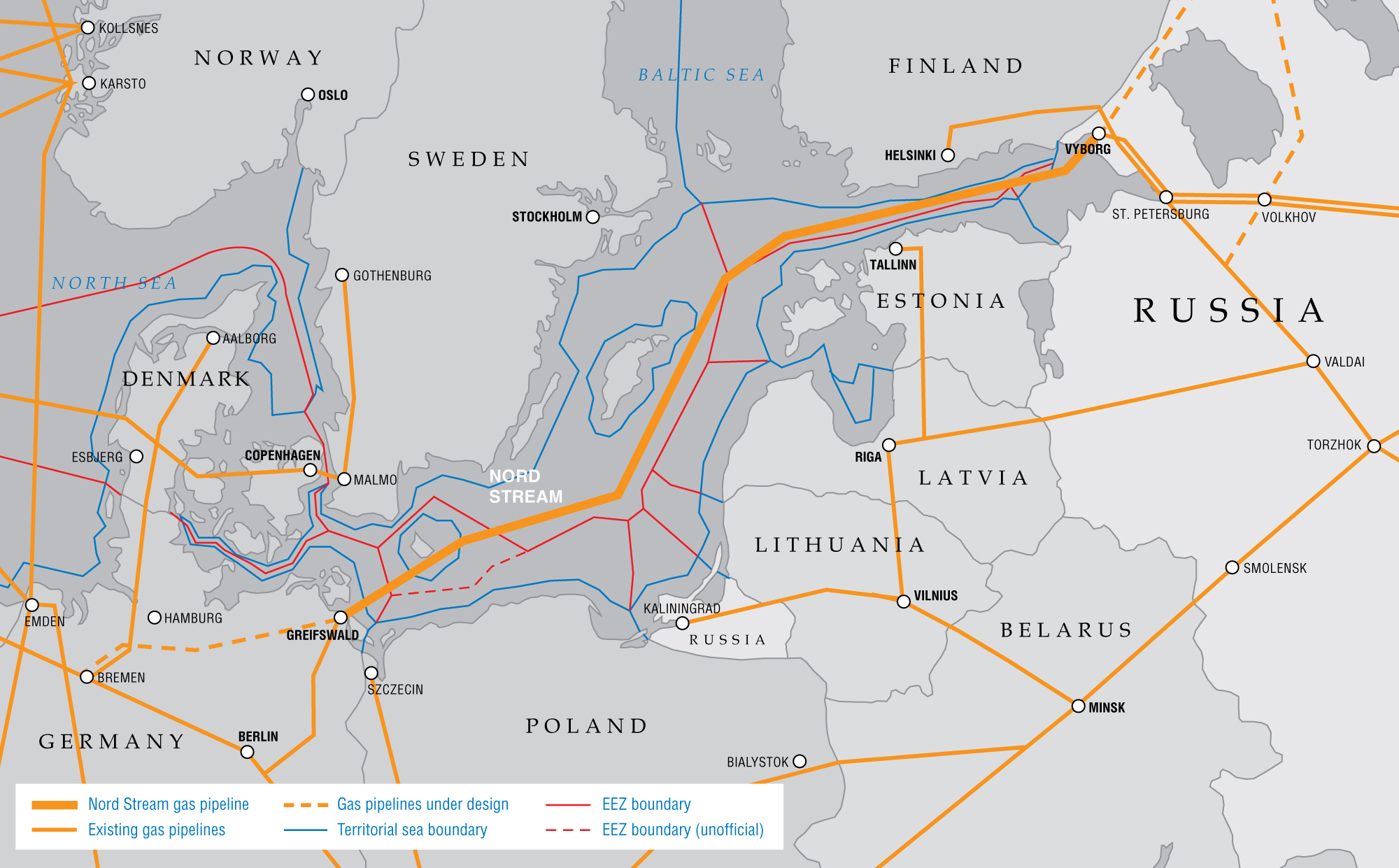
This continues to give Gazprom leverage over Ukraine, and with the North Stream pipeline now approaching its full potential after the second string was commissioned last October, Europe can receive up to 55 billion cu m per year without the gas having to pass through Ukraine.


Figure 2. Path of the North Stream (NordStream) pipeline from Russia to Germany (Gazprom)

There is now talk of adding additional capacity so that there can be a direct feed from Russia to the UK. BP is taking the lead on this, apparently with Gazprom support, although previous experience would suggest that Gazprom may end up as the major shareholder in the end, after all the bills have been paid. And speaking of which, their current dispute with Ukraine involves payment for $7 billion worth of natural gas,that Ukraine contracted for but did not, in the end use during 2012. Ukraine is paying $430 per thousand cubic meters ($12.18 per thousand cu ft) for a fixed volume per year, whether they use it or not, under an agreement signed in 2009.

There is some implication that this pressure may be related to the recent 50-year production sharing agreement that Ukraine signed with Shell to develop natural gas from shale deposits. The country is believed to have the third largest shale-bound natural gas resource in Europe (behind France and Norway ) estimated at around 42 trillion cu ft (1.2 trillion cu m).

The deposits are centered around the Yuzivskaya region, with production anticipated to start in 2017, rising to levels of around 8 – 10 bcm in ten years. Although there is some domestic opposition to the development, the schedule is aggressive.
Shell is to work with Nadra Yuzivska, a joint venture in which the state-owned resources company Nadra Ukrayiny owns 90%. SPK-Geoservice, a small private company, owns the remaining 10% in Nadra Yuzivska.

Shell is expected to invest $410 million to drill the first 15 wells, Oleh Proskuriakov, the environment and natural resources minister, said earlier in January.

The total area of the Yuzivska field is 7,886 sq km. The deposit could hold 4.05 Tcm of gas, according to the government. Proskuriakov has also projected output from Yuzivska could hit 10 Bcm/year in 10 years and 20 Bcm/year in 15. Ukraine's Stavytskiy characterized the latter figure as representing the "optimistic scenario."

"We can project that in an optimistic scenario, the project will produce 20 Bcm/year of gas, while under a pessimistic scenario, 7-8 Bcm/year," Stavytskiy said.
An adjacent well drilled by Hutton has shown promising signs of “interpreted pay in three intervals.”

Chevron is expected to develop deposits in the Olesska region with start dates of around the same time. Opposition to their plans seems to be growing, and they have yet to sign a production sharing agreement. They are, however hoping to get the same sort of deal that Shell negotiated.

It is worth injecting a note of caution into this optimistic view of the future. Just a year ago Poland was anticipating a similar bonanza from the natural gas in its shale deposits. Events have limited that dream. Although a 2011 EIA report stated that Poland had 187 tcf of technically recoverable natural gas, the Polish Geological Institute has now cut the estimates of the viable size of the resource by 90%, and there are other problems.
Difficult geology, an uncompetitive service sector, poor infrastructure, and lack of rigs have hampered development. Poland has a venerable oil and gas sector, but most of the transmission pipelines are based in the southwest, while major shale gas areas are in the northeast. Strict EU environmental laws, as well as unclear regulatory and tax frameworks have further eroded prospects. And while exploration has been going on for a few years now, only 33 wells have been drilled, with just eight of them fracked (at least 200 would have to be drilled in the exploratory stage, just to assess the actual size of reserves).

Preliminary results have not been encouraging, either: This summer, resource giant ExxonMobil withdrew from Poland after the failure of commercial gas flows, while its competitor ConocoPhillips decided not to exercise its 70 percent option in three concessions in northern Poland. Overall, costs per well have increased to $15 million, according to interviews with industry officials, roughly three times the cost in the United States.
And there are two more factors that should be considered. Ukraine is planning an LNG plant on the Black Sea to be ready by 2015, but even this is controversial. To reach the Black Sea tankers will have to pass through the Bosphorus and Dardanelles straits, and Turkey has intimated that it may not allow LNG tankers rights to that passage. That is because the terminal would compete with two that already exist in Turkey.

Secondly Ukraine is working with the Chinese to gasify some of their coal from their large deposits, with the intent of producing the equivalent of 4 bcm of natural gas to displace Russian imports.
The projects are two-fold: first, heat-producing facilities will be converted to use coal-water slurry as fuel; second, new plants will be built to enable the gasification of brown and bituminous coal in three regions: Luhansk, Donetsk and Odessa. While most of the media reports claim that Ukraine will be using Chinese coal-slurry technology, it’s actually Shell’s technology.
How soon Ukraine (and Poland) can stop imports of energetic fuels from Russia is not clear, but obviously this should happen before long, and the winters of their discontent may well disappear from the headlines.

Read more!

Thursday, December 6, 2012

OGPSS - Iranian oil and the global future

There is a lot going on in the Middle East at the moment. There is the revolution in Syria which seems now to be entering some form of end game, and there are the riots in Egypt. There are some signs that these events might move on to countries such as Jordan. Increasing levels of turmoil in the Middle East do not help stabilize the future flow of oil and natural gas around the world, and there are underlying tensions, brought about in part by the need to sustain sanctions against Iran.

Turkey, for example, which is caught up in dealing with Syrian refugees and the adjacent civil war is also largely dependent on Iranian fuel to get it through the winter. In October Turkey is reported to have imported 75 kbd of Iranian oil with larger portions of the total 417 kbd import coming from Iraq (105 kbd) and Russia (103 kbd). The volumes that continue to flow are now becoming a source of friction, since US law demands that countries continue to lower their imports every six months . While Turkey continues to work to lower their need for Iranian oil (and may increase imports from Russia) in the interim the U.S. Government is not increasing pressure but apparently moving to extend the waiver of sanctions not only to Turkey, but also to a total of 21 countries, a list that includes China, India and South Korea.
Two officials said an announcement of the six-month extensions was expected from the State Department on Friday. The officials spoke on condition of anonymity because they were not authorized to publicly preview the step.

In addition to China, India and South Korea, the waivers will apply to Malaysia, Singapore, South Africa, Sri Lanka, Turkey and Taiwan. All nine were originally granted six-month renewable exemptions from the sanctions in June.

The exemption means that banks and other financial institutions based in those places will not be hit with penalties under U.S. law enacted as a way of pressuring Iran to come clean about its nuclear program.

A total of 20 countries and Taiwan have been granted the waivers. The others—Belgium, Britain, the Czech Republic, France, Germany, Greece, Italy, the Netherlands, Poland, Spain and Japan—will come up for review in March.

Yet Turkey, which gets some 20% of its natural gas from Iran, taking roughly 90% of Iran’s natural gas exports is resisting pressure to lower its gas purchases, since the fuel is the primary source for most Turkish electricity. And further, with estimates of Turkish needs estimated as rising to 655 kbd by 2016, the ability of the country to sustain an adequate supply of power supply may become more difficult without reliance on Iran.

There is a somewhat similar argument made in South Korea, who, while they have cut demand by some 30%, continue to import around 186 kbd of Iranian oil as of October, though the volume varies, depending on who is doing the counting. Similarly one sees that both China and India are reported to be lowering their purchases so that there is a projection that Iran might not ship more than 834 kbd in December. Some of the problem in sustaining even this level of supply is apparently coming from the lack of available tankers, and with Iran now being willing, apparently, to use false shipping transponders in co-ordination with Syria rather than just changing names; events seem moving toward some form of a Bond movie.

Oil is a recognized critical component in building energy supply and the current ongoing effort to contain Iranian exports seems to take much of the headline, relative to overall supply questions. But the game is being played in the margins of balance of overall oil supply and demand. The arrival of significant supplies of natural gas, whether real – as in the United States – or potential – as in most of Europe – has moved the focus away from concerns over oil supply as an issue.

Yet China does not seem to be cutting back on overall oil use, demand rose 6.6% in October 2012, over that in October 2011, and averaged 9.76 mbd. If that continues, then China must find an additional source for 644 kbd next year, over and above current suppliers and volumes. And so, with the country still growing, that demand will also continue to grow. But there are not a lot of places that can provide for that increased need. The slow economies of the United States and Europe have dropped demand from where it could have been. And while the European economy is likely to struggle on through next year, that of the United States (lunatics no longer being allowed in Washington) is on the path to recovery, which may well swell energy demand more than anticipated, and absorb any increased domestic supply without much further change in import needs.

And thus one comes back to the aggressive nature of the Chinese in regard to the hydrocarbon resources of the China Seas. The ASEAN nations seem powerless, whether by inclination ore real power, to do much to protest the Chinese position. The Chinese are also working to minimize the American presence, and treaty obligations, that involve them in these discussions. China has just authorized seizure of foreign vessels in their waters (which they, disputedly, claim include most of both China Seas). At the same time India has taken notice, and is more than just expressing concern.
Although India doesn’t have any direct territorial claim in the area, the waters are strategically important to New Delhi for three reasons. First, like for any trade-dependent country, the South China Sea represents an important global shipping route and freedom of navigation must be maintained. Second, India’s state-run Oil and Natural Gas Corporation (ONGC) owns a stake in waters claimed by Vietnam. And third, and perhaps most importantly, the South China Sea represents an opportunity for an Indian riposte against China’s ‘string of pearls’ naval encirclement of the Indian subcontinent.
Overall the world does not seem to be heading in the direction of a peace-filled future. The underlying imperative of energy supply to meet national needs has brought the world to war before now, remaining unconcerned about the situation means that we remain unwilling to learn the lessons of history.

Read more!

Thursday, October 25, 2012

OGPSS - Global crude oil and Iran

There has been a little stir in the news on Energy lately, as folks have begun to extrapolate the growth in American oil and gas production to the point that they predict that the United States may out-produce Saudi Arabia, in terms of the totality of hydrocarbon production. Of course, in some cases, it has been North American oil independence that is featured, rather then that of the USA. And the reason for the generalization is that by broadening the geography so that the region also includes Canadian and Mexican production then the US imports from those countries magically disappear (which does not mean that they don’t have to be paid for. The US imported around 2.5 mbd from Canada and 1 mbd from Mexico in July). The stories also don’t dwell on the comparison of apples and apples. Consider the following quote from NPR. It is that easily missed sentence at the end of the first paragraph that is critical.
In 2011 the U.S. produced 5.66 million barrels of crude oil a day, according to the Department of Energy's Energy Information Administration. By next year the agency projects that will increase 21 percent to 6.85 million barrels a day. Add in things like natural gas liquids, biofuels and processing gains at refineries and that number increases.

"By 2013, we'll probably be a little over 11 million barrels a day," says EIA administrator Adam Sieminski. "That puts you pretty close to Saudi Arabia's" production of more than 11 million barrels a day, he says.
In which regard it might be pertinent to note that some of the crude produced in the Kingdom of Saudi Arabia (KSA) will be refined in the US, providing refinery gains here, and further distorting the comparison. Ah, well!

The current production gain in the US has resumed, after a short plateau, although the gains following the shut-ins for Hurricane Isaac seem to be leveling off.


U.S. Crude Production through mid-October 2012 (EIA TWIP)

The information in the October Monthly Oil Market Report from OPEC, show that crude oil production from KSA is running at 9.85 mbd, as reported by other sources.


Figure 2. Reported production from the OPEC nations through September 2012, as reported by others (OPEC MOMR)

When one looks at the production that KSA itself is reporting the numbers are slightly reduced.


Figure 3. Reported production from the OPEC nations through September 2012, as they reported to OPEC (OPEC MOMR)

While the comparison of the two levels of crude suggest that the US has a long way to go in matching KSA crude production, the two sets of figures also point to the answer to another question.

Looking at the figures for Iran, it is clear that the sanctions which have been imposed on that country by the West are having a serious impact. Not only is this seen in the fall in oil production, likely around 1 mbd, but in the more consequential cut to exports this fall is reflected in a $7 billion reduction in income. Iran has just started to admit that this bite in their export market is hurting production. And it is only now that they recognize that this will further fall, though they are now also threatening to carry this drop to its ultimate conclusion, and to stop exports entirely. An immediate impact to this would fall on Turkey, which has cut oil imports from Iran by about 20%, but which has a six month exemption from the full impact of the sanctions. It is currently importing around 200 kbd of crude. Some of the value of that oil is apparently returning to Iran as gold bullion, which can be easier to spend.

However the primary question might well be, if world oil markets are so tight, how come taking a million barrels out of production hasn’t had a more significant impact? And the answer to this comes in part because of the increase in production from KSA (Note that a year ago the country was producing around 500 kbd less than it currently is), and also from the gains in production from the United States. (As shown in Figure 1).

Further, given that the global economy, though regenerating from the depths of recession, is still not operating at levels sufficient to bring unemployment to more normal levels, overall demand also remains below what it might be.

Since we live in a global economy the problems of Europe and America are reflected in a reduced demand for goods from China and other Asian countries, which impacts the energy demand from factories. China has been taking some 40% of the Iranian export. OPEC has noted that Chinese demand has declined, and that part of this decline has been through an 18% reduction in imports from Iran. Interestingly this was partially made up through an increase in imports from Iraq.


Figure 4. Change in Chinese petroleum imports over the past year (OPEC MOMR )

One of the threats that Iran has made it that it will shut down its exports completely. The country was initially exporting some 2.3 mbd before sanctions occurred, and sanctions have dropped this already to around 860 kbd. Of this 200 kbd are going to Turkey, but this is a country with pipeline connections that give it options. There is a pipeline running from Iraq, the Kirkuk- Ceyhan connection which carries 300 kbd, and was briefly damaged by fire in August; and, more famously, there is the Baku-Tiblisi-Ceyhan pipeline from the Caspian. This can carry 1 mbd of crude, and having run 190 mb through September this year, it is running not quite full.


Figure 5. Oil and Natural gas pipelines through Turkey (Journal of Energy Security )

In short, as with the suggestions mentioned the other week, that Iran might seek to challenge Qatar in going into the natural gas LNG market, the threat this week that it might shut off exports of crude seems to be likely only geared for domestic consumption.

The global demand at present is not such that the Iranian supply is critical to ensuring a balance at an acceptable price between supply and demand. It would seem that the global economy would need to regenerate further, and for North American and KSA to reach some form of current peak in production against that potential of rising demand before this balance is threatened. But, in consolation to Iran, resting oilfields can sometimes help in terms of their longer-term production (as KSA have practiced for years).

Read more!

Wednesday, October 10, 2012

OGPSS - Iran and the possibility of natural gas exports

There has been much talk in the current Presidential debates about possible changes in US Energy Policy, with Governor Romney suggesting that more Federal land be opened for prospecting for oil. Historically one of the regions included in such lists has been up in the National Petroleum Reserve in Alaska. And, perhaps anticipating the debate, the current Administration has already and recently moved toward opening those territories up for development.** However those fields have now been determined to be more natural gas than oil, and so hopes for finding more oil reserves has shifted into moves offshore, where Shell continues to be optimistic as it begins to sink new wells in the Chukchi sea – although well completions have now moved into next year. However it should be noted that there have been suggestions in the past that more of the hydrocarbons under the Arctic are gas deposits than oil, and this argument has been strengthened by the recent discovery in the Barents Sea of more gas, when oil had been anticipated.

The current large volumes of natural gas that are being developed and marketed, whether in the United States or from Turkmenistan, are making considerable changes in the economies of many countries. Russia, who lost the sales battle to supply natural gas to China now can no longer justify the expense of opening the Shtockman field, as alternate supplies are coming to the market at lower costs, and this will, in turn, cascade on to prices in Europe, where the advent of more gas in the UK is making it more difficult to justify a switch into a greater reliance on renewable sources such as wind and solar.

This entire scenario means that it is not necessarily a good time to have a huge reserve of natural gas, and to go to the market with this as a resource to generate income. This is particularly true, if the country in question is Iran.
Iranian Oil Minister Rostam Qasemi has announced that Iran’s exploitation of the South Pars gas field will equal Qatar’s exploitation of the gas field by the end of Iranian calendar year 1392 (ends March 20, 2014) if $54 billion is invested in gas projects.
Iran and Qatar share the largest natural gas field in the world, a reserve that is known as the North Field in Qatar, and as South Pars in Iran.


Figure 1, The South Pars field which lies between Qatar and Iran in the Persian Gulf (PetroPars Annual Report )

Qatar has been exporting Liquefied Natural Gas for a number of years, and has been well able to manage a steady growth in market penetration, as noted in a previous post, and this quote from two years ago:
Ras Laffan 3 Train 7 is the fourth 7.8 million tons per year LNG plant brought online by Qatar Petroleum and ExxonMobil joint ventures within the past 12 months. It matches the capacity of Ras Laffan 3 Train 6, one of the largest operating LNG production facilities in the world, inaugurated in October 2009. These mega facilities have sufficient scale to competitively reach markets around the globe. Qatar's giant North Field, which is estimated to contain in excess of 900 trillion cubic feet of natural gas, will supply both trains.
For Iran to anticipate that they can generate the infrastructure to compete with Qatar in the short term, given the time taken to invest, not only in the surface plant, but also in the tankers that become dedicated to the customers and the routes that must be followed, is more than naïve. That they can expect to do this at a time when, more than in any time in the recent past, there is an adequacy of supply unseen in a generation, suggests a message that can be meant for local consumption only.

But Iran has other problems. At present, as noted last time, natural gas supplies are barely keeping pace with an acceleration in the volumes required to meet internal demand. Any move to increase production will face competition not only from Russia (with available natural gas supplies once anticipated to be sold to the USA, and, when that fell through, then to China) and Qatar but also potentially from the United States itself, since as The OGJ recently noted
“U.S. LNG export potential is a major issue in Asia, particularly in Seoul and Tokyo,” said Mikkal E. Herberg, research director at the National Bureau of Asian Research (NBR)’s Energy Security Program and the report’s editor, “That’s especially true for the next 5 years until major Australian and other export projects come on line.”
With China getting more of its supply through pipelines this may also weaken the LNG market, even as Iran moves to step into these waters.

So can Iran also move its natural gas by pipeline, it is, after all connected by land to potential customers. Well, apart from the relatively obvious problems of trying to do this at a time when the nations concerned with Iranian nuclear policy are tightening their sanctions on Iran, as they are being seen to have more effect, the question comes back to who might be a potential customer. At present Turkey buys the bulk of Iranian natural gas exports but the European Union is expected to include natural gas in the list of banned exports at the meeting on October 15th. (Armenia and Azerbaijan buy the remainder of the current export volumes). There was a recent explosion in a gas pipeline carrying natural gas from Iran into Turkey, stopping the flow. But while that initially imposed a supply problem for Turkey, this has been met through increased purchases from Russia which currently has plenty. Thus it would appear that while Iran has more than sufficient supplies to move into an increased export position, the current political situation will likely preclude this happening in the short term, and the global over supply may well restrict Iranian penetration into that market in the longer term.

** September Alaskan pipeline flows were at 517 kbdm against the average for this year of 537 kbd, however as winter gets established the latest volume reported for 10/09/12 was 580 kbd, moving the pipeline away for the critical numbers.

Read more!

Wednesday, January 13, 2010

The Russia:Belarus oil dispute and Western Oil supplies

I hadn’t actually been paying much attention to the Russian:Belarus dispute over oil supplies. After the annual debacles that we are used to over natural gas supplies that flow from Russia to Western Europe through Ukraine, and which seem somewhat quiescent at the moment, I had failed to grasp how much Western supplies of oil from Russia flow through Belarus. But as is pointed out in Foreign Policy the flow is significant, and this is a more far-reaching conflict than I grasped. As a brief review:
In 2001, Belarus unilaterally canceled a contract that mandated the sharing of these revenues, leading to substantial losses for Russian pipeline monopoly Transneft and the Russian state budget. Now, Transneft is demanding that Belarus pay full import duties for the portion of Russian oil that it resells on the European market, a demand that could cost Belarus as much as $5 billion per year. The Belarusian government argues that the Russia-Belarus customs union obviates the need for Minsk to pay duty on imports from Russia. Although deliveries through the Druzhba pipeline have not, as of mid-January, been cut off, the prospect that Transneft (whose chairman is Russian Deputy Prime Minister Igor Sechin, a close confidant of Prime Minister Vladimir Putin) will turn off the taps to force compliance from Minsk is clearly one that has European leaders worried because the European Union imports about a third of its oil from Russia, mostly via Belarus. Already, the prospect of supply disruptions has driven U.S. crude oil prices to a 15-month high, presumably to Moscow's delight.
Well, as my post yesterday showed, I am not convinced that this conflict had a lot to do with the rise in oil prices (which actually dropped a little today, on their overall march upwards). But that does not lessen the longer-term impact of what is going on. It is, as it was with the Ukraine dispute, to with control, with Russia seeking to control fuel distribution in these countries, and through supply controls also influence the directions in which the country moves.

Russia is now warning that it will reduce oil flows to Belarus even further and wants the duty on the roughly 290,000 bd that is refined in Belarus and then exported to the West. At the moment the refineries in Belarus have a relatively short reserve (between a few days and a week, reportedly - depending on source) and the current contracts have expired.
Germany and Poland are believed to be hit hardest once Russia halts shipments through the Druzhba pipeline. Germany depends on Russian crude for about 15 percent of its total consumption, and Poland buys from Russia to meet 75 percent of its market demands.

Minsk has threatened to raise the transit fee for its European customers more than tenfold, from 3.9 dollars to 45 dollars per metric ton, should Moscow not agree to its conditions, RIA Novostinews agency quoted an unidentified expert close to the talks as saying.
At the moment the talks appear to be stalled. However they are not limited to the transit of oil. There is also a dispute over the transmission of electric power. Belarus acts as a transit country for power both to Kalingrad and to the countries of the Baltic. It has assumed somewhat greater urgency with the closure of the Ignalina nuclear power plant in Lithuania. The plant closed on December 31, and there are fears of greater dependence on Russia for future power. Russian complacency about the situation is not, I suspect, exactly helpful.
“It is inevitable that Russia is going to become a bigger supplier of energy to Europe and particularly to the Baltic countries. Ultimately there comes a point where you have to let the old days go,” Chris Weafer, chief strategist on Moscow’s Uralsib bank, told New Europe on 5 January, adding that the Baltics, which sorely need energy supplies, should adopt a pragmatic approach and rely on their eastern neighbor and forget the legacy of the Soviet Union. As long as Russia continues to try and build a modern and diversified economy with greater global integration, then it needs the goodwill of the West just as much as the West needs Russia’s energy.
Bids for construction of a new plant are due to be submitted by the end of this month, with the hope of getting the new plant on line by 2018. (Kalingrad is hoping to have its own reactor in about the same time frame).

In the interim the Baltic states are going to be dependent, not only on Russia for their electricity and oil, but also on satisfactory conditions to allow the transit of both through Belarus on their way.

Meanwhile, over in Ukraine, there is an election underway, with initial voting to take place on Sunday. It is perhaps for that reason that there have been no major gas disruptions so far this year. Anger with the current administration is giving a bit of a boost to a third candidate, so perhaps it is in Russia’s best interests to retain a low profile at this point. In fact Russia is claiming credit for keeping the UK supplied with gas as supplies from Norway dropped due to bad weather at some of the production sites. However Russia is also being nice to Turkey as insurance just in case it will still need to do some bypassing around Ukraine to supply Western Europe after the election is over.

Not that conditions in Ukraine itself have been unaffected. There are some 175 towns and villages that are reported to be still without power, due to the bad weather. This is a decided improvement from the 1,598 who lost power in the Dec 29th storm. At least they are more used to the cold.

Those in Florida who aren’t, and plugged in too many heaters, are also causing power outages down there.

Read more!

Wednesday, November 11, 2009

Russia, Ukraine and the annual gas game

There is a developing tradition at the end of the year, in which Russia gets into a spat with Ukraine about the payment of the Ukrainian gas bill. Gas supplies are curtailed to Ukraine, which immediately passes on the cuts to the Western European nations on the other end of the pipeline, and there is a short-term, very public row, at the end of which gas supplies are re-started and the situation gets pushed under the rug for another year.

In trying to develop a longer term solution to the problem, Gazprom (the Russian gas company) and its partners have been developing two pipelines, one around the North, and one following a Southern route, to bring natural gas to Western Europe without going through Ukraine. Austria was asked to join the southern branch (South Stream) today. At the same time the West has been trying to line up enough gas supplies to run its own pipeline from Azerbaijan and Turkmenistan into Europe without going through Russia; the pipeline is called Nabucco.

None of these pipelines is yet in place, and so, as the winter season starts to arrive one would naturally begin to worry that the traditional drama would play out again this year. Thus Gazprom has hastened to proclaim, in an interview with Bloomberg that this year will be different. Ukraine is paying its bills each month, and as long as that continues then gas will continue to flow. Although, at the same time, there have been the usual heavy hints that if bills aren’t paid then taps will again close. And Ukraine is hinting that to meet those bills it will need money from the International Money Fund. However it is also seeking a loan from Europe. And the latest comments from Ukraine suggest that this years bargaining round is only just starting. The reassurances that Ukraine is providing, while superficially calming, also retain the caveat that could warn of future problems.
"Ukraine is ready to comply with its obligations on gas transit through its territory within the next half a year at least," he (Ukrainian presidential envoy for international energy security Bohdan Sokolovsky) said at a press conference in Kyiv on Nov. 9. . . . . Having 27 billion cubic meters of gas and repaired gas transportation system, Ukraine can guarantee the transit of the Russian gas provided it comes to Ukraine's GTS (Gas Transportation Services)," he said.
It’s that little catch phrase at the end that always seems to generate trouble.

UPDATE: Coincidentally Jerome has written an article that explains in much greater detail the background to this situation and yet comes to somewhat the same conclusion I draw. His article is well worth the read in understanding why, however.

And unfortunately it has been trouble in the pipelines supplying gas either to or from Russia that has caused earlier problems around the Russian perimeter, and there seems to be no indication that this year will be any different.

Unfortunately the situation is not that cut and dried. I have written about the concern that Turkmen gas, normally a significant supplier, through Russia into Ukraine, may not be available this year. Further the drop in prices and demand for Russian gas is giving Gazprom some financial problems, since they have not sold some 8.5 billion cubic meters of gas or so that they had anticipated, on top of the actual 142.5 billion cu m they actually have sold the west this year to date. (In context Gazprom would normally sell about 45 bcm to Europe in the fourth quarter, and that is about the amount of gas that they normally buy from Turkmenistan in a year). Because of the contract sales language Gazprom is thinking of fining its customers for not buying their full allocation.

And as Turkey and Azerbaijan negotiate on getting Azer natural gas for the pipelines through Turkey, the prices for transport that are being negotiated appear similar to those that Russia charges:
According to him,( Turkish Minister of Energy and Natural Resources Taner Yildiz) Turkey has offered Azerbaijan a fee of $2.36 per 100 km for transporting every 1,000 cubic meters of the South Caucasus republic’s gas.
“The proposed fees are completely competitive. Russia charges $2.6 for transporting the same volume,” the Turkish minister said.

We recall that during the “gas war” between Russia and Ukraine this January, Kyiv sought to raise transit fees for Russian gas giant Gazprom to $3 per 100 km in case prices for Russian gas increased.
The attempts by Ukraine to get that higher fee have not stopped.

Meanwhile Russian companies are coming under pressure to reduce gas flaring since Prime Minister Putin sees this as a loss in revenue. At the moment Russia is flaring about 20 bcm a year (apparently about a third of that which comes out as a byproduct of Russian oil production).

Incidentally, in regard to my earlier post on Saudi Arabian production, Platts ( has noted that it is not only Asia that saw the reduction in Saudi exports, but that the United States also got a reduced allocation, with imports falling to 745 kbd in August. Whether this is a simple monthly aberration or portends something more dramatic, only time will tell.

Read more!

Monday, May 11, 2009

Nabucco, or is the Great Gas Game turning into a waltz?

It seems as though, whenever things are relatively quiet in the energy world, which they currently seem to be, then all one has to do is type Gazprom into Google search box, and there will be some interesting snippet.

And lo, it appears that Gazprom is looking into a take-over one of the Hungarian gas pipeline networks. Now that is not what the initial part of the post says, where it notes that the Hungarians are switching their gas purchases from a company (RosUkrEnergo) (RUE) that purchased Russian gas through Ukraine, to a company known as Rosgas AG. As part of the fallout from the January dispute between Russia and Ukraine RUE lost that business, and now Hungary has found a new middleman, Rosgas.
The immediate suspicion is that RosGas AG is yet another in a long line of shadowy intermediary companies created by Firtash and Gazprom. However, in the case of RosGas this may mask a possible attempt by Gazprom to cut gas supplies to Firtash's Emfesz, as a precursor to a company takeover - vastly increasing its share of the Hungarian domestic gas distribution network.

This becomes of some importance when one looks at the relative prospects of the two alternate paths for new gas to reach Western Europe – South Stream and Nabucco. South Stream is being increasingly pushed by Gazprom. The pipeline will bring gas under the Black Sea, and pass through Serbia and Slovenia before reaching Austria. However Eni, who is a 50% partner with Gazprom in this stage of its development, is upset that Gazprom is keeping it out of the negotiations with Serbia and Slovenia. Both countries are anticipated to sign agreements with Gazprom in the near future, without Eni, for gas supplies from South Stream.

And this may be where Hungary comes in, since the competing Nabucco pipeline goes through Hungary to get to the Austrian hub. So that if Gazprom controls the Hungarian pipelines, and can stop competitors’ gas flowing through them (a fact they used to get TNK-BP out of the rich Kovytka field after TNK-BP had developed it.) It is yet another couple of nails in the Nabucco coffin.

Earlier this week, with a fanfare celebrating the coming signature of the Nabucco agreement to run gas through the pipeline across Turkey it looked as though the pipeline was moving rather rapidly forward. However, buried within the story is the backing off of European funding
The European Commission is proposing to scale back its support for the Nabucco project to 200 million euros ($268 million) from 250 million euros, Tarradellas said in February. The aid would be channeled through the European Investment Bank.
At the same time, the last paragraph is interesting.
Friday's statement, signed by leaders of the EU, Azerbaijan, Georgia, Turkey and Egypt, also said the EU and Egypt should "agree on specific projects in developing Egypt's gas reserves and export potential for the EU." It said it was signed "in the presence of the representatives of Kazakhstan, Turkmenistan and Uzbekistan."The statement also called for a memorandum of understanding on energy between the EU and Iraq "as soon as possible." Barroso said a preliminary energy accord with Iraq was "imminent."
There are nuggets in that paragraph – first the pipeline cannot be effective without the gas from Kazakhstan, Turkmenistan and Uzbekistan. But none of them signed the document. Further Azerbaijan does not think that the project is feasible without Turkmenistan. The Turks will get paid for their trouble
The Turkish government has been driving a hard bargain, insisting on collecting a "tax" on the gas being pumped and demanding 15 percent of the transit gas at discounted prices. These requests have been rejected by the European Commission, the executive branch of the 27-nation bloc, delaying the 9 billion-euro project. More than half of the pipeline is to be located in Turkey.
But getting them on board helps negate the pressure that Russia (read Gazprom) is applying to discourage the “stans” from selling Nabucco their gas.

So as steps in the Great Game you could say that Europe took the first by planning Nabucco, then Russia took the second by stopping an adequate supply availability through pressure on Turkmenistan etc. Europe now gets the third, since with the pipeline running through Turkey they can (if politics allows) run connections into Iran, Egypt and Iraq. And before the step is completed Russia moves to step on their toes and gain control of the Hungarian section, thereby taking the fourth.

With Austria involved, maybe this part of the game is turning into a waltz – but with constantly changing partners - we shall see.

Read more!