Tuesday, January 10, 2012

Progress of the Russian tanker towards Nome

Since the Russian tanker bringing fuel to Nome, and the accompanying ice breaker started out on Tuesday having sailed 53 miles on Monday, it seemed, with only 100 miles to go, that this drama was over. However it managed to move forward only 50 ft on Tuesday, due to the ice conditions. The ice breaker spent much of the time trying to break the tanker free from an ice ridge. I am therefore putting up the map again, and showing the relative position of the tanker and the ice breaker the Healy so that I can more easily add updates to the story.

Position of the ships (the icebreaker is the Healy) relative to Nome at 5 pm Tuesday (Central time)

And I know that Nome is really on the coast, but the name is more to identify the target. And for those who missed the earlier post which lies two stories down, Nome in Alaska is running out of fuel, and a tanker, supposed to deliver that fuel on the 7th January is having difficulty getting to the harbor. Due to storms earlier in the winter the normal fuel barge could not make delivery, and so the tanker and the sole remaining American active duty ice breaker were called into service. (The second ice breaker is out of service being overhauled). But the ice is thick and under considerable pressure - hence the ridges - and the pressure can also close the passage that the Healy makes before the Renda can move down it.

UPDATE: Here is the latest position of the Ice breaker (and thus I presume the tanker) at 11 am on the 11th. (Central time) It seems a little further away, but could be trying to find a better way through the ice for the tanker.


And here is a picture from the Healy Aloft camera of the Renda, date stamped 20120111-0101. (I think that the last 4 digits are GMT, since the pictures are going up every hour and the latest one - still dark, and the icebreaker starting to move (it has headlights on and is no longer pointing at the tanker) - is stamped 6 hours ahead of Central US time, which is GMT).


UPDATE 2 (4:30 pm 11th) It is now possible to see both the Icebreaker (the Healy) and the Russian tanker on the plot.

24-hours after the top map location, the tanker does not appear to be making much progress.

The Coast Guard has stopped predicting when the vessels may arrive in Nome, and even when they do there may be more problems. The icebreaker has too deep a keel to get into the harbor, and there is a 25-ft deep ice ridge that has been discovered across the mouth of the harbor. This means that the Renda will have to park off-shore and pump the fuel through a hose to the tanks. It has enough hose on board to be able to do this.

UPDATE 3: The Renda made a good run and is now 50 miles from Nome. There have been numerous ice ridges giving problems.

Position of the vessels at 10:15 pm GMT 12th Jan.

FINAL UPDATE Friday 7 pm GMT: The tanker and breaker have made good progress and are about 8 miles from the city (you can see some of the city lights in shots from the Healy aloft camera that were taken overnight.

Read more!

Monday, January 9, 2012

OGPSS - Oil and Natural Gas in the Volga-Ural Basin

In the last post on the oil and gas fields of the Northern Caucasus, I commented that one of the reasons that these older oil and gas fields were being further developed was due to the introduction of advanced Western techniques. As John Grace points out in “Russian Oil Supply” another reason that there are fields left to develop is due to the philosophy by which the Soviet government marshaled resources to keep the Union supplied with oil for domestic and export use. Because of its centralized nature, as the resources in one region declined, so the financial support and technical equipment were removed and taken to other parts of the country, where a more plentiful supply source was available. This frequently left smaller fields behind, and removed the incentive for further exploration in the older regions.

The first region to see that removal of support was around Baku, and then the North Caucasus, as more plentiful resources became evident up in the region around Almetyevsk, in what is now the Republic of Tatarstan. The region lies considerably north of Volvograd (Stalingrad) and further east, though it still lies on the banks of the Volga, though also just to the West of the Ural Mountains, and thus the more popular and general description is the Volga-Ural Basin.

Relative location of Almetyevsk, showing the Volga (black line) Stalingrad (now Volvograd), and the Caspian. (Google Earth)

The Volga-Urals Basin is now recognized to be extensive with the USGS estimating that there remain some 1.5 billion barrels of oil, and 2.3 Tcf of natural gas (at the mean) left to be discovered and produced.

Extent of the Volga-Ural Basin (USGS )

Prior to the Second World War, the region saw little development. Tar pits within the Basin had indicated the presence of oil, and Grace has pointed to outhouses exploding around the town of Orenburg, as natural gas from the underlying field collected in the buildings, as the first indicator of the presence of that field. But the fields all appeared to be small, and with enough production from Baku and Grozny to meet existing needs, there was little initial incentive to develop what seemed to be a series of small shallow fields.

Oilfields of the Volga-Ural Basin (Russian Oil Supply)

With the German advances into the Caucasus, that oil became lost or more difficult to bring north, and the relative security of the Volga-Urals meant that a greater effort was made to bring those fields on line. Production had reached 55 kbd in this “second Baku” by the end of the war. The first break had come with the discovery of the relatively shallow oil field at Tuymazinskoye in 1937, but it was not until they deepened one of the wells into the lower Devonian layers in 1944 that they hit the more productive reservoirs and the potential of the region became evident. In 1943 a test well had been sunk at Shugurovo and flowed at 140 bd from a reservoir at 2,000 ft. With the knowledge of the deeper reservoirs a third well in the region, near the town of Romashkino was drilled down to 6,463 ft, penetrating the casing on July 10, 1948. Because of formation damage the well was slow to produce, but within a short while was up to 876 bd. Holding 17 billion barrels of oil, and thus the largest oil reservoir discovered at the time, the Romashkino field (which included the well at Shugarovo) had been tapped. In time another seven fields, each of more than a billion barrels, were added to the inventory for the Basin.

The deeper Devonian beds required a number of innovations to produce at the levels that Moscow was requiring. The first of these was the development of the down-hole turbo drill. Russian steel making was not on a par with that available in the West, and the torque requirements for drilling the harder and deeper rocks were a challenge, overcome by putting the turning motor at the bottom of the well. The second problem that arose was in maintaining well pressure as the oil was removed. The use of contour water flooding evolved from the initial Master Plan in 1956 and was successively modified to perimeter flooding, so that by 1960 the basin was producing at 2.9 mbd, comfortably exceeding the target 1.2 mbd. Romashkino itself peaked at just under 1.6 mbd in 1968 and began to decline in production in 1976. As production declined, so the water cut also rose and by 1993 production was down to around 300 kbd, with about 85% water cut.

Production of oil from Romashkino (Russian Oil Supply)

Overall production from the Volga-Urals Basin includes some of the fields that lie outside of Tatarstan, as a result the decline of the Basin was a little later than that of the main field within it. For example further to the East lies the Arlan field in Bashkortostan, run by Bashneft. That too, however, is now in decline. In its 50-year life it has produced, with the Shkapovo field, over 4.7 billion barrels of oil. The overall basin produced from over 800 discrete fields.

Production history of the fields of the Volga Ural Basin (IHS via Dave Cohen )

More recently the EIA reported that the Volga-Urals Basin produced 2.03 mbd in 2009, while the Northern Causasus produced some 800 kbd.

Romashkino lies in Tatarstan, and the Tatneft Company had been formed to develop the oil in the Republic, of which some 6.3 billion barrels was in reserve. Realizing that their geography precluded independence, they became an associate subject of the Russian Federation, and Tatneft was privatized. Through helpful arrangements with the local government production, which had declined through lack of investment, was brought back to 465 kbd for the region, and has held at that level, through the collapse of the ruble. As the economy was restored the company began to expand, and has helped, for example, Kalmykia to develop their resources. (The Caspian oilfields that are now being developed lie off shore Kalmykia).

With over 15 billion barrels now produced from Romashkino more advanced techniques are being used to improve recovery of the remaining oil. These include the use of carbon dioxide injection, which has improved some production by as much as 12%.

Because Volga Urals oil has a high sulfur content (around 2.5%) this has, in the past, led to it being blended with West Siberian oil prior to refining. As the resource has declined the oil that is left is increasingly heavy, merging into the Melekess oil sands.

(Russia in total is estimated to have around 246 billion barrels of bitumen in sand formations, though most of it is in Eastern Siberia). The USGS has estimated that, at present, some 13.4 billion barrels of the Melekess oil is technically recoverable. Working with MicroPro GMBH
the bacteria Clostridiae has been tested as a means of improving production.
Improved flow conditions in the reservoir and increased gas/oil ratios led to an enhanced net oil production by 50% to 65% without changing production regime. The water content of the entire field was reduced from 74% to 57%. Between 1992 and 1995 the MEOR treatment resulted in an additional MEOR oil production of 4,200 ton (26,400 bbl)
Whether the small fields that remain in the Volga Ural Basin will be developed in the short term (as they likely would be by small independents were they in the West) appears to be currently less likely as both Tatneft and Bashneft see better returns by investing outside the region than within it. They are also reputed, by Grace, to retain a lot of Soviet-era infrastructure and thinking within the companies, which may also reduce the effort to invest in the smaller fields. It is difficult, therefore, to see the region have much increase in production from current levels, but rather it may continue a decline into the future.

In regard to natural gas, down by the border with Kazakhstan lie the natural gas deposits of the Orenburg field (of exploding outhouse fame). Production began in 1974, reaching a steady state of production in 1979, holding a 48 bcm production per year until 1984. In order to maintain pressure water flooding was used, and its influence on the production of a typical well can be seen below. Overall production has since fallen to 18 bcm per year.

The use of water pressure to sustain production from a well in the Orenburg field (Ivanov)

More recently the field has changed to the use of initially horizontal wells, and then, since 2009, the use of multi-laterals in order to sustain production and increase reserves, still considered to be around 280 bcm of natural gas (9 Tcf). This is a little more than the EIA estimate. However, given the increasing cost of developing this, when set against the much larger volumes that can be found in other parts of Russia (not to mention Kazakhstan and Turkmenistan to the south) it is reasonable to assume that the region will continue to decline in natural gas production also.

Read more!

Thursday, January 5, 2012

Alaska, diesel, refining changes and Venezuelan exports

The Iditarod dog-sled race commemorates the time in 1925 when serum had to be carried from Anchorage to Nome to counter a diphtheria outbreak and dog sleds were the only way of making it through. A different problem is now beginning to face some of the remote villages in that state, as it becomes more difficult and expensive to supply fuel reserves to get them through the winter. With supplies restricted and expensive to deliver, prices can rise as high as $7.15 a gallon, gasoline was $5.44 in Nome earlier this winter. I was reminded of that this morning, as the Russian tanker, the Renda, turned back for minor repairs before essaying the trip from Dutch Harbor in the Aleutian Islands to Nome carrying a million gallons of diesel fuel (which powers the electric generators) and 400,000 gallons of gasoline. The fuel would normally have gone by barge earlier in the winter, but storms led to that delivery being cancelled. Now the tanker is being escorted by an ice-breaker since the last 300 miles of the 700 mile voyage will be through ice that can be 2 ft thick.

In other Alaskan news the November figure for oil flow down the Alaskan pipeline averaged 625 kbd, which gets the flow above the 600 kbd level which becomes a concern in winter, since it can lead to ice and wax build-up in the pipe. The December figure should be released soon.
UPDATE: As of January 9th the Renda is 140 miles from Nome, but is finding it hard to make progress through the ice, which is under considerable pressure. The "dynamic ice" has brought both vessels to an occasional halt, and the ice is thickening.

UPDATE 2: The ice has been more than 4 ft thick in places, and pressure is closing the passage some times before the Renda can make it through. It is difficult enough that the 2 vessels took a 12-hour break on Sunday night. They made 53 miles of progress on Monday, with 100 miles still to go.

Positiion of the ships (the icebreaker is the Healy) relative to Nome at 5 pm Tuesday (Central time)

Diesel fuel prices in the rest of the country are continuing to fall, as the latest TWIP notes, although at $3.70/gallon on average the price is still some $0.50 per gallon higher than last year.

Change in Diesel prices (EIA )

The US is producing around 5 million barrels of distillate (diesel) a day, up almost half a million barrels from last year, with domestic demand running around 4 million barrels. The remaining million barrels is being exported, largely to Europe and Latin America. The EPA requirement for cleaner diesel in the US has, as a perhaps unintended consequence, brought the fuel into compliance with European usage, and opened that market to the industry. Coming at a time when Russia is seeking to lower exports of low-sulfur diesel in order to keep domestic prices down, as the Export Land Model bites again, and with China banning exports, US exports have risen to exceed fuel imports.

Increasing exports is a move of necessity for some refineries since the continued decline in domestic demand for gasoline is hurting refineries. Sunoco, for example, is getting out of the business.

Decline in US gasoline demand over the past two years (EIA )

Note that there hasn’t been as much change in the domestic diesel market.

Demand for diesel in the USA over the past 2 years (EIA )

In fact Valero, one of the Gulf refiners, projects that the diesel market will continue to grow more strongly than that of gasoline.

Anticipated world growth in demand for gasoline and diesel (Valero Investor Presentation 2012 )

It has, as a result, been suggested that the additional diesel which will be generated should the Keystone XL pipeline be approved, will largely go to export. It has been pointed out that the Valero Refinery is in a Foreign Trade Zone, the diesel that is refined and exported will not pay taxes on it.

Export Market for diesel (Oil Change International )

Exports from the Valero Refineries (Valero Investor Presentation 2012 )

In passing I noted that Valero also seems to be doing well with its ethanol operations.

Recent income from ethanol for Valero (Valero Investor Presentation 2012 )

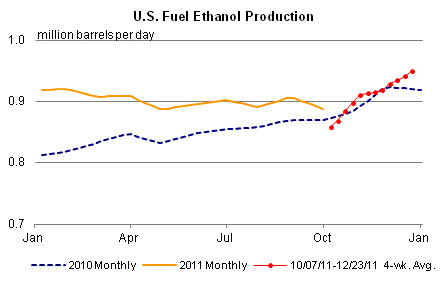
In the past 30 months Valero note that the EBITDA reached 90% of the purchase price of the 10 plants it runs, and which produce an average of 72,000 bd collectively. Collectively, in the USA, ethanol production has continued to increase.

US ethanol production (EIA )

And there was one final graph from Valero that I almost missed, but which is, in its way telling:

Venezuelan exports to the USA (Valero Investor Presentation 2012 )

It should be noted that this plot is just for refinery products, and that Venezuela has continued to export oil to the US over the past year. However the figures for the 4th Quarter show an average of 793 kbd, down 9% on last year, and the three monthly averages were October 916 kbd; November 748 kbd and December 715 kbd all significantly down on last year. In 2010 the US imported an average of 1.24 mbd, about half of Venezuelan production, but since Venezuela has fallen to become the fourth largest supplier to the USA with the average of 760 kbd much of the remaining Venezuelan production goes to China, and India. But should Venezuela continue to decline in overall production, that global shortfall will need to be made up from somewhere else.

Read more!

OGPSS - Oil production from the North Caucasus

When the topic of Peak Oil is raised, one of the first responses that is often heard from those trying to explain why a peak isn’t going to happen, at least in the short term, is that technology will come up with new answers. These will allow greater production of oil through access to previously unavailable reservoirs, and an increase in the amount of oil that can be economically recovered from them. It is an argument that has had demonstrable success in the past. An earlier post showed that innovations in technology allowed the region around Baku in Azerbaijan to remain one of the centers of oil production since the time of the first Russian oil pipeline in 1878 through today. The statement is, unfortunately, not universally or ultimately true, but it does provide an introduction to today's topic.

The change from cable-tool drilling to rotary drilling resurrected production in the Caucasus after the Soviet Revolution, and the growth of production to include the areas of the North Caucasus also brought other fields on line. These were initially the fields around Grozny and Maykop and in combination they raised production to around 622 kbd at the start of the Second World War. In more recent times it has been, again, the introduction of the latest Western technology that has helped sustain Azeri production, and new technology is starting to improve and sustain production in the North Caucasus.

The countries, and some key locations, in the North Caucasus (after a map from the BBC News )

Georgia, through the port at Batoum (now Batumi), was one of the early exporters of oil from Russia to Europe.
The production of the northern Caucasus increased from 100,000 poods in 1877 to 1,656,000 poods in 1889. In the latter year Terek furnished 275,731 poods, Elisabetpol 3,000 poods, and Daghestan 3,955 poods, while in the Signakh field, near Tiflia, 55,296 ppods were obtained.
Note: poods were the early Russian measure of production and that there are 8.33 poods per barrel.

In the period from 1884 to 1914 Georgia exported a total of around 165 million barrels of oil of oil. This oil increasingly came from the fields around Grozny (now in Chechnya, Russia) and later from the fields around Maykop (now in the Republic of Adygea in Russia), even though there were considerable signs of oil in Georgia (oil sands near Signakh west of Tbilisi and gilsonite in the Guria district). The Grozny fields were producing about 18% of Russian oil (with the rest coming from Baku) in 1915.

Following the collapse of oil production with the Revolution and the end of Western ownership, it was the use of rotary bits that allowed production to ramp back up, supplying a seventh of Western European imports (John Grace – Russian Oil Supply), and providing needed income to the Kremlin.

During the Second World War the region became a target for German occupation, given that oil from the region was providing a third of German imports in 1940. (Daniel Yergin – The Prize) However although Operation Blau reached Maykop, the smallest of the three main oil concentrations, the oil fields had been destroyed, so that only around 70 barrels per day were left available. The German Army soon became bogged down in the siege of Stalingrad, to the North, and did not reach Baku.

The oilfields around Grozny were first developed in 1893, with 386 wells by 1917 and grew steadily. The Grozny field peaked at around 154 kbd in 1932, while the output from the entire Chechen-Ingushettia region, which fed to the three refineries at Grozny, fell to around 148 kbd by 1980 and to106 kbd by 1985. Grozny then became more of a pipeline terminal.

The first major pipeline, running from Grozny to the refinery at the port of Tuapse had been built in 1927. The pipeline was later extended to also pick up oil from the Maykop fields, and fell into disuse in 1968 when it was replaced with more modern pipelines to the rail terminals and oil terminal at Tikhoretsk, and that pipeline is now being increased in size to carry 250 kbd of oil. Overall the terminal which takes oil from the North Caucasus and Kazakhstan and forwards it to Novorossiysk, on the Black Sea, has a maximum throughput of 640 kbd. Part of the pipeline carried oil initially from Grozny to Baku, but with the onset of the Azeri-Chirag-Guneshli project flow is now reversed.

Grozny has had an unfortunate history with the surface structures being largely destroyed, first in the Revolution, and then by German bombers. The town and facilities were rebuilt and became the center of the local oil business. The Chechen wars of 1994-96 and 1999-2000 then largely destroyed the center of the city. Similarly the oil wells in the region were impacted, in the 1994 war only 100 wells, out of 1,500, were operating by the turn of the year.

The more recent finds, that are resurrecting the promise of the North Caucasus come, however, as do many recent discoveries, offshore. Lukoil carried out a series of explorations in the North Caspian between 1999 and 2005, finding six large fields off the Dagestan and Kalmykian coasts. These were Khvalynskoye, Yuri Korchagin (50 kbd) , Rakushechnoye, Samatskoye and Filanovsky. The fields were initially assessed at around 4.7 billion barrels of oil, with the Valdimir Filanovsky being claimed as the largest new oil reserve discovered in Russia in 20 years. The initial well flowed at 6,400 bd with reserves estimated at 600 million barrels, with 34 billion cu. m. of natural gas. Overall North Caspian production was anticipated to peak in 2013 at 170 kbd, but Filanovsky alone, due on line in 2014, is now anticipated to reach 210 kbd with production initially coming from 11 directional wells with horizontal completions. To reach these levels Lukoil will be investing some $22 billion.

Location of the Korchagin field (Lukoil )

Looking further into the future Lukoil are expecting to be able to further develop the North Caspian to reach a production capacity of 320 kbd of oil and 13 billion cu m of natural gas per year, by 2020. Lukoil expects that the increase in production will be able to offset declines that are anticipated from Western Siberia by that time.

The introduction of modern technology is thus helping to increase production from regions that were, at one time, thought to be exhausted. It should, however, be remembered that horizontal wells have now been around for some 30 years. One wonders what ,so far unpublished, new technologies will appear to help within the decade, since to have an impact they must be widely accepted and adopted, and I don’t hear of much.

Design of the Filanovsky platform (CNGS Group )

Read more!

Sunday, January 1, 2012

And some "change of year" thoughts on climate change

The year has been quite mixed for those who follow the climate change debate. Those who have developed the CO2/temperature theories and predictions on which much Government action has been based, remain largely as much or more in control as they have been in the past. Governments in place, whether in Europe, Australia or the United States are sufficiently convinced that the theoretical predictions of future higher temperatures are correct that quite significant changes in fuel policy have been put into place. This change is now placing greater reliance on renewable power sources, with natural gas seen as the back up and replacement power source during the transition away from historic fuels. And the historic fuels of the late twentieth century, coal, oil and nuclear power are being consigned to the scrap yard as fast as legislation and political power can move them.

Yet at the same time the economic realities are biting into the renewable energy business. In Spain the largest solar power station is just coming on line but the funding to continue the transition (which some of us might designate as the experiment) is beginning to disappear.
Even if government cuts do not deepen, which is unlikely, the Ernst & Young report claimed that a gap of $22.5bn on investment in renewable energy and subsidies is likely to emerge across 10 leading world economies in less than four years. Among them is the UK where the shortfall is estimated to be $5bn, while in Spain – effectively confirming Kistner's fears – it would be $6bn.

The Ernst and Young report came out in November, and reflects a growing concern about the ability to find the financing required to continue construction of wind and solar farms, even as the fossil fuel plants are being closed. European finances are in a difficult phase for other reasons, but in addressing rather large problems elsewhere, the funding and subsidies for renewable energy are likely to be reduced. The problems of a growing gap between the power that will be required in the future and that which will be available are so far being glossed over, but that is not an issue that can be hidden forever.

The arguments over the need for reducing the production of carbon dioxide continue to prevail in the mainstream. However, much as there was a change from Anthropogenic Global Warming to Climate Change, when the planet didn’t take the hint and follow the predicted model temperatures (even when assisted with a little judicious “adjustment” of recent trends, as the individual state temperature study revealed) so now there is the beginning of a move to change the concern from Climate Change to the increase in Extreme Climate Events induced by the changes in the atmospheric composition.

This allows those who wish to gut the current methods of energy production to make claims that any extreme event (including those where there is a lower than normal temperature) can all be laid at the feet of fossil energy production. This argument fails to consider that the study of events, such as cyclones, hurricanes and tornadoes have been going on for decades. Professor Curry implies that Kevin Trenberth was the initiator and instigator of this change in focus, and NOAA wants to allocate “the blame.” (Which sort of implies that before we had a power grid that perhaps we didn’t have extreme events.) Naturally the role that atmospheric compositional changes has in influencing these events will be evaluated by theoretical models – and naturally that will require more funding for bigger and better computers and more time build and run the models and to address the issues that arise . . .

The problem with establishing an industry built around modeling climate change and its effects is that in order to justify next year’s budget new ideas have to be advanced each year in order to keep those government dollars running and after a while it becomes harder to find those new concepts. The role of attribution of extreme events seems to be one of those newly developing tangents.

After a while the need for justification requires that somewhat wilder claims will be made, and while the main stream press is remarkably supine in accepting the statements made in published papers, there are times where credulity is challenged (on both sides). A relatively rare look at the truth of conflicting claims in two opposing op-eds appeared in the Houston Chronicle recently. The two pieces that were reviewed were an op-ed in Salon which lauded the arguments that extreme events are getting worse, all due to climate change. The review compared this with an editorial in the Colorado Springs Gazette which suggested that the Global Warming theories were losing their credence.

The first article had eight statements of fact which were:
By my reckoning, the strong evidence scorecard is 2 correct, 2 mostly right, 1 mostly wrong, and 3 wrong. I think this means that the author is able to type with one eye closed and his finger stuck in one ear. It’s difficult to argue that climate change is not a hoax when half of your debating points are the equivalent of hoaxes.
On the other hand, by putting up a plot of recent temperature trends he undercut the argument of the writer in the Gazette with no further criticism needed.

Which I suppose brings me to my ending gripe for this post. Those who are concerned over global levels of carbon dioxide have been every effective in selling the message that if you disagree with them, then you are saying that global warming is not happening. You are therefore a denier, and, by association with those who denied the Holocaust, you are an idiot.

One of the consequences of the Hockey Stick graph that Michael Mann has partially built a career on was that it denied the presence of the Little Ice Age. He has since, grudgingly, changed his mind and admitted its existence, but the recognition that the globe has been warming since the depths of the LIA has been neglected. Explanations for that warming trend have to be provided and the relative proportions of natural and anthropogenic warming properly evaluated before a truly valid discussion can be had over the role of the atmospheric composition, as opposed to the solar variations, on our climate. Just saying that the only thing that explains the change is rising CO2 becomes less persuasive as global temperatures fail to follow the predictions that, for example, Dr Hansen made in starting the whole shebang.

But those discussions are not held. With the imposition of the assumption that carbon dioxide is driving global climate change and forcing weather events to be increasingly extreme the goal posts are moved so that we do not discuss the weakness of the underlying argument.

The global financial changes are going to force governments to face more squarely the relative costs of their commitments to reducing carbon emissions. As they do so, they will need to justify backtracking from some of their earlier promises. At such time, while theoretical scientists demand more money their programs, justification and validation will be under increasing scrutiny and competition for funds may change the playing field. In future years it may be said that the high water marks of the climate movement were either just before the Copenhagen summit, or with the passage of the recent agreement in Durban. From here it may be increasingly downhill.

Read more!

Wednesday, December 28, 2011

OGPSS - Some thoughts at the end of the year

For most of this past year these posts have reviewed, and then discussed data on the state of different reservoirs of oil and gas that ultimately provide the power that we need and use every day. However, as we come to the end of 2011, it seems as though there is a gloss, or spin, being applied to stories about the state of global energy supply, which implies that concerns about future energy supply are overstated. Instead the impression is left that there will be, in the immediately foreseeable future, no return to shortages. So this post will be a more general view of the topic, less concerned with absolute numbers and references but rather seeking to suggest that these perceived words of wisdom are, like the promises of a return to $30 oil that we heard only three or so years ago, likely to fade into oblivion once they have served their immediate purpose.

It should be noted up front that there are considerable differences between the supplies of natural gas that are becoming available, and those of crude oil. Natural gas reserves are still increasing, I wrote just recently of the realization that exists in Azerbaijan that the gas being produced from the Shah Deniz field will have a hard time competing in the global market-place in three years, because of the arrival of natural gas from the Levant Basin. The relatively low prices for natural gas in the United States brought about by the development of wells in the gas shales, such as the Barnett, Haynesville and Marcellus and their initial high productivity will continue to make it difficult to see much increase in price. Yet this is at a time when the price that the natural gas is being sold for in America is around $3.50 per thousand cubic feet (kcf) ($124 per thousand cubic meters (kcm)). That price is often insufficient to totally cover the costs of its production and return a profit to all the investors, with some indications that such a price would need to be closer to $6.00 per kcf. The low price of natural gas however, relative to world prices, means that it helps to keep American industry competitive, since fuel costs are usually significantly lower here than elsewhere.

China continues to show foresight in acquiring fuel, since their agreement with and the creation of the pipeline from Turkmenistan now gives them natural gas at a competitive price ($280 per kcm - $7.93 per kcf) relative to the $400+ per kcm that Russia is charging Western Europe, though that price too will be vulnerable to supplies made available as the Mediterranean fields come on line.

The bent of the stories that have recently appeared seem to imply that the United States is moving toward significantly greater crude oil production, and thus a greater independence from foreign suppliers than will actually be the case. Folks such as Dr Yergin are projecting production of oil from the shales around the country as rising to some 2.9 mbd by 2020 and being sustained through time – neither of which is likely since the Bakken in North Dakota may well start declining and be significantly below 600 kbd within four years, and the likelihood of new developments bringing in more than this on a sustained basis are not great.

The emphasis on such a possibility, however, removes some of the pressure and concern in the short term over the health of the global supply situation, and the concurrent dependence of the United States on foreign fields and suppliers. One need not be (as perhaps the argument goes) so worried about the time to bring Libyan production back to 1.6 mbd. Optimistic reports talk of Libya reaching 1 mbd, yet still leave a concern that without a stable government and infrastructure that it will be a little difficult to reach those earlier production levels. And the promises that Iraqi production will rise to levels far above 3 mbd may be more dependant on political stability in a country that at the moment isn’t showing much. Any thought that the Arab Spring would bring swift changes in the governance of the countries involved, and leave oil exports to the world sustained at previous levels appear also to be less than realistic as countries such as Egypt begin to head into the second cycle of that revolution. The Syrian government is currently blocked from exporting (and thus producing) a third of their normal levels, which has taken 100 kbd or so from the market, and the situation with Iran continues to fluctuate.

Now there are some political benefits to being able to project that the world is going to have more than sufficient oil for the next few years, among them it distracts from the less than totally healthy state of the alternate fuels and energy industry. Exxon noted in their recent annual report that they see little significant impact from solar and wind energy on the overall global supply of power over the next forty years. Were the nation still fixated on where we were going to get our power over the next decade, then the collapse of Solyndra due to poor market support, and the bankruptcy of Range Fuels, because they could not produce cellulosic ethanol at the scale needed to have any impact at all, would raise worrying questions as to how we are planning to cope with shortage. The current optimistic state of mind, of course, also makes it less of an imperative to approve the Keystone pipeline, which may now not be approved.

Because of this lack of concern we see the Administration moving ahead to restrict further the use of coal fired power stations, through EPA enforcement of tougher emissions standards, the corn ethanol subsidies appear to be very rapidly on the way out, which may impact the volumes of ethanol (now over 900 kbd) that comes to the market in the future. But if the United States has become a net exporter of fuel, though mainly diesel, why should we worry? Perhaps it might be because that is such a small fraction of the overall total that it is really insignificant, even though it makes a nice headline.

The overall picture of crude oil supply to the United States, in reality, has hardly changed at all. Yes, demand for gasoline is down as cars are being driven less these days, and fuel economy changes have some small effect, but the economy is not robust (nor is that of Western Europe) and sustained high fuel prices are not going to help with recovery. At the same time demand in Asia continues to increase, and more nations in the Middle East and elsewhere are shipping oil to China in agreements that will still be in place were the United States to continue to recover and suddenly need additional oil to sustain that recovery of growth.

Current complacency and spin will not make those agreements go away, nor – by magic –will additional oil appear to assuage American demand. The only question that I have is whether the current spin can be maintained through 2012. It is certainly unsustainable through to 2014, and what impact the realization of reality might have, were it to become obvious by say September of this year, as the election enters its final phase is an ongoing puzzle.

We live in interesting times indeed, and I hope that you all have a Prosperous and Happy Year, as we sail into that future, and I look forward to commenting on some of these issues as we move through those times.

Read more!

Monday, December 26, 2011

On giving to the charities Heifer International and Smile Train

This post is a little outside the usual frame, but arises from that little bump of curiosity that keeps me writing these posts.

Background - For Christmas this year the Advocate had asked that we donate to a couple of charities that he supports: the Heifer International operation and Smile Train. Both of these are nationally advertised operations that function at above the $120 million per year range, and have received considerable positive publicity. Since I found more answers to questions I hadn’t initially thought to ask in a brief look at both operations, I thought I would pass on what I found. It may bear a little on your choice of giving.

Heifer International provides a catalog from which you can select animals, from camels to fish fingerlings, that the organization will provide to individuals in poor areas of the world, providing them not only with additional nutrition but also a way of starting a small business, as an aid to breaking their cycle of poverty.

My curiosity arose initially because I wanted to find out if there was any particular piece of livestock that would give a higher rate of return on the investment than others. My thinking was, illustratively, that perhaps it would be better to donate to buy a water buffalo, rather than a heifer, because of the additional work that the animal would be able to carry out, as well as providing milk, manure, and ultimately dinner. I had some fun for about an hour trying to tease out different rates of return, a heifer in Malawi could generate up to $130/month in milk revenues - helping to feed the family, while selling some milk, generated $60 a month in Uganda. On the other hand water buffalo in the Philippines would quadruple farm production, but still only up to $42 a month. Pigs could generate $45 a month (but how many?) and two alpaca will create 4 lb of wool a year at maybe $6 a lb, or just $2 a month – they must have other benefits. While the actual benefits weren’t always clear, as I poked through, my original choice of livestock didn’t look too bad until I came to a disconcerting post which pointed out that my research had actually been time wasted.

For the post pointed out that, had I bothered to read it, that this is what it said, at the bottom of the donation page.
To help the most number of families move toward self-reliance, Heifer does not use its limited resources to track gift animals from donation to distribution. Gifts made through this catalog represent a gift to the entire mission. We use your gifts where they can do the most good by pooling them with the gifts of others to help transform entire communities.
I must confess that, when making the donation I did not bother to read that small print at the bottom of the page, which may have now been changed to
The prices in this catalog represent the complete livestock gift of a quality animal, technical assistance and training. Each purchase is symbolic and represents a contribution to the entire mission of Heifer International. Donations will be used where needed most to help struggling people.

Now it is understandable that tracking individual gifts may be difficult and expensive, and I really did not expect that I would hear that a particular family had received the buffalo (see this video of what might be done), but I had hoped that someone (and in my imagination it was in Nepal) would get a buffalo, and now I was left wondering about the funding and where it actually might be going. There are, it turns out, other beneficial things that are being done with the money apart from the mission that is most heavily advertised. They help start farmer organizations and work with the International Red Cross in bringing war widows and Untouchables into the Nepalese community.

I also found a note which describes the policy in more detail.
Heifer provides community groups with livestock if and only if they request it after training in community values and studying the available resources. If they submit a strategic plan showing how they will care for the animals, how having livestock will substantially increase their livelihoods, then and only then does Heifer provide support. And then we ask that they source animals locally and “pass on the gift” of offspring AND TRAINING to others. The farmers use manure as organic fertilizer to increase crop production, plant trees to preserve the environment, raise honeybees and worms for composting, and on and on.
The Charity raised some $133 million in contributions in the year ending June 30, 2008, with the outgoing CEO getting some $288,912 in compensation. The overall organization had a paid staff of some 332 at the time, and fund raising used about 14% of contributions. Apparently the charity has also built a “Global Village” down in Arkansas, that has received some criticism since it detracts from the overall mission. (I suspect we will be travelling to Arkansas in the none-too distant future.) It appears that the charity had some 928 active projects, in 54 countries in 2009. It was sufficiently worthy that the Bill and Melinda Gates Foundation gave it $42.5 million (and they are reputed to do a fairly thorough review before they give the money). In the current annual report support is stated as being given to 1,000 families, with typical project support lasting over five years. And in the latest report it also gives some of the information that I started out looking for:


The average income gain from the project is $3,808 in Albania (equal to the average per capita income). In Nepal it is $572 (against income of $427) and in Uganda it is $1,456 (against an average income of $490).

Looking at the relative return on investment for donors - in Albania the ROI (annual dollar income per dollar for livestock) is 9.46 for cows; 7.51 for goats and 10.6 for bees. In Nepal it is 3.7 for cows, 2.87 for buffalo, 1.79 for goats and 0.8 for pigs. In Uganda it is 2.6 for cows and bulls, 5.72 for dairy goats but 9.75 for meat goats, while pigs bring in 8.32 and fish return 11.22.

However as Heifer notes the income is not the only benefit. Firstly the recipient has to pass on one offspring to another recipient in order to sustain the program, but then the recipient also has a steady long-term increase in assets that come from the additional offspring that the original gift produces. Thus, in Malawi, 90 initial beneficiaries are expected to grow to 130 families by the end of 2012. And in Uganda 118 original gifts of heifers produced offspring that were handed on to a second wave of recipients, so that, to date, some 223 families have been assisted.


This does, however, resurrect the question over how many different gifts of livestock are made each year. Typical projects are of about five year duration, with the first year being one of instructing the recipient on how to care for the gift, and in preparing the “compound” (livestock must not be allowed to roam and graze, but are fed within this enclosure which helps with collection of manure for fertilizer). The second year is where the recipient receives the gift, and, depending on species, at the end of that year or during the next, the first recipient will initially raise and then pass on an offspring to a second beneficiary. (It is not clear if the process continues thereafter with that second recipient also having to pass the “first child” on in turn, so geometrically multiplying the benefits over time). There are two more years of monitoring to ensure that the health of the gift and the economic welfare of the recipient, and to integrate the individual into a community to better market the product. The initial recipient also keeps (or sells) any additional offspring. For example one of the success stories told in the 2006 report was of a disabled Chinese farmer who received an initial gift of 12 goats in 2002. By the time of the 2006 report the family had increased the herd size to 230 goats (as well as passing on the 12 gift goats to other farmers). It is this kind of growth, that leaves the farmer independent and successful, that is a major goal of the program.

Perhaps I can express my concern, however, better with another example. From 2005 to 2009 the Moutori Livestock Development Project in Burkina Faso provided 400 chickens and 80 roosters to 120 original families. If we take the donation cost of the chicks, say 120 times $20, then the livestock cost is $240. The overall project cost was, however, $148,644 (project 21-1203-70).

Put another way, the goal in 2005 was to give livestock to 1 million families over 10 years. That is some 100,000 a year, but since this includes pass-ons from the original recipients. Heifer International only supplies livestock to 50,000 families a year. If each donation is the equivalent of a heifer (though it may be three or four goats, or perhaps two water buffalo) then the initial livestock cost (as defined in the catalog, and that seems about right) is $500 per family. 50,000 times $500 is $25 million. (And that is making a generous assumption, since as shown with the chicken example, livestock costs may be a lot less). With the charity taking in more than $133 million a year, it does point out that the animal supply part of the program, the donations for which provide the vast majority of the income for the charity, sees less than 18% of the income. Now that is not to say that the rest of the activities of the charity are not worthwhile and necessary, but it is not quite the way I had thought my donation would go. Putting it in perspective, while I thought we were contributing a water buffalo, the actual livestock part of our donation was more likely to have been one of those chickens. Ah well, as was said about the Harding and Coolidge Administrations who had put a “chicken in every pot,” that is a step toward prosperity, but it is not "one giant leap for mankind."

Which brings me to the Smile Train. It is important here to distinguish this charity from Operation Smile which has basically the same goal of treating impoverished children born with cleft lips and palates, and has been around a little longer. The founder of Smile Train was apparently once involved with Operation Smile, and started this similar charity in 1999, though with a different approach to the problem. In contrast with Operation Smile which sends American surgeons abroad to carry out the surgery, a practice for which it has been criticized, Smile Train relies on training and funding local surgeons in best practices.

Number of surgeries performed with Smile Train Support (Smile Train Annual Report )

They report helping 100,000 children a year, working with local doctors to carry out the surgeries and providing information to them on up-to-date techniques to improve the procedure. They also report having distributed software to more than 38,800 medical professionals, and run conferences and encourage methods of communication that keep these individuals up to date on their subject.

In 2010 their income (including contributions in kind) was some $162,296,235. They spent some $110 million on program services and education, and around $22.5 million on fundraising, claiming only $1,187,089 for management and general costs. There should be a little caveat here. (One of the two niggles that I have with this charity). The co-founder and President, Brian Mullaney, was compensated to the tune of $678,058 in 2009. And the books showed that the assets of the charity increased by $28.5 million, to $135 million. It claims to be one of the fastest growing charities in America, and apart from the President’s pay, the size and rate of growth of these assets is the second item that is a bit of a concern. The reason goes back to a remark that the President, Brian Mullaney, made in 2008.
Mullaney estimates that Smile Train is close to reaching a historic break-even point: it will perform more operations each year than the number of children born each year in developing countries with cleft deformities. This means Smile Train may be well on its way to putting itself out of business. “That,” Mullaney says, “would be a dream.”
Unfortunately before one reaches that laudable point, the charity will reach another, when it “runs out” of doctors to train and reaches the capacity of the system to handle patients in a given year. At that point the charity may take in more money than it can effectively spend.

That is not to say that the charity is yet at that point, it has been noted that there is still a significant problem in India, for example, where over a million children need treatment, with 32,000 new cases a year. But it may be running out of “room to grow.” It has also been criticized in that the cost of the surgeries is often higher than the $250 which is used in the advertising . If the number of operations per year, for example, is 100,000 and the program services (treatment and training) cost is $85 million, then the cost per surgery is perhaps $850, doing simple division.

And yet nevertheless this seems a very worthwhile activity to support, though maybe it is getting a little too successful at fund-raising, which might cause it to add other programs and thus dilute its effectiveness on the original task in the years to come.

And so, a couple of closing thoughts.

First I am not, in itself, against programs that send American physicians abroad to help with medical problems in disadvantaged countries. My optometrist, Bud Falkenhein, has won national recognition for his work in this field, where he annually has led a group of optometrists to different parts of the world to help with eye problems. But that is slightly different from bringing in teams of surgeons that do operations under time pressure and then leave before any development problems have been dealt with.

Second, I am still glad that I honored the Advocate’s request and made the donations to two charities that seem to be a cut above the general mix; it is merely that I thought that the funds that I sent would have been more productive than they will likely turn out to be. There is, after all, somewhat of a difference between a chicken and a water buffalo, and between one operation and two. (And yes - because my great grandfather was a village plowman, a position of respect in the Scottish villages a century ago - I am just a bit disappointed that I could not help another individual gain that "step up" with the donation that we made).

P.S. I also recognize that there are other charities who allow one to donate animals. For example Episcopal Relief and Development has a "Gift for Life" program, where for just a little more money I could donate a plow with the ox to pull it. Perhaps I will look into that in a little more detail, and perhaps add another comment on a charity that I have, in the past, looked favorably on, but whose website is not available tonight.

Read more!