Showing posts with label ash travel. Show all posts

Monday, May 23, 2011

Icelandic volcano update, and a comment on Joplin

We are all reminded of the sudden changes to plans that nature can enforce, at little notice. The eruption of the Grimsfjall/Loki volcano in Iceland continues, and there are now reports of animals beginning to die, as the ash continues to blanket the island. The ejection rate is running at around 1,000 to 2,000 tons per second, and the volcano is considered to be several times the power of last year's eruption. (It can be seen on web camera here). Airlines are allowed to fly, by UK regulation, where the ash density is less than 2 gm per 10 cubic meters of air.

Although the volcano is more powerful than last year's eruption, the magma is not shattering into as small a particle range as happened last year, the fragmentation comes when the hot magma meets the ice or water in the overlying glacier. But as the eruption continues the immediate overlying ice is all consumed, and without that the magma will flow as more conventional lava. The reducing availability of ice and water, even as the magma continues to flow, means that the problems that the ash cloud generates may be more transient than last year, where European airspace was closed for a week.

The threat to European Airspace 23 May 2011 (flight radar 24)

The cloud, which has closed Icelandic air space, is now approaching the UK, and has already caused President Obama to move his trip to the UK forward a day , so as not to be at risk from flying through the cloud. At present the cloud is close to Scotland, and it is expected that that airlines will cancel flights to affected airports. Some already have and the effects of the eruption could soon spread into Europe. However, with the changing ash size, as the water and ice is all used up, so there is hope that the ash plumes will decrease in size, and that Iceland may be able to open some airports as soon as tomorrow.

UPDATE: The picture above was taken late in the evening of the 23rd, the following picture is at around noon in the UK on the 24th, and flights are already being cancelled as the cloud becomes too dense at certain altitudes for planes to fly.


One of the questions, however, is as to whether the volcano may change from issuing from a single vent into a situation where the magma finds a second channel, which would put the second outlet back under ice, and give a secondary ash cloud. This might then spread south, giving a more continuous problem that would extend over time. The extrusion of magma from a series of vents along a fissure line is characteristic of the Laki eruptions which lie to the south of the current site.

While the impact of that natural event continues to unfold, the disaster in Joplin was there and gone in almost no time, with winds of up to 198 mph. I looked out of my window 150 miles East of there last night, and saw a storm coming in, gave it no more thought and went to bed. This morning I awoke to hear that 89 people had died, (now updated to 116) and that about a third of the city of 50,000 was destroyed. It is a city where many off the folk that work at KMT, a waterjet manufacturer in Baxter Springs KS, live and these include a number that have graduated and worked with me at MO S&T. Sadly I have heard already that three that I know as friends have lost their homes and all that they possess, and that of the six employees of the firm who did lose their homes, one also lost his wife.

Our thoughts and prayers are with them tonight.

Read more!

Tuesday, April 20, 2010

Winds, plumes, travel and the Iceland volcano is not predictable

Following an increase in the ash clouds generated by the volcano at Eyjafjallajokull NATS has issued the following statement for today:
The situation regarding the volcanic eruption in Iceland remains dynamic and the latest information from the Met Office shows that the situation today will continue to be variable.

Based on the latest Met Office information, part of Scottish airspace including Aberdeen, Inverness and Edinburgh airports will continue to be available from 1300-1900 today, and also south to Newcastle Airport. Restrictions will remain in place over the rest of UK airspace below 20,000ft.

Overnight the CAA, in line with new guidance from the International Civil Aviation Organisation (ICAO) decided flights above the ash cloud will be permitted in the UK; between 1300-1900 this will enable aircraft movements above 20,000ft in UK airspace.
The Met Office, whose models of the ash cloud have come under criticism has responded by noting
The Met Office uses multiple dispersion models endorsed by the international meteorological community. The output from the Met Office volcanic ash dispersion model has been compared with our neighbouring VAACs in Canada and France since the beginning of this incident and the results are consistent.

Our models are confirmed by observations which have seen ash in the UK and south of England. These include:
• Met Office and NERC aircraft have observed volcanic ash in UK airspace at varying heights.
• Multiple land observations have recorded ash in the skies across the UK, including across southern Britain.
• Balloon observations have shown a 600 m deep ash cloud at an altitude of 4 km across parts of the UK.

NATO F16 fighter jets have reported engine damage, due to volcanic ash when flying through European airspace.
And given that there is some blame now being tossed around the main stream media, as well as some blogs, on who made what decision they go on to point out
It is for the aviation industry and regulator to set thresholds for safe ash ingestion. Currently, world-wide advice from ICAO is based on engine and airframe manufacturers stating a zero tolerance to ash ingestion. This means that aircraft should not be exposed to any volcanic ash.

Eurocontrol is trying to get this restriction eased, with the support of some airlines to:
A proposal by Eurocontrol, the intergovernmental air traffic body, to European transport ministers suggested the implementation of a no-fly zone limited to the visible ash plume as determined by satellite images and adequate buffer areas which could be updated on a six-hour basis.

The current map of the ash that the Met Office has produced shows that there is a way of getting from the US to the UK without going through the cloud, but only as far south as Newcastle. There are moves to do a better job on predicting where these flight paths would be. While planes can now fly over the UK, it is getting down through the space below 20,000 ft that contains the ash that is the problem, and you have to do that if you are landing or taking off.


But it also shows how the ash has put a barrier between Northern and Southern Europe.

After the height of the cloud being produced had reduced over the past few days, there was hope that it was not getting high enough into the atmosphere to reach Europe (i.e. below 3 miles). The latest outburst, however, put more material higher into the atmosphere strengthening the cloud once more.

I wrote yesterday about the size of the particles, and why those that are in the 50 – 100 micron range are particularly dangerous as abrasive cutting threats to aircraft. Smaller particle sizes, around 5 microns, are the greater personal threat, since these very small yet sharp particles can be breathed into the lungs and do damage, both chemically and mechanically. Larger particles fall out of the cloud fairly rapidly but the smaller particles, which are formed both from the contact of the molten lava with water and ice (which causes it to shatter) and from the bursting of bubbles of gas that are being emitted within the molten rock, and burst as it reaches the surface, are the ones carried higher both by the relative heat of the plume, but also by the prevailing winds.

Part of the problem that is sustaining the cloud has been the warm weather with a fairly steady wind direction although this is swinging south, with the predictions through Friday suggesting that the cloud may intensify while narrowing. There is some hope that an increase in wind speed could displace and disperse the ash already over parts of Europe confining the restricted zones (which sadly seem likely to include the airports of the south of England) to a narrower band. The projected path of the wind does seem to vary with forecasters, this is from Accuweather, which has the cloud sweeping back north over Scotland, and moving away from the southern airports, while the Met Office view (above) has the cloud further South and covering them.

Projected Ash Cloud path (Accuweather)

Winds at the level of the ash plume are also expected to become more aligned Tuesday into Wednesday, which may result in the ash plume becoming more concentrated and posing a greater threat to air travel. This, of course, is assuming the volcano continues to erupt through then.

On a positive note, AccuWeather.com meteorologists expect this greater alignment of the winds to cause the ash plume to become narrower and affect a smaller area.

Looking at American Airlines policy for future travelers, while the notice says:
Due to the ash plume from the volcano that erupted in Iceland, some of American Airlines operations have been disrupted. Ticketed customers whose flights have been cancelled are being re-accommodated on other American Airlines flights with available seats. If a customer whose flight has been cancelled decides to cancel or reschedule their trip instead of continuing travel, that customer is eligible for a refund on any unused portion of their ticket.

In addition, American offers customers whose flights have not been canceled, but who are traveling to or from the impacted areas in the next several days, the convenience to change their plans. Ticketed customers may change flights as shown below, without incurring a charge for changing their tickets.
In essence the “shown below” says that passengers who booked flights before April 16th, and who plan to fly between the 16th (when this started) and the 22nd (Thursday) can change tickets without penalty only if they rebook their flight to occur before May 3rd. Part of the problem with that is of course no-one knows how long this will go on, and in my own case I have to be back here by a certain date, and so am a bit restricted in my options. (Oh, and they only allow one re-booking).

Read more!

Monday, April 19, 2010

Some thoughts on aircraft damage from the Iceland volcano

There is increasing pressure on the governments in Europe to allow commercial aircraft flights to resume, because of the financial hardships they are suffering. At the same time the impact from the absence of teachers and students in classes, as they resume after the Easter break, has caused some additional problems around the UK. Unfortunately just having commercial companies take jets up and fly them around for a while, does not necessarily prove that the skies are completely safe. There is also a little discrepancy between the commercial company reports of no damage to their planes, and the damage to a Belgian F-16 plane that came back with deposits in their engines (this is separate from the Finnish F/A-18 problems). The build-up of melted ash can be seen on this borescope picture of the inside of one of the Finnish engines.


The deal that has been developed with break the airspace into three separate parts, that which remains closed, that which is restricted and that which is open, based on the conditions in different zones. The problem now will come in determining and maintaining the records of what the conditions are like along different flight paths, so that pilots and airlines can make the best judgment of how, where and if to fly. The process cannot be left to the pilots since it is very difficult to discern when the particle cloud reaches a level of intensity that can cause problems.

The melting of the ash particles so that they coat the inner parts of the engine, possibly closing off critical openings in the engine are the most common problem that a plane will apparently encounter in a brief exposure to the ash cloud. It is not, however the only problem. A 747, for example, flies at a cruising speed of 567 mph. This converts to 830 ft/sec. At these particle velocities there is an entire commercial industry out there that uses such particles, in a waterjet stream, to cut through a wide range of materials. As an illustration, this is a half-inch thick piece of titanium that one of my graduate students cut using such a system. The jet was travelling across the piece at a speed of several inches a minute, and cutting all the way through (the cut was made fairly slowly to ensure an acceptable surface finish). In steel when running a standard quality test the jet of abrasive, which carries about 0.8 lb of abrasive particles in every gallon of water, will cut to a depth of about 1.75 inches at a cutting speed of 1.5 inches/minute.

Half-inch thick titanium sheet cut through by abrasive slurry jet. (The face visible if that which was exposed by the cut).

If the impact speeds are higher, then it is not necessary to have particles in the water, though that generally requires higher impact velocities. (There is this story about Andy Fyall of the Royal Aircraft Establishment - Farnborough, a Concorde and a typhoon that I don’t seem able to find on the web! But I remember it from an early ELSI conference).

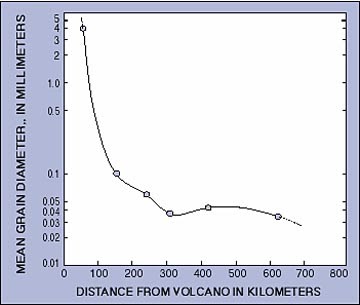
The particles that are used in cutting are quite small (they typically come out of orifices that are smaller than 0.03-inches) but they are quite densely packed in the jet, relative to those encountered in the plume of a volcano, but at high speed it does not take that many to start to do damage. Damage is reduced, however, at particle sizes below 100 microns, (0.1 mm). So the question is, how big are the ash particles? While there is not enough data yet on the current eruption particles, there is some from the eruption at Mt St Helens.

Particle size v travel distance (Sarna-Wojcicki and others, 1981)

The particles that will travel furthest appear to be mostly in the 50 micron and below range, though 100 km from the volcano there will still be 100 micron particles in the cloud that could be significantly damaging. (Respirable particles are down in the 5-micron range).

The question thus remains as to how to tell if the particles are there in sufficient density to cause problems. And so far there is not a lot of consensus it appears on how that determination will be made. The problem also arises in determining at which height the plume is going to be, since the varying intensity of the eruption has been ejecting material to different heights. More recently higher clouds have obscured the plume, on occasion, from satellite view, which is partly because the intensity is, perhaps temporarily perhaps not, decreased.

There are, unfortunately a lot more things that we don't know, as yet, about the eruption, that will only be determined with time. Thus it seems a little better to proceed with caution at this point, until the techniques for establishing what is safe, and what not, have been clearly established.


Read more!