Showing posts with label diesel demand. Show all posts

Thursday, January 5, 2012

Alaska, diesel, refining changes and Venezuelan exports

The Iditarod dog-sled race commemorates the time in 1925 when serum had to be carried from Anchorage to Nome to counter a diphtheria outbreak and dog sleds were the only way of making it through. A different problem is now beginning to face some of the remote villages in that state, as it becomes more difficult and expensive to supply fuel reserves to get them through the winter. With supplies restricted and expensive to deliver, prices can rise as high as $7.15 a gallon, gasoline was $5.44 in Nome earlier this winter. I was reminded of that this morning, as the Russian tanker, the Renda, turned back for minor repairs before essaying the trip from Dutch Harbor in the Aleutian Islands to Nome carrying a million gallons of diesel fuel (which powers the electric generators) and 400,000 gallons of gasoline. The fuel would normally have gone by barge earlier in the winter, but storms led to that delivery being cancelled. Now the tanker is being escorted by an ice-breaker since the last 300 miles of the 700 mile voyage will be through ice that can be 2 ft thick.

In other Alaskan news the November figure for oil flow down the Alaskan pipeline averaged 625 kbd, which gets the flow above the 600 kbd level which becomes a concern in winter, since it can lead to ice and wax build-up in the pipe. The December figure should be released soon.
UPDATE: As of January 9th the Renda is 140 miles from Nome, but is finding it hard to make progress through the ice, which is under considerable pressure. The "dynamic ice" has brought both vessels to an occasional halt, and the ice is thickening.

UPDATE 2: The ice has been more than 4 ft thick in places, and pressure is closing the passage some times before the Renda can make it through. It is difficult enough that the 2 vessels took a 12-hour break on Sunday night. They made 53 miles of progress on Monday, with 100 miles still to go.

Positiion of the ships (the icebreaker is the Healy) relative to Nome at 5 pm Tuesday (Central time)

Diesel fuel prices in the rest of the country are continuing to fall, as the latest TWIP notes, although at $3.70/gallon on average the price is still some $0.50 per gallon higher than last year.

Change in Diesel prices (EIA )

The US is producing around 5 million barrels of distillate (diesel) a day, up almost half a million barrels from last year, with domestic demand running around 4 million barrels. The remaining million barrels is being exported, largely to Europe and Latin America. The EPA requirement for cleaner diesel in the US has, as a perhaps unintended consequence, brought the fuel into compliance with European usage, and opened that market to the industry. Coming at a time when Russia is seeking to lower exports of low-sulfur diesel in order to keep domestic prices down, as the Export Land Model bites again, and with China banning exports, US exports have risen to exceed fuel imports.

Increasing exports is a move of necessity for some refineries since the continued decline in domestic demand for gasoline is hurting refineries. Sunoco, for example, is getting out of the business.

Decline in US gasoline demand over the past two years (EIA )

Note that there hasn’t been as much change in the domestic diesel market.

Demand for diesel in the USA over the past 2 years (EIA )

In fact Valero, one of the Gulf refiners, projects that the diesel market will continue to grow more strongly than that of gasoline.

Anticipated world growth in demand for gasoline and diesel (Valero Investor Presentation 2012 )

It has, as a result, been suggested that the additional diesel which will be generated should the Keystone XL pipeline be approved, will largely go to export. It has been pointed out that the Valero Refinery is in a Foreign Trade Zone, the diesel that is refined and exported will not pay taxes on it.

Export Market for diesel (Oil Change International )

Exports from the Valero Refineries (Valero Investor Presentation 2012 )

In passing I noted that Valero also seems to be doing well with its ethanol operations.

Recent income from ethanol for Valero (Valero Investor Presentation 2012 )

In the past 30 months Valero note that the EBITDA reached 90% of the purchase price of the 10 plants it runs, and which produce an average of 72,000 bd collectively. Collectively, in the USA, ethanol production has continued to increase.
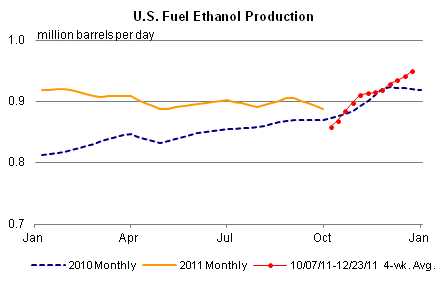
US ethanol production (EIA )

And there was one final graph from Valero that I almost missed, but which is, in its way telling:

Venezuelan exports to the USA (Valero Investor Presentation 2012 )

It should be noted that this plot is just for refinery products, and that Venezuela has continued to export oil to the US over the past year. However the figures for the 4th Quarter show an average of 793 kbd, down 9% on last year, and the three monthly averages were October 916 kbd; November 748 kbd and December 715 kbd all significantly down on last year. In 2010 the US imported an average of 1.24 mbd, about half of Venezuelan production, but since Venezuela has fallen to become the fourth largest supplier to the USA with the average of 760 kbd much of the remaining Venezuelan production goes to China, and India. But should Venezuela continue to decline in overall production, that global shortfall will need to be made up from somewhere else.

Read more!

Thursday, November 11, 2010

The Chinese diesel situation

Well it appears that we are about back up to $90 a barrel oil which is the top end of the range which the Saudi Oil Minister said he was comfortable with, the other day. However, I suspect that were it to go higher, it would not change the current Saudi plans on oil production.

It might, however, draw more attention to the problems of dealing with an increasing demand for oil, in face of a limited ability to meet that demand. OPEC have just announced that they see next year’s average demand to be at 87 mbd, up about 120,000 bd over their estimate last month. Whether that projection proves realistic will depend on what happens in Asia.

Refineries in Asia have been faced with an increased demand from China, where there have been recent shortages of diesel across country, likely leading to the price increases that have just been imposed. Part of the cause of the increase is because refineries in China were reported to be losing up to $18 a barrel in refining oil they were buying at $80 a barrel. (Diesel was at $2.43 a gallon, and prices have been raised 10%, which given the current oil price, still leaves the refineries making a loss). Nevertheless Chinese government data shows that refining reached a record volume (8.8 mbd) in October, at the same time that overall Chinese crude imports fell for the month. In light of the increased demand it is expected that this month’s production will be even higher. Sinopec will also import feedstock for ethylene production so that refineries that were being used to supply the feed can, instead, concentrate on making diesel.

The unexpected size of the problem has been caused by the Chinese government trying to lower electricity consumption to meet a national target for energy savings by the end of the year. As a result of those decisions coal-fired power fell back, in October to the levels of a year ago, after an earlier increase. Because of these cuts in power, those who still need it (including metal production plants) have switched to diesel generators, with the increase in demand overwhelming the available supply. (Though some have had to close including 100,000 tons of aluminum smelting capacity). Thus the situation may be transient and improve, with electricity supply, after the end of the year, though that is not necessarily a given at this point, since it is dependant on government policies. (And hidden in that discussion has been the Chinese record refinery outputs of gasoline, which also hit a new record this month.)

For countries in Asia outside China the situation is reversed. With the profit on refining Dubai crude at over $14 a barrel in Singapore, refineries around the region are seeking to increase imports of crude. (China has been a net exporter of diesel until recently, but demand had grown, until recently, at 13% this year leading China to the potential switch to becoming a net importer of diesel, though that is debatable.) There are thus some strains evident in current ability to match existing demand.

In addition to getting additional supplies of crude from Russia, China has also increased crude imports from Iran, helping that country at a time when gasoline rationing and sanctions are being blamed for an 18% drop in internal gasoline demand.

In the United States there has been an increase in distillate demand according to the latest TWIP that is somewhat greater than usual:

(EIA)

The heating season is however anticipated to be, in general warmer than usual (sorry NorthEast), reducing heating fuel needs.
Fuel expenditures for individual households are highly dependent on local weather conditions, market size, the size and energy efficiency of individual homes and their heating equipment, and thermostat settings. The National Oceanic and Atmospheric Administration (NOAA) projects population-weighted U.S. heating degree-days will be about 4 percent lower than last winter. However, heating degree-day projections vary widely between regions. For example, NOAA projects that the South, a large market for propane, will be about 17 percent warmer than last winter, while the Northeast will be about 4 percent colder. The largest residential propane consuming region is the Midwest, where 8 percent of the homes heat with this fuel. Projected temperatures in this area are 2.2 percent warmer than last year. EIA projects Midwest propane prices to increase by 18 percent this winter while consumption in that region falls by 2.3 percent, resulting in an expenditure increase of 15 percent.

Oh, and in case you missed it, following my piece on explosives on Sunday, just to prove that not everything in life goes perfectly, here is a chimney demolition falling the wrong way.

Read more!