Showing posts with label mud injection. Show all posts

Tuesday, August 3, 2010

Deepwater Oil Spill - tests end and the kill begins

Overnight there was a second set of leaks detected in the BOP assembly sitting on top of the Deepwater well in the Gulf, however these were successfully stopped by Tuesday morning and the flow testing of the well began. Oil was pumped into the well at several different rates, starting at 1 barrel/minute and ending at 7 bpm. During this series of tests the pressure in the well was monitored, and the results were sufficiently satisfying – “Textbook”, as Kent Wells noted, that the well is now in process of being killed as mud is fed into the well at a slow, but steady rate.

Admiral Allen described the plan, before the testing began on Tuesday morning. Somewhere at the bottom of the well oil has been flowing into the well, and before it was capped, out into the Gulf. To fill the well with mud, the oil that is in the well has to be pushed back through the flow passage into the rock it came from. There are some different flow dynamics involved in the flow back down the well, but given that the well has been flowing at rates of more than 20 barrels a minute, there was little reason to doubt that the flow could be reversed, as it was.

Increasing the flow up to 7 bpm allowed the engineers to monitor the increase in pressure that was required as the flow rate increased. The increase comes both from the higher resistance to flow as the oil moves down the tubular passageways to the bottom of the well, and in the increased resistance as the oil/natural gas Is forced back into the narrower passages in the rock itself.

UPDATE: Early on Wednesday BP issued a press release, announcing that the well has reached a static balance. In other words the weight of the mud injected has countered the pressure of the oil in the reservoir rock, so that there is no longer a pressure differential driving oil into the well. The process took 8 hours - less than was expected.


The equipment has been fitted with pressure transducers to measure the pressure at different points along the flow (though none beyond the BOP at the top of the casing). Admiral Allen described how this occurs.
We have three different sites where we're going to be taking pressure readings. And those pressure readings will be transferred every 12 to 15 seconds by wireless modem to their ROVs that are down there. And they'll be transmitted up into the control room here in Houston and be monitored continuously.

In addition we have what we would call an analog or a traditional dial-type pressure meter. And an LED readout that the ROVs will actually have a camera on and be looking at. So there are potentially five different pressure gages we will be reading to monitor the pressure.

This tells us a couple of things. It tells us the capacity of the system to absorb a volume of oil or mud. It tells how much pressure we are exerting when that volume goes in. We've established a maximum pressure inside the capping stack of 8,000 PSI. That will guide how much pressure is being used to push that mud in. Excuse me, the base oil.

And in the conclusion of several hours of doing that we will have a profile of how the mud will flow, how the well will react to the volume, and what kind of pressures we can expect to be generated. And then there will be curves established for if – we're filling the mud just into the casing, or the casing in the annulus. How we can expect how much mud will needed because there is more of this wider diameter, and the type of pressures we can expect based on that diameter and that volume. And then we will track the actual mud as it goes in during the static kill against those pressure versus volume lines.
(Edited to note that the instrument is a Light Emitting Diode (LED) display and that the vehicles are Remotely Operated Vehicles (ROV) and not as transcribed).

The tests were successful, and Kent Wells reported on the success of the oil injection at 3:30 pm. BP also put out a press release, noting that they were beginning to inject mud into the well.
Based on the results of the injectivity test, BP started pumping drilling mud today at 21:00 (UK) and 15:00 (CDT) as part of the static kill operations. All operations are being carried out with the guidance and approval of the National Incident Commander.

The aim of these procedures is to assist with the strategy to kill and isolate the well, and will complement the upcoming relief well operation.

At this start of the injection it is not clear which paths the mud will flow down the well, but as Admiral Allen noted, by the time that 200 – 300 barrels have been injected, then the changing pressure in the well will tell where that mud is going. As I noted yesterday, the reason for this is in two parts. Firstly the oil flow has established a flow path from the reservoir up to the BOP, and outside of that flow channels where the oil is not flowing will remain full of oil, but largely unable to accept the mud as it is injected into the well (because fluid can’t be injected into a passage if there is no way for the fluid already there to escape). So the mud will push the oil back down the flow channel. But at the start of the process no-one knows if that channel included flow down through the production casing, flow down through the annulus around the production casing, or both.

Section through the well showing with the light yellow color the channels that the oil might flow through up the well, and which will be filled with mud.

Had the well integrity remained as it was planned, there would only be oil (the light yellow) in the center of the production casing after the well was brought into production by firing small shaped charges through the cement at the bottom of the well. There should be no oil in the outer annulus between the production casing and the rock. Obviously oil has been flowing up one or the other, or both, but no-one is sure which is the case.

However when the mud is added, then it will only flow down the well back along the path that the oil was taking. This will thus help tell which channel is being filled with mud. As a given amount of mud is introduced, then the weight of the column of mud will lower the pressure at the top of the well necessary to keep injecting the mud. (Which is sensibly the pressure in the reservoir less the weight of the section of the column which is oil and that which is mud). For a given volume of mud injected, knowing the length of the mud column from the change in the pressure value at the top of the well, it is relatively easy, knowing the cross sectional areas of the three options, to establish which of the channels the mud is flowing down through.

The mud is being injected relatively slowly, at about 2 bpm, but the channels are not that large so that within a few hours (in fact they should already know before I post this piece) they will know which path the oil is flowing through, and therefore where the leak at the bottom of the well is likely located. This will then help in the planning of the relief well. For although the injection of the mud should kill the well, so that there will be no flow into the Gulf, it will only be when then bottom of the well (and ultimately the top) are sealed with cement plugs that the well will be considered dead. Admiral Allen wants that to be clearly understood.
The Static Kill will increase the probability that the relief well will work. But the whole thing will not be done until the relief well is completed. The Static Kill is not the end all be all. It is a diagnostic test that will tell us a lot about the integrity of the casing. And the wellbore will tell us about the tolerance for volume and pressure. But in the long run, drilling into the annulus and into the casing pipe from below, filling that with mud and then filling that with cement is the only solution to the end of this.

And there should be no ambiguity about that. I'm the National Incident Commander, and that's the way this will end. It will be end with the relief wells being drilled, and the annulus and the casing being filled with mud and cement being poured.
And that, Hurricane Colin and other tropical depressions behaving, should be in the next couple of weeks.

Read more!

Thursday, July 8, 2010

Deepwater Oil Spill - adding mud to the well

Admiral Allen held another briefing today in which he elaborated a little more about the procedures to be followed when the two wells, the relief (RW) and the original (WW) are joined. He also promised that in a briefing tomorrow he will bring together the different numbers that have been used for well positioning - the measured depth and the true vertical depth – so that everyone can start talking from the same page. However, in discussing the connection between the two wells he broke down the process into four parts, and to illustrate these I am going back to the figure that I used yesterday, and making a couple of modifications to it so that the process might be better understood. I am also going to revisit my gripe about the “band of brilliant minds” which Secretary Chu put together, but who seem unable, in a timely fashion, to decide whether to allow BP to change the cap on the well, or not.

So to begin with let me start with the illustration from yesterday showing the possible configuration at the bottom of the lined section of the Deepwater Horizon well.


As I noted earlier, we don’t actually know how long the gap is in the cement around the production casing. It depends on how far up the annulus the cement was able to penetrate after it was injected from the bottom of the production casing. The bottom of the lined section is at 17,163 ft, and the bottom of the well is at 18,360 ft (according to Congressional testimony ). And, for reference, in his briefing today Admiral Allen said
Development Driller III, which is the lead drilling rig for the relief wells is now at 17,780 feet measured depth, within a couple hundred feet of the proposed penetration point of the wellbore.
Well it was at 17,700 ft on Monday, so the progress has been 80 ft over three days, but with 200 ft to go from the beginning, we should perhaps be about 120 ft above the intersection.

For those who want to do the math Haliburton, if my memory serves, injected 55 barrels of cement into the well at the bottom of the production casing, and the casing has a 7-inch outer diameter. I believe the last section of the well was drilled at 8.5 inch diameter from this bit of the Congressional information.
Operations Procedure for Cementing Production Casing
1. Ensure BOP has been tested (per compliance with approved APO).
2. Ensure 16" liner and blind shear rams have been tested (per APO requirements). Record pressure with volume pumped.
3. Pick-up and run-in-hole with 8-112" clean-out drilling assembly (same as drilling assembly)
• Oril-Quip Wear Sleeve Running/Retrieval Tool should be run in the 6-5/S" OP
4. RIH to bottom and wipe/work any tight spots (document)
5. At TO circulate per WSL recommendation / hole conditions
• If a short trip is not required, circulate per step 7.
6. If tight spots were seen, make a short trip to the casing shoe to ensure any tight areas have been properly cleaned up and mud weight is correct.
7. Once at TO again, pump a 100 bbl weighted / viscous sweep and circulate hole clean with a minimum of 1-1/2 capacity.
• Plan to set the 7" x 9-7/8" long string 50-60' off bottom
• Circulate and condition, as required, to clean hole and lower yield point for running liner (lower YP to -15 or as hole conditions dictate and keep gels flat).
• Do not need to set 16.5 ppg mud in rat hole as volume is only -4 bbls and a large volume may cause issues with the cement job or breaking down the
8. POOH and retrieve the wear sleeve.
• Do not rotate once the wear bushing has been pulled.
(That is an interesting document to read, in regard, inter alia, to the discussion on centralizers it notes:
Centralizer details: Weatherford Bow Spring subs (6) / Weatherford Slip-on (15)
I may revisit those procedures in a later post, since they contain several bits of information that has been debated after some earlier posts.

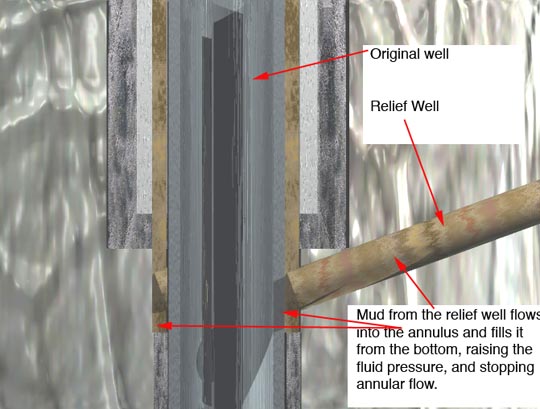
To return to the discussion of the kill process, the RW will drill over so that it intersects the WW in the gap zone below the last lined section. This means that the drill will enter the gap between the production casing and the well. At the point that the drill enters this space, the mud in the RW will flow into the WW, and be carried by any oil and gas flow up the well. At this time the mud pumps on the ships will kick into gear, and keep pumping in mud at a relatively high rate, so that the mud concentration in the column now flowing up to the surface through the WW annulus is as heavy (mud containing) as possible. The relief well is not cased but is, at this stage an open hole connection (i.e. just lined by the rock drilled through).


Once the mud reaches the surface, and the concentration, over time, increases to the point that flow up the annulus is halted (because the mud column weight exceeds the reservoir pressure) then – if flow is only through the annulus, the well has been killed. To seal it, the mud is displaced, at the bottom of the well, by injecting a cement plug into the well, that fills the bottom of the relief well and the annulus.


If the flow of oil has only been up through the annulus, there should, at this point, be no more oil flow out of the well, and the top of the well can be sealed with an additional cement plug, (as will the relief well) and the site can be closed down.

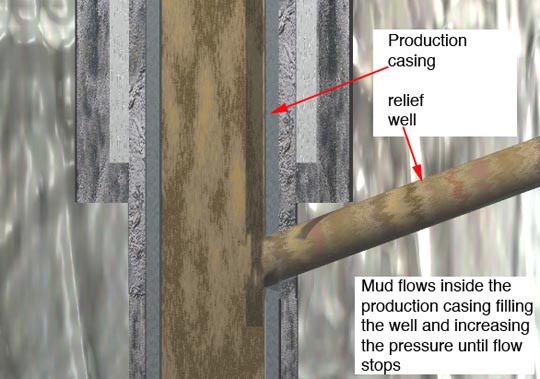
However if the oil flow continues, then it means that the oil is flowing up the inside of the production casing, At this point the drill is replaced on the end of the drilling string in the RW and the drill drills the cement plug out of the well, and continues drilling forward until it has penetrated the production casing. (It will use PDC cutters to do this). As before the mud in the RW will flow into the open channel, and with the mud pumps engaged, mud will flow into the central bore of the well filling it with a heavier and heavier mud concentration, until, again, the pressure exceeds that in the rock, and the oil and mud flow stop. The well is now killed.


Once the well is stable, then, as in the earlier step, the mud is replaced with a cement to create a plug at the bottom of the WW and the RW and the wells are sealed. Additional caps at the top of the wells, and they can be closed down.


Admiral Allen described the process thus
What will have to happen is when the relief well is adjacent to the well bore and close enough to be able to turn to make the penetration, then we'll first penetrate the area outside the well pipe.

And we will see if there is oil there or not. At that point mud will be pumped into the wellbore to see if that contains the well. If that does not, the mud and a (inaudible) plug will be inserted and then we will drill again into the inner pipe.

That will be the second attempt to plug the well if oil is coming up through the pipe with mud and cement. These two procedures will take us into August. There're things that could happen that could shorten that but right now into August is what the official estimate is.
And he then reinforced the point
Number one, if you take into account that you’re going to exhaust every possibility, if you go someplace and there’s not oil and you have to go find it in other place in that wellbore and you have to first seal what they call the annulus, the area outside the pipe, with mud and then cement that and go back in and re-bore into the pipe itself because you’re going to slowly remove any source of oil the closer you get inside the wellbore.

If you have to do all of that, it will take you well into August. If you get in there and you find the oil, you can see the oil in the annulus of the well bore the first time around, then it could be shorter. So it could happen, but I’m not going to assume that. I’ve been around you folks long enough to know that we need to under-promise and over-deliver.


He also mentioned that the decision on the cap had not yet been made.
I am asking BP to give me a detailed timeline in 24 hours on how they would accomplish the hookup of the units producer to the free standing riser pipe and then how they would move the current containment cap off, putting a containment cap on that would effectively seal the top of that well and go to the new containment structure, which does a couple of things, it gets us to a production capacity and a redundancy in the system of 60 to 80,000 barrels of day.

It also gives us quick hookup and quick disconnect and it will give us heavy weather or a hurricane. So not only do we have number one we have a weather window, number two we're going to get the weather to be able to hookup the Helix Producer.

I have asked BP to give me within the next 24 hours a detailed timeline that we can look at and then approve that will allow them to move forward. If we can take advantage of this weather window we will certainly do that.
The we here is the “brains trust” that Secretaries Chu and Salazar have assembled, and who will vet the idea. Here is my gripe. They have known about the design and the plans for weeks now. They have a short window of opportunity before the next storm rolls in and stops the effort, and they are only now getting the paperwork that they have to approve. It does not seem unreasonable to ask why this wasn’t done over a week ago, so that approval was in hand the moment that the weather allowed the procedure to begin. If the weather closes in again before the approval is given and the process completed, whose fault is this?

If the new cap is on, then when mud flows up the well it will go through the BOP and the sealed cap and up to the surface so that there is an additional pressure on the bottom of the well. If it is not, then the mud column weight above the BOP is lost. But the Federal Government is in charge, and processes and procedures must be followed, as they are repeatedly now informing folk. Sigh! So if the opportunity is lost, why that is just the way things go!

The current data on oil and gas production from the site:
For the first 12 hours on July 8 (midnight to noon), approximately 8,565 barrels of oil were collected and approximately 3,940 barrels of oil and 28.3 million cubic feet of natural gas were flared.

• On July 7, total oil recovered was approx. 24,575 barrels:

• approx. 16,655 barrels of oil were collected,
• approx. 7,920 barrels of oil were flared,
• and approx. 57.6 million cubic feet of natural gas were flared.


Read more!

Thursday, May 27, 2010

Deepwater Oil Spill - restarting the mud, and an apology

It appears that a significant part of what I have written for the past day has been wrong, and the information that I, in good faith, commented on to several radio stations and newspapers about the status of the Gulf leak was similarly not totally correct.

I have reaped, I guess, the rewards for believing statements about transparency. From the LA Times
The company announced late in the day that it had suspended shooting heavy drilling mud into the blown-out well 5,000 feet underwater around midnight Wednesday so it could bring in more materials. Thursday evening, BP PLC said it had resumed the pumping procedure known as a top kill. Officials said it could be late Friday or the weekend before the company knows if it has cut off the oil that has been flowing for five weeks.
The conclusions that I drew about the pressure drop up through UPDATE 8 on Wednesday, when we were losing visual contact with the leak, because of what I thought was mud falling around the well could have been correct.

However, later comments on the relative flow velocity were based in part on the assumption the BP was still pumping mud. They were not. So that while the velocity observation was correct (since BP has stopped pumping) that is the only consolation I have from believing the Admiral’s statement this morning that there was only a slight problem with pressure balance before the company could start pumping cement into the well. (The LA story that I took this from has been updated so I cannot go back to the original quote). As I say this is more than mildly irritating, and I will try and be more cautious in drawing conclusions in the future. It does, however, through the pictures I posted, allow us now to be able to identify the difference between the mud flow (top picture) and the oil/gas flows that are in the remainder, with very little, if any, mud. (and at 8:40 pm on Thursday it is still oil and gas).

There was, however, some additional material available in the article:
Although incident commander Adm. Thad Allen of the U.S. Coast Guard said Thursday morning that BP had temporarily stopped the flow of oil, the company's chief operating officer later said petroleum was still flowing. "Once the well has stopped flowing then we would pump cement down into the hole to fully seal it," Doug Suttles said. "We might finish this in the next 24 hours, or it might take longer." Engineers next plan to inject heavier "bridging material" above the mud to prepare to put a cement seal on the well.
Well I see that the monitoring ROV is back in position to watch the leaks as BP, perhaps, is about to restart pumping mud – if they really are.

I would stop commenting on this, but sadly it is too important a subject not to continue. My apologies if I have, inadvertently misled you.

UPDATE: 9:52 pm the camera is focusing on the cracks in the riser, and it seems that they may be injecting rubber pieces one of which is now stuck in one of the cracks in the riser. (Not very securely it seems)

Piece of "junk" (?) in the riser crack, as BP apparently work to reduce the size of the path through the BOP.

Note that this piece has had to pass through the BOP, and it is sealing the BOP path which is more critical to success. It could also be a piece of the rubber from the annulus seal that broke loose and got caught in the riser. Without knowledge of what BP is trying it is hard to decide, but the flow looks to be still gas and oil without mud, and I would expect that BP would have to use mud as the carrier if they were injecting material into the flow, so this could just be a piece of seal that got caught. If you can't tell where it is, it is in the crack to the immediate right of the center line (without the paint) on the riser. (The view has changed)

UPDATE 2: Mud is clearly visible in the change in the look of the flows out of the riser. But at the moment it does not appear to be under the pressure of the flows on Wednesday. (This could be because it is being pumped in at a lower pressure, or it could be that they have sealed some of the leaks in the BOP and that is cutting back the driving pressure at the riser).

Leak shot at 10:25 pm Central

The problem we saw on Wednesday night with mud being heavier than oil and thus settling more readily and obscuring the view, is also evident.

UPDATE 3: 12:18 AM So it appears that BP have injected "rubber strips" into the flow, and that some of these have lodged in the BOP, reducing the flow channel, while one made it through and is trapped in one of the leaks in the bent portion of the riser.

Now what may happen is that they will slowly increase the mud flow/pressure to a) find out how much the leak rate has been reduced and b) to make sure that the restrictions in the flow channel are stable, and won't blow out. (If they do then they will have to repeat the process). Once they have a sure reduction in leakage then they will re-generate the higher pressures that overcome the pressure in the reservoir and start forcing the oil and gas back down the well, as the mud begins to fill the pipe.

The mud seems to have a slightly different texture from last time, so they could have increased the mud weight so that when the column of mud is re-established that this time it weighs a little more and overcomes the slight pressure imbalance that they were left with the first time they tried this.

Now is a good time for caution and, though the fill time may be reduced because of the smaller leak rate into the Gulf, they may still pump at a relatively only slightly higher pressure that that in the reservoir, to slowly sweep down the well, getting into the necessary channels, and giving time for the oil and gas to be pressed back into the rock that it came from.

UPDATE 4: 9:30 AM The latest report from the Gulf
Hayward told CNN BP engineers had injected a "junk shot" of heavier blocking materials into the failed blowout preventer of the ruptured wellhead, and would also pump in more drilling "mud"- all part of the top kill procedure being attempted.

"We have some indications of partial bridging which is good news," he said.

"I think it's probably 48 hours before we have a conclusive view," he added.
Admiral Allen also noted at that time that the leak had been stopped, but that they were not sure that they could sustain the halt in flow. However at 8:10 am, Sterling925 who wa watching and commenting on The Oil Drum saw some sort of event occur around the BOP.
Chaotic images - looks like an explosion!

09:14 et 5/28/2010
and from SteinarN
It looks like A LOT of gas is coming up from the seabed around the BOP. Considering the large water pressure and the possibly large area this gas is emanating from it ought to be a large flow. This indicate the integrity of the well is not good?
Unfortunately I did not see any of this and haven't been able to see the BOP apart from one short short since, though in that shot it did not appear to have any problem. The PBS viewed ROV at the moment is working with a chain, while the ROV that was monitoring the plume is now staring out into the ocean.

The CNN shot however shows that we are back with oil and gas apparently coming out of the leaks at the top of the riser, and no different to the conditions before they started pumping mud into the well last evening. So the second filling of the well has apparently all been washed out, and they will try again later. The comment from BP was that this might take another couple of days.

UPDATE 5: 10:24 AM Well I am not sure that the CNN feed was actually live and there are other stories catching their attention at the moment, but there is a Youtube recording of what took place (h/t Jessica in Pensacola).

UPDATE 6: 11:09 AM The feed has gone back to the riser, and we are back to the oil and gas flows that we were saw at the beginning. Not quite the same shapes as earlier, so perhaps the block in the BOP was partially effective, but BP have now apparently filled the well twice and failed to get enough weight into the mud to hold the driving pressure from the rock. They could try again with a higher density mud, I am presuming that the second shot had a higher weight than the first, and that while the first left a small pressure imbalance, that the second was closer, but as yet no banana. (Though the Admiral did say that they had stabilized the flow). My presumption is that they will mix up another batch and try again - though whether they will try another junk shot is not clear.

Flow at 11:09 am

The way in which you try and stop leaks is that you put the big stuff in first. If you can get enough of that to stick, it still leaves large flow channels, and so the second shot uses smaller pieces that fit into the gaps. Then you try smaller shots etc until you get as good a seal as you can. Doing this to plug water flows into tunnels can take several shots to get a total seal, working with sequentially smaller sizes of particles.

Read more!