With Labor Day weekend, and the recovery of the blowout preventer from the Deepwater Horizon well in the Gulf of Mexico, the remaining parts of the operation are going to be increasingly directed at plugging the well, so that it can be abandoned. Part of this operation will be to ensure that the bottom plugs at the reservoir end of the well have adequately sealed off the bottom of the well. To do this the relief well will be used to intersect the top of the unlined section of the original well, and determine the condition and fluid content of the annulus surrounding the production casing at that point.
There was concern that when the relief well intersected this annulus and then injected fluid into it as part of a possible additional plugging process, that this would increase the fluid pressure in the annulus. This could have raised the fluid pressure to the point that it might have been able to flow past the top seal at the well head, that was separating the annulus fluid channel from the path through the production casing. It was along that second path that the cement travelled to plug the bottom end of the well. Now that a BOP has been installed that can handle 15,000 psi fluid pressure in the well, the concern that a leak in the seal could allow oil to flow into the Gulf is of less consequence. So the relief well can proceed.
At the same time, it is likely that work will continue to prepare the top of the well for additional plugging so that the well can then be abandoned, according to regulation.
One of the remaining issues that will be resolved when the relief well intersects the annulus is over what type of fluid is actually in that channel. In the original sequence of events, before the well failed, the well was full of mud, and then a cement plug was pumped down the center of the well, to the bottom, from where it flowed up the outside of the production casing, filling the lower section of the annulus. In the process it pushed the mud that was already in the well, up the annulus ahead of the cement. As that cement started to set, and filled the annulus, there should have been no flow path up the annulus to the well head. Thus the fluid in the annulus should still be the original mud that was in the well ahead of that first cement injection.
In a large part of the early thinking of how the well failed, there was a preponderance of opinion that the fluid flow in the well developed up through the cement in the annulus, from the oil reservoir. This then flowed up the outside of the production casing, dislodged the hanger seal at the top of the well, and flowed on up into the BOP and on. But when the second set of cement was sent down the well, to seal it after it had stopped flowing the cement, apparently following the path that the oil had taken in leaving the well, only flowed down the production casing to the bottom of the well, and thence back up to the oil reservoir. This suggests that the early thinking which would leave the annulus full of oil and natural gas, was not correct, and rather than oil, the annulus still holds mud.
We won’t know which is right until the well is intersected, but once the information is available, then it will make it easier to decide what steps to take to complete the final stages of plugging the well.
At present the DD2 is preparing for these plug and abandon procedures. It is also, given past problems, testing the new BOP to ensure that it is fully functional before the process restarts. With there being sensibly no further likelihood of oil from the well escaping into the Gulf, the pressure to complete the process has diminished, and there is no urgent need for the relief well to be completed (apart that is for such matters as the amount of money that both the drilling rigs are costing BP every day).
As the Admiral instructs, it will be interesting to see when, and what the relief well finds as it completes its mission in the next week or so.
Showing posts with label cement plug. Show all posts
Showing posts with label cement plug. Show all posts
Tuesday, September 7, 2010


Monday, August 16, 2010
Deepwater Oil Spill - the two options
So who makes the decision? BP are now faced with a couple of problems that may have arisen because of a false assumption early in the process, about the condition of the well. They have now been led to two different choices, as to how to proceed with the final steps. Let me explain what I mean and how, I believe, these came about.
At the beginning of the disaster, when the plans were being made to bring in a relief well to seal the bottom of the flowing well, it was necessary to make a number of decisions. One of these had to be where the relief well should intersect the well that was flowing.
If you go back to those times there was an increasingly dominant viewpoint that developed in the early weeks that the failure had been in the cement surrounding the production casing, and that, as a result, the oil and gas was flowing up the outside of the production casing, through the gap between it and the liner segments higher in the well, and then through a failed seal in the BOP, down into the main flow channel and up through the center of the BOP.
Accordingly when the relief well was planned, it was assumed that there was a flow channel that had developed down through the cement in the annulus to the reservoir. The path of the relief well was therefore aimed so that it would intersect the annulus a the top of the gap below the last lined segment of the well. Once there it would allow a check that there was flowing oil, and could then be used to force mud and then cement into the annulus to displace the oil. The cement would push the existing fluids down the well, back into the reservoir, and thus create an 800-ft long plug in the annulus. If there were indications that there was still some flow up through the production casing, then the relief well would have re-drilled through the injected cement, and then, using a milling bit, cut an access slot through the casing.
In the same way, as before, the relief well would then have injected mud, firstly to kill any driving pressure in the well, by filling the well with mud, and then killed the flow by driving the oil back into the reservoir, and then injecting cement to kill the well. At this point the bottom of the well would be sealed with a known amount of cement in both the annulus and the bottom of the production casing. For this method to work, however, there had to be a pathway that would allow the mud injected either into the annulus, or the casing, to displace the oil in the well back into the reservoir.
In the initial arrival at the annulus injected mud would push the oil both up along the anticipated existing annulus flow path to the BOP, and then fill the casing as the mud displaced the oil downwards in the production casing. The injected mud would also push down, through the flow path through the cement around the production casing, pushing that oil more directly into the reservoir.
This scenario should have worked ff the leak had been through the annular cement and up through the outside of the production casing. However some snags have now arisen. The first is that the leak was not apparently mainly up the annulus, but rather up through the production casing. That poses the first problem with the trajectory for the relief well. Because if the flow did not go up the annulus, then cement could not be sent down the annulus to stop it. Thus, I suspect, the decision to send the cement down the production casing. At least this way the reservoir and flow path could be sealed off, and should there be a need to temporarily abandon the well due to a hurricane, then there would be no significant chance of a leak. So that was done.
But now it has left BP and the oversight panel with the problems that I have mentioned in the last two posts on the subject (here and here). Because with the bottom end of the production casing sealed, and it having been determined that the annular seal under the BOP is still intact, there is no good and easy way to get the oil (if there is any) from the annulus and replace it, first with mud, and then with a cement plug of suitable, and known, size. Injecting additional fluid into what is a sealed system doesn't work very well.
One thing that could be done is to sensibly shrug the shoulders, say to heck with the bottom – we know it is currently sealed, and just do a conventional plug and abandon at the top of the well. This would require removing the existing stack, and the original BOP and the 3,000 ft of drill pipe (DP) suspended below it in the well (but now surrounded by drilling mud). Then putting a new BOP in place that would allow a new DP to be run down the well. This could be fitted with the necessary tools to put a cement plug in both the production casing, and in the annulus beyond it. It would also allow any remaining superstructure above the plug to be removed, according to regulation. That operation would, however, come under a different jurisdiction.
This would, I gather, now be a route that BP might prefer to move along. But Admiral Allen has been fairly adamant about having the bottom plugged with the relief well. But his latest directive to BP is beginning to work to give them wiggle room in changing this option. He sets out four directions:
Because we have seen the very small leaks on some of the joints in the stack, any increase in pressure could possibly cause a greater failure, and a fluid leak into the Gulf of significant size. To ensure that doesn’t happen, the Admiral wants to be sure there is another form of pressure relief in place, or a way of capturing fluids, so that they don’t get into the water.
The next direction is to be ready to have the DDIII able to continue the completion of the relief well, when directed.
The third directive, however, addresses the change in the stack to a more regular BOP to allow a top plug to be inserted into the well.
And the final direction is
There are offsetting risks in the two approaches being considered. Drilling into the annulus will identify whether there is any communication (flow path) from the reservoir up through the annulus to the BOP. But it runs the risk of overpressuring the seals in the BOP and higher elements of the stack that could rupture and dump up to 1,000 bbl of oil into the Gulf. On the other hand accepting that the annulus is currently sealed, so that the BOP can be removed to inject the top plug, runs the risk that, if the seal at the top of the annulus were to fail during the operation, then seawater could flow down the annulus, displacing the lighter oil and causing it to flow up out of the well and again dump it into the waters of the Gulf.
It appears that the Admiral is asking for the arguments on both sides. But these focus on whether or not to allow the relief well to intersect the original well or not. The need for the top plug is still an abandonment requirement.
At the beginning of the disaster, when the plans were being made to bring in a relief well to seal the bottom of the flowing well, it was necessary to make a number of decisions. One of these had to be where the relief well should intersect the well that was flowing.
If you go back to those times there was an increasingly dominant viewpoint that developed in the early weeks that the failure had been in the cement surrounding the production casing, and that, as a result, the oil and gas was flowing up the outside of the production casing, through the gap between it and the liner segments higher in the well, and then through a failed seal in the BOP, down into the main flow channel and up through the center of the BOP.
Accordingly when the relief well was planned, it was assumed that there was a flow channel that had developed down through the cement in the annulus to the reservoir. The path of the relief well was therefore aimed so that it would intersect the annulus a the top of the gap below the last lined segment of the well. Once there it would allow a check that there was flowing oil, and could then be used to force mud and then cement into the annulus to displace the oil. The cement would push the existing fluids down the well, back into the reservoir, and thus create an 800-ft long plug in the annulus. If there were indications that there was still some flow up through the production casing, then the relief well would have re-drilled through the injected cement, and then, using a milling bit, cut an access slot through the casing.
In the same way, as before, the relief well would then have injected mud, firstly to kill any driving pressure in the well, by filling the well with mud, and then killed the flow by driving the oil back into the reservoir, and then injecting cement to kill the well. At this point the bottom of the well would be sealed with a known amount of cement in both the annulus and the bottom of the production casing. For this method to work, however, there had to be a pathway that would allow the mud injected either into the annulus, or the casing, to displace the oil in the well back into the reservoir.
In the initial arrival at the annulus injected mud would push the oil both up along the anticipated existing annulus flow path to the BOP, and then fill the casing as the mud displaced the oil downwards in the production casing. The injected mud would also push down, through the flow path through the cement around the production casing, pushing that oil more directly into the reservoir.
This scenario should have worked ff the leak had been through the annular cement and up through the outside of the production casing. However some snags have now arisen. The first is that the leak was not apparently mainly up the annulus, but rather up through the production casing. That poses the first problem with the trajectory for the relief well. Because if the flow did not go up the annulus, then cement could not be sent down the annulus to stop it. Thus, I suspect, the decision to send the cement down the production casing. At least this way the reservoir and flow path could be sealed off, and should there be a need to temporarily abandon the well due to a hurricane, then there would be no significant chance of a leak. So that was done.
But now it has left BP and the oversight panel with the problems that I have mentioned in the last two posts on the subject (here and here). Because with the bottom end of the production casing sealed, and it having been determined that the annular seal under the BOP is still intact, there is no good and easy way to get the oil (if there is any) from the annulus and replace it, first with mud, and then with a cement plug of suitable, and known, size. Injecting additional fluid into what is a sealed system doesn't work very well.
One thing that could be done is to sensibly shrug the shoulders, say to heck with the bottom – we know it is currently sealed, and just do a conventional plug and abandon at the top of the well. This would require removing the existing stack, and the original BOP and the 3,000 ft of drill pipe (DP) suspended below it in the well (but now surrounded by drilling mud). Then putting a new BOP in place that would allow a new DP to be run down the well. This could be fitted with the necessary tools to put a cement plug in both the production casing, and in the annulus beyond it. It would also allow any remaining superstructure above the plug to be removed, according to regulation. That operation would, however, come under a different jurisdiction.
This would, I gather, now be a route that BP might prefer to move along. But Admiral Allen has been fairly adamant about having the bottom plugged with the relief well. But his latest directive to BP is beginning to work to give them wiggle room in changing this option. He sets out four directions:
Provide me a plan for a pressure relief system to prevent excessive pressurization of the Macondo well stack (capping stack, LMRP, and BOP), including any necessary containment option, Contingent upon the approval of the plan, this system will be installed before the intercept of the DDIII relief well.Because the seal is still in place at the top of the annulus, and the cement is sealing the bottom of it, when the relief well drills into the annulus, any imbalance of pressure could cause flow into the original well. This would increase the pressure in that well, and cause the top seal that is currently intact to likely open. This in turn could increase the contained pressure within the stack assembly.
Because we have seen the very small leaks on some of the joints in the stack, any increase in pressure could possibly cause a greater failure, and a fluid leak into the Gulf of significant size. To ensure that doesn’t happen, the Admiral wants to be sure there is another form of pressure relief in place, or a way of capturing fluids, so that they don’t get into the water.
The next direction is to be ready to have the DDIII able to continue the completion of the relief well, when directed.
The third directive, however, addresses the change in the stack to a more regular BOP to allow a top plug to be inserted into the well.
Provide me a plan for an ambient pressure test and analysis to assess the stability of the well during the period of time after the removal of the current Macondo well stack and its replacement with a new BOP package.In other words tell me how you can be sure that the well won’t flow after you take the stack and BOP off. The question of the fluid in the production casing has been answered by the pressure tests on the cement plug, and I believe that the negative pressure test, has shown that there would be no flow up through the annulus. It just needs BP to couch the results in the form that the Admiral requests.
And the final direction is
Before the current BOP stack is removed, prove to my satisfaction that the Macondo annulus does not represent a potential pathway for hydrocarbon flow; or, if the potential for flow can’t be proven, identify the conditions under which flow could occur and the risks of those events occurring.This is where the judgment call is required. Can BP provide a logical answer to satisfy the Admiral and the science panel?
There are offsetting risks in the two approaches being considered. Drilling into the annulus will identify whether there is any communication (flow path) from the reservoir up through the annulus to the BOP. But it runs the risk of overpressuring the seals in the BOP and higher elements of the stack that could rupture and dump up to 1,000 bbl of oil into the Gulf. On the other hand accepting that the annulus is currently sealed, so that the BOP can be removed to inject the top plug, runs the risk that, if the seal at the top of the annulus were to fail during the operation, then seawater could flow down the annulus, displacing the lighter oil and causing it to flow up out of the well and again dump it into the waters of the Gulf.
It appears that the Admiral is asking for the arguments on both sides. But these focus on whether or not to allow the relief well to intersect the original well or not. The need for the top plug is still an abandonment requirement.
Read more!
Friday, August 13, 2010
Deepwater Oil Spill - how to deal with a dead well?
The Admiral confirmed, in his Friday press conference, that the negative pressure test on the Deepwater well held steady for 24-hours without any inflow of fluid into the well, or increase in pressure. That means that there is sufficient cement in the annulus to block a free passage from the reservoir, through the annulus, to the well head. In other words the well is killed. The problem now becomes something different.
As I mentioned yesterday the central section of the well, inside the production casing, is full of cement. The only path possibly available is up the annulus, above the bottom section where cement has filled it. The problem that is now faced is that no-one knows how much of the cement in the annulus was there from the original cementing of the production casing into place, and how much from the injection of cement during the static kill. If it is a relatively small amount, then there is a risk that this barrier may fail, with time, and oil under reservoir pressure can then flow up the annulus to the well head. And to help with the discussion, here is the picture that I have used before to illustrate the situation.

I would suspect that it is a relatively thick barrier – the original injection of cement into the well from the production casing was, if my memory serves, about half that required to fill the annulus to the previous cement lining injection. Given that this is 800 ft above the bottom of the well, then there is 400 ft of cement above the shoe in the annulus.
In a relatively close to surface operation, the flow of fluid across the bottom of that column might induce enough cavitation to eat back the cement by about 20-ft or more (Glen Canyon Dam, and Tarbela High Dam for eg) but with the back pressures in the well that would suppress cavitation, I don’t anticipate that there was that much erosion out of the flow path of the oil and gas to the bottom of the well. There could be enough erosion along the contact with the overlying sandstone, which would erode out the column over the height of the sandstone, (say 60 ft) but even with that there is likely at least a couple of hundred feet of cement in the annulus above the reservoir creating a seal.
But that leaves the problem of the up to 1,000 barrels of oil that may be trapped in the annulus, begging the question as to how it is supposed to have got there if the cement in the annulus retained its integrity above the reservoir.
To determine if that is oil, which would imply that the above supposition was wrong and that the well had no cement integrity in the annulus until the cement from the static kill provided some, the relief well has to intersect the original well. When it does so it raises two problems, only one of which I mentioned in the last post.
The one I mentioned is that with a cement plug in the annulus below the intersection if BP start to inject fluid into the annulus they don’t have an easy way of displacing the fluid already there. There is nowhere to push it, and no clear way to circulate it out with the relief well configuration. The logical path to push it upwards out of the well runs into a slight problem that the Admiral introduced today, which is that the part between the new stack and the old BOP (the spooling tool) is only rated to 7,500 psi. And there is no simple path for fluid to flow from the annulus up through the existing hardware on top of the rig into a pipe that could carry it to a vessel at the surface.
The one that I did not mention was that if the original cement has been removed over the full column of the annulus down at the bottom of the well, and only replaced by the cement injected during the static kill, then there is no way of knowing how thick that barrier is. Raising the pressure in the annulus to inject cement into it from the relief well could break that barrier (though it would also provide a path for oil in the well to displace downwards back into the reservoir and thus dispose of maybe 10% of the oil in the annulus., which still leaves the question as to how to displace the rest.
On the other hand if the relief well goes into the annulus and finds nothing but mud (from the pre-cement days when the production casing was installed) then the question becomes moot.
.
Read more!
Thursday, August 12, 2010
Deepwater Oil Spill - is the well dead already?
Much of the focus of recent efforts at the Deepwater Horizon well site have been focussed on getting the relief well down to do a bottom kill of the well. However, in recent remarks the possibility has been raised that this may already have been done, and that the well is effectively dead already.
In his press conference on Wednesday, Admiral Allen noted, relative to the understanding of the conditions at the bottom of the Deepwater Well, that there may have been some communication (in other words a passage) from inside the production casing, out to the annulus outside the casing.
He also noted
In other words if the production casing passage is sealed, and the annulus is adequately sealed then the well is no longer a threat, and no longer part of the response activity. At that time the well moves into the jurisdiction of the Department of the Interior and their regulations, which have been discussed here earlier, of the steps needed to abandon the well.
The problem that the Admiral relates to is actually in several parts. Let me try and explain them in a little detail. Firstly we will start, this time, at the bottom of the well, where the shoe sits that was meant to seal off the inside of the production casing. Very simply, at the end of the operations with the Deepwater Horizon, the bottom of the well might have looked a bit like this (which is definitely not to scale, but drawn just to illustrate some thoughts)

At the end of the drilling a plug of cement had been pushed down the production casing and out of the end so that it flowed back up the annulus several hundred feet. The well should have been plugged at the bottom.
We now know that there was a failure at the bottom, since all the cement that was injected went down the production casing. This means that there had to be a passage between the well and the oil-bearing sandstone. I show this as green and it has eroded a path through the cement down to the bottom of the casing and then up the inside of it to the BOP and thence to the Gulf.

Note there has to be a passage through the annulus to the sandstone from the central section of the production casing for the oil and gas to flow.
Now consider that in killing the well the cement was pumped down to the bottom of the casing and 200 barrels then went out into the annulus, and up into the oil-bearing sandstone. That may have been enough to totally seal the passages to the bottom of the casing but also any erosion that had taken place eating upwards along the outside of the casing through the annulus to the top of the cement.
I wrote about that the other day, and as a reminder, this is what it may look like.
Now the original assumption had been that the leak was up through the annulus of cement to the Gap that I show – but that turned out not to be the case. And remember that this is 800 ft above the shoe we were just talking about.
So if the relief well intersects here it has to drill a fair way down to check on conditions at the bottom of the well, if the cement lining at this point has integrity. If there is no oil found here, which means there was no passage down to through the annulus (at this level, obviously there was at the bottom of the well) then as insurance they can inject cement back through the gap and annulus, but in reality the well is already dead.
However if that is the case, and they want to fill the annulus here with cement, they have to be careful. For the outer annulus up at the BOP is protected by a seal. The Admiral described the problem and solution.
By the Thursday press conference the storm had largely passed, the storm packer was being removed from the relief well, and a negative pressure test was being carried out at the top of the well, under the BOP, to ensure that the cement had no problems, and to see if with that lower pressure there was any flow out of the annulus. They are anticipating that once drilling restarts it will take 96 hours to intersect the annulus.
The science team believe that there is a “low probability” that the leaks through the annulus to the well were sealed by the cement injected during the static kill (which suggests they still believe there was a passage up to the gap at the top of the cement) but the results of the test may indicate whether they were right or wrong. However, as the Admiral noted,
In his press conference on Wednesday, Admiral Allen noted, relative to the understanding of the conditions at the bottom of the Deepwater Well, that there may have been some communication (in other words a passage) from inside the production casing, out to the annulus outside the casing.
Following the cementing of the casing itself in the well last week and successful pressure test, we had discussion between the government science team and BP engineers, we believe there may be a chance that the cement that was forced down through the casing of the well entering the reservoir might have actually moved over and come back into the annulus which is the area outside the casing but inside the well bore.
We want to understand the condition of the annulus before we actually drill into it so we are working with BP right now to establish procedures to do a pressure test that will tell us whether or not there’s free communication between the annulus and the reservoir itself or there’s cement that actually works its way over there from the static kill.
He also noted
Just to project out a little bit further for everybody’s information, once the well is killed it is no longer a threat of discharge at that point it will no longer be considered part of the response to the oil spill per say because there won’t be any source of the oil.
In other words if the production casing passage is sealed, and the annulus is adequately sealed then the well is no longer a threat, and no longer part of the response activity. At that time the well moves into the jurisdiction of the Department of the Interior and their regulations, which have been discussed here earlier, of the steps needed to abandon the well.
The problem that the Admiral relates to is actually in several parts. Let me try and explain them in a little detail. Firstly we will start, this time, at the bottom of the well, where the shoe sits that was meant to seal off the inside of the production casing. Very simply, at the end of the operations with the Deepwater Horizon, the bottom of the well might have looked a bit like this (which is definitely not to scale, but drawn just to illustrate some thoughts)

At the end of the drilling a plug of cement had been pushed down the production casing and out of the end so that it flowed back up the annulus several hundred feet. The well should have been plugged at the bottom.
We now know that there was a failure at the bottom, since all the cement that was injected went down the production casing. This means that there had to be a passage between the well and the oil-bearing sandstone. I show this as green and it has eroded a path through the cement down to the bottom of the casing and then up the inside of it to the BOP and thence to the Gulf.

Note there has to be a passage through the annulus to the sandstone from the central section of the production casing for the oil and gas to flow.
Now consider that in killing the well the cement was pumped down to the bottom of the casing and 200 barrels then went out into the annulus, and up into the oil-bearing sandstone. That may have been enough to totally seal the passages to the bottom of the casing but also any erosion that had taken place eating upwards along the outside of the casing through the annulus to the top of the cement.
I wrote about that the other day, and as a reminder, this is what it may look like.
Now the original assumption had been that the leak was up through the annulus of cement to the Gap that I show – but that turned out not to be the case. And remember that this is 800 ft above the shoe we were just talking about.
So if the relief well intersects here it has to drill a fair way down to check on conditions at the bottom of the well, if the cement lining at this point has integrity. If there is no oil found here, which means there was no passage down to through the annulus (at this level, obviously there was at the bottom of the well) then as insurance they can inject cement back through the gap and annulus, but in reality the well is already dead.
However if that is the case, and they want to fill the annulus here with cement, they have to be careful. For the outer annulus up at the BOP is protected by a seal. The Admiral described the problem and solution.
The casing in which the drill bit and the well and the well pipe sits (hang) from the top of the well head. And then they kind of telescoped down to the smaller diameters. In that mechanism where they hang off the top of the well head, there was a seal and if enough pressure is applied from the annulus, this is outside the casing, on that seal it is meant to give way so it won’t cause damage to the well bore.
In other words it’s like a relief valve, and the seal which completely circles the casing at the top of the well if enough pressure is exerted will rise up and allow oil to flow. One of the theories was that somehow sometime during the explosion or what happened that that pipe was lifted up to allow that seal to be opened. It might have allowed oil to move up into the blow out preventer, it might have been the source of the hydrocarbons coming up other than the actual casing itself.
We don’t think that’s the case right now we think it’s seated where it should be but what we wouldn’t want to have happen is to start pumping mud and cement into the annulus at the bottom is filled with cement and you have stagnate oil there. And we increase the pressure as we’re doing that so that stagnate oil is forced up and that forces that seal to rise up open itself and go into the blow out preventer.
And as you know we restricted the pressure on the injectivity tests in the top kill to be less than 8,000 psi. The cap itself is rated at 10,000 psi and what we want to understand is we go ahead with the mud and the cement for the bottom kill is there any chance at all that that would force stagnate oil up to the point where it would lift that up again, open those seals, push that up into the blow out preventer and the capping stack and at some point erode, approach pressures that might be a concern to us.
We think it’s a very low probability outcome but the discussion of those seals and whether or not that pipe has ever been lifted is something that’s been discussed for some period of time. But we think we just need to rule it out before we go forward.
By the Thursday press conference the storm had largely passed, the storm packer was being removed from the relief well, and a negative pressure test was being carried out at the top of the well, under the BOP, to ensure that the cement had no problems, and to see if with that lower pressure there was any flow out of the annulus. They are anticipating that once drilling restarts it will take 96 hours to intersect the annulus.
The science team believe that there is a “low probability” that the leaks through the annulus to the well were sealed by the cement injected during the static kill (which suggests they still believe there was a passage up to the gap at the top of the cement) but the results of the test may indicate whether they were right or wrong. However, as the Admiral noted,
I guess what I'm saying is if the cement is already there it would obviate the need to do the bottom kill because the cement from the top kill had worked its way into the annulus. That's what we're trying to find out.The way that they are doing this is to lower the pressure above the hanger that the production casing rides on, so that the seals to the annulus open.
lowering the pressure in the stack enough where it would raise those seals on the hangar which would allow oil to flow up and if there was communication with the reservoir we would see an increase in pressure.That may still leave up to 1,000 barrels of oil trapped in the annulus, but this could be recovered during the plugging operation later in time, and under another jurisdiction. But the well would be dead, and no further steps, including intersecting the bottom, might be needed. But they will likely do that any way, just to be sure.
That would tell us there is no cement in the annulus and we should proceed with the bottom kill. If for some reason the pressure stays level that would indicate that we have some kind of a static condition in the annulus and that would present the possibility that the cement had entered the annulus and we might either a full or a partial kill from the bottom accomplished with the static kill. . . . . . . .
What we hope we'll find out is there will be an immediate rise in pressure which will tell us there is hydrocarbons being pushed up from the reservoir and we should go ahead and proceed with the bottom kill.
It will be more problematic and quizzical if there is no discernable change in the pressure readings. That would indicate that the oil is being held in place and its' static. That won't tell us how much cement and to what extent the communication between the reservoir and the annulus may have been filled with the static kill.
And at that point there will have to be a determination made on whether or not we'll go ahead and proceed to drill in with the relief well and be prepared to go ahead and put the cement in. That will be a discussion that we'll have with the BP engineers when we know the results of the test.
Read more!
Tuesday, August 10, 2010
Deepwater Oil Spill - relief well intersection version 2
Both Admiral Allen and Kent Wells (audio only no transcript yet) held press conferences today. The primary focus in both cases was the weather, with the currently approaching storm producing waves that are causing a halt to operations.
 Gathering potential storms (National Hurricane Center)
The storm is not seen as being very threatening, to the point that the riser will not be disconnected. However the drill pipe is being withdrawn, a storm packer inserted into the hole, and the riser filled with sea water. As a result, if there is a problem, the drilling rig can release from the well without creating further complications. But it allows a faster recovery if nothing untoward happens.
The relief well had made it 50 ft beyond the casing and has been surveyed. In the next step it will go another 30 ft before a survey, and then (getting closer to the original well) another 15 ft and so forth. At any time it may intersect the well, and so it might be appropriate to explain (as both parties did) what is expected, and where the intersection can occur.
When I had earlier written about the intersection and the injection of the cement into the bottom of the well it was before the well had been killed from the top. The situation at the moment is that the bottom 5,000 ft of the well inside the casing has been filled with cement.
So that if I go back to the original situation at the intended intersection point, what it may well look like at the moment is this:

The vertical gap between the two outer cement linings which (for simplicity) I have shown as very short is actually likely to be a couple of hundred feet long perhaps. The inner cement plug within the production casing stretches several thousand feet above the intersection point.
The bottom of the well is some 800 feet further down the production casing. At the present time the well is being held at 4,200 psi pressure at the BOP to check and see if there are any leaks. Just as an observation when you put that much pressure on that long a solid confined column it will dissipate out to side loading long before it gets down to this depth, so the test does not have that much value in these particular circumstances. As far as testing the integrity of the central concrete plug neither will the negative pressure test which they intend to follow the current positive pressure test with. In this case they will lower the pressure in the well to 2,300 to 3,000 psi, and see if the well makes fluid. Again, because of the length of the concrete column in the production casing, that drop in pressure will not extend down to the intersection point (let alone the bottom of the well) and thus won’t provide that much information on the conditions at the reservoir.
What it will do, however, is provide some information about what might be going on in the annulus and particularly what might be in the gap, and the condition of it before the relief well runs into it. If the integrity of the production casing remains, (except potentially at the bottom of the well) and all the mud and cement flowed down it, and into the formation, then there may be no way for the fluids in this annulus to have escaped the well. (I have colored them an off yellow since we don’t know if they are oil or mud). If they are the original drilling mud, and the lower cement lining around the production casing has retained enough integrity to seal this zone off from the bottom of the well and the reservoir, then this may even still be the mud used just prior to the cementing of the production casing.
In that case the well is really already well sealed, although for insurance they will likely pump cement into the well to fill the gap and back up the annulus a few hundred feet with more cement. Doesn’t matter then what the condition of the bottom of the well is – there is no path for fluid to get up the well.
If on the other hand they find some oil in the gap then this could indicate that the cement had lost some integrity, and allowed some oil passage (but then how did it then get into the solid steel pipe of the production casing?) But again, pumping cement into the well to fill the gap will provide a permanent seal without needing to go much distance down into the lower cement lining to assess its condition.
Because the original well could well now be a sealed system then the actual fluid in this section will be determined by looking at what comes back up out of the relief well as it drills into the gap.
There is a caveat to this, however. If there was a massive failure of the lower cement liner down to the reservoir, then when the relief well strikes the gap there will be a path for mud to flow down into the well, pushing the fluid before it down into the reservoir. The mud weight that they are using is a 13.8 ppg mud, and so this should displace down to the reservoir. By monitoring the flow and the pressure it will be possible then to determine the size of the flow channel, and other values. If that happens it might complicate the analysis of what actually is the condition of the bottom of the original well. But the treatment remains the same. Stabilize the well, then inject the cement to form a plug in the gap and back up the annulus, and the well is sealed.
Because of the currently anticipated storm it is expected that there will be a delay of perhaps a few days more before the intersection occurs, but with the condition of the rock around the well in the unsupported (unlined) section somewhat unknown it is not going to be possible to accurately predict exactly when that intersection will occur.
Read more!
Friday, August 6, 2010
Deepwater Oil Spill - details of the cement kill
New facts continue to emerge from the press conferences of Kent Wells and Admiral Allen in regard to the current state of the killing of the Deepwater Horizon well.
Admiral Allen held the first and shorter conference on Friday, and there were only two external questions, so perhaps interest is now fading fast as the well is now effectively plugged. It is not yet legally plugged and the need for certain procedures to comply with regulation was part of the discussion today.
Admiral Allen noted that after injecting the well with cement, a separating fluid was injected and then the cement pumped down to the bottom of the hole by injecting mud behind the separating fluid. He again spoke to the finding that the cement had only gone down the production casing, and not the annulus.
The sense of those comments is that if the cement followed the oil path and sealed it, then there wasn’t a leak in the annulus, since all the cement went down through the casing. Thus he likely is now expecting that when the relief well intersects the annulus and the cement within it, it is not going to find any hydrocarbons. (These will be detected in the returns of the mud to the surface as they continue to circulate fluid through the drill bit on the relief well).
It is going to take another week or so to reach and penetrate the annulus and assess its condition, but after that the finale will come quickly. Kent Wells noted that the relief well has drilled beyond the last set of casing, that was just set, for an additional 15 ft, and this has given them the space to run the cement bond log and the first ranging run to ensure the positions of the wells remain as desired. The next drilling run (of about 30 ft) will likely take place on Sunday, and he too felt that the intersection would be in the August 13-15th time frame. (Incidentally the finding that the leak was from the cement in the shoe of the well, and not in the annulus could well mean that the cement bond log test, even if run, would not have found the original leak in the Deepwater well, since it was below the range over which the instrument would run - as the need to drill out the cement in the relief well before running it illustrates. Similarly the discussion about the number of centering pieces on the production casing may also no longer be pertinent to the failure).
However, if the oil flow was constrained only through the center of the production casing, then there should be no hydrocarbon in the annulus, and to verify that they may, perhaps drill longer and further down the annulus than otherwise planned. (This to get down to the area of the shoe to ensure that the cement job already completed has sealed off any possible paths upwards outside the casing).
In response to a question, Kent Wells stated that BP had pumped 500 barrels of cement down the well, and of this roughly 200 barrels went into the formation, with 300 barrels left in the casing.
At the time of the conference ( 3 pm Central) BP was running the pressure test on the well, having raised the pressure above the plug, it was being held constant, watching to see if there is any leakage that would drop the pressure and indicate the need for a fix.)
He also pointed out that for the abandonment procedure required for the well, BP will have to replace the current BOP with a functional one that would allow them then to insert a new drilling pipe into the top of the well. They will use this pipe to create a second plug up near the top of the well, prior to carrying out the removal of the top sections of the casing (as I showed in an earlier presentation) at a level below the sea bed. This will provide the original BOP for forensic examination. The final top plug might look something like this:
 Side view showing the removed top part of the casing and the two cement plugs required to seal the well below the seabed.
Admiral Allen held the first and shorter conference on Friday, and there were only two external questions, so perhaps interest is now fading fast as the well is now effectively plugged. It is not yet legally plugged and the need for certain procedures to comply with regulation was part of the discussion today.
Admiral Allen noted that after injecting the well with cement, a separating fluid was injected and then the cement pumped down to the bottom of the hole by injecting mud behind the separating fluid. He again spoke to the finding that the cement had only gone down the production casing, and not the annulus.
As I’ve told you in previous briefings, we’re starting about 4-1/2 feet away from the well horizontally, and we’ll drill down at a very, very slight angle. If for some reason they penetrate the annulus in the process of doing that, they’ll prepare – they'll be prepared to go ahead and assess the condition of the annulus at that point and go ahead and submit the well in.
We do not believe that the second try will be needed to go into the casing pipe because the indications are from the cement that was put in from the top is that the casing has been filled with cement down at that level, but we will not be sure of that until we finish the pressure checks that I mentioned earlier. But if the – if the pressure checks hold and we have indication the casing has been sealed off with cement, then the killing alone would require only going into the annulus. But we will not know that until the pressure checks are complete on the – on the cementing that was done yesterday and we actually enter the annulus itself and understand what the condition is at that time.
The sense of those comments is that if the cement followed the oil path and sealed it, then there wasn’t a leak in the annulus, since all the cement went down through the casing. Thus he likely is now expecting that when the relief well intersects the annulus and the cement within it, it is not going to find any hydrocarbons. (These will be detected in the returns of the mud to the surface as they continue to circulate fluid through the drill bit on the relief well).
It is going to take another week or so to reach and penetrate the annulus and assess its condition, but after that the finale will come quickly. Kent Wells noted that the relief well has drilled beyond the last set of casing, that was just set, for an additional 15 ft, and this has given them the space to run the cement bond log and the first ranging run to ensure the positions of the wells remain as desired. The next drilling run (of about 30 ft) will likely take place on Sunday, and he too felt that the intersection would be in the August 13-15th time frame. (Incidentally the finding that the leak was from the cement in the shoe of the well, and not in the annulus could well mean that the cement bond log test, even if run, would not have found the original leak in the Deepwater well, since it was below the range over which the instrument would run - as the need to drill out the cement in the relief well before running it illustrates. Similarly the discussion about the number of centering pieces on the production casing may also no longer be pertinent to the failure).
However, if the oil flow was constrained only through the center of the production casing, then there should be no hydrocarbon in the annulus, and to verify that they may, perhaps drill longer and further down the annulus than otherwise planned. (This to get down to the area of the shoe to ensure that the cement job already completed has sealed off any possible paths upwards outside the casing).
In response to a question, Kent Wells stated that BP had pumped 500 barrels of cement down the well, and of this roughly 200 barrels went into the formation, with 300 barrels left in the casing.
At the time of the conference ( 3 pm Central) BP was running the pressure test on the well, having raised the pressure above the plug, it was being held constant, watching to see if there is any leakage that would drop the pressure and indicate the need for a fix.)
He also pointed out that for the abandonment procedure required for the well, BP will have to replace the current BOP with a functional one that would allow them then to insert a new drilling pipe into the top of the well. They will use this pipe to create a second plug up near the top of the well, prior to carrying out the removal of the top sections of the casing (as I showed in an earlier presentation) at a level below the sea bed. This will provide the original BOP for forensic examination. The final top plug might look something like this:
 Side view showing the removed top part of the casing and the two cement plugs required to seal the well below the seabed.
Read more!
Thursday, August 5, 2010
Deepwater Oil Spill - Waiting for the cement to set
BP began pumping cement into the Deepwater well at 9:15 am CDT on Thursday and stopped the operation at 14:15 CDT, having thereby pumped cement into the well for a period of 5 hours. The intent was to fill the well and any wormholes and voids that had developed in the reservoir during the leak. The cement has to harden before it can be tested to insure that it has integrity.
During the process Admiral Allen held his press conference and commented that the wait for the cement to harden would likely be in the 24 – 36 hour time frame, after which the relief well will start to drill forward into the annulus. The process of going down, intersecting and then cementing the annulus, and then doing the same for the production casing is apparently further confirmation that the well flowed up the production casing, which implies a shoe failure, rather than the annular failure which was the predominant theory of failure earlier in the summer.
Note the Admiral’s comment on where the mud and cement from the static kill went.
However, the final confirmation will not come until the relief well finalizes the kill, which is still the plan.
With the well cemented shut, once the pressure tests are carried out to validate the seal will hold, then the well can be considered effectively sealed, even though it is going to take another two weeks (one week to intersect, check and cement the annulus, then another week to do the same for the production casing) before the fleet of ships can disperse, leaving the well itself to history.
At the same time the fleet of ships that has been capturing the spill will move closer to shore, as the last of the oil that flowed into the Gulf is likely to be more evident now at some distance from the well.
The latest distribution of how the oil has fared is shown in this pie chart:

There will continue to be a lot of controversy over these numbers. Some of them are based on actual measurement, some on models, and the residual is a catch-all covering the difference between the estimated flow and the volumes in the other slices of the pie. I would still like to see the inside of the BOP, presuming that it will at some time come to the surface, to see how much erosion went on, and thus whether there was a build in the flow rate or, as has been suggested by the Admiral, a higher earlier peak in the flow.
It is welcome news that the well can now, if necessary, be left without any further risk of oil leakage into the Gulf. Given that the possible storms are multiplying, and that we are moving into the more intense period for hurricanes, the relief felt by most at having reached this stage (assuming that the cement proves out, or is – if necessary – re-injected with a finer grade to ensure a seal if not) must be tangible.
 Potential storms and Colin (NHC)
It will also allow me to start looking again at some of the other concerns that are developing around the world that are of concern as we stare into the tea leaves predicting the available fuels for our energy future.
During the process Admiral Allen held his press conference and commented that the wait for the cement to harden would likely be in the 24 – 36 hour time frame, after which the relief well will start to drill forward into the annulus. The process of going down, intersecting and then cementing the annulus, and then doing the same for the production casing is apparently further confirmation that the well flowed up the production casing, which implies a shoe failure, rather than the annular failure which was the predominant theory of failure earlier in the summer.
Note the Admiral’s comment on where the mud and cement from the static kill went.
Absent of what we've done in top kill, the assumption is you would have to go in, pump mud and cement into the annulus. But that hardens. So you've got that locked down. And you will come in and drill again into the casing.
Once we get in there we will know how much of an effect we've had with the mud and the cement from the top. That could shorten and make more simpler the bottom kill. That was one of the reasons to do it, and also reduce the risk of the bottom kill. Exactly.
However, the final confirmation will not come until the relief well finalizes the kill, which is still the plan.
I have stated over and over again, let me be perfectly clear. I am the National Incident Commander. I issue the orders. This will not be done until we complete the bottom kill.
With the well cemented shut, once the pressure tests are carried out to validate the seal will hold, then the well can be considered effectively sealed, even though it is going to take another two weeks (one week to intersect, check and cement the annulus, then another week to do the same for the production casing) before the fleet of ships can disperse, leaving the well itself to history.
At the same time the fleet of ships that has been capturing the spill will move closer to shore, as the last of the oil that flowed into the Gulf is likely to be more evident now at some distance from the well.
The latest distribution of how the oil has fared is shown in this pie chart:

There will continue to be a lot of controversy over these numbers. Some of them are based on actual measurement, some on models, and the residual is a catch-all covering the difference between the estimated flow and the volumes in the other slices of the pie. I would still like to see the inside of the BOP, presuming that it will at some time come to the surface, to see how much erosion went on, and thus whether there was a build in the flow rate or, as has been suggested by the Admiral, a higher earlier peak in the flow.
It is welcome news that the well can now, if necessary, be left without any further risk of oil leakage into the Gulf. Given that the possible storms are multiplying, and that we are moving into the more intense period for hurricanes, the relief felt by most at having reached this stage (assuming that the cement proves out, or is – if necessary – re-injected with a finer grade to ensure a seal if not) must be tangible.
 Potential storms and Colin (NHC)
It will also allow me to start looking again at some of the other concerns that are developing around the world that are of concern as we stare into the tea leaves predicting the available fuels for our energy future.
Read more!
Wednesday, August 4, 2010
Deepwater Oil Spill - Cementing the well
The Deepwater well has now reached a point where the mud inside the well is applying enough weight to the fluid in the formation that the flow of fluid, when such exists, is now from the well back into the rock. The well is sufficiently secure that, just before 7 pm CST Admiral Allen issued the following press release:
In his press conference today Kent Wells described the steps to kill the well, and what is currently happening as the work moves toward sealing the well.
The crew is now running the drill pipe within the relief well, but must first run a test of the Blow-out Preventer (BOP). There is a regulation, which the other drilling rig did not follow earlier in the process, that is, no doubt, now being practiced.
Simplistically the pressure in the bottom of the well is slowly increased until the fluid in the well starts to penetrate the rock, shown when the pressure no longer steadily increases as fluid is added. This is then used to determine the weight of the mud that will then be used to drill the last section of the well (to ensure that the well pressure isn’t high enough to reach that pressure that will fracture the rock, and lose fluid to the formation).
With that in hand the well will start the short advances, then be surveyed, then advance again, to ensure that the relief well remains on target to hit the original well, first along the annulus, and then to penetrate through the production casing to allow a cement seal of the whole bottom section of the well.
The static kill was carried out with a flow rate of 5 bpm, and Kent Wells noted the success that was achieved.
The cap itself can’t be removed, since the pressure balance is achieved at sea level, not at the sea bed, and the system is being maintained, with small injections of more mud (75 barrels at 5 bpm every 6 hours) to keep the fluids mobile and stop any settling.
Again the injection of cement is likely to be an ongoing event as I write this post – so we will see what the morning brings. If they do run the cement, it is likely, as Kent Wells noted, that after the injection they will run a positive pressure test to see if the seal holds against higher pressures (without letting mud flow into the well), and then perhaps they will run a negative pressure test to see if, as they drop pressure above the cement, any fluid from below the cement makes its way through the cement and up the well.
Based on the successful completion of the static kill procedure and a positive evaluation of the test results, I have authorized BP to cement its damaged well. I made it clear that implementation of this procedure shall in no way delay the completion of the relief well.
In his press conference today Kent Wells described the steps to kill the well, and what is currently happening as the work moves toward sealing the well.
The crew is now running the drill pipe within the relief well, but must first run a test of the Blow-out Preventer (BOP). There is a regulation, which the other drilling rig did not follow earlier in the process, that is, no doubt, now being practiced.
The Transocean Development Driller II (DD II) working for BP, received one INC (Incidence of Non-Compliance) because it had not alternated between control stations for BOP testing. MMS regulations require that the regular 14-day BOP tests alternate between the BOP station on the rig floor and the remote station located at another site on the rig. On the DD II they conducted the BOP pressure testing only from the driller’s control station for the last two tests. They did perform function testing on the remote station, but the pressure testing was only performed using the driller’s station. MMS has ordered the rig to alternate control stations in the future. . . . . . in addition, as a condition of its drilling permit, the rig will be required to conduct increased testing of the BOP stack and Remote Operated Vehicle (ROV) intervention both on the rig and on the seabed.I presume that it is this scheduled BOP test that is currently being planned. After it is over then the excess cement that is still in the casing will be drilled out. This will allow instruments to then move over the full length of the injected cement to ensure that the cement was placed properly (using a cement bond log – something that was controversially not done by Schlumberger before the well failure of the Deepwater Horizon). In addition there will be a leakoff test, to test the strength of the surrounding rock.
Simplistically the pressure in the bottom of the well is slowly increased until the fluid in the well starts to penetrate the rock, shown when the pressure no longer steadily increases as fluid is added. This is then used to determine the weight of the mud that will then be used to drill the last section of the well (to ensure that the well pressure isn’t high enough to reach that pressure that will fracture the rock, and lose fluid to the formation).
With that in hand the well will start the short advances, then be surveyed, then advance again, to ensure that the relief well remains on target to hit the original well, first along the annulus, and then to penetrate through the production casing to allow a cement seal of the whole bottom section of the well.
The static kill was carried out with a flow rate of 5 bpm, and Kent Wells noted the success that was achieved.
We were able to watch the pressure continuously and (see it) gradually decline. We were able to watch as the – if you remember, I mentioned the word we injected for the injectivity test, base oil. We were able to watch as the base oil and then the mud actually hit the reservoir. We were able to see (the well) pressure up, and then we were able to see that pressure come back down.In earlier posts I had worried that injecting cement after the static kill could cause problems, because the mud might require higher pressures before it would flow into the formation, and this could cause the well to fracture (see the leakoff test comment above). However BP had designed the mud so that it would flow into the rock, as they have demonstrated, and thus would be displaced by any cement that was injected into the well to seal it, as the Admiral has now authorized.
And these were all very encouraging signs. And then what we kept doing is we kept injecting it as five barrels a minute, injecting more of the oil that was in the casing and actually mud, and continued to inject it into the reservoir for a period of time to try to get – make sure we'd cleaned out all of the oil that we could out of the casing.
And so we pumped for a number of hours. And then as we got confident that we'd actually got the well into a static condition, we actually increased the rate up to 10 barrels a minute, and then ultimately 15 barrels a minute, and we did that to give ourselves confidence that, if we chose to go ahead with the cementing procedure, that we could actually pump at higher rates, because that will give us a more effective cement job. And so that went well, as well.
So we spent some extra time yesterday pumping more fluid in, just to give ourselves more information and confidence. So by the end of the whole process, we had injected about 2,300 barrels of mud, and a lot of that was actually designed at just cleaning out the casing and making sure that we could move forward with the cement job with confidence, if we choose to do so.
The cap itself can’t be removed, since the pressure balance is achieved at sea level, not at the sea bed, and the system is being maintained, with small injections of more mud (75 barrels at 5 bpm every 6 hours) to keep the fluids mobile and stop any settling.
Again the injection of cement is likely to be an ongoing event as I write this post – so we will see what the morning brings. If they do run the cement, it is likely, as Kent Wells noted, that after the injection they will run a positive pressure test to see if the seal holds against higher pressures (without letting mud flow into the well), and then perhaps they will run a negative pressure test to see if, as they drop pressure above the cement, any fluid from below the cement makes its way through the cement and up the well.
Read more!
Thursday, July 8, 2010
Deepwater Oil Spill - adding mud to the well
Admiral Allen held another briefing today in which he elaborated a little more about the procedures to be followed when the two wells, the relief (RW) and the original (WW) are joined. He also promised that in a briefing tomorrow he will bring together the different numbers that have been used for well positioning - the measured depth and the true vertical depth – so that everyone can start talking from the same page. However, in discussing the connection between the two wells he broke down the process into four parts, and to illustrate these I am going back to the figure that I used yesterday, and making a couple of modifications to it so that the process might be better understood. I am also going to revisit my gripe about the “band of brilliant minds” which Secretary Chu put together, but who seem unable, in a timely fashion, to decide whether to allow BP to change the cap on the well, or not.
So to begin with let me start with the illustration from yesterday showing the possible configuration at the bottom of the lined section of the Deepwater Horizon well.

As I noted earlier, we don’t actually know how long the gap is in the cement around the production casing. It depends on how far up the annulus the cement was able to penetrate after it was injected from the bottom of the production casing. The bottom of the lined section is at 17,163 ft, and the bottom of the well is at 18,360 ft (according to Congressional testimony ). And, for reference, in his briefing today Admiral Allen said
For those who want to do the math Haliburton, if my memory serves, injected 55 barrels of cement into the well at the bottom of the production casing, and the casing has a 7-inch outer diameter. I believe the last section of the well was drilled at 8.5 inch diameter from this bit of the Congressional information.
To return to the discussion of the kill process, the RW will drill over so that it intersects the WW in the gap zone below the last lined section. This means that the drill will enter the gap between the production casing and the well. At the point that the drill enters this space, the mud in the RW will flow into the WW, and be carried by any oil and gas flow up the well. At this time the mud pumps on the ships will kick into gear, and keep pumping in mud at a relatively high rate, so that the mud concentration in the column now flowing up to the surface through the WW annulus is as heavy (mud containing) as possible. The relief well is not cased but is, at this stage an open hole connection (i.e. just lined by the rock drilled through).

Once the mud reaches the surface, and the concentration, over time, increases to the point that flow up the annulus is halted (because the mud column weight exceeds the reservoir pressure) then – if flow is only through the annulus, the well has been killed. To seal it, the mud is displaced, at the bottom of the well, by injecting a cement plug into the well, that fills the bottom of the relief well and the annulus.

If the flow of oil has only been up through the annulus, there should, at this point, be no more oil flow out of the well, and the top of the well can be sealed with an additional cement plug, (as will the relief well) and the site can be closed down.
However if the oil flow continues, then it means that the oil is flowing up the inside of the production casing, At this point the drill is replaced on the end of the drilling string in the RW and the drill drills the cement plug out of the well, and continues drilling forward until it has penetrated the production casing. (It will use PDC cutters to do this). As before the mud in the RW will flow into the open channel, and with the mud pumps engaged, mud will flow into the central bore of the well filling it with a heavier and heavier mud concentration, until, again, the pressure exceeds that in the rock, and the oil and mud flow stop. The well is now killed.

Once the well is stable, then, as in the earlier step, the mud is replaced with a cement to create a plug at the bottom of the WW and the RW and the wells are sealed. Additional caps at the top of the wells, and they can be closed down.

Admiral Allen described the process thus
He also mentioned that the decision on the cap had not yet been made.
If the new cap is on, then when mud flows up the well it will go through the BOP and the sealed cap and up to the surface so that there is an additional pressure on the bottom of the well. If it is not, then the mud column weight above the BOP is lost. But the Federal Government is in charge, and processes and procedures must be followed, as they are repeatedly now informing folk. Sigh! So if the opportunity is lost, why that is just the way things go!
The current data on oil and gas production from the site:
So to begin with let me start with the illustration from yesterday showing the possible configuration at the bottom of the lined section of the Deepwater Horizon well.

As I noted earlier, we don’t actually know how long the gap is in the cement around the production casing. It depends on how far up the annulus the cement was able to penetrate after it was injected from the bottom of the production casing. The bottom of the lined section is at 17,163 ft, and the bottom of the well is at 18,360 ft (according to Congressional testimony ). And, for reference, in his briefing today Admiral Allen said
Development Driller III, which is the lead drilling rig for the relief wells is now at 17,780 feet measured depth, within a couple hundred feet of the proposed penetration point of the wellbore.Well it was at 17,700 ft on Monday, so the progress has been 80 ft over three days, but with 200 ft to go from the beginning, we should perhaps be about 120 ft above the intersection.
For those who want to do the math Haliburton, if my memory serves, injected 55 barrels of cement into the well at the bottom of the production casing, and the casing has a 7-inch outer diameter. I believe the last section of the well was drilled at 8.5 inch diameter from this bit of the Congressional information.
Operations Procedure for Cementing Production Casing(That is an interesting document to read, in regard, inter alia, to the discussion on centralizers it notes:
1. Ensure BOP has been tested (per compliance with approved APO).
2. Ensure 16" liner and blind shear rams have been tested (per APO requirements). Record pressure with volume pumped.
3. Pick-up and run-in-hole with 8-112" clean-out drilling assembly (same as drilling assembly)
• Oril-Quip Wear Sleeve Running/Retrieval Tool should be run in the 6-5/S" OP
4. RIH to bottom and wipe/work any tight spots (document)
5. At TO circulate per WSL recommendation / hole conditions
• If a short trip is not required, circulate per step 7.
6. If tight spots were seen, make a short trip to the casing shoe to ensure any tight areas have been properly cleaned up and mud weight is correct.
7. Once at TO again, pump a 100 bbl weighted / viscous sweep and circulate hole clean with a minimum of 1-1/2 capacity.
• Plan to set the 7" x 9-7/8" long string 50-60' off bottom
• Circulate and condition, as required, to clean hole and lower yield point for running liner (lower YP to -15 or as hole conditions dictate and keep gels flat).
• Do not need to set 16.5 ppg mud in rat hole as volume is only -4 bbls and a large volume may cause issues with the cement job or breaking down the
8. POOH and retrieve the wear sleeve.
• Do not rotate once the wear bushing has been pulled.
Centralizer details: Weatherford Bow Spring subs (6) / Weatherford Slip-on (15)I may revisit those procedures in a later post, since they contain several bits of information that has been debated after some earlier posts.
To return to the discussion of the kill process, the RW will drill over so that it intersects the WW in the gap zone below the last lined section. This means that the drill will enter the gap between the production casing and the well. At the point that the drill enters this space, the mud in the RW will flow into the WW, and be carried by any oil and gas flow up the well. At this time the mud pumps on the ships will kick into gear, and keep pumping in mud at a relatively high rate, so that the mud concentration in the column now flowing up to the surface through the WW annulus is as heavy (mud containing) as possible. The relief well is not cased but is, at this stage an open hole connection (i.e. just lined by the rock drilled through).
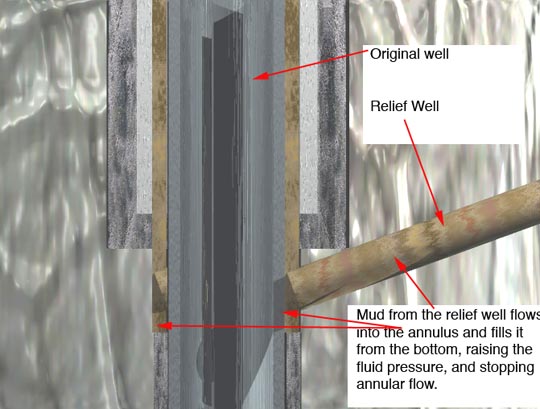
Once the mud reaches the surface, and the concentration, over time, increases to the point that flow up the annulus is halted (because the mud column weight exceeds the reservoir pressure) then – if flow is only through the annulus, the well has been killed. To seal it, the mud is displaced, at the bottom of the well, by injecting a cement plug into the well, that fills the bottom of the relief well and the annulus.

If the flow of oil has only been up through the annulus, there should, at this point, be no more oil flow out of the well, and the top of the well can be sealed with an additional cement plug, (as will the relief well) and the site can be closed down.
However if the oil flow continues, then it means that the oil is flowing up the inside of the production casing, At this point the drill is replaced on the end of the drilling string in the RW and the drill drills the cement plug out of the well, and continues drilling forward until it has penetrated the production casing. (It will use PDC cutters to do this). As before the mud in the RW will flow into the open channel, and with the mud pumps engaged, mud will flow into the central bore of the well filling it with a heavier and heavier mud concentration, until, again, the pressure exceeds that in the rock, and the oil and mud flow stop. The well is now killed.
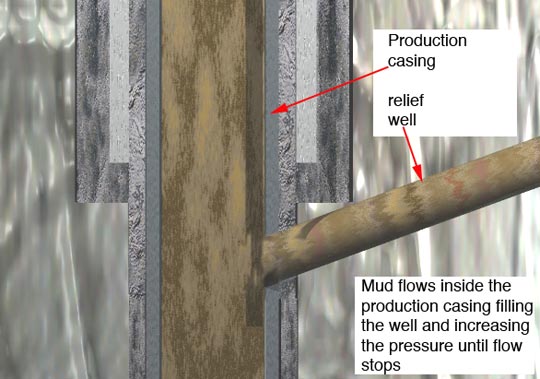
Once the well is stable, then, as in the earlier step, the mud is replaced with a cement to create a plug at the bottom of the WW and the RW and the wells are sealed. Additional caps at the top of the wells, and they can be closed down.

Admiral Allen described the process thus
What will have to happen is when the relief well is adjacent to the well bore and close enough to be able to turn to make the penetration, then we'll first penetrate the area outside the well pipe.And he then reinforced the point
And we will see if there is oil there or not. At that point mud will be pumped into the wellbore to see if that contains the well. If that does not, the mud and a (inaudible) plug will be inserted and then we will drill again into the inner pipe.
That will be the second attempt to plug the well if oil is coming up through the pipe with mud and cement. These two procedures will take us into August. There're things that could happen that could shorten that but right now into August is what the official estimate is.
Number one, if you take into account that you’re going to exhaust every possibility, if you go someplace and there’s not oil and you have to go find it in other place in that wellbore and you have to first seal what they call the annulus, the area outside the pipe, with mud and then cement that and go back in and re-bore into the pipe itself because you’re going to slowly remove any source of oil the closer you get inside the wellbore.
If you have to do all of that, it will take you well into August. If you get in there and you find the oil, you can see the oil in the annulus of the well bore the first time around, then it could be shorter. So it could happen, but I’m not going to assume that. I’ve been around you folks long enough to know that we need to under-promise and over-deliver.
He also mentioned that the decision on the cap had not yet been made.
I am asking BP to give me a detailed timeline in 24 hours on how they would accomplish the hookup of the units producer to the free standing riser pipe and then how they would move the current containment cap off, putting a containment cap on that would effectively seal the top of that well and go to the new containment structure, which does a couple of things, it gets us to a production capacity and a redundancy in the system of 60 to 80,000 barrels of day.The we here is the “brains trust” that Secretaries Chu and Salazar have assembled, and who will vet the idea. Here is my gripe. They have known about the design and the plans for weeks now. They have a short window of opportunity before the next storm rolls in and stops the effort, and they are only now getting the paperwork that they have to approve. It does not seem unreasonable to ask why this wasn’t done over a week ago, so that approval was in hand the moment that the weather allowed the procedure to begin. If the weather closes in again before the approval is given and the process completed, whose fault is this?
It also gives us quick hookup and quick disconnect and it will give us heavy weather or a hurricane. So not only do we have number one we have a weather window, number two we're going to get the weather to be able to hookup the Helix Producer.
I have asked BP to give me within the next 24 hours a detailed timeline that we can look at and then approve that will allow them to move forward. If we can take advantage of this weather window we will certainly do that.
If the new cap is on, then when mud flows up the well it will go through the BOP and the sealed cap and up to the surface so that there is an additional pressure on the bottom of the well. If it is not, then the mud column weight above the BOP is lost. But the Federal Government is in charge, and processes and procedures must be followed, as they are repeatedly now informing folk. Sigh! So if the opportunity is lost, why that is just the way things go!
The current data on oil and gas production from the site:
For the first 12 hours on July 8 (midnight to noon), approximately 8,565 barrels of oil were collected and approximately 3,940 barrels of oil and 28.3 million cubic feet of natural gas were flared.
• On July 7, total oil recovered was approx. 24,575 barrels:
• approx. 16,655 barrels of oil were collected,
• approx. 7,920 barrels of oil were flared,
• and approx. 57.6 million cubic feet of natural gas were flared.
Read more!
Tuesday, July 6, 2010
Deepwater Oil Spill - the last cement job?
The first relief well at the Deepwater Horizon site appears to be close to setting the last casing in the new hole, before the final step of drilling down to and through the original well casing. While this is bringing the initial major concern (stopping the oil flow) closer to closure, there is still some time to go. Wind and weather are not cooperating and the depression over the Yucatan is reminiscent of Alex, which held up work until wave sizes dropped at the site. Sadly wave heights are now back up to the point that they are holding up work on completing the connections for the new cap to the well. At present, while the connection to the Helix Producer will carry an additional volume away from the BOP through the kill line, perhaps allowing some of the vents on the original cap to be closed, some leakage must still be maintained.
Since the stage is ripe for the final installation of casing at the lower end of the relief well, I thought I would just repeat a very simplified description of the process that is going on, so that you can understand the delay, before they drill over to intersect the leaking well.
As the well has been drilled down through the ground, it passes through layers where the rock might either be porous enough that the drilling fluids will flow into them, or might itself contain fluid at pressure that can flow into the well, and dilute that mud. In order to stop either event from happening, the drilling process is stopped and a process undertaken that seals off the rock on the sides of the well from the well itself. This is known as casing the well, and running casing and for this relief well the process has been carried out a number of times as the well was driven. The well is now at the point that the final casing is about to be set, following which the connecting passage over to the flowing well will be undertaken.
The drill string is first taken out of the hole, and the drill bit is removed. The drill string can then be used to lower a larger steel pipe into the well to encase the well, from the bottom of the earlier lining run down to the current bottom end of the well. (Hence the name casing). Having this continuous length of casing in the hole will stop, say water, from getting in and diluting the drilling mud or the mud itself from flowing out into the rock. But if this was all that we did, then it would still leave a problem, since the steel pipe does not completely fit up against the rock wall created by the drilling bit. In other words there will be a gap between the casing and the rock wall, and this will allow fluids to travel up or down. This gap has to be filled, and the filler is normally a special form of cement. The casing has, therefore, been fitted with a small ring, called a shoe, that fits on the bottom end of the casing as it is set in place.
 Components used in cementing casing into place (after Schlumberger
The way that the cement is placed is simple in principle, but a fair bit more difficult to do properly and effectively. Think of the long thin tube of casing, filled with a cement that acts something like toothpaste. This cement has to be pushed down the tube so that it squeezes out of the bottom and then flows back up between the casing and the rock wall, filling all the gaps as it is pushed back up to the top of the previous run. Particularly when this last casing is run, it is important that the gap is fully filled. This is because this is the casing that seals the well so that no fluid can escape back up around the casing, rather than flowing from the relief well into the well that is flowing oil and gas. Since the cement will move more easily thorough a larger passage, than a very narrow one, this gap has to be above a certain minimum size. Small centralizers are attached at points down the steel casing to keep it in the middle of the hole, rather than pressing up against one of the walls (since this might leave an open channel up through the cement). (And it was the number of these that caused some of the concerns in the final casing of the well that the Deepwater Horizon ran).
 Cementing plugs
A small plastic plug (the bottom plug) is put into the casing ahead of the cement. This separates it from the mud that is already in the hole. It is fitted with wipers, that clean mud from the walls of the casing, and it is pushed down to the bottom of the casing by the cement that is pumped into the well behind it. There are some pictures of some of the tools and descriptions of the process here, here and here.
Once the bottom plug gets to the end of the casing, there are ports it passes that allow the cement to flow out of the casing and back up the outside. Once the cement has been pumped into the casing a second, top plug, also fitted with wipers, is put into the casing and this is then pushed down by the conventional drilling mud. As it is pumped down it forces the plug down, and the cement out and back up to the surface. Because of possible variations in hole size and other possible problems, perhaps about 50% more cement might be pumped into the well than the calculations might suggest. When the top plug hits the bottom plug, then there is a pressure spike at the pumping station, telling the operator that it is finished. The rig then waits on cement (WOC) until the cement is hardened. The drill pipe can then be put back in the hole with the mud motor on it ready to make the connection over to the flowing well.
At present the debate over exchanging the cap on top of the old well does not appear to be totally settled, and Admiral Allen has been meeting with BP to move this part of the operation forward.
Incidentally, while Tony Hayward who has left the scene in the US is still busy on BP business, but was spending the day in Azerbaijan
Mr Hayward re-iterated BP’s commitment to Azerbaijan and to continuing successful cooperation with the government and SOCAR. Mr Hayward once again highlighted the importance of the Azeri-Chirag-Gunashli and Shah Deniz oil and gas development, as well as the Baku-Tbilisi-Ceyhan and South Caucasus Pipeline projects to Azerbaijan, the region and global energy markets.I’ll add information on oil production when available, since the BP server appeared down when I just went to access it.
Read more!
Monday, June 28, 2010
Deepwater Oil Spill - closing in on the well
Well with Alex trundling off towards Mexico, the second area of concern having dissipated, and the two +3 earthquakes in Iceland being North of the island, or up around Loki, the worry over the impact of natural hazards can be set back just a little today. Which is helpful, given that the relief well is approaching the point where it might soon bring this sorry episode a lot closer to the end game.
Total recovery from the BP site has been relatively consistent in the immediately recent past:
Connections for the first free standing riser have been completed and this will be connected to the Helix Producer – “a redundancy measure also taken under the direction of the Federal Government.”
The first relief well has now drilled to a depth of 16,545 ft – which puts it within about 150 ft of the point where the first connection may be tried, so I suspect the drill might be being turned horizontal. (Remember that it has to hit with an accuracy of about an inch). They may be steering it with a device called an Autotrak system where, just behind the drill bit (which is rotating – as are the main pipe segments – yellow in the picture below) a non-rotating piece of equipment is located (blue) that has three small rams that can push out against the well bore and direct the drilling head over in the direction required.
 Autotrak assembly (Oil Museum in Stavanger) – you can see one of the pads pushed out as though it was pushing the head over.
This also implies that the last cement job was tested out satisfactorily, after the cement had set.
Total recovery from the BP site has been relatively consistent in the immediately recent past:
For the last 12 hours on June 27 (noon to midnight), approximately 8,340 barrels of oil were collected and approximately 4,100 barrels of oil and 28.8 million cubic feet of natural gas were flared.
On June 27, total oil recovered was approx. 24,450 barrels:
approx. 16,275 barrels of oil were collected,
approx. 8,175 barrels of oil were flared,
and approx. 56.2 million cubic feet of natural gas were flared.
Total oil recovered from both the LMRP Cap and Q4000 systems since they were implemented is approx. 438,000 barrels. An additional 22,000 barrels were collected from the RIT tool earlier in May bringing the total recovered to approx. 460,000 barrels.
Connections for the first free standing riser have been completed and this will be connected to the Helix Producer – “a redundancy measure also taken under the direction of the Federal Government.”
The first relief well has now drilled to a depth of 16,545 ft – which puts it within about 150 ft of the point where the first connection may be tried, so I suspect the drill might be being turned horizontal. (Remember that it has to hit with an accuracy of about an inch). They may be steering it with a device called an Autotrak system where, just behind the drill bit (which is rotating – as are the main pipe segments – yellow in the picture below) a non-rotating piece of equipment is located (blue) that has three small rams that can push out against the well bore and direct the drilling head over in the direction required.
 Autotrak assembly (Oil Museum in Stavanger) – you can see one of the pads pushed out as though it was pushing the head over.
This also implies that the last cement job was tested out satisfactorily, after the cement had set.
Read more!
Thursday, May 27, 2010
Deepwater Oil Spill - preparing for cement
Admiral Allen, who is the Government head of the effort to cap the flowing well in the Gulf, and to oversee the cleanup operation, commented this morning that the well had reached a point where the internal pressure difference between the mud pumped in and the reservoir pressure was very low. However, with the relatively high volume of leakage that was passing through the BOP, the plan now included a try at blocking some of that leakage path by injecting debris (for which likely read rubber strips and small spheres) in the hope that these will lodge in the flow path within the BOP and reduce the leakage of fluid.
The leakage rate is significant (I calculated earlier that it was around 17,000 bd, which lies within the newly reported range of 12,000 to 19,000 bd, and may have been higher than BP were actually anticipating. (Though the leak may also have increased a little as the mud was injected at higher pressures). The operation has already used all the mud on one of the supply boats, and has moved to the second (there is a third standing by so they won't run out). The concern, however is now with the volume of cement that will be required for the seal.
The high volume that is leaking would require that additional amount to the volume needed for the seal itself, and that may be closer to the available capacity of the system that they have in place, or the supplies that they have on site to achieve the seal. If that is the case, one can understand the desire to at least partially plug the leaks in the BOP, and to wait until the mud column fully balances the pressure in the oil reservoir before starting this phase of the operation.
Until this point in the operation the volume of cement required to create an effective plug has not been seen as an issue.
Unfortunately as I write the feed from the leak has moved to look at other things, but the last glance I had seemed to suggest that they have been able to reduce the flow somewhat, though I guess not enough. Just to remind you of the problem, this is what the internal flow path through the BOP looks like:
 Section through the BOP, showing the anticipated mud flow path (initially from BP)
Now they have to get relatively large particles (larger than the smallest diameter of the flow path) through the feed lines, which have a size of 3-inches, and those of us who pump particles in fluids much prefer that the particle diameter be no more than 30% of the pipe diameter - which is to say in this case an inch. And so if the orifice in the BOP is larger than that, then there is a problem in working out how to get something in there that will be effective, remembering that it has to work through all the flow convolutions of the supply line that has just been installed for the mud.
Read more!
Subscribe to:
Posts (Atom)

 Posts