Showing posts with label top kill. Show all posts

Sunday, July 25, 2010

Deepwater Oil Spill - After the storm

The “Bonnie” storm has passed, and the different vessels are not only returned to the site, but are already making progress in returning to operations. As Admiral Allen noted on Sunday
DDIII is now running the riser pipe down. They have 67 joints to complete, they've done 39 of those as of about 10:30 Central Daylight time this morning, need about five more hours to do that. They are planning to latch on to the well around midnight tonight. Development Driller II which was – had drill – was involved in drilling the backup well is returning to site and will start running their riser today.

Q4000 is inspecting the yellow pad, that is the control device that's placed subsea to operate the hydraulics. They replaced the valve on that and they plan to install it later on today and then they will begin preparations for the static kill operations.
He also noted that the pressure in the well has now risen to just over 6,900 psi, while the temperature at the BOP remains at 40 deg – suggesting no flow and that well integrity is apparent. The storm has, however, dispersed and moved the oil, and they are resurveying to find where the threats now lie.

He then gave the current anticipated time line for the kill of the well.

.
The time line is roughly over the next week. We'll return the Development Driller III, run the riser pipe, latch in, pull that undersea containment device, which they call a packer.

They're going to need to circulate conditioning fluids through that pipe line to make sure it's ready what they call conditioning a hole and then some time in the next week they'll be in a position to be able to run that (nine and seven-eighths inch) liner which is the critical path right now to moving – to move ahead.

Once that liner is laid, they're going to put cement in and around it. And at that point the two vessels that were supporting the liner operation, one call the Blue Dolphin, the other is called the Center Line will redeploy and hook up with the Q4000.

This is sometime – this will be sometime during the week of 1 August. And they will set up for that to be able to inject the static kill and during that week of August subject to the (inaudible) I'm sorry the containment pipe being installed and cemented in then we will go to the static kill with the Q4000.

Kent Wells has also now released the animation showing how the different kill methods will take place, and interestingly also showed the section at the bottom of the well that shows the different layers of oil bearing rock in the reservoir.

The animation follows along the process in much the way that I described in an earlier post on the bottom kill, which is now scheduled in two parts. As the Admiral noted, the first part is to case the relief well. Once that is in place, and the cement run, then the top kill will start.

Because the well is shut-in, the plan is that the flow to the surface will be reversed. the flow lines are now passing oil and gas to the surface, the circuits will be reversed to return them to their original condition, and then mud will be fed into the well. Because this can be done a little at a time, it will be, and the pressures will be monitored to ensure that, as the well fills with mud, that there are no integrity problems.

Once the well is full of mud, they may try pumping cement into the well from the top (this is shown in the animation), though, because of concerns over flow control, I would suspect that they will not put the cement in until they connect through the relief well, and they will then do a two stage (annulus and then inside the casing) final kill.

And I should note that, contrary to my concern, the leaks that are being shown again now by the HOV ROV1 are no worse than they were before the storm, so perhaps that is not going to be much of a problem going forward.

Read more!

Tuesday, July 20, 2010

Deepwater Oil Spill - time is not our friend

There is a certain frustration in hearing some of the officials who act as spokesmen for the management team handling the spill from the Deepwater well in the Gulf of Mexico. Their evaluation of the situation is bound around a full collection and compilation of the existing evidence, a comprehensive and contemplative understanding through a scientific explanation of the causes of whatever anomalies and other behavior that is not following the model anticipated, and subsequently then working out the best steps forward and determining the potential benefits relative to alternative approaches. Such an attitude works well in a scientific laboratory, where whether the results are available tomorrow or next week only really matters if there is another lab in the world that is working closely along the same lines as you are. (And if the work is relatively topical that is often the case). Unfortunately this relatively leisurely approach to making progress is not nearly as compatible with a situation where a high-pressure piece of equipment is showing signs of leakage, and where there is the possibility that, within the week, equipment is going to have to be withdrawn from the site because of the imminence of a hurricane.

The imposition of an ultimately superior layer or more (depending on how much the White House is actually involved in decision making) of evaluation and decision making can do little beyond stretching the time over which decisions are made, eating up the time that is available for action, before the current gentle weather window closes. Now it may be that the current tropical depression will not solidify into a problem (I’ll let wiser heads in those topics answer that question), but even if this one does not, there will come a time when one will, and the working interval is shrinking.


Some of the worries about seeps in the vicinity have now been put to rest, in his brief yesterday Admiral Allen noted:
The first one was to see pitch about three nautical miles (Ed. Note amended to kilometers) from the wellhead itself. We do not believe that is associated with this particular well integrity test or the Macando well.
Similarly the bubbling from the sediments around the well have not been seen as something to worry about, although the material ejected is being tested. (It proves very difficult to get a meaningful picture of this). There is, however, one leak that is due to the well, and that is in the equipment that is sitting on the well itself.
Let me just tell you right away, because this happened overnight, as you know, we had a – a connector piece of equipment that we established in to allow us to put the capping stack on. These are the three rams that are associated with the capping stack. This is a schematic of those three rams. The leakage is occurring in a flange just located right about here, and there is hydrate formation appearing on this side of the capping stack as we move forward.

We do not know, but we do not believe this is consequential at this time, nor is – doesn't appear that the hydrate formation is inhibiting any operation of the capping stack. This is something we will continue to monitor as we move forward.
He noted that
it is the collective opinion of the folks that are talking about this that the – the small seepages we are finding right now do not present, at least at this point, any indication that there is a threat to the wellbore. . . . . . . There is a – there's actually a metal gasket in the flange, rather than a rubber (one). It's actually a metal – metal seal in there. And that appears to be the source of (the leak). But we don't know if it's consequential to the operations of it. It's not a huge leak, but it is causing the formation of hydrates.
(Ed note I corrected some transcription errors). The lack of concern seems to focus on the possible stratification of the fluid in the wellbore, and the concentration of any sand, which could cause problems if rapidly released.

Now that in itself is somewhat revealing, since one of the things that I have discussed in the past is the concentration of sand in the fluid flow, and that, when the fluid gets to a pressure differential of 2,500 psi or more that sand will erode metal and anything else in its way, as it flows out. With the sensible admission of the presence of that sand, what BP intend, apparently and if necessary, is to bleed the pressure down sufficiently slowly that the current segregation within the well, with the lighter gas-related hydrocarbons rising to the top, can be maintained until the pressure differential is low enough that the sand would no longer cause much erosion if caught up in the fluid. (Whether this would need to take the “several days” that Admiral Allen suggests is, perhaps, debatable.

There are a couple of problems with that. The first is that the sand is not in a single size range, but likely goes all the way down to sub-micron in size. The smaller particles don’t settle out that easily and thus are likely to be present to some concentration in the fluid throughout the well. Which raises the second problem which is that particles do cause erosion if they are moving over a surface at relatively high speed (caused by the pressure differential). In a much earlier post I discussed this and the effects that it might cause.

In my other life we have dealt with the problems of having abrasive get into high pressure fittings, and the leaks that result. Leaks tend not to fix themselves, and get bigger over time. Expecting that they might not change over the next month, while the odd hurricane might pass by, and the relief well completion gets postponed, is not a reassuring path to take.

In Kent Wells review on Tuesday he was, similarly to Admiral Allen, complacent about the leaks.
And then in terms of the couple of gas leaks that you probably observed on the BLP and capping stack. Those are just coming from places where we have what we call (metal) seals. Those are small leaks that are as a result of gas. Those connections have been tested to very high pressures in the case of the capping stack we actually tested it to 15,000 PSI with water and with no leaks, and it’s just when we – we probably got a gas bubble that’s formed up there and that’s why we have that very slow leak. It’s nothing that we’re concerned about.
At those pressures and temperatures, the gas is still liquid and still capable of carrying sand with it.

The potential for injecting mud to kill the well, which is getting more of a hearing at the moment, could be the way forward. Once mud in any significant volume is introduced into the well, through existing lines initially designed just to do this very thing, then the pressure at the top of the well will decline. This lowers the differential pressure across any leaks, lowering the flow and extending the time period before they may fail.

But, in regard to doing this “top kill”, Admiral Allen noted
We now have a closed system, so there's back pressure. And so the question is is there enough back pressure there where you could do basically more of a static rather than a dynamic top kill, where you could put mud in. That might suppress the hydrocarbons.

There's been some discussion about whether or not that might be possible. We're looking for BP to give us an idea of whether or not that it's possible, how they would do it. And we'll react to that when we receive it.
And BP themselves does not have a sense of urgency about moving forward with the process. From Kent Wells:
And then in terms of the static kill – and once again, I want to reinforce, no decisions have been made yet on proceeding forward with that. But we are continuing with preparation and planning. We continue to get equipment lined out, what we would want to do, making sure that we will have the right equipment out there to do it, writing procedures, starting to get procedures approved.

At the same time, we’re doing testes (sic) with scientists, challenging the way we’re thinking about this, what we’re doing, so we’ve got parallel paths going on that’s leading towards somewhere ideally in the next day or two that we’d be in position through unified command to make a decision whether we’d go forward with that.
He may take a couple of days to make an animation showing how it will work. Essentially however it involves reversing the flow down one of the kill lines (originally set up to allow mud flow into the well) which are now being used to allow oil to flow out of the well and up to a service vessel. From Kent Wells:
Now, one of the things we do need to do is we need to make some changes on the Q4000 to change it from its ability to contain oil and turn it back around into the pumping facility. But that does not take us very long to make that change and of course we’ll always have the ability to change back if at some point we need to do that.
It will, likely, take much longer for management to decide whether or not it should proceed. And the weather window continues to shrink.


Oh, and from the Admiral’s brief, in case you missed it.
The Discoverer Enterprise is no longer on station.


Read more!

Sunday, May 30, 2010

Deepwater Oil Spill - using a nuclear weapon

While the likelihood of using a nuclear weapon to shut off flow to the leaking oilwell in the Gulf are absolutely zero, nevertheless, under a different circumstance it did work in the Soviet Union. This video of that event shows it happening. Thanks, Rune.


Read more!

Deepwater Oil Spill - why Top Kill may have failed

The Top Kill attempts have failed, and the Government has a response.
He (President Obama) said US Energy Secretary Steven Chu was leading a team of "the world's top scientists, engineers and experts" in devising a contingency plan should the "top kill" attempt fail.
But while waiting for that, and for the Lower Marine Riser Package (LMRP) I thought I would spend a few paragraphs discussing why Top Kill may have failed.

In a couple of earlier posts I wrote about how it was necessary to fill the gaps that ran through the Blow-Out Preventer (BOP) either with spheres and triangles or with wire(string would act similarly). To refresh your memory, in the initial simpler analysis I had put up a simple sketch of the BOP and well, to show how the blocking particles were injected.

Simple approximation of the situation

Now unfortunately that diagram missed a significant part out, and that is that there are three sets of pipes leading down into the well. These are the well outer casing, which, surrounded by a layer of cement, holds the BOP in place. Then there is the production casing, which had just been set to the full depth of the well. And there is the drill pipe that, at the time of the incident, extended down 8,367 ft from the platform, or roughly 3,367 ft below the BOP. That drill pipe (DP) had previously been used to locate the production casing at the bottom of the well, and itself now rode inside that production casing. In most normal operations it is closed at the bottom by a drill bit, but (and I’ll come back to this later) it had just finished the cementing of the production casing into position, and once it detached from that and was being pulled from the well, it was an open pipe all the way up to the rig floor. And in that condition it could be used for other things. By pulling mud out of the DP and transferring it to the mud pits (or standoff vessel), the level in the riser would fall and be replaced by seawater flowing in at the top. Unfortunately this also lowered the weight of mud in the well, and that is what caused the oil and gas to flow into the well.


Outside of the DP is the casing and cement segments that make up the outer lining of the well. The diagram presented in Congressional testimony, shows these various pipes, except for the central drill pipe.

Casing and cement down the Deepwater well

BP do not know, but believe that the oil is getting into the well through the cement wall at the bottom of the well, and probably rising up the well through the empty space (annulus) between the production casing and the outer lining of the well. However the oil and gas may have broken through the bottom of the cement plug and be rising up within the production casing, in which it is also rising through the BP once the oil reaches its lower end.

Most normal blowouts occur when the well is being drilled, and mud is flowing down, through the drill bit, and then back up the space (the annulus) between the DP and the rock wall. Thus, when there is a blowout, the oil and gas that flow into the well normally flow up this outer passage to the rig, and give the spectacular fountain of oil. The BOP was invented (by Harry Cameron and Jim Abercrombie) to stop that flow and to protect the crew at the surface. Because the flow is normally up the outside of the drill pipe, the initial BOP designs were rams that pushed seals across the flow path through the BOP, and sealed against the side of the DP.

BOP open allowing flow through the annulus (ASME )

BOP closed against the pipe, sealing the annulus (ASME )

A BOP could have two of these mounted so that one sealed to the production casing in the well, and one to the drill pipe, but if underwater then the production casing is tied back to the Wellhead Collet Connector, and then the only tube running through the BOP will be the DP, to which they will seal.

BOP connection to casing at the seabed (PCCI report for MMS)

The problem that this leaves, in the current situation is that the pipe that runs through these two seals is open at the bottom to the oil flow. So how can the flow through this be stopped?

The answer is to mount a top ram set that has a set of shear cutting blades on it, that will cut through the pipe and seal the full face of the well.

Shear blades to cut through the DP and seal the well (Varco )

The BP should shear, but would be held in place by the grip of the annular sealing rams below.

In this case it seems to be recognized that for some reason this shear event did not totally succeed. Thus the pipe was not totally severed and the two shear plates did not fully move over one another to complete the seal.

Now this is where the problem arises, because, in part, that pipe is still open at its lower end. If the leak is around the outside of the pipe, through a gap that has generated between the pipe and the annular seals, then the use of the junk shot to fill the cracks and gaps could conventionally have worked. But the configuration of the rams on the Deepwater Horizon had changed from the initial simpler configuration to add seals for occasions where the drill pipe was not in place.

Ram layout on the BOP (Times Picayune)

And the "junk" is being injected at the bottom of this stack.

Section through the BOP, showing the anticipated mud flow path (initially from BP)

If the leak is coming up through the remnants of the drill pipe then life is complicated. It can’t all be coming up through an undamaged pipe alone, since it was the far open end of that which was successfully closed at the beginning of the remedial steps, but if it is coming through the pipe and leaking out at the shear rams into the annulus that feeds into the riser, and out to the sea, then putting sealing particles into the bottom of the BOP to seal the cracks, could have sealed some of the leakage around the DP trapped in the shears, but not that flowing through the shears in the remaining pipe section.

The reason that it can’t is that the access to that flow is occurring 3,367 ft below the riser, and there is no easy way to get the sealing particles down that far. If they are mixed with mud and pushed down the well to that level and then released they have a different problem. The hope when they were released into the well was that the flow of the current would be enough to carry them up to the cracks that they could seal. But if they have to be carried down to the zone where the oil remains, then their density may be sufficient, if they get into the flow without enough speed to lift them up into the BOP to cause them to sink to the bottom of the well.

The materials that BP tried included materials that might float on the surface, and might not
Those materials, including fibrous pieces of rope and chunks of rubber, were supposed to force more of the mud down the wellbore, but ultimately it did not work.
Rubber has a specific gravity of 0.91 and rope varies from 0.9 to 1.4. But remember that at that depth any buoyancy from air entrainment would be lost.

In other circumstances it might have worked, If they could have dropped the DP out of the shears perhaps, but they couldn’t and it didn’t. So on to the LMRP.

UPDATE: Thinking about this a little more, I had two more thoughts. The first is that once the LMRP preparation cuts off the riser and the bent drill pipe that the full weight of the pipe below the shears may come onto the section in the shear jaws at the moment, pulling them further out of alignment and increasing the flows. It could also cause the pipe to drop out of the jaws, pulled out by the underlying weight, and hopefully not distorting them too much so that in the best of worlds they could then be cranked shut.

One could also, once the bent riser and pipe had been cut, go in down the pipe bit that extends up, go down past the annular seals with an abrasive jet lance (most of the flow is around the DP as we have established above) and cut it off, right above the shears. Then partially open the shears, drop the pipe out, and close them again. If they move all the way closed, without the obstruction, then the well may be sealed.

(Note because a) this is really a sort of Tech Talk, and b) its a nice day, there won't be the regular Sunday tech talk which would have been on coal mining today - it is postponed, as was the Saturday discussion of state climate changes - hopefully I'll be able to get back to both of those before long).

Read more!

Saturday, May 29, 2010

Deepwater Oil Spill - the end of Top Kill

BP and Admiral Landry just held a Press Conference in which they said that, based on a decision 90 minutes ago, by the “best and brightest minds” that it was time to move on the next option, the Lower Marine Riser Package (LMRP). BP was unable to block sufficient flow out of the well to make the injection of cement possible, and thus to kill the well. They had made, I believe he said three attempts to inject material (the junk shots) without being able to get that material to block the passages through the Blow-Out Preventer (BOP) . (Unfortunately I missed a large part of his opening remarks, and thus have only the question response to go on at present). The volume of mud used did not appear to have changed from earlier reports at some 30,000 barrels.

Mr Suttles said that they had given the technique every chance, but could not get it to start to provide an effective seal. They had, however, determined that the majority of the pressure restrictions to the flow of oil was coming from some resistance within the well itself, and from the BOP. Since the riser above the BOP was not contributing much to the resistance, and thus to control of the oil flow, the next plan is to remove it, using a band saw device (of which pictures will be available) and then to lower the LMRP onto the existing BOP. They intend cutting the surface that the LMRP will sit on flat, so that it will give a good, but not perfect seal. Thus there will be some leakage around the joint, and they will monitor that and use dispersant as appropriate.


The new change should take somewhere between 4 and 7 days to implement. The assembly, which has been constructed, and is not the Top Hat assembly built earlier, to fit on the bottom of a riser. Flow of oil from the LMRP will rise up a 6 7/8 inch drill pipe within the riser (the same size as the one currently fitted to the RIT). The riser will also carry hot water down to the LMRP to protect against the formation of hydrates.

He noted that their inability to stop the well “scares everybody” but is reasonably confident (no success percentage estimates) that this will collect the majority of the oil and gas. Because they do not know the flow path of the oil below the seabed it is difficult to estimate what is actually going on in terms of oil path below the BOP. Thus they are, again, trying something that has never been done before, but expect, based on the RIT, that it will work.

On being asked about the cleanup of the dispersed oil – he pointed out that the reason that the dispersant was used was to break the oil into small droplets. These are small enough to be consumed by the microbes in the sea, and thus there is no plan to do other than let nature take its course. For the oil on the surface, they are getting better at spotting oil pools and sending skimmers to deal with them.

The Admiral drew attention to the article on Hurricanes and the Oil Spill which is available at the Unified Command We site.

The relief well is about half-way through the rock it must drill (about 6,000 ft below sea level) but progress will slow as the well deepens.

The Lower Marine Riser Package (LMRP) option

Read more!

Friday, May 28, 2010

Deepwater Oil Spill - why Top Kill starts and stops

Out in the Gulf BP are going through the preparations for the next stage in the attempt to top kill the deep water well that has been leaking oil and gas for more than a month. The kill attempt has now been underway for a couple of days, and so this is initially a recap on what I believe has happened to date, and what they are currently planning on doing. I will include in this explanation the two attempts that BP have made so far, and what I expect that they will do next.

UPDATE: (9:19 PM) There have been at least two and possibly as many as four times today that there has been something that looks like an explosion, and debris rains around, and for a while the ROV cameras go and look at something else (right now it is the riser outflow that we haven't seen for a while).

What I believe is going on is that BP is running a series of "junk shots" with the Nat Lab "junk", and after they run one they fill the well with mud to see if it has changed anything. To date, while there are changes (you stop doing this when there aren't) they haven't been enough. But after each time that they fill the well with mud, they switch the pumps off while they go and regroup. That allows the gas and oil to push the mud back out of the way (one of these tries, perhaps, it won't and we will know that it has worked).

But when the oil and gas get through the constriction of the BOP there is a drop in pressure and an expansion, and this gives that little bit of excitement that we see. After a while, not so exciting, though this time one of the cameras went off air, so maybe there was something else going on as well?? OH, and BP has decided to halt, for a while, the second drilling of a relief well, so that they can prepare for plan B. One has to remember that these drilling rigs are at a premium, and there is an opportunity cost with just about every decision.
"The (Developmen Driller II) has temporarily suspended drilling operations in preparation for the possible future deployment of its BOP on top of the (Macondo) BOP," he told UpstreamOnline in an email response.
END of UPDATE.

UPDATE 2: 10:53 pm. It appears that they are pumping mud again, so another test may be under way. (I am judging this on texture and jet structure) . There is one interesting thing to note, and you have to be familiar with the patterns to see it. So I am going to repeat a picture from 3:45 am yesterday (which has been my standard base reference for mud, rather than oil flows.

3:45 pm 5/26/2010

Now look at the current flow:

10:59 pm 5/28/2010

Notice the changes in the flow pattern, and particularly that the crack to the right of the central paint removed line, which had a piece of rubber jammed in it . By adding more NL junk they have just about totally bridged that crack and stopped the flow - which illustrates that what they are trying to do at the BOP is at least partially working - as I explain below. In fact, after watching for a short while, both the central jets that used to carry most of the flow, are now significantly diminished, so both have some form of particle bridging the gap.

I am almost tempted to note that the flow seems at a little less pressure, judged again by jet structure, and which would indicate more bridging in the BOP, but I grow more cautious as the process extends.

And one last point - you should not expect the majority of the cracks at the riser (the ones we are looking at) to get closed until almost the end of the injections since their width is much smaller than the one that they are trying to block in the BOP, but as it grows smaller, so they should come into the range of the NL "junk." END UPDATE 2

To help with the explanation I am going to use some very simple models, which oversimplify the situation, but hopefully help in explaining it. To start with I am going to break the overall system down into a very simple diagram.

Simple approximation of the situation

Basically BP are sending mud through a series of feed lines, which I have simplified for the explanation into one feed pipe that I have called the choke line (grey). It has an internal diameter, at most, of 3 inches. (I say at most because most fittings on these lines have smaller diameters). It feeds into the top of the well, which I have colored brass, and which is the pipe (casing) that feeds from the seabed down to where the oil is emerging from the rock, some 13,000 ft further down.

The casing and choke line sit underneath the Blowout preventer (which is the large assembly at the top of the rig). I have colored this bronze, and simplified the shape, for this explanation, to represent a pipe that has been partially closed by the action of the BOP.

Now, here is the problem. BP want to feed mud through the choke line at such a pressure and flow that it will push the oil and gas flowing up out of the well back down the well. To do that they have to create enough resistance to the flow that the combination of the mud flow and the oil can’t all escape out through the hole in the BOP.

They can do this since, as you increase the flow through a hole (or nozzle) it has to move faster to get through the space in a given time. It takes a driving pressure to get the fluid moving at that speed, and for a given driving pressure the fluid will only move at a certain speed, and so only a fixed volume of fluid can go through the hole.

Thus if BP pump more fluid into the well than this volume, for that given pressure (which is higher than the pressure that the oil was flowing at) then all the flow out of the well will change to mud, and the excess mud that is not flowing out of the hole will be at enough pressure over the oil (and gas) in the well that it pushes it back down the well and back into the rock.

Now that was the first step. The idea was that once the column of mud filled the well, down to where the rock reservoir lies, that the weight of the mud would exert a pressure on the oil in the rock, that was higher than the fluid pressure, and the flow would stop.

The first time they did this, the density of the mud (weight of a cubic foot) was not high enough for the full column to balance the pressure in the rock, and the leakage of mud out of the hole in the top of the BOP was higher than BP had thought, so they were losing too much mud to the Gulf.

So they moved to step two. The first part of this is to try and reduce the size of the hole in the BOP. And for this they used a variety of what everyone is calling a junk shot. It actually isn’t. Given the problem that I am about to outline, they have an ally that folks normally don’t have. As Secretary Chu has pointed out there is the full intellectual strength of the Federal Labs behind this attempt, so where one would normally just chop up tires and similar materials, there is a fascinating mathematical problem in designing plug pieces of the right shape that will fit the constraints, and which will accelerate the blocking of the flow path. So I suspect that some of the shapes that will appear in the flow, will have been specificially designed for the problem.

Not being familiar with their answer I’m going to stick with the spheres and triangles of the more traditional, shall we say old fashioned, way of addressing the problem.

It is one of these problems where the bounding conditions can make life rather difficult. Let me redraw the problem with a different orientation. What we have to do is to block (the term that is being used is bridge) the passage through the BOP. This will stabilize the flow, and will allow the cement plug time to set up. (We’ll talk about cements another time).

So here is the slit: through the BOP – it is going to be a more complex shape, but this allow some explanation of the problems.

Simplified picture of the slot to be sealed

Now to block the slot we have to have some pieces of material (although they are quite large for simplicity I am going to call them all particles) that are big enough to wedge in the slot, but small enough to get through the feed lines to that point.

Now here’s the first catch, we don’t want them to be hard enough that we will damage the passages, nor soft enough that they will bend distort and compress and squeeze through the hole. Rubber turns out to fit the bill, and though there are other materials that could be better, in this initial explanation that’s what I am going to use.

The easy thing to do is to use some spheres, not easy to get, though golf balls are an example. Unfortunately they are a bit too big. The reason is that the feed line through the choke has a maximum inner tube size of probably 2.75 inches. A golf ball is about 1.6 inches, which is more than half this, so that two balls together could block the feed line – a definite no-no. (And don’t say it can’t happen, I’ve seen it with smaller particle ratios than this).

The maximum size that you can get through the line should be about a third of the minimum diameter – say 0.9 inches, stretch a point and make it a maximum ball size of an inch. So we fill the mud with miniature golf balls, pump enough of them down that they end up going through the BOP and wait for the effect. Let me show you, using pearl spheres, how the problem evolves:

Spheres in slot

See all the open space around the spheres, and how much of the slot remains open. We really haven’t made much of a blockage in the slot area of contact, and we have made it hard to push other materials into the slot area itself. However the smallest open area now may be at the maximum diameter of the spheres, which is further back, where the feed pipe is larger. Putting more spheres of the same size down won’t improve the situation much, because they still leave room, around the spheres, for fluid to flow.

There are two ways to go, once the initial building blocks for the bridge have been established. The first might be to use triangular pieces of rubber (as we saw protruding from the crack in the riser. These can fit closer together and fill more of the slot and flow passage.

Ideal case of three rubber strips blocking flow

Here the strips have aligned in the right way and have been driven into the slot, reducing the flow path. But note, as with the spheres that the gaps that are left are now too small for more strips of that size to feed into the slot and do more blocking.

So in either case what has to happen is that there should be a second pass, where smaller particles are used . These couldn’t be used before, because they would push through the slot, but now the slot size is smaller, and so these can start to fill in the gaps. Let me illustrate with the spheres:

Filling the gaps with a smaller second set of spheres.

So now the gaps that remain are even smaller, and so in a third shot, with even smaller gaps the feed particles have to be even smaller.

It can take a number of different slugs of material going through the choke line (and being pushed into the BOP instead of falling down the well, before the slot is sufficiently “bridged” that there isn’t much flow out of the BOP.

So expect that there will be a number of these shots, after each of which mud will be pumped in to see how much progress in filling the holes they have made. Bear again in mind that there is this restriction on how big a piece they can feed in, and just hope that all the gaps in the BOP are small enough that big enough particles can be fed into the lines to block it.

Now, as I said, they are probably using more sophisticated shapes from the National Labs, that will allow the number of shots to be reduced, but the relative sequence still has to be followed, as they build the bridge. Let's see how it goes, and be patient, each shot takes time to set up.

And at the same time, given that they have to balance the weight of the column of mud against the rock pressure, they are using the interval to change the mud weight increasing it each time, to seek that balance. (They don't want it higher than it has to be or it could hydraulically fracture the rock and lose the mud into the crack).

(Oh and if some of you remember the class in school where the teacher filled a jar with big pebbles and asked you if it was full, you said yes, then he/she poured in smaller pebbles, now is it full? Then came sand - now is it full? And then the jar was filled with water - its the same basic idea).


Read more!

Thursday, May 27, 2010

Deepwater Oil Spill - preparing for cement

Admiral Allen, who is the Government head of the effort to cap the flowing well in the Gulf, and to oversee the cleanup operation, commented this morning that the well had reached a point where the internal pressure difference between the mud pumped in and the reservoir pressure was very low. However, with the relatively high volume of leakage that was passing through the BOP, the plan now included a try at blocking some of that leakage path by injecting debris (for which likely read rubber strips and small spheres) in the hope that these will lodge in the flow path within the BOP and reduce the leakage of fluid.

The leakage rate is significant (I calculated earlier that it was around 17,000 bd, which lies within the newly reported range of 12,000 to 19,000 bd, and may have been higher than BP were actually anticipating. (Though the leak may also have increased a little as the mud was injected at higher pressures). The operation has already used all the mud on one of the supply boats, and has moved to the second (there is a third standing by so they won't run out). The concern, however is now with the volume of cement that will be required for the seal.

The high volume that is leaking would require that additional amount to the volume needed for the seal itself, and that may be closer to the available capacity of the system that they have in place, or the supplies that they have on site to achieve the seal. If that is the case, one can understand the desire to at least partially plug the leaks in the BOP, and to wait until the mud column fully balances the pressure in the oil reservoir before starting this phase of the operation.

Until this point in the operation the volume of cement required to create an effective plug has not been seen as an issue.

Unfortunately as I write the feed from the leak has moved to look at other things, but the last glance I had seemed to suggest that they have been able to reduce the flow somewhat, though I guess not enough. Just to remind you of the problem, this is what the internal flow path through the BOP looks like:

Section through the BOP, showing the anticipated mud flow path (initially from BP)

Now they have to get relatively large particles (larger than the smallest diameter of the flow path) through the feed lines, which have a size of 3-inches, and those of us who pump particles in fluids much prefer that the particle diameter be no more than 30% of the pipe diameter - which is to say in this case an inch. And so if the orifice in the BOP is larger than that, then there is a problem in working out how to get something in there that will be effective, remembering that it has to work through all the flow convolutions of the supply line that has just been installed for the mud.

Read more!

Deepwater Oil Spill - comparison of flows

I am putting up these pictures to show why I believe that the injection pressure of mud into the well has dropped, indicating that BP have filled the well, and are now holding pressure to see if there are any problems. I would assume, if none develop, that they will inject cement to seal the top of the well, sometime today. And I am slightly modifying the order since, at 6:35 they showed the ROV and the leak to give you some sense of how close the camera is to it.

ROV and plume 6:35 am

3:45 pm yesterday

5:32 am this morning

Notice how the flow was longer and straighter, indicating that it was at higher pressure (velocity) and that now it blows out at much closer distance, meaning it doesn't have the same pressure (velocity). There is a small caveat, and that is that I am assuming that there hasn't been any significant erosion of the surface of the cracks between the two shots, and that may be a possible change, though not enough to cause the reduced throw distance of the central jet.

And here is the flow at 6:30 am


Read more!

Wednesday, May 26, 2010

Deepwater Oil Spill - permissions and concerns about Top Kill

Rather than stick continuous updates on the previous post, I am going to add them as updates to this separate post on the progress of the Deepwater Top Kill attempt

By 1 pm Louisiana time, permission had been obtained from Admiral Landry to go ahead with the top kill procedure. The team is therefore waiting for final approval from the top folks at BP, before going ahead.

There have to be concerns about the increasing number of leaks at riser near the BOP, which is lowering the flow out of the end of the riser (and which were visible on a CNN feed earlier this morning). Leaks of a fluid that is carrying abrasive particles can get larger very quickly, and can threaten the integrity of the BOP. This now, therefore, becomes a driver to accelerate the process, given that if the flow is allowed to continue that the BOP may be further eroded and weakened and may collapse on the one hand, and that even if it were not to, that the resistance to the pressure of the top kill process will decline as it erodes.

We are at a point where endless discussion and the need for permit after permit begins to have a negative impact on success.

UPDATE - Well so much for impatience, the process has been started, and we should know fairly quickly whether it works.

UPDATE 2: There appears to be mud coming from the leaks in the riser at the top of the BOP, showing they have started pumping at 2 pm

UPDATE 3: Well BP said that they would provide a live feed, they just didn't say which one - grin - so the feeds are now showing things such as parts of the BOP, where they were looking for leaks initially, but where nothing much is now happening, But it does seem from the occasional glance of the leaks near the top of the BOP that they are increasing the pressure on the feed to the well at 2:30 pm. Hmm, now CNN are showing the top leak, and if you look at the one at the back, it noticeably got bigger in the last couple of minutes.

(Oh, and for those watching CNN you don't need 2000 ft of cement to seal this well, they can get by with a whole lot less (less than 40 ft) but may go for an absolute assurance that nothing will ever get out of that well again.)

UPDATE 4: (3 pm) BP are planning on injecting 50 barrels of mud a minute. Let us assume that the leaks are still allowing 5000 bd of flow, which is equivalent to 150 gal/min. 50 barrels at 42 gallons per barrel is 2,100 gallons. Let us assume, for discussion that the amount that escaping fluid through the BOP doubles during the injection. Then the flow that will go down the well is 2,100 – 300 = 1800 gallons.

There are 231 cu inches in a gallon. So they will be injecting 416,000 cu inches/minute. While the well has various diameters I will assume a diameter of 16 inches as an average. This gives a cross-sectional area of 200 sq inches (roughly).

Then the speed at which mud will travel down the well to fill it is 416,000/ 200 = 2,080 inches per minute, or 172 ft per minute. The underground part of the well is 13,000 ft deep.

At 172 ft/minute, it will take 13,000 / 172 = 75 minutes to fill the well with mud.

So that is about as fast as the operation can determine success. Though, due to pausing between steps to ensure that there aren't too many problems, it will likely be somewhat longer. And it depends on how much worse the leaks at the top of the BOP get.

UPDATE 5: There is nothing really exciting about watching a mud fountain play into the ocean for an hour or more, and so I thought I would stick my neck out a little and predict how this might end. (Nothing dramatic being visible, means that so far it is working).

Once they consider that the well is full of mud they will likely back off the pump pressure that is injecting mud into the well. They will monitor the pressure in the well as they drop the inflow pressure down, and watch to see, as the pressure falls, if there is any increase in pressure from down hole. If they can take the pressure of the pumps all the way down to ambient (which is under 5,000 ft of sea water, and is therefore around 2,400 psi) and stop injecting fluid, and nothing changes on the pressure gages, and there is no flow out of the well, then the well will have been brought under control. As the pressure in the pumps starts to fall, so the mud fountains at the leaks will start to diminish.

UPDATE 6: Well I notice that the BP Press Conference keeps getting postponed, which may be good or bad news. If the Top Kill had immediately failed (unacceptable erosion of the BOP) then there would likely have been a Press call.

If it had immediately worked then there might have been another, but that they are delaying it means that it may be working but a little slower than they had hoped.

UPDATE 7: Ah, in the Press Conference Doug Suttles said that they are only injecting mud at the rate of 20 barrels a minute. (7,000 barrels over 6 hours). This is less than half the anticipated flow (50 barrels) and they may have dropped the injection flow rate to keep pressures in theleak above the BOP at an acceptable level. That does increase the time it will take to fill the well significantly (by several hours, depending on the leak rate). Though it also shows that those estimates that the well was leaking at 100,000 barrels a day were fantasy.

It would take 87.5% of the mud injected being lost to leaks, for it to take 22 hours to fill the well, and that would indicate that the leakage rate was 25,000 bd.

I was watching CNN and Campbell Brown talked over what the biggest problem has been so we'll have to wait until either a reporter or the transcript lets us know.

UPDATE 8: Well it may be my old eyes, but I think that the flow from the leaks is definitely less than it was, leading me to suggest that the well is now full of mud, and they are reducing the flow to see if the well behaves. (8:47 pm) I haven't been watching for a little while however, but did have these other thoughts before I got distracted (its called dinner if I recall).

The leaks at the tops of the riser do appear to be getting bigger. However they look like crack leaks, which seem to get longer preferentially to wider, with less overall increase in flow. I would expect, since BP has more than enough pump capacity, that they will just increase the flow to balance any increase in leakage. They can monitor this through the pressure gages, and so can set the flow rate to give a certain progress down the well, or well pressure. I suspect they are more concerned about well pressure, and will just keep that at a steady value until they are sure that they have filled the well. (Probably indicated by a change in pressure levels as they start to try injecting mud into the formation rather than pushing the oil and gas back.. The mud will coat the walls and make it more difficult to inject and thus they should see a pressure increase). (8;47 pm)

UPDATE 8.5: Oh, and if you were wondering why you can't see the camera feeds any longer. Oil and gas are lighter than water and float off upwards, mud is heavier and so the plume is dispersing and settling back downwards, around the well. Good job we have pressure gages. (9:07 pm)

UPDATE 9: Well the picture is clear again (wonder if they used an ROV backwash to remove the mud?) and I have been sat with an earlier picture of the leak flows, relative to the current picture and I still think, from the lowering of the points at which the flows bulge out, that the jets aren't at as high a pressure as earlier. This could, however, be because the cameras have moved, or changed lenses, but the pictures do have several common features. And the heights of the plumes from both side jets are significantly lower. (In fact by 9:45 the back one appears to have disappeared, while the main central flow is noticeably less powerful).

UPDATE 10: Looking at the flow now, relative to the earlier pictures it does definitely seem to be reduced. So I would suspect that they have reduced the amount they are pumping in to balance against the leaks, while they monitor the pressure in the well and see if there are any problems develop. If there aren't any (and their chance is reducing) then the plan was to inject cement and create a plug. No-one has mentioned how much of that they have available.

Incidentally, in my calculation above, if it took 22 hours to fill the well at 20 barrels a minute, then one could assume, knowing the volume of the well, that the rest was leakage. It looks as though it took about 7 hours to fill the well, which would mean (at that assumed pumping rate) that about 60% of the fluid injected was going out through the leaks, and this comes out at about 12 barrels/min or 17,000 bd. (5 am)

Read more!

Tuesday, May 25, 2010

Deepwater Oil Spill - waiting for the Top Kill

This is the day when the top kill of the leaking BP well in the GOM will likely be attempted. Kent Wells, Senior Executive VP for Exploration and Production, has given a technical brief on what is likely to happen. Having tried a number of other ways of describing the underlying idea, a more mundane example came to mind. If you have roots growing into the drain that runs out of your house, and you turn the tap on in a bathroom, the water will still be able to get down past the roots, and there is no problem. However if you flush a toilet or equivalent higher flow, this can’t easily get past the roots, and thus the water backs up and flows back out into your basement.

Essentially that is what is being tried. The well has a certain ability to get oil through the BOP at a given (though debated) flow rate. If the volume is increased, by pumping mud into the well below the BOP, then the well will “back up” and the oil will flow back down the well. As it does more mud enters the well. This is dense enough that, as the column grows longer it pushes down on the oil, and applies enough pressure, due to this weight, to overcome the pressure in the rock. Without that positive difference , there is nothing to drive the oil out, and thus the well is “killed.”

UPDATE: For those watching the live feed, the whilte fluid coming out of the riser is the dispersant that BP is injecting with the the oil, and this is mixing with the black oil to give the brown color. BP had earlier said that this flow was 10 gpm, and if that is so, then at 9:38 am CDT there is a significantly less flow coming out of the riser). END UPDATE

One thing that should be noted, however, is that most illustrations show a section of the BOP such as the one just below (which I modified from one in the WP) . Life is actually more complex since there are large rams sitting in the side ports that appear as notches on the main flow line. The actual position of the rams and the condition of the pipe that runs through the assembly somewhat in question (through BP used gamma rays to check it out), and this flow channel complexity may play a little part in the response to the Top Kill injection. Hopefully it will tend to act as "roots" and make it more difficult for the flow to reach the riser, and then leak onto the seabed, and more likely for the flow to be directed down the well.

Section through the BOP, showing the anticipated mud flow path (initially from BP)

In his presentation Kent Wells noted that there is not just flow from the Q4000 available, but that additional vessels, including the HOS Centerline are connected into the Q4000 and available to add additional flows and volumes of mud if needed.

HOS Centerline

This can carry up to 30,000 barrels of mud, and deliver this to the Q4000 at a flow rate of 50 bbl/min. It is supported by a second vessel, the M/V Blue Dolphin, which carries 11,800 bbl of mud, that can deliver it at a rate of 80 bpm, using 9 pumps. If needed this has more than enough capacity and flow for the job required.
It is equipped with eight skid-mounted 3,000 brake horsepower Gorilla
 fracturing units can store 2.75 million lb of proppant. The vessel can provide up to 23,000 hydraulic horsepower and 80 bbl/min blending rates to meet high-rate fracturing and stimulation requirements of ultra-deepwater projects. At more than 300 ft (91 m) in length, the multipurpose vessel includes additional storage for up to 11,800 bbl of fluids or completion brines, 12,600 gal of raw acid and 6,300 gal of solvent. The Blue Dolphin has a maximum on-the-fly acid blending capacity of 50 bbl/min.

“The advanced capabilities of the Blue Dolphin vessel have made it the flagship of BJ Services’ stimulation fleet,” said Ronney Coleman, vice president for North America pressure pumping services, BJ Services. It is the first 20,000-psi pressure-rated stimulation vessel specially designed for Lower Tertiary conditions, which include long, multiple-pay zones and intense pressure and temperature variations.
With such capabilities there is more than enough pressure and volume to overcome what pressures and flow rates are found in the well.

However it should be remembered that the mud has to get to the well through delivery lines from the surface, and the riser and supply lines will themselves exert a resistance to the flow at higher rates. So the amount likely to be used will, at least at the beginning, likely be restricted to the 50 barrels (2,000 gpm) flow which has been reported. (The oil flow at 5,000 barrels a day, is equivalent to 150 gpm. )

At the moment the rig is undergoing final diagnostic tests to ensure that the valves, fittings, hoses pumps etc are all operational and that there are no leaks. (At these pressures – perhaps 10,000 psi or so – the drilling mud can cut into metals, so that a leak can very rapidly grow to unacceptable size).
“What we learn during the diagnostic phase will be absolutely crucial to us,” Wells said. The top kill procedure, which may begin as early as tomorrow, might take as little as 12 hours or as much as a “couple of days” to carry out, Wells said.
The operation may, if seen to be needed, include a variation of the “junk shot” since there are rubber strips on hand, that could be added to the mud flow and which would, if caught in the BOP, restrict further the flow path out of the riser, and make it easier to get the mud down the well. (Like adding additional roots to your drain to make it back up faster).
Over the next few hours, engineers will test the pressure at each opening, aiming to design a pumping procedure that will “outrun” the flow of oil and gas, forcing it back down into the petroleum reservoir.

Should pressure from the well outrun the drilling fluids, engineers may inject heavy fluid mixed with rubber scraps through valves above the mud flow to hold it in the well, Wells said.
Even if the mud starts down the well as planned, there may be complexities in the flow, based on where the oil appears to be coming from.

Doug Suttles commented on Tuesday
Flow from the Macondo well is not travelling up the main well bore, BP operations boss Doug Suttles said Tuesday, a revelation that would support theories that a cement failure played a part in the blowout.

“We actually believe the flow path is between two strings of the casing and not up the main wellbore,” Suttles said.

Suttles said BP could not be certain of the flow path but diagnostic tests on the well seem to indicate the flow is not coming up main bore.
As the complexity of the job becomes evident there are also reports that the Government are stepping back from taking over the problem, should this try fail.
After days of lambasting the company's handling of the spill, the Obama administration appeared to step back from Interior Secretary Ken Salazar's threat on Sunday to "push out" BP if it did not do enough to plug the leak.

The U.S. government needs BP's deepwater technology to try to shut off the oil well, said Carol Browner, President Barack Obama's adviser on energy and climate change.

"Obviously, we need the BP technology, but we are not relying on them ... we have our own minds in there," she told CNN, referring to the team of government scientists working with BP to battle the disaster.
Some longer term punishment is, however, apparently now being considered.
ProPublica is reporting that that the Environmental Protection Agency is considering whether to bar BP from receiving U.S. government contracts, a move it said would cost the company billions of dollars in revenues and could end its drilling in federally controlled oil fields.
But hopefully the leak will be stopped before the President visits on Friday. And then we won’t need to consider those nukes. (after all only 3 out of 4 worked in the Soviet Union, and one site may still be burning, all those years later.)

BP has also released a statement about the incident. As they note:
"I understand people want a simple answer about why this happened and who is to blame. The honest truth is that this is a complex accident, caused by an unprecedented combination of failures," said Chief Executive Tony Hayward. "A number of companies are involved, including BP, and it is simply too early – and not up to us – to say who is at fault."
Among the possible mechanisms, BOP is considering:
1. The cement that seals the reservoir from the well;
2. The casing system, which seals the well bore;
3. The pressure tests to confirm the well is sealed;
4. The execution of procedures to detect and control hydrocarbons in the well, including the use of the BOP;
5. The BOP Emergency Disconnect System, which can be activated by pushing a button at multiple locations on the rig;
6. The automatic closure of the BOP after its connection is lost with the rig; and
7. Features in the BOP to allow Remotely Operated Vehicles (ROV) to close the BOP and thereby seal the well at the seabed after a blow out.

The House Committee has also released a memo about this investigation:
A memo released by Democrats on the House energy committee said that BP has found three “flow indicators” from the well before the explosion, one of which occurred 51 minutes before the blast, a time when more fluid began to flow out of the well than was being pumped in. When the pump was shut down, 41 minutes before the explosion, the well continued to flow instead of stopping, and drill pipe pressure “unexpectedly increased”. Then, just 18 minutes before the explosion, abnormal pressures were observed by the rig crew. Eleven men died as a result of the explosion.

It should be noted, since there were comments on both PBS and ABC News tonight about the change in the oil color coming out of the riser in the last two days, that the clear difference in the photos they showed was the lack of the injected dispersant in the later pictures, and BP have stated that they have cut back on the volume of this, under EPA orders. Since it was mixing with the oil and changing its color, this may be part of the change that folk have been noticing.

And, after some debate today, BP has announced that they will continue the live feed from the seabed during the time that the top kill is initiated.

(And for those interested, yes the downstairs carpet should be dry again by tomorrow night. Now if we could only get rid of the smell.)

Read more!

Monday, May 24, 2010

The Gulf Deepwater Oil Spill - the Top Kill attempt

The next attempt to shut off the flow from the leaking BP well in the Gulf is still aimed to occur early Wednesday. The attempt will use the “top kill” method to try and kill the well. WhileI have described this in earlier posts, the Unified Command have put out a video animation of the process, and there was an earlier diagram. So I am going to use these, which are simplified explanations, with some additional comments and tie it in to more facts that came out of briefings today, to try and give a more detailed explanation. Here is the animation:


Before the process could begin, however, it was necessary to significantly modify the blow-out preventer (BOP) that sits on the top of the well. For those interested (its a bit like watching one of the operations on the space station) BP has assembled a short (5 minute) selection of the video footage of the various steps. When watching it, you should bear in mind that the ROV’s carrying out the different steps have to operate in a relatively crowded environment.

The well neighborhood


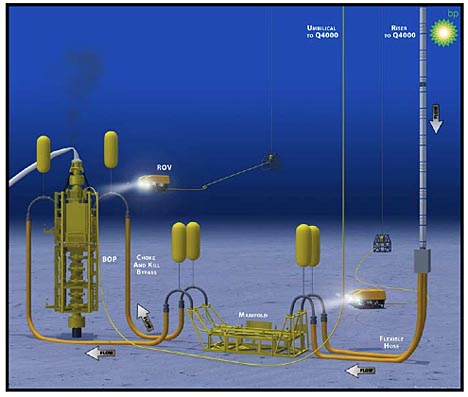
The tasks to be done included removing, modifying and replacing the control box (or pod) that operates the valves that open and close the flow lines into the choke and kill lines on the well. Other than this, the flow lines to the flow and choke lines themselves had to be replaced with the feed lines (shown in the animation) that will carry the mud into the well. Even tightening a fitting that had worked loose takes time, when it has to be done using an ROV (with the operator at the surface needing to see what he is doing while getting the ROV to hold the necessary wrench and turn the fitting). The old feed lines then had to be cut from the BOP, and replaced.

ROV image showing the control pod fitting being tightened

This involved
* cutting off the choke and kill line connectors
* Cutting the bolts on a flange
* Removing the clamp
* Removing the pipe flange end
* Buffing and cleaning the pipe end
* Preparing to attach the new jumper lines. (This had to be done for each feed line)
* A special hydraulic connector attached to the 150-ft jumper cables was used to latch onto the old inlets. This is slow work (as the video shows) and as a result this part of the work has taken seven days. (The jumper shown in the video was attached on the 16th and chained down into position on the 17th.)


When the connections and fittings have all been made and checked, and the control pod operation validated, and the necessary permits from MMS and others obtained, then the process can begin.

The process will be controlled from the Q4000, which is designed to have the capabilities needed. Two lines feed from the vessel to the BOP. The first carries the control feeds through an umbilical, while the second is a riser that carries the mud down to the flexible hoses and jumper lines into the BOP itself. This mud, at about twice the density of water, will be delivered from the two high-pressure Schlumberger MD 1000 mud pumps made by Schlumberger and will flow through the two feed lines that were the choke and kill circuits, into the well itself, below the main rams of the BOP.

Top Kill Circuit

The pumps will deliver the mud into the lines at a pressure of 6,800 psi, but as Kinuachdrach has correctly noted, it will then acquire the pressure from the full 5,000 ft column of mud as it flows down to the BOP, and enters the flow channel carrying the oil. Now we know that the BOP rams at least partially closed. If they are planning on using golf balls for the “junk shot”, it is feasible to surmise that the maximum width of the flow channel is no more than a third of a golf ball diameter. Not arguing the merits of American vs British ball sizes, let us assume that this is roughly half-an-inch (though it may have a greater length).

However, as flow volumes go up it requires more and more pressure for the fluid to get through a small gap. And at a given delivery pressure, only a certain flow volume will thus be able to escape that way. As long as this pressure exceeds that in the well, the net result will then be that the mud begins to push the oil and gas back down the well, and the well fills up with mud. The weight of that mud should then be enough to exert a pressure on the bottom of the well that is enough to exceed the fluid pressure in the rock and therefore stabilize the well and stop the flow of fluid out. Cement can then be pumped into the well to seal the top end. (Or with the flow stopped another BOP can be put on the well to seal it). The main worry is that the hole in the top of the BOP is small enough to contain the additional flow volumes, and not allow the entire flow to escape upwards rather than being forced down the well. The higher flows might, in addition, if they do exit the riser, further erode the openings. This could increase the oil flow, as it lowers the resistance. (If this happened then the LMRP will be deployed).

There are, however , a number of caveats to this operation. If the pressure in the well gets too high it can cause fractures in the rock at the bottom of the well, and this can cause the mud in the well to flow into the rock, rather than sitting in the well holding the pressure against the oil pressure.

There are also concerns with the condition of the bottom of the well, and whether this will have any impact on the flow of mud back down to the well and in sealing it.
Suttles said BP could not be certain but diagnostic tests on the well seem to indicate the flow is not coming up the main bore.

The well also contains obstructions that are restricting the flow rate.

It is impossible to know for certain what those obstructions are, Suttles said, but cured cement and rocks from the formations that crews drilled through could be partially clogging the well.

If the top kill fails, then the next step will be to cut off the riser, and use the top hat that is sitting on the sea bed near the well, to capture the flow in the LMRP option.

The Lower Marine Riser Package (LMRP) option

Were it me, I might contact Atlas Tocco and have them look into connecting up an induction heating coil around the outside of the bottom of the riser section. Might give them the occasional additional bit of heat on the inside surface that might be needed to dislodge any inconvenient crystals that might form., without interfering with the internal flow channels.

As a point of scale for the video from the riser leak, the amount of dispersant that is being ejected into the water is about 14,000 gallons a day or about 10 gallons a minute (quarter of a barrel roughly). A 5,000 bd flow is around 150 gals/minute.

This came from Doug Suttles teleconference in which he noted that BP have now spent around $800 million. He noted that oil levels in the water near the well are being measured at 10 ppm )(parts per million), against an EPA limit for oil discharge which is 15 ppm. However it is early in the monitoring cycle, and with a fleet of government sampling vessels now starting to work, the plumes and oil dispersant paths will be mapped in more detail in the weeks ahead.

Read more!

Sunday, May 23, 2010

The Gulf Deepwater Oil Spill, barriers, flow rates and top kill

The Gulf oil spill continues to generate headlines, and ABC News has been running the story at the top, or close to the top of its evening World News with Diane Sawyer. This photo was at the top of the page on Sunday morning. Their coverage, as with the most recent comments from the Administration, is increasingly unfavorable to BP.

Burning parts of the oil spill (ABC News 11 am 23-5-2010)

However, while BP has overall responsibility, sometimes (as in the accident itself) some of the problems may arise from those subcontractors tasked with some of the work, of which more anon.

Part of the ABC story deals with a drop in the production volumes that are being picked up by the riser insertion tube (RIT) that is taking oil from the leak to storage tanks on the surface.
BP spokesman John Curry told The Associated Press on Sunday that a mile-long tube inserted into the leaking well siphoned some 57,120 gallons of oil (1,360 barrels a day) within the past 24 hours, a sharp drop from the 92,400 gallons of oil a day (2,200 bd) (and 15 million cf of natural gas) that the device was sucking up on Friday. However, the company has said the amount of oil siphoned will vary widely from day to day.
Both of those numbers are significantly short of the 5,000 bd that the system was anticipated to remove from the riser, thereby significantly lowering the amount that is piped to the surface. At the same time there is an Op-Ed piece that have just run in the NYT which suggests, based in part on the measurements at Purdue from the oil venting video, that the real flow rate is around 40 – 100,000 barrels a day. BP have not released some of the information that would allow ball-park calculations of the actual flow, despite their claim to be open and transparent (I included the Unified Command in that decision initially but they don’t have that ability and I recognize the error). But there are some some factors that should perhaps be considered in evaluating the possible accuracy of these estimates (recognizing that there may never be a way of making an accurate assessment, though there now is a group, including the folk from Purdue, that will provide a final analysis that will be peer-reviewed and released to the public).

In an earlier post BP had noted that the pressures that they were recording at the top of the well, and across the BOP were lower than they had anticipated, and that they were falling. They need to have this information before they inject the mud into the bottom end of the riser to do the top kill later this week. The Op-Ed piece suggested that this will only limit the leak, but if the kill works it will actually stop the leak and allow a cement plug to be placed at the top of the well, sealing it from leaking. However the mud must be injected at a pressure greater than that within the well itself, and in sufficient volume that it will flow down the well, rather than through the BOP and out the broken riser. This is achieved by raising the flow level to such a value (in this case 1,680 gal/min of mud) that there is too much resistance for this to flow through the gap in the BOP and the flow therefore pushes back down the well, filling it with mud with sufficient density that it will overcome the pressure at the bottom of the well.

Now the pressure along the passage that oil and gas makes as it goes from the reservoir, up through the initial well, through the BOP, down the riser, and then either into the RIT or out into the ocean, undergoes several pressure drops. With each drop the gas content will preferentially expand more and take up a greater volume of the total flow space.

Partial separation of the gas from the outflow at the riser (AP feed at 11 am 23-5-2010)

However not all the gas is separated from the oil, and not knowing the relative points of pressure change (recognizing that the presence of the RIT, flaps and the drill pipe all constrain the flow area out of the riser) the velocity component from gas expansion cannot be properly estimated. Thus taking spot velocity measurements don’t really help much in estimating the average velocity of the flow, and have no bearing on the actual oil:gas ratio at that point). A close look at the end of the riser (an hour later) shows gas flowing along the RIT suggesting that the tool may no longer be optimally placed to pick up the oil component within the riser.

Gas flow around the RIT surface as it comes out of the riser (12:08 pm 23-5-2010)

What one might do is consider the flows from wells in the Gulf, and as Euan Mearns has pointed out, if you look at the Thunder Horse platform after it had four wells in production (with their construction designed to ease fluid flow out of the formation to the well and production lines) it was averaging 50,000 bdoe per well. This well is not in such a productive zone, the well is producing through a badly damaged cement liner, and a complex path to the well head, and from a shallower depth, so that the differential pressure will likely be less. The constraint from the damaged BOP will probably add additional resistance to the flow, and thus it is hard to see how the flow could get near 50,000 bd.

On the other hand it is not clear what diverting a considerable resource, currently being directed at stopping the flow, to measuring the flow volume would achieve. The booms, siphoning ships and control burns are operating to scoop up the oil as fast as they can. The system fielded is using about as much resource as is available, and as the Admiral has noted, is not constrained by estimates of the well flow volume.

Which brings me back to my opening thought. The ABC stories at the end of the week were focused on the arrival of the oil and emulsion on the shores of Louisiana. The question that I had in an earlier post was as to why the oil was getting there, when there had been so much effort put into erecting barriers to prevent that happening. There are over 300 miles of boom that have been fielded.

Admiral Landry addressed that in her comments at the press conference on Friday, noting that oil had come ashore at Terrebonne Parish, in Louisiana. She was disappointed to note that the boom had been prestaged in Terrebonne Parish, and that skimmers were there, but folks had hesitated to deploy them. Thus while other areas along the shore had been more aggressive and successful in controlling the oil, that there had not been the same kind of action, and resulting success paid in Terrebonne Parish – however she noted that this will change. (Something missing from the ABC reports, which focus more on the inability of BP to stop the oil from coming ashore.)

Weather conditions are just about optimal for cleanup, so that while skimmers would normally only get 10 – 15% of the oil, they have been achieving 50-60% recovery, the burns have been very successful and sustained, while the use of the dispersant at depth means that there is not that much oil coming to the surface to be dealt with. (It is too calm to use surface dispersants since they need some turbulence to mix with the oil.) However the problem will only start to diminish after the well stops emitting oil.

The most likely step to stop this is the top kill, scheduled for this week, though the process must be thoroughly reviewed by the MMS before it is implemented. BP will use the Q4000 as the vehicle to carry out the kill. This has two Schlumerger MD 1000 pumps which will likely be fitted to deliver the highest flow rate (which gives a maximum pressure of 6,800 psi or around 4,300 psi differential to the water pressure at the well. The pressure can be increased to 20,000 psi but at much lower flow rates). The mud pumped will have a density that is about twice that of water. They are still also looking at crimping the well, and doing a hot tap, should the top kill not work. The attempt is currently anticipated to take place on Tuesday.

Read more!