Showing posts with label oil leak. Show all posts

Tuesday, January 11, 2011

The Alaskan Pipeline stoppage

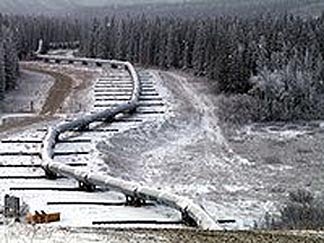
Some years ago I drove up the Dawson Highway from Fairbanks to the Yukon River, and as the highway paralleled the Trans-Alaska Pipeline, we stopped at one of the pumping stations to take a look. I think we were there about a minute before a security vehicle came whipping up alongside to tell us a) that we were not permitted to stop there and b) that we couldn’t take photos. Which is why I am not illustrating the post today about the leak at one of the pumping stations, with my own photo of one. However I am quite happy to borrow one from the Pipeline Website.

Pump Station 1 (Alyeska Pipeline )

The pipeline was shut down on January 8th when the leak, which is in a section of pipe feeding into the first of the pump sets along the line, occurred. Because the leak was within the plant the leak was caught early, only 10 barrels of oil spilled into the basement before the system was shut down. While the initial options were to either repair the leak, which is in a length of the pipe that is encased in concrete, or bypass it, the current plan is to install a bypass length of about 157-ft which will effectively replace the damaged section and bring the system back on line. This is expected to happen before the end of the week. As long as this holds true then the impact of this short-term 650 kbd of oil will be minimal, since the oil feeds into storage tanks that remain, at the present, comfortably full. Unfortunately the company did not have spare parts on hand, and these have bad to be made in Fairbanks, and transported to the site at Prudhoe Bay.

UPDATE: Because of fears of the problems caused by the falling temperatures in the pipeline, the flow has been restarted at a low level, without the bypass installed. I have added a paragraph of explanation at the end of the story. And in a further UPDATE, the problem pig is stuck about half-way down the pipeline.FURTHER UPDATE (THURS) The pipeline is now flowing at around 400 kbd but the pig is still moving to the transfer point, and remains in the line, but with no problems encountered, except that the leak is worse, but that should be be fixed this weekend.

Last November, for example, one the runs of the instrumented pigs down the pipeline indicated that there might be significant corrosion in the pipeline at Isabel Pass.
Isabel Pass, is a gap in the eastern mountains of the Alaska Range. Located approximately 11 miles north of Paxson at Pipeline Milepost 592.50, the Top of the World is geographically known as a funnel valley, a land feature that compresses the wind flowing north or south of the Alaska Range through this narrow passage. Work at the site was, in fact, halted for two days due to extremely high winds in mid-November.

The second challenge with this site also involves geography: the confluence – the meeting point – of Phelan Creek and the Delta River. The pipeline runs directly under this northern waterway. Aufeis – groundwater that swells up through layers of ice – is also a common feature at this location, adding to the water challenge of this project.
Interestingly back in 2006, when flows along the pipeline were reduced to 650 kbd, the lower flow caused some vibrations along the pipeline just south of Isabel Pass. At that time the pipeline was still producing 800 kdb, from a peak supply of over 2 mbd. It has now fallen pumping some 642 kbd in December, against an annual average of 620 kbd. That drop in flow rate has also increased the time it takes the oil to reach Valdez. (Since the pipeline remains full, at lower flow volumes, the oil moves more slowly than it did at peak). Thus a transit time of 4 days at peak production, now takes 13 days to arrive. Because of the longer residence times in the pipe, the oil, which enters the pipe at 110 def F cools more than it did before, and below 70 deg F wax begins to precipitate out on the walls. This has to be removed, and that means that the pigs used to clean the pipe are sent down more frequently now. (Every 4-7 days instead once every few weeks).

The next concern long-term problem may come as flow continues to drop may come if/when the flow drops below 500 kbd, since at that point the temperature may fall below 32 degrees, and ice may start to form in the pipeline. (H/t Luke H). ) However, in the short-term, this is the longest the pipeline has been shut down in winter and if the delay continues much longer, Alyeska President Kevin Hostler has explained the problem to Congress thus:
Our current studies and plan indicate that if the pipeline is shutdown during continuous minus 40 F temperatures, we will need to restart within 14 days to avoid significant problems. If BP reduces throughput this winter to 500,000 barrels or less, we may only have 9 days to restart after a cold temperature shut down.

There are four issues about cold restart that concern us: the crude oil develops a gel strength that is too strong to allow pipeline start-up; water drops out of the crude oil, collects in low spots, and freezes; ice in the pipeline upon restart could plug the mainline pump suction piping and custody transfer flow meter strainers, causing restart to fail; and the pipe steel temperature cools to minus 40 F or minus 50 F, making pipe welds susceptible to fracture.
The pipeline was designed for quite sever loads, Luke H, put up some pictures after my pipeline post, showing how it coped with an earthquake that moved the earth along the pipeline route.


And after the earthquake

(Photos from Luke H ).

Overall it looks as though this stoppage may not, in itself, cause any problems, but as with so many events in the oil business, these days, it is a warning of problems in the years ahead.

UPDATE: Well about the time I was writing this story, Alyeska began pumping oil down the pipeline again. They had found a way to temporarily route oil around the leak, so that enough flow could be achieved to stop the pipe from reaching the freezing point. The problem is made worse in this case because there is a pig in the line, and a continued drop in temperature would cause ice and wax to settle in the pipe. Then, when the pig moved, it would sweep this material before it, and if there was enough of it, this could then cause a pipe blockage, or get into and damage the pumps. By starting the pipeline before the temperature falls that low, the pig can be moved to a place where it can be taken out of the line. At the same time the line temperature can be brought back up to the level where some of the solids will re-melt and move back into circulation. It is still going to take about four days to get the parts needed for the bypass finished, and this would have taken the pipeline into the critical time period for a cold restart. The leak is continuing to flow small amounts of oil, and a total of 1,200 barrels has now been captured. The company are accepting the consequences of the leak continuing.
The restart would cause a small amount of oil to leak from the broken pipe that was discovered last weekend, but industry officials said that leaking a little more oil was better than leaving liquid idle in the pipes in freezing temperatures. Without warm oil moving through the system, water in the pipes could freeze and expand, possibly causing cracks in the pipeline or around the North Slope oil wells. . . . . . . .Industry officials in Alaska said that if it took more than a week or two to repair the leaky pipe, many wells could also suffer damage from freezing water.

A freeze in the system “is a nightmare, a worst-case scenario” that could shut production for several weeks, said one Alaska oil executive, who asked for anonymity because he was not authorized by his company to discuss the situation.


Read more!

Wednesday, August 25, 2010

Deepwater Oil Spill - More questions than answers

Hmm! So what is going on at the well? On Tuesday evening there were a couple of posts in the comments at TOD, one of which showed oil leaking past the shear rams in a BOP, as a Youtube segment, (H/t TOB ) while the second was a short clip showing the shear opening (H/t Chuck Schick ) . Because of the bandwidths involved I am just going to take a couple of frames from them to show the situation. This is from the Youtube segment:


This is a different shot from the one shown in a loop by Chuck which includes this frame:


And then there was the ejection of what appeared to be mud from the stack at about 12:41 pm that (H/t MoonofA) is also on Youtube.


Which leaves one wondering what is going on? Did the DP fall and rupture the casing and this is flow from the annulus? Has the seal at the top of the annulus lost its integrity? Is this oil, gas or some combination – since mud alone would be denser than seawater and should sit in the well without a problem, given the testing that was done at the end of last week. Is this perhaps some residual fluid in one of the lines that was being flushed out, and if so which one?

There are (and I am writing this around 10 pm Central) it seems two borehole cameras. The official one, which is swinging in free water it appears at the moment, and that from the BOA Sub C ROV1, which is the feed that is showing the ram blades and the flow. Unfortunately (unlike the main ROV cameras) this is not date stamped, so that when I just went back for a check the view is relatively quiet with no flow and the valve open – so this may have been another unwarranted alarm. But it would be nice if, perhaps, the Admiral could explain this. (At the moment the listing of the Transcript of the press conference for Aug 24th reverts through a link to the Transcript from the 23rd).

In regard to the events in Chile, now is not the time to talk much about the rising price of metals and other minerals that come from underground – their depletion and the problems they cause are more the subject of the more conventional posts that we write at this site – but I did note the comment on the price rise of copper which has gone from $1.835 to $3.234 per pound in the last year.

More small diameter drill shafts are being sunk, so that there is communication down one, supplies down a second and a third, soon to be completed, will be for ventilation. The large drill that will drill the rescue shaft is now on site and is being set-up to start the hole.

For those who have not seen the layout, ( H/t Ericy this shows the relative position of the refuge and the slope that was the main access to the underground.


You will notice that there are a few more turns than the simple spiral that some of the networks have been showing.

Read more!

Friday, July 23, 2010

Deepwater Oil Spill - Tropical Storm Bonnie -1a

I have not been over to the ROV sites for a while, since the rigs are preparing to close, but (h/t to JamesRWhite) I have to say that if I were running a pressurized line that had the leak that is now evident in the Hos ROV 1 feed, I would be seriously thinking about doing something to alleviate the problem. (Such as pumping in mud to alleviate the driving pressure).

Leaks on the fittings around the wellhead

And if I didn't do something there were two members of my staff who would have bent my ear until I did.

Read more!

Tuesday, July 20, 2010

Deepwater Oil Spill - time is not our friend

There is a certain frustration in hearing some of the officials who act as spokesmen for the management team handling the spill from the Deepwater well in the Gulf of Mexico. Their evaluation of the situation is bound around a full collection and compilation of the existing evidence, a comprehensive and contemplative understanding through a scientific explanation of the causes of whatever anomalies and other behavior that is not following the model anticipated, and subsequently then working out the best steps forward and determining the potential benefits relative to alternative approaches. Such an attitude works well in a scientific laboratory, where whether the results are available tomorrow or next week only really matters if there is another lab in the world that is working closely along the same lines as you are. (And if the work is relatively topical that is often the case). Unfortunately this relatively leisurely approach to making progress is not nearly as compatible with a situation where a high-pressure piece of equipment is showing signs of leakage, and where there is the possibility that, within the week, equipment is going to have to be withdrawn from the site because of the imminence of a hurricane.

The imposition of an ultimately superior layer or more (depending on how much the White House is actually involved in decision making) of evaluation and decision making can do little beyond stretching the time over which decisions are made, eating up the time that is available for action, before the current gentle weather window closes. Now it may be that the current tropical depression will not solidify into a problem (I’ll let wiser heads in those topics answer that question), but even if this one does not, there will come a time when one will, and the working interval is shrinking.


Some of the worries about seeps in the vicinity have now been put to rest, in his brief yesterday Admiral Allen noted:
The first one was to see pitch about three nautical miles (Ed. Note amended to kilometers) from the wellhead itself. We do not believe that is associated with this particular well integrity test or the Macando well.
Similarly the bubbling from the sediments around the well have not been seen as something to worry about, although the material ejected is being tested. (It proves very difficult to get a meaningful picture of this). There is, however, one leak that is due to the well, and that is in the equipment that is sitting on the well itself.
Let me just tell you right away, because this happened overnight, as you know, we had a – a connector piece of equipment that we established in to allow us to put the capping stack on. These are the three rams that are associated with the capping stack. This is a schematic of those three rams. The leakage is occurring in a flange just located right about here, and there is hydrate formation appearing on this side of the capping stack as we move forward.

We do not know, but we do not believe this is consequential at this time, nor is – doesn't appear that the hydrate formation is inhibiting any operation of the capping stack. This is something we will continue to monitor as we move forward.
He noted that
it is the collective opinion of the folks that are talking about this that the – the small seepages we are finding right now do not present, at least at this point, any indication that there is a threat to the wellbore. . . . . . . There is a – there's actually a metal gasket in the flange, rather than a rubber (one). It's actually a metal – metal seal in there. And that appears to be the source of (the leak). But we don't know if it's consequential to the operations of it. It's not a huge leak, but it is causing the formation of hydrates.
(Ed note I corrected some transcription errors). The lack of concern seems to focus on the possible stratification of the fluid in the wellbore, and the concentration of any sand, which could cause problems if rapidly released.

Now that in itself is somewhat revealing, since one of the things that I have discussed in the past is the concentration of sand in the fluid flow, and that, when the fluid gets to a pressure differential of 2,500 psi or more that sand will erode metal and anything else in its way, as it flows out. With the sensible admission of the presence of that sand, what BP intend, apparently and if necessary, is to bleed the pressure down sufficiently slowly that the current segregation within the well, with the lighter gas-related hydrocarbons rising to the top, can be maintained until the pressure differential is low enough that the sand would no longer cause much erosion if caught up in the fluid. (Whether this would need to take the “several days” that Admiral Allen suggests is, perhaps, debatable.

There are a couple of problems with that. The first is that the sand is not in a single size range, but likely goes all the way down to sub-micron in size. The smaller particles don’t settle out that easily and thus are likely to be present to some concentration in the fluid throughout the well. Which raises the second problem which is that particles do cause erosion if they are moving over a surface at relatively high speed (caused by the pressure differential). In a much earlier post I discussed this and the effects that it might cause.

In my other life we have dealt with the problems of having abrasive get into high pressure fittings, and the leaks that result. Leaks tend not to fix themselves, and get bigger over time. Expecting that they might not change over the next month, while the odd hurricane might pass by, and the relief well completion gets postponed, is not a reassuring path to take.

In Kent Wells review on Tuesday he was, similarly to Admiral Allen, complacent about the leaks.
And then in terms of the couple of gas leaks that you probably observed on the BLP and capping stack. Those are just coming from places where we have what we call (metal) seals. Those are small leaks that are as a result of gas. Those connections have been tested to very high pressures in the case of the capping stack we actually tested it to 15,000 PSI with water and with no leaks, and it’s just when we – we probably got a gas bubble that’s formed up there and that’s why we have that very slow leak. It’s nothing that we’re concerned about.
At those pressures and temperatures, the gas is still liquid and still capable of carrying sand with it.

The potential for injecting mud to kill the well, which is getting more of a hearing at the moment, could be the way forward. Once mud in any significant volume is introduced into the well, through existing lines initially designed just to do this very thing, then the pressure at the top of the well will decline. This lowers the differential pressure across any leaks, lowering the flow and extending the time period before they may fail.

But, in regard to doing this “top kill”, Admiral Allen noted
We now have a closed system, so there's back pressure. And so the question is is there enough back pressure there where you could do basically more of a static rather than a dynamic top kill, where you could put mud in. That might suppress the hydrocarbons.

There's been some discussion about whether or not that might be possible. We're looking for BP to give us an idea of whether or not that it's possible, how they would do it. And we'll react to that when we receive it.
And BP themselves does not have a sense of urgency about moving forward with the process. From Kent Wells:
And then in terms of the static kill – and once again, I want to reinforce, no decisions have been made yet on proceeding forward with that. But we are continuing with preparation and planning. We continue to get equipment lined out, what we would want to do, making sure that we will have the right equipment out there to do it, writing procedures, starting to get procedures approved.

At the same time, we’re doing testes (sic) with scientists, challenging the way we’re thinking about this, what we’re doing, so we’ve got parallel paths going on that’s leading towards somewhere ideally in the next day or two that we’d be in position through unified command to make a decision whether we’d go forward with that.
He may take a couple of days to make an animation showing how it will work. Essentially however it involves reversing the flow down one of the kill lines (originally set up to allow mud flow into the well) which are now being used to allow oil to flow out of the well and up to a service vessel. From Kent Wells:
Now, one of the things we do need to do is we need to make some changes on the Q4000 to change it from its ability to contain oil and turn it back around into the pumping facility. But that does not take us very long to make that change and of course we’ll always have the ability to change back if at some point we need to do that.
It will, likely, take much longer for management to decide whether or not it should proceed. And the weather window continues to shrink.


Oh, and from the Admiral’s brief, in case you missed it.
The Discoverer Enterprise is no longer on station.


Read more!

Monday, July 19, 2010

Deepwater Oil Spill - bubble, bubble oil and trouble

UPDATE on this post. Although there has been some additional discussion, and the test has been allowed to run another 24-hours, not much else has changed over the past 24 hours, apart from knowing that the anomaly on the BOP is a slight leak on the flexible joint. I am going, therefore, just to add to the earlier post, to give an update on the overall situation.

I rather suspect that we will know a lot more about the behavior of the sediments and matter at the bottom of the Gulf within the next year or so than we have learned in the past hundred years. I am looking at the view from the Skandi ROV 2 at 10 am on Monday, and it is looking at a patch of mud that is bubbling a little, though over a relatively significant area (that of the camera illumination). There is no trace of oil venting and flowing upwards (and a fish just swam by) so there will be, no doubt, some samples taken, and, over time, we will learn what is the cause.


There were other views, from different ROVs that seemed to show clouds of something, but the definition was poor and it was not clear that this was not mud that the ROV itself has stirred up. This has been the case several times today, in watching the video, though there were, in the seep area, shots of small drops of oil heading up to the sea surface.

Given the debate that is developing between BP and the panel that advises Secretary Chu and Admiral Allen, the redirection of the thought process to include another attempt at a top kill, brings in a whole pile of new matter to be used in those discussions

As the day continued there has been clarification of the remarks that both Admiral Allen and Kent Wells have made in the past, as well as an update on the relief well progress, and the resurrection of the idea of possibly doing a top kill. Looking at the Kent Wells conference at 5 pm he began by reporting on the status of the relief well:
Our first relief well, the total depth is at 17862, that’s our casing point. We’re four feet horizontally from the Macondo well at 2.8 degrees and we’re looking directly at the Macondo well. So we’re absolutely perfectly positioned. The team is feeling very good about how they’ve set this well up.

They’re now in the process of what we call opening the hole. So they’re drilling the hole a little bit bigger diameter and then on Wednesday, Thursday we’ll run casing and cement is in place and there’s some testing to do followed by the drill out and ranging runs

The pressure in the well itself has rise to over 6810 psi and is rising at about 1 psi per hour. This lower pressure than the pressures originally estimated makes it possible to reconsider the top kill option. This is where, by feeding mud into the top of the well through the kill line, while the well is shut-in, the mud fills up the well. (The oil and gas are pushed back into the formation). Then should they be able to fill the well up with this mud, the weight of the full column of it, down the well, would be high enough to balance the pressure of the oil in the formation. At this point, rather than the well being shut in, by the cap, it becomes killed by the mud pressure on the flow. There is no longer any concern about pumping the mud in at any high rate of pressure, since the flow is already stopped. Instead the mud flow and pressure can be set to a slightly higher pressure than currently is in the well, and then slowly increase the flow to fill the well, without bringing the pressure to such a high level as to further compromise the well integrity. The injection would be followed with cement, to seal the well at the top of the underground part. This would later be followed by the well intersection by the relief well, and an injection of cement at the bottom of the well.

There are three areas where concern has been raised over the possibility of oil escaping the well below the sea bed and migrating back up to the surface. This is why the ROVs are located around the well monitoring the sea bed itself. There are, as noted earlier, patches where the sea bed is evidently bubbling (in that you can see where the bubbles pop out of the mud). But there is no sign of gas or oil then slowly rising to the sea surface from the bubble action. It may, therefore be something like a field of clams sitting below the surface and aspirating and then spitting out some of the sea water. This action is not at the moment of concern, BP has checked the fluid coming out of the sediment and it is running at around 15% methane, which could just arise (according to Mr Wells) from biodegradation in the mud below the sea bed.

There is a natural seep some 3 miles from the site, this hydrocarbon flow has been tested and is not related to the Deepwater Spill. And so the only other area of concern is a very small leak coming out from the seal in the flexible joint (which, if you remember was straightened before the new cap was installed). The leak, at the moment is very small, and not of that much concern. However if the leak starts to get bigger, and then turn into a stream, it may pick up some of the sand that is reported as being a concern from being in the BOP assembly. This will then, at the pressures anticipated, be enough to erode out the leak to an unacceptable size within a couple of hours. For now, however, it is very small, and not continuous flow, and so can be viewed with less concern, relative to other issues.
The leak was detected in a flange between the top of the well and the rams that regulate flow up the main bore.

Video footage is showing some hydrate build up on the outside of the stack and scientists believe a small amount of oil and natural gas is leaking out.

Allen said the leak is not expected to hurt performance of the device and is not seen as a threat to its structural integrity.


Read more!

Sunday, May 23, 2010

The Gulf Deepwater Oil Spill, barriers, flow rates and top kill

The Gulf oil spill continues to generate headlines, and ABC News has been running the story at the top, or close to the top of its evening World News with Diane Sawyer. This photo was at the top of the page on Sunday morning. Their coverage, as with the most recent comments from the Administration, is increasingly unfavorable to BP.

Burning parts of the oil spill (ABC News 11 am 23-5-2010)

However, while BP has overall responsibility, sometimes (as in the accident itself) some of the problems may arise from those subcontractors tasked with some of the work, of which more anon.

Part of the ABC story deals with a drop in the production volumes that are being picked up by the riser insertion tube (RIT) that is taking oil from the leak to storage tanks on the surface.
BP spokesman John Curry told The Associated Press on Sunday that a mile-long tube inserted into the leaking well siphoned some 57,120 gallons of oil (1,360 barrels a day) within the past 24 hours, a sharp drop from the 92,400 gallons of oil a day (2,200 bd) (and 15 million cf of natural gas) that the device was sucking up on Friday. However, the company has said the amount of oil siphoned will vary widely from day to day.
Both of those numbers are significantly short of the 5,000 bd that the system was anticipated to remove from the riser, thereby significantly lowering the amount that is piped to the surface. At the same time there is an Op-Ed piece that have just run in the NYT which suggests, based in part on the measurements at Purdue from the oil venting video, that the real flow rate is around 40 – 100,000 barrels a day. BP have not released some of the information that would allow ball-park calculations of the actual flow, despite their claim to be open and transparent (I included the Unified Command in that decision initially but they don’t have that ability and I recognize the error). But there are some some factors that should perhaps be considered in evaluating the possible accuracy of these estimates (recognizing that there may never be a way of making an accurate assessment, though there now is a group, including the folk from Purdue, that will provide a final analysis that will be peer-reviewed and released to the public).

In an earlier post BP had noted that the pressures that they were recording at the top of the well, and across the BOP were lower than they had anticipated, and that they were falling. They need to have this information before they inject the mud into the bottom end of the riser to do the top kill later this week. The Op-Ed piece suggested that this will only limit the leak, but if the kill works it will actually stop the leak and allow a cement plug to be placed at the top of the well, sealing it from leaking. However the mud must be injected at a pressure greater than that within the well itself, and in sufficient volume that it will flow down the well, rather than through the BOP and out the broken riser. This is achieved by raising the flow level to such a value (in this case 1,680 gal/min of mud) that there is too much resistance for this to flow through the gap in the BOP and the flow therefore pushes back down the well, filling it with mud with sufficient density that it will overcome the pressure at the bottom of the well.

Now the pressure along the passage that oil and gas makes as it goes from the reservoir, up through the initial well, through the BOP, down the riser, and then either into the RIT or out into the ocean, undergoes several pressure drops. With each drop the gas content will preferentially expand more and take up a greater volume of the total flow space.

Partial separation of the gas from the outflow at the riser (AP feed at 11 am 23-5-2010)

However not all the gas is separated from the oil, and not knowing the relative points of pressure change (recognizing that the presence of the RIT, flaps and the drill pipe all constrain the flow area out of the riser) the velocity component from gas expansion cannot be properly estimated. Thus taking spot velocity measurements don’t really help much in estimating the average velocity of the flow, and have no bearing on the actual oil:gas ratio at that point). A close look at the end of the riser (an hour later) shows gas flowing along the RIT suggesting that the tool may no longer be optimally placed to pick up the oil component within the riser.

Gas flow around the RIT surface as it comes out of the riser (12:08 pm 23-5-2010)

What one might do is consider the flows from wells in the Gulf, and as Euan Mearns has pointed out, if you look at the Thunder Horse platform after it had four wells in production (with their construction designed to ease fluid flow out of the formation to the well and production lines) it was averaging 50,000 bdoe per well. This well is not in such a productive zone, the well is producing through a badly damaged cement liner, and a complex path to the well head, and from a shallower depth, so that the differential pressure will likely be less. The constraint from the damaged BOP will probably add additional resistance to the flow, and thus it is hard to see how the flow could get near 50,000 bd.

On the other hand it is not clear what diverting a considerable resource, currently being directed at stopping the flow, to measuring the flow volume would achieve. The booms, siphoning ships and control burns are operating to scoop up the oil as fast as they can. The system fielded is using about as much resource as is available, and as the Admiral has noted, is not constrained by estimates of the well flow volume.

Which brings me back to my opening thought. The ABC stories at the end of the week were focused on the arrival of the oil and emulsion on the shores of Louisiana. The question that I had in an earlier post was as to why the oil was getting there, when there had been so much effort put into erecting barriers to prevent that happening. There are over 300 miles of boom that have been fielded.

Admiral Landry addressed that in her comments at the press conference on Friday, noting that oil had come ashore at Terrebonne Parish, in Louisiana. She was disappointed to note that the boom had been prestaged in Terrebonne Parish, and that skimmers were there, but folks had hesitated to deploy them. Thus while other areas along the shore had been more aggressive and successful in controlling the oil, that there had not been the same kind of action, and resulting success paid in Terrebonne Parish – however she noted that this will change. (Something missing from the ABC reports, which focus more on the inability of BP to stop the oil from coming ashore.)

Weather conditions are just about optimal for cleanup, so that while skimmers would normally only get 10 – 15% of the oil, they have been achieving 50-60% recovery, the burns have been very successful and sustained, while the use of the dispersant at depth means that there is not that much oil coming to the surface to be dealt with. (It is too calm to use surface dispersants since they need some turbulence to mix with the oil.) However the problem will only start to diminish after the well stops emitting oil.

The most likely step to stop this is the top kill, scheduled for this week, though the process must be thoroughly reviewed by the MMS before it is implemented. BP will use the Q4000 as the vehicle to carry out the kill. This has two Schlumerger MD 1000 pumps which will likely be fitted to deliver the highest flow rate (which gives a maximum pressure of 6,800 psi or around 4,300 psi differential to the water pressure at the well. The pressure can be increased to 20,000 psi but at much lower flow rates). The mud pumped will have a density that is about twice that of water. They are still also looking at crimping the well, and doing a hot tap, should the top kill not work. The attempt is currently anticipated to take place on Tuesday.

Read more!

Sunday, May 2, 2010

Further comments on the Gulf of Mexico oil well disaster

The oil spill in the Gulf is continuing to get worse, and there are some questions that have been raised on what could have gone wrong, and how it can be fixed. I am in the same position as most, in regard to getting information – it comes from news reports, in the main. But there are some points that can be picked out as the focus of those reports switch to the impact that the oil is going to have on the coast and businesses that are going to be severely damaged. But there is enough information now available to draw some conclusions.

Pictures of the oil flows (Drillingahead )


Firstly, in regard to the post that I put up earlier about the blow-out preventer not working effectively, an early story noted that the BOP had recently been tested (thanks Gail).
Mr. Hayward said the blowout preventer was tested 10 days ago and worked. He said a valve must be partly closed, otherwise the spillage would be worse.

There are a number of things that can go wrong with a blowout preventer, said Greg McCormack, director of the Petroleum Extension Service at the University of Texas, which provides training for the industry.

The pressure of the oil coming from below might be so great that the valves cannot make an adequate seal. Or in the case of a shear ram, which is designed to cut through the drill pipe itself and seal it off, it might have encountered a tool joint, the thicker, threaded area where two lengths of drilling pipe are joined.

Still, Mr. McCormack said, “something is working there because you wouldn’t have such a relatively small flow of oil.” If the blowout preventer were completely inoperable, he said, the flow would be “orders of magnitude” greater.

However oil is now flowing through the BOP and out into the water immediately above the well site on the sea bed. When the site was visited by a small remotely operated vehicle with cameras they showed(see below) that the riser, the pipe that normally carries the oil from the sea bed to the surface, had kinked over when the rig sank, and oil was coming from three places:
The Coast Guard said it had not detected oil coming from the well Friday and assumed post-accident efforts to activate the blowout preventer “a huge stack of valves sitting atop the wellhead on the sea floor” had been successful.

But later trips by the remotely operated vehicles (ROV’s), discovered oil shooting from the end of the pipe-like riser that had connected the rig to the blowout preventer.

A second, smaller leak was found in a section of drill pipe near the wellhead.

That 21-inch-diameter riser had become detached from the rig when it sank. In the process, it was folded over at a 90-degree angle just above the wellhead, which had the effect of kinking it like a garden hose and constraining the flow of oil from the well. It now sits in a long, meandering mess on the ocean bottom. This helps explains why oil was not initially thought to be seeping.” . . . . . . The preferred option, he said, is still to find a way to engage the blowout preventer. That fix, if it works, could be handled in a matter of days, he said.

But if that doesn't work, the other option is to drill a deep “relief” well into the damaged well and stem the flow of oil, though that option could take several months, Suttles acknowledged. He said his team would spend the next several days trying to determine the best method.

The problem lies, in part, with the capabilities of the ROV’s and their ability to get access to the well site on the sea-bed.
There is a report from a survivor (h/t Fractional Flow) that says that the well was shut in and they were going through the process of separating the rig from the well, and moving it off. They began by cleaning out the drilling mud from the riser, replacing it with sea water. However, when they re-opened the valves at the top of the well, the pipe in the well had become filled with gas from the well, under considerable pressure, and this “Kicked” the well as the valve opened. Gas, as the pressure gets less as it moves up the pipe, expands much more than oil. And unfortunately in the process of disconnection, the pressure to hold the gas, which comes from the density of the drilling mud in the riser initially, had been removed as part of the disconnection process.

So the high pressure gas was able to blow all the sea water in the riser out onto the deck of the rig. (This happens extremely quickly, well below a minute) The gas then followed, and as it flowed out of the pipe at the top of the well there was some hot source that caused it to ignite. (This could even be from a static electricity spark). Because of the depth of the well, the pressure in the bottom of the well was in the 30-40,000 psi range.

Part of the problem that arises with flows at that pressure is that any abrasive particles (such as small pieces of rock) will cut through metal at the speeds at which it is carried. (Such jets were used to remove the damaged tops of the wells in Kuwait after the Gulf War, for example). So that it is possible that as the BOP started to function the high-velocity flow may have eroded part of the system to allow some fluid to bypass the plug that the BOP inserted. If that happened then the continued flow would just enlarge the passage again fairly quickly, so that the BOP will become ineffective.

However there are pictures of the leaks available.

Pictures of the oil flows (Drillingahead )

At this stage there does not appear to be that great a driving pressure for the oil coming out of the well. (If there were the flow would be more directed horizontally) This suggests that the BOP did at least partially function, and that the passage may have been eroded by the particles in the gas and oil now escaping.

There is a recent report that the accident may have been caused by a poor cementing job by Haliburton:
After an exploration well is drilled, cement slurry is pumped through a steel pipe or casing and out through a check valve at the bottom of the casing. It then travels up the outside of the pipe, sheathing the part of the pipe surrounded by the oil and gas zone. When the cement hardens, it is supposed to prevent oil or gas from leaking into adjacent zones along the pipe.

As the cement sets, the check valve at the end of the casing prevents any material from flowing back up the pipe. The zone is thus isolated until the company is ready to start production.

The process is tricky. A 2007 study by the U.S. Minerals Management Service found that cementing was the single most-important factor in 18 of 39 well blowouts in the Gulf of Mexico over a 14-year period. (But) . . . .
But at the time of the accident, "well operations had not yet reached the point requiring the placement of the final cement plug, which would enable the planned temporary abandonment of the well," the Halliburton statement said.

However it is hard to see from what is known, that this was a cause in this case.

Read more!

Saturday, May 1, 2010

The Gulf of Mexico oil rig disaster

I am still travelling in the UK, and thus have not been able to follow, in any detail, the environmental disaster that is unfolding along the Louisiana coast, as the oil from the Transocean Deepwater Horizon fire and sinking spreads across the Gulf of Mexico.

However I thought that it might be useful to explain where part of the problem might lie, and so am going to repost one of the technical posts from the past, where I explain what a blow-out preventer is. Then I will add a couple of comments on why it might be that they did not stop the leak in this case.

Blow-out preventer (Schlumberger )

This post is going to deal with some of the problems that a driller encounters as he reaches the layer of rock (the reservoir) in which the oil or gas is being held. And what I want to talk about is something called Differential Pressure, but to explain that, I need to drag you back to High School for just a minute.

Let's, in fact, go back to Newton's Three Laws. And, for those who slept through that part of the Physics class in school, don't be too ashamed - I have seen the desk where Newton whittled his name, being similarly bored. Let's start with the first law, which is probably the most relevant.
Every object in a state of (rest or) uniform motion tends to remain in that state of (rest or) motion unless an external force is applied to it.
Except that I want to change external force into pressure (which is force divided by area) since it is the way we normally think of it. (Note: I added rest which is a special case of uniform motion since that is specific to the oil we want to talk about). In other words, nothing is going to move unless something pushes it. It is what does the pushing and what does the moving that this is all about.

And now our drill, is down through the casing, drilling the well open hole and using the circulating mud to carry away the cuttings as it continues to go deeper. I had stopped progress last week just before we went down to total depth (TD) of the well, or into the pay. And the reason I did has to do with this differential pressure. But first, the bit about how you calculate pressure.

As you go deeper into the earth, the rock at any layer is carrying the weight of all the rock vertically above it. For rough calculations we generally consider that this rock weighs 144 lb a cubic foot. So that 10 ft down the weight of the overlying column on a square foot would be 144 x 10 = 1,440 lb/sq ft. But through convention we reduce the area that we talk about to a square inch (144 sq in= 1 sq ft) so with this division the weight on a square inch would be 10 lb. A remarkable resemblance to the depth number (grin). This means that we can assume, as we go deeper into the earth, that the pressure on the rock increases by 1 lb/sq. inch (psi) for every foot we go deeper. This means that at 6,000 ft, the rock is under a pressure, from the rock above it, of 6,000 psi.

Now water does not weigh as much as rock, but can be approximated to roughly half the weight. So that, by the same argument, under water, for every foot of depth the pressure goes up roughly half-a-psi. So that at 6,000 ft under water the pressure is 3,000 psi (roughly twice the water pressure in the wand you use at a car wash). Now because we have increased the density of the fluid in the well (the mud) to help lift the cuttings out of the hole it weighs a bit more than water, but for the sake of working the example I'm going to use the half-psi measure for now. We are now at the point where the actual amount that it weighs becomes important.

Simplified sketch of an oil bearing layer in the ground.

I have made a very simple sketch of the layer of rock that we are going to drill into. In order to trap the oil it is shaped into a dome, and the sketch shows a vertical slice through that dome, viewed from the side. It has a layer of oil in it (the reddish layer), but above that is a layer of gas that has diffused from the oil (brownish), and below it is water (bluish) which may have been there when the algae died and which has stayed with the remains as they turned into oil under the temperatures and pressures deep in the rock. Oil floats on water, and gas is lighter than oil, so we have the three layers. At the moment the well has not arrived and all three fluids are sensibly in equilibrium at the same pressure.

Now why do we need to know this before we reach our layer of oil-bearing rock? Well first let's go and interpret that first law a little more.

If a person on either side of you pushed you with equal force at the same time, you don't move, because the two forces balance out. It is only if there is one force, or if one of the two pushes harder, that you move. In other words, where there are a number of forces acting on a body, it is the size of the difference in pressures, and the direction of that difference, that controls the movement.

Consider, here we are drilling merrily away (and have cased the well near the surface, and hit no more fluids on the way down) and at 6,000 ft. we penetrate the rock that is capping the well, and enter the rock with the oil in it. The oil (in the rock) is at some fraction of the overburden pressure, since it is trapped in the rock, and for the sake of this example I am going to say that it is at 5,000 psi , the fluid in the well is at 3,000 psi, the height of the mud column.
There is a difference of 2,000 psi. We are drilling a hole some 6-5/8th inches in diameter. That has an area of about 34.5 square inches. The total force we have suddenly applied to the bottom of the well (bit and fluid) is thus (area x pressure difference) 34.5 x 2,000 = 69,000 lb (or 35 tons).

Oil rig blowout in Turkmenistan (Energy Industry Photos)

Sadly most catch fire and the rig is destroyed (there are more pictures of such damage at the EIP site)
It's called a blow-out, and sadly, as we have just seen in the Gulf, they can still happen.

This is why we approach the oil/gas producing zone of the rock with caution. And bear in mind that the driller that is controlling the progress of this well is at the surface, trying to guide the bit at the bottom of the hole, with, historically, little immediate information to help.

Based on the surveys that brought the crew to the site in the first place he knows roughly how thick the layers of rock are, and probably what rock they are, but the only real information on where the bit is in that sequence, is from the returns (cuttings) that come out of the well, and there is the lag, we mentioned before, while those chips make their way up the 6,000 ft pipe. (This is why Measurement While Drilling [MWD] has been such a relatively recent boon to the industry ( though not all rigs have it).
By monitoring a number of pressure gages the driller can gain a sense of what is happening at the bottom of the well.

If he senses that there is going to be a problem, then he can do one of several things, based on the way the well is set up. The first thing is to increase the density of the mud. By making the fluid in the well weigh more, the difference in the pressure across that face is reduced, and the change in conditions is easier to handle. However weighting up the hole has the disadvantage that it becomes much slower to drill with a heavier mud (it is a poor bottom-hole cleaner among other things). And, if done during drilling, bear in mind that once the heavier mud is added to the well it won't be fully effective until it has had time to get down to the bit and then fill back up the annulus between the drill string and the casing all the way to the surface.

So that is an expensive and slow option. Let us take the game a little more interesting and say that there is a gas pocket above the oil, and that the hole is going to go into the layer at A. Gas will enter the well at the down-hole pressure, but as the bubble rises, that pressure is reduced, and the gas expands, pushing the mud above it out ahead of itself. Another potential source for big-time trouble. And this one (which is known as a kick in the well) happens much faster, so there is less time to react.

How do we handle this? The answer is to invert the problem. Gas or oil flows into the well because the well is at a lower pressure than the fluid in the rock. The fluid in the well is, initially at the pressure created by the depth, and by the weight (density) of the mud in the hole. However, if we put a restriction on the flow of fluid out of the well (such as when you put your finger over the end of a garden hose so that the stream becomes smaller and shoots out further) we can increase the pressure in the well.

For those who want to know why, if the same volume has to go through a smaller hole in the same amount of time it has to go faster. This means it has to be pushed harder. Bernoulli explained it, and there is an animation available that helps explain it.

What it means is that by adjusting the flow out of the hole, the driller can adjust the internal pressure, and thus "kill the kick", or if gets to be too much of a problem, “kill the well”. But it is not completely that simple. Bear in mind that there is all the drilling and rotating equipment on the rig floor connected to the drill pipe at the top of the well. None of this can stand much pressure. So we need to place another piece of equipment between the drilling rig, and the top of the well.

Blow-out preventer (Schlumberger )

This is the Blow-out Preventer(BOP), which is essentially a ram that very rapidly shuts off fluid flow at the top of the well. These have to be well designed, since they are generally the line of last defense against a blowout, and when they fail as the pictures show serious problems arise. They also form the basis for the well-known structures, often referred to as Christmas Trees, that sit at the top of producing wells. By themselves, however, these aren't enough, since their main function is just to slam the door shut, before all the oil gets out and we have a gusher.

The more critical tools are the chokes on the well. (Below the rams in the picture above). There are generally several, both hydraulically operated and manual (in case the power dies) which are simply large valves that can be turned to increase or reduce the size of the flow path out of the well over to the mud pits. By adjusting these, in real time, the driller can control the well pressure, and thus the dynamics of the behavior at the bottom of the well. And after the rig leaves, an operator can adjust well pressure, and thereby the production from the well and its long-term performance.

If the operator is well trained (and you find drilling simulator equipment in Petroleum Engineering Departments so that students can understand how to do this (I last tried some decades ago) the well pressure will be controlled, so that any kicks can be handled, and the drill can now penetrate safely into the rock containing the oil/gas, which we call the reservoir, or the pay.

. . . . . . .
To return to the present it appears that the blow-out preventers, which are located on the sea bed, did not work as they should, in this case. Whether that is because the pressure of the surrounding water (they are at a depth of around 5,000 ft and thus there is about 2,500 psi pressure, which is significant, but these days not an insurmountable level) or because of some other failure is unclear. But since the gas and oil seems to have come straight up to the platform where it ignited, then it logically must have gone up the pipe or riser that would carry oil from the well to the surface. Thus it had to pass through the BOP. Both manual and remote attempts to activate the BOP did not work.

The risers have now collapsed, and the area around the well completion is now a mess of wreckage, so that access to the area is not easy. Further the robotic vehicles sent in to try and get the BOP to work effectively haven’t been able to do their job. And the leak may now be coming from a larger area than just the top of the well casing.

The current plans are to contain the spill and to drill an intersecting well that can seal the original flow path, and contain the oil, through BOP on the second well. But that will take some time to put in place.

There are additional bits of information in the technical posts that I have written in the past, and that are listed on the right side of the page.

Read more!