Showing posts with label soil. Show all posts
Thursday, March 27, 2014
Waterjetting 19c - Of soil removal by water
The tragedy in Washington state, where a hillside slid down, across a river and destroyed and covered the small community of Oso on the other side is a reminder of the ways in which natural ground saturation can help dislodge large volumes of material. While it is unlikely that the exact trigger for the slide will be identified the underlying cause is well known. As water from the heavy persistent rains permeated down through the hillside it penetrated deeply into the sand, silt and clays that made up the cliff, filling the voids in the material and reducing the friction that held the slope together.
Once the water is between the grains there is a second stage, where the overlying water adds hydrostatic pressure to the water below it. This pressure starts to push the grains apart, further reducing the friction holding the grains together and, since water has no shear resistance, lowering the overall resistance to the gravity that is pulling the overlying material down a potential failure plane. Once the resistance falls below that pull the slope starts to fail. It happens very quickly and large volumes can move almost as fast as though it were just water. In this case the water moved roughly 15 million cubic yards of material off the mountain. and across the valley.
The power of water to move material once dislodged was an early part of the mining process, and an earlier post referred to “hushing” where water was first trapped, and then released to erode away overlying soil, and then ore, before carrying it down to a flume where the valuable mineral could be trapped and recovered. But it does not take much pressure to dislodge weak material. Russian studies* have shown that light soil can be moved with a pressure of only about 10 psi (which would be generated in the water at the bottom of a slope only 20-ft high), while medium soil would require perhaps 30 psi, and firm clay would need a pressure of about 100 psi before the jet would mine and erode it.
That ability to move soil using a monitor was further developed in Russia, where tests showed that it would take water flows of between 3 and 10 times the amount of soil being removed depending on the strength of the material. In the gold mining regions around Lake Bykal it lowered mining costs to 40% of that for conventional mining, and gradually the tool found wider application in general soil removal, being used in the construction of several dams, and also for soil removal during construction of the Moscow Canal.
An interesting example of the speed and effectiveness with which waterjets can remove relatively soft soil formations arose during the Yom Kippur War (10th of Ramadan War, October 1973) between Egypt and Israel. The Israeli Army had built defensive positions along the edge of the Suez Canal and these were mounted behind an earthen and sand barrier known as the Bar-Lev line.
Egyptian intelligence had determined** that the Israeli Army had assumed it would take 24 hours for this barrier to be breached, and a total of 48 hours for the Egyptian tank forces to successfully penetrate the line. The response time of the military units was planned accordingly. This time estimate was based upon the time that it was expected to take to make a hole 22-ft wide through the barrier, since this had, for each breech, to move 60 cu yards of material, and a total of 60 such holes were needed to get enough troops through to be effective. Conventional methods involving explosives, artillery, and bulldozers would taken over ten to twelve hours, and required nearly ideal working conditions. For example, sixty men, 600 pounds of explosives, and one bulldozer would have needed five to six hours, uninterrupted by Israeli fire, to clear 2,000 cubic yards of largely sand from the wall. Employing a bulldozer on the east bank while protecting the congested landing site from Israeli artillery would be nearly impossible during the initial hours of the assault phase. Construction of much-needed bridges for the main army would consequently begin much too late.
Figure 1. Using waterjets to breech the Bar-Lev line during the 1973 war (Mashpedia)
To deal with these 70-ft high sand and earth barriers, the Egyptians instead used water cannons fashioned from hoses attached to dredging pumps that were floated on platforms in the canal. A study was made of the speed with which different pumps could move the sand:soil mix and the initial tests with British pumps showed that it would take around 3 hours. But by combining them with larger German pumps into six pumps per breech the army was able to get the time down to about two hours, although it took a little time after that to deal with the residual mud on the floor of the breech and give an adequate road for the tanks and other vehicles. A total of 81 holes were made, moving over 3 million cubic yards of material.
Figure 2. Egyptian forces crossing the Suez Canal, showing the size of the breech created (Wikipedia)
The bridges were then put in place, and the Egyptian Army moved on into the Sinai, well ahead of the time that they had been anticipated to be there.
The combination of high-pressure water to dislodge and separate the particles of a soil/sand layer can be combined with the active suction from a modern vacuum truck, in what is now being called hydro-excavation. By removing the soil and water as the excavation is made this stops water from entering the walls of the excavation and leaves them relatively dry – thus resolving one of the problems that the Egyptian army encountered after their holes had been made. At the same time, by using smaller jets at higher pressures and moving them much faster the excavation rates can also be increased, with lower water volumes, so that narrow trenches can be excavated without the need for support, where rapid access is needed. But I will talk about those applications in a separate post.
*Okrimenko, V.A., "Hydro-Monitor Operator in Coal Mines and Pits", State Scientific Technical Press of Literature on Mining, Moscow, 1962, pp. 264 (Translation U.S. Army Foreign Science and Technology Center, Document AD 820634, 1967).
**London Sunday Times, December 16, 1973, p. 33
Read more!
Friday, September 14, 2012
Waterjetting 1b - Force, Pressure and Flow volume.
This is the second in a series on some of the ways in which high pressure water jets can be used. The series was introduced last week.
Back in September of 2012 archaeologists found the remains of the last king of England to die in battle. He was Richard III, to whom Shakespeare gave the line “a horse, a horse, my kingdom for a horse!” He died because a blow to his head was focused down to a very high local pressure, even though the overall force of the blow might not have been that great.
Figure 1. Gothic Armor of the type worn by Richard III. (Detroit Institute of Arts)
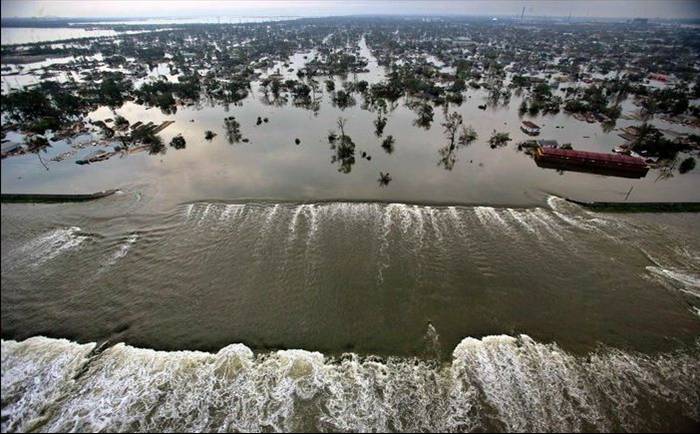
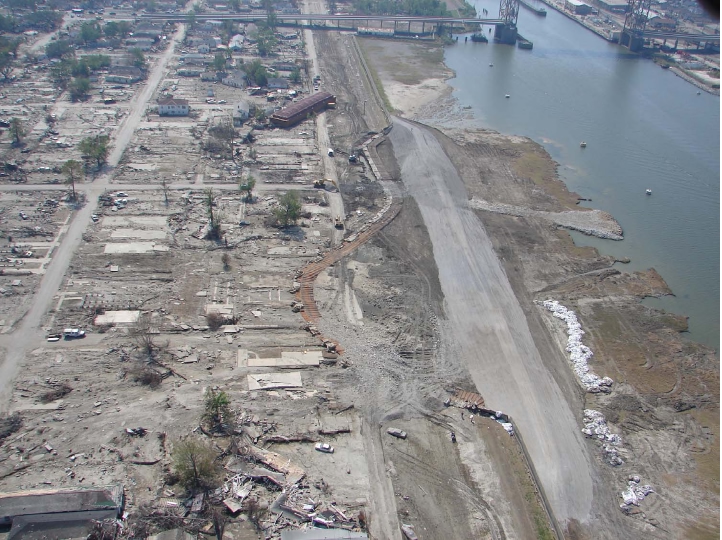
On the other hand, in the middle of Hurricane Katrina, seven years ago, a barge broke through the levee wall above the Lower 9th Ward in New Orleans, LA (NOLA) and released a wall of water that swept through the district. The pressure of the water was quite low, but the overall force it exerted demolished the buildings in its path, and swept them off their foundations for eighteen blocks back from the levee. In this case force, not pressure, was the cause of the damage.
Figure 2. The Lower 9th Ward in New Orleans after Katrina, as the water falls, it flows back into the Industrial Canal. The barge that broke through the levee is on the right. Most of the debris lined the second row of trees back from the levee. (Tulane)
It is this initial relationship between force and pressure, and the role that each has to play in the use of waterjets to remove material that form the topic not only for today, but in a number of the posts that will follow. Waterjetting applications now cover a wide spectrum of different uses, and finding the best choice of pressure and flow (which combine to give power) will change from job to job, and hopefully these posts will help make the choice easier.
It is raining outside. As the water drops hit the soil, the water soaks into the soil by penetrating along the existing cracks that exist between the grains of the soil. After a short time the water fills this space, and as it continues to rain, the impact of new rain drops hit the thin wedges of water that now run down into the soil. Although at much lower forces the action is the same as when you hit a wedge driven into a log with a hammer. The wedge pushes the two walls on either side apart, and a crack grows. One of the key elements that give waterjet cutting its advantage is this transformation from an impact force into a pressure, and most particularly a pressure which is applied against all the surfaces with which the water is in contact. It is a point that will be repeated many times.
Figure 3. The stages of soil erosion – the white arrows in (b) and (c) show the small pressures that are exerted on the particles as additional raindrops keep falling on the water in the ground. This lifts the top two particles in (c) so that the flow of water will carry them away.
With the soil there is not that much material holding the grains together, and so as the rain continues, the soil grains begin to separate from those on either side. Water gets underneath the grains and starts to lift the individual grains free from the mass. Since most land is not flat, the water will now start to flow away under the continued rain, and as it does it carries some of the soil particles that have been freed. This is a simple explanation for the erosion that happens in fields, dirt roads, and other exposed surfaces as they weather. As materials get stronger this process can take much longer to be seen. A high quality stone will erode at the rate of perhaps an inch every thousand years, depending on local weather patterns. There are buildings and bridges built by the Romans all over Europe to prove that point. A weaker granite (and one thinks of the granite in the walls of the Basilica in St Louis as an example) may severely erode within a hundred.
Which brings up an important point: the performance of a waterjet stream is not just controlled by what happens upstream of the nozzle in the delivery system, but it is also affected by the material that it is hitting. And I’ll come back to that in future posts.
First, however, consider what happened during Hurricane Katrina in the Lower 9th Ward. When the barge broke through the levee wall and was carried into the district, it rode on a wall of water that was initially no more than about 30 ft high. We can make a very crude estimate of the pressure of the initial wall of water (neglecting any impact due to the speed at which it moved) based on the height of that wave. A cubic foot of water weighs 62.4 lbs. It sits on an area of 12 x 12 = 144 square inches, so that the pressure under that water is 62.4/144 = 0.43 pounds per square inch (psi). Since that is somewhat close to half-a-psi, as a very simple way of getting the pressure at the bottom of a column of water one can just divide the height in two, and call it psi instead of feet.
So, in the case of that wall of water the pressure at the bottom of the wall would be 30/2 – 15 psi. Since the pressure increases with depth, the average pressure over the height will be half of that, or 7.5 psi. That pressure, by itself, does not appear that powerful.
But when the wave hits a building that pressure is applied over the entire wall. So if the building is 40 ft long and 10 ft high, then the area that sees that pressure is 40 x 12 x 10 x 12 = 57,600 square inches. If that small (7.5 psi) pressure is applied over the whole area, then the force = pressure x area = 7.5 x 57,600 psi = 432,000 lb.
You can now perhaps understand why, when the wave hit the first rows of houses in NOLA that they almost immediately disintegrated, and were carried back as broken debris for about ten blocks.
Figure 4. Aerial view of the Lower 9th Ward after the water had drained, and the levee had been replaced. For a sense of scale there is a school bus sitting partially under the barge, and that is the yellow dot at the end of the upper arrow. Each of the flat slabs to the left of the levee marks where a house stood. When we visited the site the house slabs were as shown, but there was still water – and some live fish, standing in the district. (Tulane )
This was a terrible disaster, but there are occasions, particularly in mining, where this terrible force, combining low pressure but high volume flow rates, can be harnessed to do useful work. Such flows are something that our ancestors have known for millennia, and were used as a way of mining from before the age of pumps, and l will tell how they did it in some later articles.
But in most cases we don’t have that amount of water, and the job is more often one where we want to precisely cut a hole, perhaps, in one of the walls of a building, rather than destroying the building. And we haven’t the patience to wait a hundred years to cut through a block of stone. So how do we speed it up? And so we come back to the death of King Richard.
Back in the day a foot soldier could make a bit of money in a battle by knocking a knight off his horse, and then holding him for ransom. The weapon that they used for this was generally known as a poleaxe. These come in various shapes, but one general idea was to have a hammer on one side of the long pole. Thus, by swinging the pole one could hit a knight with a force of say 50 – lbs. and this could knock him off his horse, allowing him – in the best of such worlds – to be captured alive and then ransomed.
Figure 5. Modern Reproduction of a poleax from about the time of the Wars of the Roses (Wallace Collection)
However that hammer head could measure about a square inch or two, and neither the force nor the pressure would have been enough to penetrate armor or a helmet of the type King Richard wore (Figure 1). To give the footman that advantage the design was changed to include a small spike in the center of the hammer.
Figure 6. Spiked Poleaxe from about 1582, (Royal Armories, Leeds) via My Armory.com)
Now when the force of 50-lb is applied through the hammer to the target it is not distributed over a square inch (giving a pressure of 50-psi). Instead it is focused down on a point that is less than a twentieth of an inch across. Total area of the circular point comes from pi x radius squared = 3.14 x 0.025 x 0.025 = 0.002 sq inches. Pressure applied through the spike to the helmet = 50/0.002 = 25,000 psi. That is enough for the spike to pierce through the metal helmet and the bone underneath, killing Richard III. Battle over, England had a new king, Henry VII, and the War of the Roses was over.
The intent of the two examples is to show how, in some circumstances, high volume flow rates at low pressure can do the most damage, and in others that much higher pressure applied over a much smaller area is the most effective. They are extreme examples but seek to illustrate the point, and in many cases neither extreme (highest pressure, lowest flow or lowest pressure, highest flow) will give the best answer. There are cutting conditions where operational concerns and benefits would argue that pressures of 90,000 psi, and flow rates around 1 gpm will be the best business choice. In other cases a flow of a thousand gpm, but at a pressure of 1,000 psi will be the most economic and viable way to remove soil, and weaker rocks like coal. This series is aimed, in part, at giving you the knowledge that will help you decide where, within that range, to make that balance, between flow and pressure.
(For those reading this series who are not that familiar with blogging conventions, the words that are highlighted in blue are links. So that if you want to read more about that specific topic, clicking on the highlighted words will take you to a web page that gives more information).
UPDATE: 1. This post was updated in 2013, after the body had been positively identified as that of the late King. The validation included a check on the DNA of the remains, which was compared with that of descendants of the family line.
UPDATE: 2. This post was slightly modified on April 19, 2013 to clarify some points that were not explained as well as I thought they were.
Read more!
Labels:
erosion,
force,
Henry VII,
hurricane,
Katrina,
Lower Ninth Ward,
poleax,
pressure,
Richard III,
soil,
War of the Roses
Subscribe to:
Posts (Atom)