Showing posts with label garnet. Show all posts

Monday, December 22, 2014

Waterjetting 28b - More on abrasive use

The costs of running a high pressure waterjet table divide into two parts, one that covers the basic costs of the system, whether it is running or not, such as building rent, while the second covers those costs that are a part of the actual work. Of the latter costs it is the cost of the abrasive that is often the most significant. This comes about in two ways, since the abrasive must first be purchased for use, and then, after it has been used it must be disposed of. Depending on the materials that were cut, this disposal cost can be significantly higher than the original purchase price. In some work carried out at the High Pressure Waterjet Lab (HPWL) at Missouri University of Science and Technology (MST) in the past we have seen disposal costs that were more than three times the cost of the original abrasive. And one should bear in mind that, as a research lab, the table was used much less than a comparable conventional table in an industrial cutting environment. But we also did not have a cutting operational budget, and so the cost of abrasive was something that we examined, to see if it could be reduced.

The first idea was that we would just recycle the abrasive. The particles of the target materials that were cut are generally much smaller than the abrasive particles themselves, and so it should be relatively easy to remove them from the mix. However, as we looked into the process in more detail, it was clear that it would not be quite as simple as it might, at first, appear. Marian Mazurkiewicz (retired) and Greg Galecki (who now runs the HPWL) carried out studies on the behavior of the particles as they moved through the mixing chamber and were accelerated down onto the target material. They found, as noted in an earlier post, that most of the abrasive was crushed to a smaller size when it passed through the cutting head, and a mix that started out with a particle size of 210 microns as it was fed into the system, was leaving the focusing tube with an average size of 140 microns.


Figure 1. Percentage of abrasive at different sizes after it has passed through a mixing chamber (and before it has hit the target). (After Galecki).

The reason that this is a concern is that, as the particles become smaller, so a point is reached where, depending on the target material, the abrasive no longer has sufficient energy to effectively cut into the target. When cutting into metals such as titanium and steel, our targets of choice in the study, this cut-off grade was at around 100 microns.
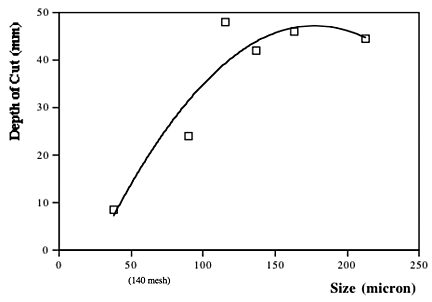

Figure 2. Effect of particle size on the cutting performance of an abrasive jet in cutting steel. (The tests were part of a factorial experiment and are thus averages over a number of different test runs at differing abrasive feed rates (AFR and pressures).

Roughly 25% of the mix in the example shown in figure 1 lies below 100 micron at it leaves the chamber. After impacting the target this value increases to more than 50%. Obviously recycling this fine material and re-using it in the cutting process is going to be less effective than removing it from the mix. Generally alluvial garnets will break up more rapidly than mined garnet, because of the structure of the abrasive particles, and thus the percentage that leave the focusing tube at the larger and more effective diameters are lower with the alluvial mix. The results were, we found, confirmed in the cutting results, with alluvial garnet producing a generally shallower depth of cut that would be achieved, other things being equal, in the cutting tests.

A quick word of explanation of the tests we ran, which are described in more detail here. The tests are run at a standard pressure and nozzle size, and at a constant traverse rate, with the depth that the jet cuts into a standard steel at a fixed speed measured over a 4-inch traverse length.

The results of the tests showed that, because of the particle crushing during the cutting process, the abrasive would have to be screened, and for most effective re-use only the larger fraction (on average less than 40%) should be recycled. The rest would be too fine for effective re-use in the operations we were developing. (Although finer abrasive has use in other applications, it would have to be screened and stored). It was interesting to note, and perhaps logical in retrospect, that once the particles had been used once and the larger ones separated out, then the percentage that survived and could be reused a second and third time increased significantly. This is mainly because those particles that had some form of weakness crack (either from weathering or from the mining process) were broken during the first impact, and the particles that survived did not have these cracks, and would therefore inherently be more prone to survive multiple times.

For our purpose, therefore, given that there was a high cost in purchasing the abrasive, and an even higher one in disposing of the contaminated material after cutting (because of the contamination by the target material) there was a potential economic advantage in recycling the abrasive. There were several ways in which the particles can be separated, but a simple screening process, if carried out properly, is quite time consuming, since the particles are required to “sit” on a vibrating screen for several minutes to ensure accurate separation, and this can be labor intensive if it is carried out as a batch process. We tried a number of different ways, including using a counter-flow fluid column that worked well for low feed rates, but the most efficient unit for one operation (we build virtually all of ours, and extensively modified them over time) may not be the best in other cases. (The one that survived the longest was a Wilfey table (though not this one).

In conventional AWJ cutting the abrasive has also to be dried before it can be re-used, and that can also add power and labor costs to the process. Thus, as with many choices that must be made when developing an efficient cutting operation, the best answer is to carry out a series of tests yourself, and run the numbers to decide whether, in the long run, recycling would, or would not, be an effective choice.

Read more!

Wednesday, March 5, 2014

Waterjetting 18d - Abrasive considerations

It would be best if, before I ended this short session on abrasive, I mentioned some of the practical constraints that sometimes limit the options for choosing abrasive types. To give a simple example, we were, at one time, demonstrating the ability of a waterjet drill to penetrate limestone. In the demonstration that morning we had used garnet as the abrasive and had made a steady penetration down to about 70-ft but the contracting office on the project did not seem overly impressed. So, after lunch, I suggested that we switch to an aluminum oxide abrasive, since we knew it was more aggressive.

Unfortunately for the afternoon program we were using a DIAjet type of system, where the abrasive is added to the water under pressure just downstream of the nozzle, and upstream of the delivery nozzle. While that worked well with the garnet abrasive (which passed without significant damage through the swivel on the end of the drill) that was not the case with the aluminum oxide. This is a much sharper abrasive and less prone to damage in mixing. As a result once we had the rig back in operation we were immediately struck by the black color of the water coming out of the hole – as the aluminum oxide stripped the inner lining from the hose carrying it to the nozzle. We then watched as, in real time, the pressure gage on the driving pump slowly slid back from the 10 ksi initial pressure to about 2 ksi as the abrasive ate out the orifices of the nozzle. Needless to say, having pretty much destroyed the downstream equipment in about five minutes, the afternoon demonstration was a bit of a disaster.

I also remember the first time that we used steel shot to try and cut through some rock, without giving too much thought to encasing the cutting operation. Those small spheres retained a lot more energy than most particles, and we were dodging the equivalent of shotgun pellets which ricocheted around the lab as we raced to shut the system down.

Both abrasives are, in their place, very effective tools in cutting materials that might be more difficult or uneconomic to cut by other means, but the peculiarities of their nature require that special precautions be used when they are used to make sure that there are not unintended consequences.

Sometimes the choices are simply practical. When we were cutting the walls of the Omnimax theater under the Gateway Arch in St. Louis, where we had to cut straight down (within half-an-inch either way over 15-ft of cut depth) through dolomite and chert it took less than a day to realize that the cost of using garnet to achieve the 12 – 15-inch individual cut depths was going to drive us out of economic reality within a week. Changing to a blasting sand (which we bought by the ton) did not change the cutting performance by much, but had a remarkable effect on overall costs.


Figure 1. Effect of abrasive type, size and feed rate on the depth of cut and optimal cutting condition when cutting rock. (after Yazici*)

Abrasive type and abrasive size both effect the depth of cut, and thus the economics of a cutting operation. Yet it is not possible to draw absolute rules since the different abrasives have different relative cutting efficiencies in different materials. For example, in the above plot boiler slag was relatively ineffective in cutting rock. On the other hand, with the right type of slag and steel Faber and Oweinah** have reported that slag can cut steel more than three times as efficiently as garnet. (This is partly because the slag shatters on impact and the fragments go on to scour the uplifted edges of the cavities generated by the initial impact of the particle.)

And while the British Welding Institute use smaller particles to cut softer materials, they have found it critical to use larger particles to get viable performance as the target material gets harder. In cutting steel I had mentioned in an earlier post, that garnet becomes less effective at a particle size below 100 micron. Yet in cutting aluminum (which is softer) the particles can be smaller and yet still effective.


Figure 2. The effect of particle size when cutting aluminum using corundum particles (after Faber and Oweinah ibid)

Yet, as discussed at the beginning, the cost of the abrasive must not only be set off against the potential for improving the cutting rate, one has to also look and see if there is an increase in the operating cost of the system when a harder, and thus often more effective cutting abrasive is used. Zaring et al showed this with a plot that they published at the 6th American Waterjet Conference***.


Figure 3. Relative benefits and costs of changing abrasive type (after Zaring et al***)

All things are, however, relative, and in some small cutting operations we have found it more economic to sacrifice the nozzle over the cutting time required in order to achieve a cut that could not be effectively achieved any other way.

As with many things in the waterjet business, while there are general rules that can be laid down to guide operations, when it comes to specific cases then it is often worth running a small series of tests on the projected target material, using different abrasives, at varying size ranges and feed rates, before calculating (usually using a normalized cost in dollars or gms per area of cut) the most effective abrasive for a given operation.

*Yazici, Sina, Abrasive Jet Cutting and Drilling of Rock, Ph.D. Dissertation Mining Engineering, Univ. of Missouri- Rolla, Rolla, MO, 1989, 203 pp.
**Faber, K., Oweinah, H., "Influence of Process Parameters on Blasting Performance with the Abrasive Jet," paper 25, 10th International Symp Jet Cutting Technology, Amsterdam, Oct, 1990, pp. 365 - 384.
***Zaring, K., Erichsen, G., Burnham, C., "Procedure Optimization and Hardware Improvements in Abrasive Waterjet Cutting Systems," 6th American Water Jet Conf, Houston, TX, Aug, 1991, pp. 237 - 248.

Read more!