Showing posts with label recycling. Show all posts

Monday, December 22, 2014

Waterjetting 28b - More on abrasive use

The costs of running a high pressure waterjet table divide into two parts, one that covers the basic costs of the system, whether it is running or not, such as building rent, while the second covers those costs that are a part of the actual work. Of the latter costs it is the cost of the abrasive that is often the most significant. This comes about in two ways, since the abrasive must first be purchased for use, and then, after it has been used it must be disposed of. Depending on the materials that were cut, this disposal cost can be significantly higher than the original purchase price. In some work carried out at the High Pressure Waterjet Lab (HPWL) at Missouri University of Science and Technology (MST) in the past we have seen disposal costs that were more than three times the cost of the original abrasive. And one should bear in mind that, as a research lab, the table was used much less than a comparable conventional table in an industrial cutting environment. But we also did not have a cutting operational budget, and so the cost of abrasive was something that we examined, to see if it could be reduced.

The first idea was that we would just recycle the abrasive. The particles of the target materials that were cut are generally much smaller than the abrasive particles themselves, and so it should be relatively easy to remove them from the mix. However, as we looked into the process in more detail, it was clear that it would not be quite as simple as it might, at first, appear. Marian Mazurkiewicz (retired) and Greg Galecki (who now runs the HPWL) carried out studies on the behavior of the particles as they moved through the mixing chamber and were accelerated down onto the target material. They found, as noted in an earlier post, that most of the abrasive was crushed to a smaller size when it passed through the cutting head, and a mix that started out with a particle size of 210 microns as it was fed into the system, was leaving the focusing tube with an average size of 140 microns.


Figure 1. Percentage of abrasive at different sizes after it has passed through a mixing chamber (and before it has hit the target). (After Galecki).

The reason that this is a concern is that, as the particles become smaller, so a point is reached where, depending on the target material, the abrasive no longer has sufficient energy to effectively cut into the target. When cutting into metals such as titanium and steel, our targets of choice in the study, this cut-off grade was at around 100 microns.
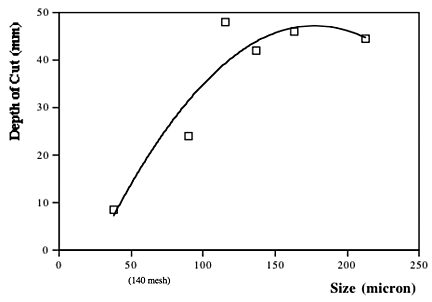

Figure 2. Effect of particle size on the cutting performance of an abrasive jet in cutting steel. (The tests were part of a factorial experiment and are thus averages over a number of different test runs at differing abrasive feed rates (AFR and pressures).

Roughly 25% of the mix in the example shown in figure 1 lies below 100 micron at it leaves the chamber. After impacting the target this value increases to more than 50%. Obviously recycling this fine material and re-using it in the cutting process is going to be less effective than removing it from the mix. Generally alluvial garnets will break up more rapidly than mined garnet, because of the structure of the abrasive particles, and thus the percentage that leave the focusing tube at the larger and more effective diameters are lower with the alluvial mix. The results were, we found, confirmed in the cutting results, with alluvial garnet producing a generally shallower depth of cut that would be achieved, other things being equal, in the cutting tests.

A quick word of explanation of the tests we ran, which are described in more detail here. The tests are run at a standard pressure and nozzle size, and at a constant traverse rate, with the depth that the jet cuts into a standard steel at a fixed speed measured over a 4-inch traverse length.

The results of the tests showed that, because of the particle crushing during the cutting process, the abrasive would have to be screened, and for most effective re-use only the larger fraction (on average less than 40%) should be recycled. The rest would be too fine for effective re-use in the operations we were developing. (Although finer abrasive has use in other applications, it would have to be screened and stored). It was interesting to note, and perhaps logical in retrospect, that once the particles had been used once and the larger ones separated out, then the percentage that survived and could be reused a second and third time increased significantly. This is mainly because those particles that had some form of weakness crack (either from weathering or from the mining process) were broken during the first impact, and the particles that survived did not have these cracks, and would therefore inherently be more prone to survive multiple times.

For our purpose, therefore, given that there was a high cost in purchasing the abrasive, and an even higher one in disposing of the contaminated material after cutting (because of the contamination by the target material) there was a potential economic advantage in recycling the abrasive. There were several ways in which the particles can be separated, but a simple screening process, if carried out properly, is quite time consuming, since the particles are required to “sit” on a vibrating screen for several minutes to ensure accurate separation, and this can be labor intensive if it is carried out as a batch process. We tried a number of different ways, including using a counter-flow fluid column that worked well for low feed rates, but the most efficient unit for one operation (we build virtually all of ours, and extensively modified them over time) may not be the best in other cases. (The one that survived the longest was a Wilfey table (though not this one).

In conventional AWJ cutting the abrasive has also to be dried before it can be re-used, and that can also add power and labor costs to the process. Thus, as with many choices that must be made when developing an efficient cutting operation, the best answer is to carry out a series of tests yourself, and run the numbers to decide whether, in the long run, recycling would, or would not, be an effective choice.

Read more!

Saturday, April 17, 2010

Asphalt highways, gravel roads and the pig manure answer

One of the problems that the rising price of crude has created lies with the related cost of asphalt. As a result states are being more creative in spending their repair budgets, and it is interesting to see some of their answers. Asphalt is used extensively in creating the roads that we drive over every day. Because of this traffic, and movement of the underlying material, roadbeds can fail and erode. But not all do, at least to the extent of the majority. Just this last week the Asphalt Pavement Alliance has announced the winners of this years Perpetual Pavement Award. The winners have to be the owners of asphalt pavements that are at least 35 years old and have never had a structural failure, and the average time between resurfacing has to be no less than 10 years. There are ten awardees, with sections of highway that won being found in Alabama, Arkansas, Kentucky, Michigan, Minnesota, Mississippi, Missouri, Nebraska, South Carolina and Tennessee. The winners range in length up to 12 miles, and from Interstates to State Roads.

Asphalt has been getting more expensive, as the price of crude oil increases, and this reflects back to the state highway departments that must repair damaged roads.

In Illinois, for example, the average asphalt overlay will last between five and eight years (Illinois State Toll Highway Authority) or eight to fifteen years (Illinois Department of Transportation). The decision on repair is a function of both the amount of damage, and the amount of traffic. One consequence of this is the return from asphalt coated to gravel roads. Ugo Bardi recently commented on this at The Oil Drum. He noted that an early use of the Canadian Tar Sands was as a direct application as a roadbed material, and the same has been considered for the West Indies.

Asphalt is one of the most re-circulated of materials, since the material that is laid into the roadbed is only about 5% asphalt and 95% aggregate, so that when the original surface is removed as part of the resurfacing operation, about 80% of it is recycled. And it is not just the aggregate, and some of the binder that gets recycled.

Starting in 1994 Florida DOT has also mandated that the mix include recycled ground tire rubber.
From 1994 through 2007, Florida has recycled the equivalent of over 12.5 million passenger tires into asphalt pavements, saving valuable landfill space while improving the performance of our highways. That works out to over 471 passenger tires per lane mile. Current research shows benefits of combing both ground tire rubber and high tech polymers to improve asphalt binders even more.

Because of the changing price of oil, most states have an adjustment index for the price of asphalt that their construction contractors buy (and then charge the state for).

Some states are returning roads back from asphalt to gravel, though this is not as easy as it may at first appear, since the construction of the roadbeds is different, as is the maintenance, since a gravel road is graded back to quality, rather than being ground up and resurfaced. This is particularly true when road traffic is light, but a number of states are moving this way because of budget constraints.
Thirty-eight counties in Michigan replaced a total of 100 miles of asphalt roads with gravel because of decreasing funds in 2008-09, said Monica Ware, a spokeswoman for the County Road Association of Michigan.

In Montcalm County, Mich., 10 miles were converted to cut patching costs in 2009, said Randy Stearns, managing director of the county's road commission. He cited one road that cost a combined $39,244 in 2008 and early 2009 for patching, but only $7,300 to crush into gravel. More roads may be converted this summer, he said.
The relative costs of going from gravel to asphalt indicates that the transition comes at around 200 vehicles/day.

Relative costs for different road types (U of Minnesota )

Now the price of asphalt is anticipated to rise again, and so what are states to do? In Missouri, a state that grows a lot of pigs, – mainly in farms, though there is a concern over the rising numbers of feral hogs in the state. Putting the problem of disposing of a lot of porcine waste with the high cost of asphalt, folks in Missouri, at the highway leading into Six Flags at Eureka (just outside Saint Louis) have taken the logical next step.
The witnesses lining the bright stretch of North Outer Drive along Interstate 44 — particularly those with noses and an abiding interest in sustainable technology — won't soon forget the moment the red dump truck deposited a 15-ton load of the designer asphalt into a road paver late Wednesday morning.

"Whew!" gasped a worker with Pace Construction Co., the St. Louis County road contractor that joined forces with Innoventor, the Earth City-based engineering and design firm that perfected the process of converting the animal waste into a bio-oil used in asphalt binder.

To others, the air swelled with the sweet smell of potential for new manufacturing opportunities, jobs and, possibly, profits.

The initial stretch of road treated was some 500-ft long, and will get a significant seasonal traffic from the amusement park, accelerating wear potential and allowing the evaluation to be made in a shorter time.

The process was thought up and developed through Innoventor. Essentially the animal waste is converted into a bio-oil that can serve as the binder in the asphalt. The program is currently getting the close attention of the Missouri Department of Transportation, as well as the U.S. EPA. (And I suspect that the next time I drive by the site, I may roll down a window and have a quiet sniff).

It takes all kinds, to find the right answers.

Read more!