Showing posts with label Syria. Show all posts
Wednesday, September 11, 2013
Of Gas attacks, World War 1 and my Grandfather
With all the discussion of the use of chemical weapons in Syria, it is perhaps worth remembering that their first use against a Western Army at any scale took place at the Second Battle of Ypres almost one hundred years ago. My grandfather was there, serving in the Northumberland Fusiliers, and this is an account of that battle.
In August 1914, at the beginning of the First World War,, the German armies marched through Belgium, hoping by avoiding the French fortifications at Verdun, to swing around and capture Paris. En route they ran into the British Expeditionary Force, (BEF) and initially drove this, and the French armies back into France. A counter-attack in September pushed the German Army back to a line, running from the North Sea to Switzerland, that was the sensible length of the battle fields until the closing months of the war in 1918. The Belgians has opened the sluices to flood the ground west of Ypres.
Figure 1. Troop movements leading up to the establishment of the trench line.
By this time a large proportion of the BEF, which included most of the experienced troops in the British Army, had suffered considerable casualties, and as 1915 began they began to be replaced by troops from Britain. At the same time there was massive enlistment in the British Forces, averaging 125,000 men a month.
Such was the case with my grandfather, who joined the 7th Battalion of the Northumberland Fusiliers on October 19, 1914. The battalion was send to Le Havre, on the 16th April, 2015. From there they were marched forward, and held in GHQ reserve as part of the 50th (Northumberland) Division around Steenvoorde and Cassel, some 20 miles west of Ypres. At that time the British Army held the line running south from Ypres, with French and Belgian troops mustered from their North to the sea.
Figure 2. Location of the British Armies at the end of 1914.
By this time troops had dug trenches, with simple barbed wire entanglements, but these early dugouts were shallow. Because the water level was about 2 feet below the surface, the trenches could not be dug any deeper than that, and often were only about three feet wide. Full height was thus achieved by building up sandbag walls to a height of about four feet. In front of these trenches the wire entanglements were placed stretching continuously and over a width of perhaps 6 yards.
On the 14th April a captured prisoner (August Jager) revealed that the Germans were planning an attack for the following day, and that they planned to use gas. The French general requested that his men be withdrawn but was over-ruled (and after the battle dismissed). Jager, some 17 years later, was arrested in Germany and sentenced to 10 years for treason. Nothing else was done. There is some evidence that gas was used for the first time the following day. However the gas was fired from shells and was not widely effective.
German records revealed that Chloracetone, Benzylbromide and Benzyliodide were used in shells before the Battle of Ypres. Some 3 000 shells loaded with dianisidine which irritates the mucous membranes had been tried, with no effect, at Neuve Chappelle. This was changed to Xylyl-bromide and the shells marked with a T. (This led to Allied confusion and interpretation of these as tear gas shells, in fact the effect is mainly on the eyes but in stronger doses it can cause edema of the lungs,) While these had some effect, the shells were initially lined with lead and this reduced their effect. They had only little effect on troops before the main battle.
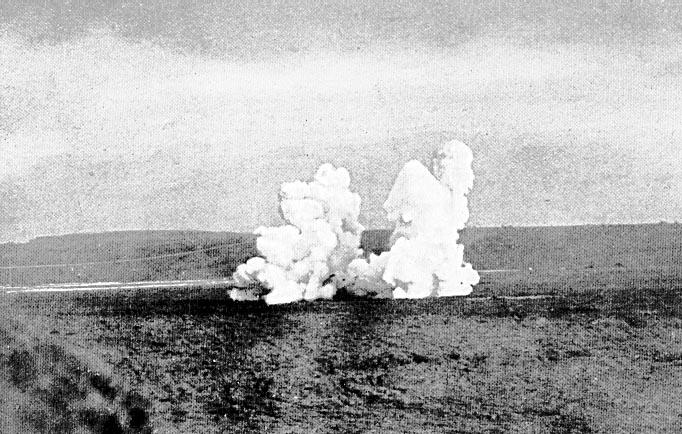
Figure 3 Gas shell bursting
The 22nd of April began as a beautiful spring day , at around 5 pm, 5,700 cylinders of chlorine, located along the German lines and about 3.7 miles long were opened in the space of 3 minutes. Each container held 44 lb. of liquid which vaporized as it escaped. (A total of 120 tons of chlorine).. The gas then spread over land which, at that time was still being farmed, and formed a cloud which rose to a height of 10 - 30 yards and moved over the ground at a speed of around 1 mph. After ten minutes, to allow the cloud to reach the trenches 40 yards away, the German guns opened up in a barrage. By 7 p.m. the French guns had stopped. The Germans advanced until they met the Canadian reserves , who had been called up, and had advanced just beyond Mouse Trap Farm.
In the ten minutes that the gas took to pass over the lines, 5,000 French had been killed, 15,000 gassed, and 6,000 were captured together with 51 guns and 70 machine guns. There were virtually no survivors left in place, but those left retreated to form a new line.
Figure 4. German First Gas attack.
South of the French the line was held by Canadian Divisions, but a series of large gaps rapidly grew between these troops and the remaining French. This gap was some 2 miles long. By 9 p.m. the gap had grown to 4.5 miles except for only three places, at the Polcappelle road held by the French Tirailleurs, and the 3rd Canadian Brigade, by 2.5 companies at St. Julien and by four companies around Mouse Trap Farm. This line was some four miles from the backs of the 27th and 28th divisions on the other side of the salient. But at 7:30 pm German troops stopped advancing and began to dig trenches and a new gas line.
Figure 5. Position of troops at 5 pm on 22 April 1915.
To provide new troops the 50th (Northumbrian) Division, which was 20 miles away at Steenvoorde, was ordered forward. Arriving in France on the 16th April it consisted of the 149th (Northumberland), 150th (York and Durham) and 151st (Durham Light Infantry) Brigades. It was the first full Territorial Division to reach the front, some being sent forward by bus.
At midnight the Canadian 45th Division counterattacked the German line with success but without adjacent support, it had to be withdrawn. (The 2 battalions were reduced to 10 officers and 400 men). Messages between forces were being sent around by foot and by mounted riders who got as near as they could on horseback before finishing on foot. Many runners did not make it, and communications were poor. It should be remembered that most of the troops, supplies, wounded etc. travelled over the same road network , and that troops had neither gas masks nor steel helmets.
Figure 6. Troops lie in a field near a farm.
By daybreak ten battalions had been moved into the gap between the French and the Canadians but had little cover, and some lay in the open, while rudimentary trenches were dug. Facing them were some 42 battalions of German troops, heavily armed with artillery, machine guns and already occupying the ridges that crossed the area. The German guns outnumbered the allied by more than 5 to 1. .
The following day also began with perfect weather, with little enemy activity as the allies tried to decide how to defend against the gas. The idea that they used was to hold wetted cloth (handkerchiefs or what was available) over their mouths, damped if possible with a solution of bicarbonate of soda. If it was too wet the men could not breath through it and took it off. This did not become evident until the next gas attack.
Figure 7. Early gas masks>
The British tried unsuccessfully to counter attack, using the 13th Brigade, but it suffered very heavy casualties. All the reserves had been committed and the 150th Brigade was brought forward in buses while the 149th Brigade were ordered to march to Brandhoeke. Three of the Colonels that had been commanding battalions were killed, together with 56 other officers and 2100 men. The 150th Brigade was therefore ordered up to provide support for the remaining troops. The flat land and troops could be seen advancing for a long way.
On the 24th April the Germans to turn the flank by attacking the Belgian army to the north. They also launched a second gas attack, at the Canadian troops. Again the gas was launched from cylinders, along a thousand yard front. Some 24 battalions of Germans attacked the defending eight battalions, which had had little protection from the gas, and a mile-wide gap developed. Canadian forces then created a second defensive line behind the gap.
The strong German attack, however continued and by 3 p.m. the Canadians were forced to fall back through St. Julien, and were reinforced by 150th Brigade, counterattacking and halting the German advance.
Rain had started during the night and it came down heavily before ending in the early morning. Communication remained very poor. But reserves were now coming forward, and a British attack was planned, initially for 3 am, but due to blocked roads and only two gaps in the British wire it was delayed until after dawn. “Without adequate artillery preparation and support, on ground unknown and unreconnoitred, they were sent to turn an enemy well provided with machine guns out of a position which had ready-made cover in houses and a wood, and splendid artillery observation from higher ground behind it.”
Figure 8. Situation after the 25th April Battle, showing troop movements
The 149th Brigade was to attack Kitchener’s Wood and St. Julien from the left, but as they moved forward they came under rifle and machine gun fire. They advanced within a hundred yards of St. Julien before they were stopped in place. The men were pinned down, and eventually retreated. The Brigade lost 73 officers and 2,346 other ranks.
The German lines were well defended, and the British troops carried banners to show where they were, supposedly to help British artillery , but it also helped the Germans.
Figure 9. British troops approaching German trenches, note the wire and the flags.
The 4th and 7th battalions of the Northumberland Fusiliers (including my grandfather) were to reinforce the right flank and extended it to the right. The attack was called off at 9:15 am. (My Grandfather was in the band, and for two more months those individuals served as stretcher-bearers and to recover the wounded, but in May they were moved back into the ranks as regular troops.)
During the day the Germans launched several heavy attacks further down the line and troops were called up as available to create a viable defensive position, although it was necessary to retreat on several points. German attacks continued all night By this time the 8th DLI had lost 19 officers and 574 men and was reorganized as a company of 6 officers and 140 men. The 149th were ordered to the south of Wieltje to act as a reserve. The Lahore Division had marched up at noon, and had been in huts 5 miles south west of Ypres.
General Smith-Dorrien ordered that the Lahore Division should attack towards Mauser Ridge, They Lahore Division marched out at 5:30 am and lined up at 11 am. Moving forward to attack at 1:20 pm. They continued forward until they were within a hundred yards of the German lines, where they were halted. At this point gas was released from the German lines and although the troops held position in time they were withdrawn back to the British front lines, The Division had lost 95 officers and 1,724 men including 3 Lt. Cols.
The Northumbrian Brigade “fared even worse.” Only the 4th 6th and 7th battalions were available. Brig. Riddell did not receive orders to participate in the attack until 10 minutes before it was due to start at 1:20 p.m. Neither he nor his men were aware of the British wire than ran obliquely in front of the GHQ line before them.
“Notwithstanding the lack of protection on the left, the Northumberland Brigade, the first Territorials to go into battle as a brigade - pushed through the 10th Brigade line with the greatest dash, but like Gen. Hull’s men on the previous day, it was met by machine gun fire from the houses. Without artillery support it could only advance a short distance beyond the British front trenches. About 3:40 Brig. General Riddell was killed and when soon after, the leading lines reached some old trenches it was obvious that no further progress could be made..”
The brigade had lost 42 officers and 1,912 ranks, over two thirds of its strength. “ My grandfather survived, though he was wounded, and was in hospital on the 5th May. He was back on the front lines when he was shot by a sniper in June, 2015, and was then invalided out to the UK where, after almost two years of treatment he came home. He was also gassed several times(German artillery were firing 40% gas shells at the time) and for all the time I knew him suffered with his breathing in the winter.
Subsequently the German Army used gas around the salient, leading to a British withdrawal to a more defensible line. This was completed by the 3rd May and sensibly ended the Second Battle of Ypres. There were two subsequent gas attacks that month, but in the one on the 11th May the wind shifted, and two of the German battalions were caught in the gas clouds. By the time of the second, on the 24th May there were sufficient gas masks and material that the Allies were able to withstand the attack. British losses over the month were 2,150 officers and 57,125 men. German losses were 860 officers and 34,073 other ranks.
Figure 10. Battle Lines for the gas attack on the 24th May.
Figure 11. My Grandfather Private Archibald Summers.
In August 1914, at the beginning of the First World War,, the German armies marched through Belgium, hoping by avoiding the French fortifications at Verdun, to swing around and capture Paris. En route they ran into the British Expeditionary Force, (BEF) and initially drove this, and the French armies back into France. A counter-attack in September pushed the German Army back to a line, running from the North Sea to Switzerland, that was the sensible length of the battle fields until the closing months of the war in 1918. The Belgians has opened the sluices to flood the ground west of Ypres.
Figure 1. Troop movements leading up to the establishment of the trench line.
By this time a large proportion of the BEF, which included most of the experienced troops in the British Army, had suffered considerable casualties, and as 1915 began they began to be replaced by troops from Britain. At the same time there was massive enlistment in the British Forces, averaging 125,000 men a month.
Such was the case with my grandfather, who joined the 7th Battalion of the Northumberland Fusiliers on October 19, 1914. The battalion was send to Le Havre, on the 16th April, 2015. From there they were marched forward, and held in GHQ reserve as part of the 50th (Northumberland) Division around Steenvoorde and Cassel, some 20 miles west of Ypres. At that time the British Army held the line running south from Ypres, with French and Belgian troops mustered from their North to the sea.
Figure 2. Location of the British Armies at the end of 1914.
By this time troops had dug trenches, with simple barbed wire entanglements, but these early dugouts were shallow. Because the water level was about 2 feet below the surface, the trenches could not be dug any deeper than that, and often were only about three feet wide. Full height was thus achieved by building up sandbag walls to a height of about four feet. In front of these trenches the wire entanglements were placed stretching continuously and over a width of perhaps 6 yards.
On the 14th April a captured prisoner (August Jager) revealed that the Germans were planning an attack for the following day, and that they planned to use gas. The French general requested that his men be withdrawn but was over-ruled (and after the battle dismissed). Jager, some 17 years later, was arrested in Germany and sentenced to 10 years for treason. Nothing else was done. There is some evidence that gas was used for the first time the following day. However the gas was fired from shells and was not widely effective.
German records revealed that Chloracetone, Benzylbromide and Benzyliodide were used in shells before the Battle of Ypres. Some 3 000 shells loaded with dianisidine which irritates the mucous membranes had been tried, with no effect, at Neuve Chappelle. This was changed to Xylyl-bromide and the shells marked with a T. (This led to Allied confusion and interpretation of these as tear gas shells, in fact the effect is mainly on the eyes but in stronger doses it can cause edema of the lungs,) While these had some effect, the shells were initially lined with lead and this reduced their effect. They had only little effect on troops before the main battle.
Figure 3 Gas shell bursting
The 22nd of April began as a beautiful spring day , at around 5 pm, 5,700 cylinders of chlorine, located along the German lines and about 3.7 miles long were opened in the space of 3 minutes. Each container held 44 lb. of liquid which vaporized as it escaped. (A total of 120 tons of chlorine).. The gas then spread over land which, at that time was still being farmed, and formed a cloud which rose to a height of 10 - 30 yards and moved over the ground at a speed of around 1 mph. After ten minutes, to allow the cloud to reach the trenches 40 yards away, the German guns opened up in a barrage. By 7 p.m. the French guns had stopped. The Germans advanced until they met the Canadian reserves , who had been called up, and had advanced just beyond Mouse Trap Farm.
In the ten minutes that the gas took to pass over the lines, 5,000 French had been killed, 15,000 gassed, and 6,000 were captured together with 51 guns and 70 machine guns. There were virtually no survivors left in place, but those left retreated to form a new line.
Figure 4. German First Gas attack.
South of the French the line was held by Canadian Divisions, but a series of large gaps rapidly grew between these troops and the remaining French. This gap was some 2 miles long. By 9 p.m. the gap had grown to 4.5 miles except for only three places, at the Polcappelle road held by the French Tirailleurs, and the 3rd Canadian Brigade, by 2.5 companies at St. Julien and by four companies around Mouse Trap Farm. This line was some four miles from the backs of the 27th and 28th divisions on the other side of the salient. But at 7:30 pm German troops stopped advancing and began to dig trenches and a new gas line.
Figure 5. Position of troops at 5 pm on 22 April 1915.
To provide new troops the 50th (Northumbrian) Division, which was 20 miles away at Steenvoorde, was ordered forward. Arriving in France on the 16th April it consisted of the 149th (Northumberland), 150th (York and Durham) and 151st (Durham Light Infantry) Brigades. It was the first full Territorial Division to reach the front, some being sent forward by bus.
At midnight the Canadian 45th Division counterattacked the German line with success but without adjacent support, it had to be withdrawn. (The 2 battalions were reduced to 10 officers and 400 men). Messages between forces were being sent around by foot and by mounted riders who got as near as they could on horseback before finishing on foot. Many runners did not make it, and communications were poor. It should be remembered that most of the troops, supplies, wounded etc. travelled over the same road network , and that troops had neither gas masks nor steel helmets.
Figure 6. Troops lie in a field near a farm.
By daybreak ten battalions had been moved into the gap between the French and the Canadians but had little cover, and some lay in the open, while rudimentary trenches were dug. Facing them were some 42 battalions of German troops, heavily armed with artillery, machine guns and already occupying the ridges that crossed the area. The German guns outnumbered the allied by more than 5 to 1. .
The following day also began with perfect weather, with little enemy activity as the allies tried to decide how to defend against the gas. The idea that they used was to hold wetted cloth (handkerchiefs or what was available) over their mouths, damped if possible with a solution of bicarbonate of soda. If it was too wet the men could not breath through it and took it off. This did not become evident until the next gas attack.
Figure 7. Early gas masks>
The British tried unsuccessfully to counter attack, using the 13th Brigade, but it suffered very heavy casualties. All the reserves had been committed and the 150th Brigade was brought forward in buses while the 149th Brigade were ordered to march to Brandhoeke. Three of the Colonels that had been commanding battalions were killed, together with 56 other officers and 2100 men. The 150th Brigade was therefore ordered up to provide support for the remaining troops. The flat land and troops could be seen advancing for a long way.
On the 24th April the Germans to turn the flank by attacking the Belgian army to the north. They also launched a second gas attack, at the Canadian troops. Again the gas was launched from cylinders, along a thousand yard front. Some 24 battalions of Germans attacked the defending eight battalions, which had had little protection from the gas, and a mile-wide gap developed. Canadian forces then created a second defensive line behind the gap.
The strong German attack, however continued and by 3 p.m. the Canadians were forced to fall back through St. Julien, and were reinforced by 150th Brigade, counterattacking and halting the German advance.
Rain had started during the night and it came down heavily before ending in the early morning. Communication remained very poor. But reserves were now coming forward, and a British attack was planned, initially for 3 am, but due to blocked roads and only two gaps in the British wire it was delayed until after dawn. “Without adequate artillery preparation and support, on ground unknown and unreconnoitred, they were sent to turn an enemy well provided with machine guns out of a position which had ready-made cover in houses and a wood, and splendid artillery observation from higher ground behind it.”
Figure 8. Situation after the 25th April Battle, showing troop movements
The 149th Brigade was to attack Kitchener’s Wood and St. Julien from the left, but as they moved forward they came under rifle and machine gun fire. They advanced within a hundred yards of St. Julien before they were stopped in place. The men were pinned down, and eventually retreated. The Brigade lost 73 officers and 2,346 other ranks.
The German lines were well defended, and the British troops carried banners to show where they were, supposedly to help British artillery , but it also helped the Germans.
Figure 9. British troops approaching German trenches, note the wire and the flags.
The 4th and 7th battalions of the Northumberland Fusiliers (including my grandfather) were to reinforce the right flank and extended it to the right. The attack was called off at 9:15 am. (My Grandfather was in the band, and for two more months those individuals served as stretcher-bearers and to recover the wounded, but in May they were moved back into the ranks as regular troops.)
During the day the Germans launched several heavy attacks further down the line and troops were called up as available to create a viable defensive position, although it was necessary to retreat on several points. German attacks continued all night By this time the 8th DLI had lost 19 officers and 574 men and was reorganized as a company of 6 officers and 140 men. The 149th were ordered to the south of Wieltje to act as a reserve. The Lahore Division had marched up at noon, and had been in huts 5 miles south west of Ypres.
General Smith-Dorrien ordered that the Lahore Division should attack towards Mauser Ridge, They Lahore Division marched out at 5:30 am and lined up at 11 am. Moving forward to attack at 1:20 pm. They continued forward until they were within a hundred yards of the German lines, where they were halted. At this point gas was released from the German lines and although the troops held position in time they were withdrawn back to the British front lines, The Division had lost 95 officers and 1,724 men including 3 Lt. Cols.
The Northumbrian Brigade “fared even worse.” Only the 4th 6th and 7th battalions were available. Brig. Riddell did not receive orders to participate in the attack until 10 minutes before it was due to start at 1:20 p.m. Neither he nor his men were aware of the British wire than ran obliquely in front of the GHQ line before them.
“Notwithstanding the lack of protection on the left, the Northumberland Brigade, the first Territorials to go into battle as a brigade - pushed through the 10th Brigade line with the greatest dash, but like Gen. Hull’s men on the previous day, it was met by machine gun fire from the houses. Without artillery support it could only advance a short distance beyond the British front trenches. About 3:40 Brig. General Riddell was killed and when soon after, the leading lines reached some old trenches it was obvious that no further progress could be made..”
The brigade had lost 42 officers and 1,912 ranks, over two thirds of its strength. “ My grandfather survived, though he was wounded, and was in hospital on the 5th May. He was back on the front lines when he was shot by a sniper in June, 2015, and was then invalided out to the UK where, after almost two years of treatment he came home. He was also gassed several times(German artillery were firing 40% gas shells at the time) and for all the time I knew him suffered with his breathing in the winter.
Subsequently the German Army used gas around the salient, leading to a British withdrawal to a more defensible line. This was completed by the 3rd May and sensibly ended the Second Battle of Ypres. There were two subsequent gas attacks that month, but in the one on the 11th May the wind shifted, and two of the German battalions were caught in the gas clouds. By the time of the second, on the 24th May there were sufficient gas masks and material that the Allies were able to withstand the attack. British losses over the month were 2,150 officers and 57,125 men. German losses were 860 officers and 34,073 other ranks.
Figure 10. Battle Lines for the gas attack on the 24th May.
Figure 11. My Grandfather Private Archibald Summers.
Read more!
Thursday, July 25, 2013
OGPSS - Of Egyptian Bread and Oil
The turmoil in the Middle East shows little sign of ending in the near future, and the potential lack of enough cheap fuel for the population is a warning that the levels of unrest may continue and even get worse. There is, however, some hope for enough local supply in the near term to help with some of the indigenous problems. Consider, for example, Egypt which has the largest population of the countries in its immediate vicinity, a population that has grown 200% in the last 50 years.
Figure 1. Growth in Egyptian population (Trading Economics )
By last December Egypt was populated by some 83.66 million folk, with little sign of change in the growth rate. Over that time, energy demand has grown, while domestic supplies of fuel have not kept up. The most significant change, perhaps, is in oil consumption, with recent data, as previously noted, showing that the country has now switched to one that must import oil to meet demand.
Figure 2. Egyptian oil statistics (Energy Export Databrowser )
The EIA puts consumption at 811 kbd, set against a production of 555 kbd of petroleum products and, for natural gas, the country produced 2.1 bcf , which can be set against a consumption of 1.8 bcf, but the balance there also is trending downwards as recent levels of discovery and development have failed to match the increase in domestic demand.
Figure 3. Trends in Egyptian natural gas statistics (Energy Export Databrowser)
The developing need for oil imports is made more difficult by the subsidies that have become an accepted part of the Egyptian economy, including not only fuel, but also bread. Fuel subsidies are reported to be at around $17.4 billion and about a fifth of total state spending. Bread subsidies though a similarly critical part of picture, run only at about 20% of the fuel cost. To help manage costs and encourage domestic production, the Morsi government had cut back on foreign purchases of wheat, but this has now been reversed with the take-over even as the new government works to transition away from the subsidy burden. With the change, foreign governments are now also more willing to provide fuel, the United Arab Emirates (UAE) will send around a million barrels of oil this month, and Kuwait, Saudi Arabia and the UAE are promising more aid packages.
This may help with the short–term problem, which has too many political entanglements to allow any solid predictions for longer term help from outside the country, but there are potential sources of increasing domestic supplies from both the Western Desert and the Nile Delta itself.
Egypt has been supplying natural gas to Jordan, Syria, Lebanon and Israel through the Arab Gas Pipeline with flow starting in Arish, and the leg to Ashkelon being underwater.
Figure 4. Route of the Arab Gas Pipeline with projected extensions. (hydrocarbons technology)
Because of the connection to Israel the pipeline has been the subject of a number of terrorist attacks (the latest a couple of weeks ago) . However these more often affect the flow of gas to Jordan, rather than to Israel, because of the pipeline locations, with the pipeline being vulnerable in the Sinai where it is flowing south to Taba. This problem has led Jordan to consider importing natural gas from Israel and the recently found offshore natural gas deposits being developed in that country. Flow from the Tamar field started on March 30th tapping into the estimated 8 Tcf therein, while flow from Leviathan is anticipated in 2016.
The possible presence of oil-bearing strata at a lower depth in the Levant Basin has led Noble to plan an offshore well to go down 31,200 ft to a potential field holding perhaps as much as 1.8 billion barrels of oil. However Noble estimates the chance of success at 25%.
The recent success in finding these resources within the Levant Basin suggests that the potential for other discoveries in future years, with significant possible impacts on the local economies.
Figure 5. Location of some of the discoveries and developments in the Levant Basin (USGS)
The problems limiting future exploration in the region tie in with the conflicts and internal disruption that seems to spread to most of the countries in the above map. But in the more immediate short term Egypt is reducing exports in order to meet the growth in domestic demand, while importing natural gas, currently as a gift, from Qatar.
In the longer term, as the Israeli fields come on line, it might be possible to change the direction of flow of the Arish-Ashkelon pipeline to carry Israeli gas into Egypt. There are thus potential technical solutions to getting fuel to Egypt to meet their growing need.
However this does not address the underlying problem of how Egypt is going to be able to pay for that fuel (not to mention the bread). Even with a potential glut in global natural gas prices, without a stable economy Egypt is not going to be able to pay its import bill. This was evident towards the end of the Morsi government, when a lack of cash, or hard credit made it more difficult for the country to assure itself of enough imported oil to meet demand. The continued turmoil will keep away the tourists that could provide the economy with enough funds, while the lack of international recognition of the current regime is currently keeping the IMF from providing any help.
A couple of hundred years ago deriding the people’s need for bread reputedly led one ruling family to the guillotine. In the time since the people have also come to expect that they can also get fuel. Until both demands are satisfied it may be more likely than not that rule in Egypt will remain unstable, with the presence and influence of the competing mobs making rational decisions less achievable and the situation worse. (And they are also blowing up pipelines in Iraq.)
Figure 1. Growth in Egyptian population (Trading Economics )
By last December Egypt was populated by some 83.66 million folk, with little sign of change in the growth rate. Over that time, energy demand has grown, while domestic supplies of fuel have not kept up. The most significant change, perhaps, is in oil consumption, with recent data, as previously noted, showing that the country has now switched to one that must import oil to meet demand.
Figure 2. Egyptian oil statistics (Energy Export Databrowser )
The EIA puts consumption at 811 kbd, set against a production of 555 kbd of petroleum products and, for natural gas, the country produced 2.1 bcf , which can be set against a consumption of 1.8 bcf, but the balance there also is trending downwards as recent levels of discovery and development have failed to match the increase in domestic demand.
Figure 3. Trends in Egyptian natural gas statistics (Energy Export Databrowser)
The developing need for oil imports is made more difficult by the subsidies that have become an accepted part of the Egyptian economy, including not only fuel, but also bread. Fuel subsidies are reported to be at around $17.4 billion and about a fifth of total state spending. Bread subsidies though a similarly critical part of picture, run only at about 20% of the fuel cost. To help manage costs and encourage domestic production, the Morsi government had cut back on foreign purchases of wheat, but this has now been reversed with the take-over even as the new government works to transition away from the subsidy burden. With the change, foreign governments are now also more willing to provide fuel, the United Arab Emirates (UAE) will send around a million barrels of oil this month, and Kuwait, Saudi Arabia and the UAE are promising more aid packages.
This may help with the short–term problem, which has too many political entanglements to allow any solid predictions for longer term help from outside the country, but there are potential sources of increasing domestic supplies from both the Western Desert and the Nile Delta itself.
Egypt has been supplying natural gas to Jordan, Syria, Lebanon and Israel through the Arab Gas Pipeline with flow starting in Arish, and the leg to Ashkelon being underwater.
Figure 4. Route of the Arab Gas Pipeline with projected extensions. (hydrocarbons technology)
Because of the connection to Israel the pipeline has been the subject of a number of terrorist attacks (the latest a couple of weeks ago) . However these more often affect the flow of gas to Jordan, rather than to Israel, because of the pipeline locations, with the pipeline being vulnerable in the Sinai where it is flowing south to Taba. This problem has led Jordan to consider importing natural gas from Israel and the recently found offshore natural gas deposits being developed in that country. Flow from the Tamar field started on March 30th tapping into the estimated 8 Tcf therein, while flow from Leviathan is anticipated in 2016.
The possible presence of oil-bearing strata at a lower depth in the Levant Basin has led Noble to plan an offshore well to go down 31,200 ft to a potential field holding perhaps as much as 1.8 billion barrels of oil. However Noble estimates the chance of success at 25%.
The recent success in finding these resources within the Levant Basin suggests that the potential for other discoveries in future years, with significant possible impacts on the local economies.
Figure 5. Location of some of the discoveries and developments in the Levant Basin (USGS)
The problems limiting future exploration in the region tie in with the conflicts and internal disruption that seems to spread to most of the countries in the above map. But in the more immediate short term Egypt is reducing exports in order to meet the growth in domestic demand, while importing natural gas, currently as a gift, from Qatar.
In the longer term, as the Israeli fields come on line, it might be possible to change the direction of flow of the Arish-Ashkelon pipeline to carry Israeli gas into Egypt. There are thus potential technical solutions to getting fuel to Egypt to meet their growing need.
However this does not address the underlying problem of how Egypt is going to be able to pay for that fuel (not to mention the bread). Even with a potential glut in global natural gas prices, without a stable economy Egypt is not going to be able to pay its import bill. This was evident towards the end of the Morsi government, when a lack of cash, or hard credit made it more difficult for the country to assure itself of enough imported oil to meet demand. The continued turmoil will keep away the tourists that could provide the economy with enough funds, while the lack of international recognition of the current regime is currently keeping the IMF from providing any help.
A couple of hundred years ago deriding the people’s need for bread reputedly led one ruling family to the guillotine. In the time since the people have also come to expect that they can also get fuel. Until both demands are satisfied it may be more likely than not that rule in Egypt will remain unstable, with the presence and influence of the competing mobs making rational decisions less achievable and the situation worse. (And they are also blowing up pipelines in Iraq.)
Read more!
Thursday, June 20, 2013
OGPSS - Insecurity in the Middle East
The continuing conflict in Syria, and the slow spread of violence in the region around it, continue to make it difficult to make accurate predictions about the future of oil exports from the region. Within Syria itself production had fallen into decline about ten years ago, before the current struggle began. The precipitate drop over the last two years has, however, been much more dramatic. As Energy Export Databrowser noted from the BP statistic review, production fell by 49% last year.
Figure 1. Syrian oil production showing the recent fall in volume. (Energy Export Databrowser ).
As with most oil-producing nations oil consumption had, on the other hand, been steadily rising with net exports (some is exported as crude and re-imported as refined product) falling to around 100 kbd. The conflict has, however, also reduced internal consumption at similar rates earlier in the conflict.
Figure 2. Syrian production and consumption until 2011. (EIA )
At the same time that Syrian exports have sensibly disappeared, the exports from Iran have continued to fall. Data through the end of last year shows that sanctions continued to bite, with exports falling 31% last year.
Figure 3. Oil production, consumption and exports for Iran (Energy Export Databrowser)
Much of the oil from Iran goes to China, India and Turkey. In May 2013 the total exports are reported to have fallen to 700 kbd although individual monthly numbers fluctuate given the complexity of now getting oil into the hands of customers. (H/t Gail - that report may only cover Chinese imports, since Bloomberg reports a different set of numbers, and an IEA estimate that Iran is averaging 1 mbd of exports this year.) India is hoping that the change in the Iranian Presidency will lead to an easing of sanctions. In the interim, the exemptions that China, India and Turkey are receiving to some of the sanctions have just been extended another six months. Part of this comes from the cuts those countries have already made. India, for example is now down to around 117 kbd around half that of a year ago.
Oil imports into China are reported to have increased, perhaps because the Chinese have just agreed to buy a number of Chinese drilling rigs. Total exports are projected to fall to 1.3 mbd over the current Iranian fiscal year (which started in March). If Iran is having to store more of its oil in off-shore tankers, this may explain the fall in regional tanker availability over the past month.
In a recent post I discussed my concern over the likelihood of Iraq being able to achieve the increased volumes of production within the time frame that their Central Government has suggested. However, as Leanan caught recently, Kurdish Iraq is moving more and more toward independent action in regards to their oil. From the Turkish side a pipeline will be allowed, that can go to the border, but not cross it. Mysteriously it will likely then fill, over time, with a flow of 1 mbd. Turkey is working with BP to develop the resources of Kurdish Iraq. In the interim Turkish demand has stabilized to a greater degree than it has in its southern neighbors.
Figure 4. Oil imports and consumption in Turkey (Energy Export Databrowser)
To a degree the instability is feeding off itself. Egypt continues to have problems in ensuring an adequate supply of fuel, and while Iraq and Libya have agreed to help, they prefer cash up front for the delivery, and that is proving to be a bone of contention. The country has reached the point where domestic production can no longer keep up with consumer demand, and these imports are going to become more critical to the budget, and, as a follow-on, national stability.
Figure 5. Change in oil consumption and the need for more imports for Egypt (Energy Export Databrowser)
The hope is that a pipeline can be built from Iraq, through Jordan, but that requires that a mutually acceptable line of credit be established, and that appears to be a problem. Egypt has the same soft-credit deal with Libya for a supply of a million barrels a month. The price, however, will be at that of the world market.
Unfortunately as the level of violence continues to grow one starts to get into an almost inevitable snowball effect, and there is a consequent negative impact on much industry, likely including that of oil production. The most likely consequence will be a further fall in the regional export of oil, which has a follow-on consequence in that the customers who have lost this supply (Japan has given up all Iranian oil for example) must then go onto the world market to find an alternate source of supply.
As those sources become even scarcer than they are already, marginal amounts of oil become more critical to maintaining a global balance. But such supplies don’t become available at the drop of a hat.
It seems to be a drum that I beat perhaps a bit often, but it is a message that bears repeating. Without significant and ongoing investment in the more difficult regions of the world, funds to identify the necessary availability of resource, and then to drill, in a timely manner, to prove the resource and start the process of turning it into a reserve, the oil balance cannot be sustained at a viable and acceptable price. It does not matter how glowing a set of reports are put out about how we can all relax because the world has plenty of oil in shale.
The largest of those resource sites is in Russia, where there may be as much as 75 billion barrels. But two things should be remembered. The first is that peak oil is reached, not when we run out of oil, but when we start producing less each year than in the previous. And the second is that getting much of the oil in the shale into the proven reserve category is going to take a fair amount of time, after which production rates, going from the results seen, for example, in the Bakken will decline at such a rate that a continued and expansive program of expensive drilling will be required to sustain production. And all this time the flow of oil from existing reservoirs will continue to fall.
Figure 6. A pretty wall hanging . (EIA)
Editorial Note: Because of one of those delightful family events that occur from time to time, this series will be on hiatus for a couple of weeks, since we will be traveling, when I would otherwise be writing.
Figure 1. Syrian oil production showing the recent fall in volume. (Energy Export Databrowser ).
As with most oil-producing nations oil consumption had, on the other hand, been steadily rising with net exports (some is exported as crude and re-imported as refined product) falling to around 100 kbd. The conflict has, however, also reduced internal consumption at similar rates earlier in the conflict.
Figure 2. Syrian production and consumption until 2011. (EIA )
At the same time that Syrian exports have sensibly disappeared, the exports from Iran have continued to fall. Data through the end of last year shows that sanctions continued to bite, with exports falling 31% last year.
Figure 3. Oil production, consumption and exports for Iran (Energy Export Databrowser)
Much of the oil from Iran goes to China, India and Turkey. In May 2013 the total exports are reported to have fallen to 700 kbd although individual monthly numbers fluctuate given the complexity of now getting oil into the hands of customers. (H/t Gail - that report may only cover Chinese imports, since Bloomberg reports a different set of numbers, and an IEA estimate that Iran is averaging 1 mbd of exports this year.) India is hoping that the change in the Iranian Presidency will lead to an easing of sanctions. In the interim, the exemptions that China, India and Turkey are receiving to some of the sanctions have just been extended another six months. Part of this comes from the cuts those countries have already made. India, for example is now down to around 117 kbd around half that of a year ago.
Oil imports into China are reported to have increased, perhaps because the Chinese have just agreed to buy a number of Chinese drilling rigs. Total exports are projected to fall to 1.3 mbd over the current Iranian fiscal year (which started in March). If Iran is having to store more of its oil in off-shore tankers, this may explain the fall in regional tanker availability over the past month.
In a recent post I discussed my concern over the likelihood of Iraq being able to achieve the increased volumes of production within the time frame that their Central Government has suggested. However, as Leanan caught recently, Kurdish Iraq is moving more and more toward independent action in regards to their oil. From the Turkish side a pipeline will be allowed, that can go to the border, but not cross it. Mysteriously it will likely then fill, over time, with a flow of 1 mbd. Turkey is working with BP to develop the resources of Kurdish Iraq. In the interim Turkish demand has stabilized to a greater degree than it has in its southern neighbors.
Figure 4. Oil imports and consumption in Turkey (Energy Export Databrowser)
To a degree the instability is feeding off itself. Egypt continues to have problems in ensuring an adequate supply of fuel, and while Iraq and Libya have agreed to help, they prefer cash up front for the delivery, and that is proving to be a bone of contention. The country has reached the point where domestic production can no longer keep up with consumer demand, and these imports are going to become more critical to the budget, and, as a follow-on, national stability.
Figure 5. Change in oil consumption and the need for more imports for Egypt (Energy Export Databrowser)
The hope is that a pipeline can be built from Iraq, through Jordan, but that requires that a mutually acceptable line of credit be established, and that appears to be a problem. Egypt has the same soft-credit deal with Libya for a supply of a million barrels a month. The price, however, will be at that of the world market.
Unfortunately as the level of violence continues to grow one starts to get into an almost inevitable snowball effect, and there is a consequent negative impact on much industry, likely including that of oil production. The most likely consequence will be a further fall in the regional export of oil, which has a follow-on consequence in that the customers who have lost this supply (Japan has given up all Iranian oil for example) must then go onto the world market to find an alternate source of supply.
As those sources become even scarcer than they are already, marginal amounts of oil become more critical to maintaining a global balance. But such supplies don’t become available at the drop of a hat.
It seems to be a drum that I beat perhaps a bit often, but it is a message that bears repeating. Without significant and ongoing investment in the more difficult regions of the world, funds to identify the necessary availability of resource, and then to drill, in a timely manner, to prove the resource and start the process of turning it into a reserve, the oil balance cannot be sustained at a viable and acceptable price. It does not matter how glowing a set of reports are put out about how we can all relax because the world has plenty of oil in shale.
The largest of those resource sites is in Russia, where there may be as much as 75 billion barrels. But two things should be remembered. The first is that peak oil is reached, not when we run out of oil, but when we start producing less each year than in the previous. And the second is that getting much of the oil in the shale into the proven reserve category is going to take a fair amount of time, after which production rates, going from the results seen, for example, in the Bakken will decline at such a rate that a continued and expansive program of expensive drilling will be required to sustain production. And all this time the flow of oil from existing reservoirs will continue to fall.
Figure 6. A pretty wall hanging . (EIA)
Editorial Note: Because of one of those delightful family events that occur from time to time, this series will be on hiatus for a couple of weeks, since we will be traveling, when I would otherwise be writing.
Read more!
Labels:
crude oil production,
Egypt,
Iran,
Iraq,
Kurdistan,
Libya,
Middle East,
oil consumption,
Syria,
Turkey
Thursday, December 6, 2012
OGPSS - Iranian oil and the global future
There is a lot going on in the Middle East at the moment. There is the revolution in Syria which seems now to be entering some form of end game, and there are the riots in Egypt. There are some signs that these events might move on to countries such as Jordan. Increasing levels of turmoil in the Middle East do not help stabilize the future flow of oil and natural gas around the world, and there are underlying tensions, brought about in part by the need to sustain sanctions against Iran.
Turkey, for example, which is caught up in dealing with Syrian refugees and the adjacent civil war is also largely dependent on Iranian fuel to get it through the winter. In October Turkey is reported to have imported 75 kbd of Iranian oil with larger portions of the total 417 kbd import coming from Iraq (105 kbd) and Russia (103 kbd). The volumes that continue to flow are now becoming a source of friction, since US law demands that countries continue to lower their imports every six months . While Turkey continues to work to lower their need for Iranian oil (and may increase imports from Russia) in the interim the U.S. Government is not increasing pressure but apparently moving to extend the waiver of sanctions not only to Turkey, but also to a total of 21 countries, a list that includes China, India and South Korea.
Yet Turkey, which gets some 20% of its natural gas from Iran, taking roughly 90% of Iran’s natural gas exports is resisting pressure to lower its gas purchases, since the fuel is the primary source for most Turkish electricity. And further, with estimates of Turkish needs estimated as rising to 655 kbd by 2016, the ability of the country to sustain an adequate supply of power supply may become more difficult without reliance on Iran.
There is a somewhat similar argument made in South Korea, who, while they have cut demand by some 30%, continue to import around 186 kbd of Iranian oil as of October, though the volume varies, depending on who is doing the counting. Similarly one sees that both China and India are reported to be lowering their purchases so that there is a projection that Iran might not ship more than 834 kbd in December. Some of the problem in sustaining even this level of supply is apparently coming from the lack of available tankers, and with Iran now being willing, apparently, to use false shipping transponders in co-ordination with Syria rather than just changing names; events seem moving toward some form of a Bond movie.
Oil is a recognized critical component in building energy supply and the current ongoing effort to contain Iranian exports seems to take much of the headline, relative to overall supply questions. But the game is being played in the margins of balance of overall oil supply and demand. The arrival of significant supplies of natural gas, whether real – as in the United States – or potential – as in most of Europe – has moved the focus away from concerns over oil supply as an issue.
Yet China does not seem to be cutting back on overall oil use, demand rose 6.6% in October 2012, over that in October 2011, and averaged 9.76 mbd. If that continues, then China must find an additional source for 644 kbd next year, over and above current suppliers and volumes. And so, with the country still growing, that demand will also continue to grow. But there are not a lot of places that can provide for that increased need. The slow economies of the United States and Europe have dropped demand from where it could have been. And while the European economy is likely to struggle on through next year, that of the United States (lunatics no longer being allowed in Washington) is on the path to recovery, which may well swell energy demand more than anticipated, and absorb any increased domestic supply without much further change in import needs.
And thus one comes back to the aggressive nature of the Chinese in regard to the hydrocarbon resources of the China Seas. The ASEAN nations seem powerless, whether by inclination ore real power, to do much to protest the Chinese position. The Chinese are also working to minimize the American presence, and treaty obligations, that involve them in these discussions. China has just authorized seizure of foreign vessels in their waters (which they, disputedly, claim include most of both China Seas). At the same time India has taken notice, and is more than just expressing concern.
Turkey, for example, which is caught up in dealing with Syrian refugees and the adjacent civil war is also largely dependent on Iranian fuel to get it through the winter. In October Turkey is reported to have imported 75 kbd of Iranian oil with larger portions of the total 417 kbd import coming from Iraq (105 kbd) and Russia (103 kbd). The volumes that continue to flow are now becoming a source of friction, since US law demands that countries continue to lower their imports every six months . While Turkey continues to work to lower their need for Iranian oil (and may increase imports from Russia) in the interim the U.S. Government is not increasing pressure but apparently moving to extend the waiver of sanctions not only to Turkey, but also to a total of 21 countries, a list that includes China, India and South Korea.
Two officials said an announcement of the six-month extensions was expected from the State Department on Friday. The officials spoke on condition of anonymity because they were not authorized to publicly preview the step. In addition to China, India and South Korea, the waivers will apply to Malaysia, Singapore, South Africa, Sri Lanka, Turkey and Taiwan. All nine were originally granted six-month renewable exemptions from the sanctions in June.
The exemption means that banks and other financial institutions based in those places will not be hit with penalties under U.S. law enacted as a way of pressuring Iran to come clean about its nuclear program.
A total of 20 countries and Taiwan have been granted the waivers. The others—Belgium, Britain, the Czech Republic, France, Germany, Greece, Italy, the Netherlands, Poland, Spain and Japan—will come up for review in March.
Yet Turkey, which gets some 20% of its natural gas from Iran, taking roughly 90% of Iran’s natural gas exports is resisting pressure to lower its gas purchases, since the fuel is the primary source for most Turkish electricity. And further, with estimates of Turkish needs estimated as rising to 655 kbd by 2016, the ability of the country to sustain an adequate supply of power supply may become more difficult without reliance on Iran.
There is a somewhat similar argument made in South Korea, who, while they have cut demand by some 30%, continue to import around 186 kbd of Iranian oil as of October, though the volume varies, depending on who is doing the counting. Similarly one sees that both China and India are reported to be lowering their purchases so that there is a projection that Iran might not ship more than 834 kbd in December. Some of the problem in sustaining even this level of supply is apparently coming from the lack of available tankers, and with Iran now being willing, apparently, to use false shipping transponders in co-ordination with Syria rather than just changing names; events seem moving toward some form of a Bond movie.
Oil is a recognized critical component in building energy supply and the current ongoing effort to contain Iranian exports seems to take much of the headline, relative to overall supply questions. But the game is being played in the margins of balance of overall oil supply and demand. The arrival of significant supplies of natural gas, whether real – as in the United States – or potential – as in most of Europe – has moved the focus away from concerns over oil supply as an issue.
Yet China does not seem to be cutting back on overall oil use, demand rose 6.6% in October 2012, over that in October 2011, and averaged 9.76 mbd. If that continues, then China must find an additional source for 644 kbd next year, over and above current suppliers and volumes. And so, with the country still growing, that demand will also continue to grow. But there are not a lot of places that can provide for that increased need. The slow economies of the United States and Europe have dropped demand from where it could have been. And while the European economy is likely to struggle on through next year, that of the United States (lunatics no longer being allowed in Washington) is on the path to recovery, which may well swell energy demand more than anticipated, and absorb any increased domestic supply without much further change in import needs.
And thus one comes back to the aggressive nature of the Chinese in regard to the hydrocarbon resources of the China Seas. The ASEAN nations seem powerless, whether by inclination ore real power, to do much to protest the Chinese position. The Chinese are also working to minimize the American presence, and treaty obligations, that involve them in these discussions. China has just authorized seizure of foreign vessels in their waters (which they, disputedly, claim include most of both China Seas). At the same time India has taken notice, and is more than just expressing concern.
Although India doesn’t have any direct territorial claim in the area, the waters are strategically important to New Delhi for three reasons. First, like for any trade-dependent country, the South China Sea represents an important global shipping route and freedom of navigation must be maintained. Second, India’s state-run Oil and Natural Gas Corporation (ONGC) owns a stake in waters claimed by Vietnam. And third, and perhaps most importantly, the South China Sea represents an opportunity for an Indian riposte against China’s ‘string of pearls’ naval encirclement of the Indian subcontinent.Overall the world does not seem to be heading in the direction of a peace-filled future. The underlying imperative of energy supply to meet national needs has brought the world to war before now, remaining unconcerned about the situation means that we remain unwilling to learn the lessons of history.
Read more!
Labels:
ASEAN,
China,
Egypt,
India,
Iran oil exports,
Iran sanctions,
Natural gas,
Russia,
South Korea,
Syria,
Turkey
Monday, March 28, 2011
OGPSS - thoughts on oil production from the MENA countries in turmoil
The popular protests among the countries of the Middle East and North Africa (MENA) are continuing to roil, and so, rather than the review of the countries that I have been discussing in the posts of the last few Sundays, I thought I would just briefly review the status of the countries that are now in various stages of unrest, and include their relative production and exports of oil. I am not going to discuss the natural gas situation since, in relative terms, there is currently a significant excess of natural gas available to the world market. As a result, should the MENA production falter (providing it does not spread to countries such as Qatar), any default can be made up from elsewhere.
I am going to take a quick look at Libya, Yemen, Syria, Algeria, Morocco, Bahrain and Jordan, as counties that are looking less than stable. The list is my estimate of the order in which they will fall, or not, in the sequence shown (my unapologetic dominoes). I am not going to talk about Tunisia and Egypt since, optimistically, they are now in transition with little impact, in the short term, for their hydrocarbon statistics. (And Schlumberger would add Ivory Coast to the list.)
Let me start with Libya, since I was struck by a comment by a Guardian reporter on the current situation there.
Just as a reminder of the balance between exports and domestic use, here is the EIA plot of that balance.
Libyan oil statistics (Source EIA )
The impacts of the protests in Libya was almost immediate and the world market has lost 1.4 mbd of oil. The impacts in other countries will be more or less drawn out, depending on the nature of the change.
Yemen appears to be the next shakiest in my rather murky crystal ball. With Yemen, although the President there just withdrew his promise to resign, the protests are beginning to follow the Libyan model in that the protesters have taken over part of the country, and fighting has started. Yemen produces some 260 kbd of oil, but exemplifies the Export Land model in that production as now declining, and domestic consumption rising, the volume available for export is rapidly diminishing. The EIA report that it was 125 kbd in 2009, and mostly went to Asia.
Yemeni oil statistics (Source EIA )
It is beginning to look as though Syria might collapse along the same path. The precursors are starting to happen, in the same way as for Libya, and if it goes there is another 368 kbd of production that may be lost. Of this some 148 kbd is exported, mainly to Germany, Italy and France. Internal consumption, on the order of 200 kbd, may decline, which will, in itself, likely foment unrest.
Syrian oil statistics (Source EIA)
While the protests in Algeria have died down, for now, should more governments topple (as seems increasingly likely, vide the above) then protests may return to more public visibility, since the causes of the unrest largely remain. However we are now moving from the countries where significant change is beginning to seem probable, to those where it is increasing unlikely. Algeria is, I suspect, right in the balance on this. There is less motivation to get back into the troubles that preceded the French leaving the country back in 1962, when a million people died, and then there was a civil war that ended in 1999 that killed another 150,000. As a result there is more of a chance for the current President to make enough changes to survive.
I wrote about Algeria, which produces more than 2 mbd, earlier in the series and for now will presume that the production of both oil and natural gas will continue.
Algerian oil statistics (Energy Export Databrowser)
Morocco, which produces only around 4 kbd of crude, needs to import around 191 kbd to meet domestic needs. It is also a country where, after some initial unrest, the king took some actions and has promised reforms. Whether these will come to pass and will be sufficient remains in question, but for the present it moves the country over more toward stability, and I will accept that for now.
Bahrain, produces around 40 kbd of oil, with recent investments of $15 billion being projected able to increase that to 100 kbd by 2017. This is expected to require an additional 3,500 wells be drilled.
Bahrain has seen more turmoil than some adjacent countries and had seemed to be heading along the Egyptian path. However it lies close to Saudi Arabia, and there has been sufficient intervention from tanks and troops from there that the unrest seems to have been quashed. Unfortunately the economy has nose-dived, but this is unlikely to affect the oil production.
Jordan follows along the same lines as Morocco, in that the king remains relatively popular, and the unrest is more directed at the government. The recent protests demonstrated the conventional use of the police water cannons for riot suppression, as opposed to cooling spent nuclear fuel piles (as in Japan recently). In terms of oil production, Jordan sensibly stopped producing oil around 1992, and has imported around 100 kbd since then. Thus with a low probability of the monarchy falling, and no oil production, there is likely to be little impact from Jordan, at the present.
Given the concern by Schlumberger let me end with a quick glance at the Ivory Coast. The EIA page for the country is currently down, and to remind you of the problem there – there was an election and the incumbent President was defeated. He has, however, refused to step down, and so unrest is growing as the winner would like his job. The more immediate impact may come in the price of cocoa, since this is the major export, but there is an oil component. The concern comes because the Ivory Coast is along the off-shore trend from Nigeria, through Ghana, that is now being followed by international exploration. Results haven’t been particularly promising, but the ongoing violence is reducing exploration drilling to validate potential.
To summarize the situation therefore it would seem that, for just the MENA countries, the developing unrest could take Libyan (1.4 mbd); Yemeni (125 kbd); and maybe Syrian (148 kbd) oil from the export market. The domino that is starting to look a little unstable is Algeria at 2 mbd, but at the moment I doubt that it will go.
The rolling blackouts in Japan are a warning of what will happen in other countries that start to come up short in energy production. It makes industrial production difficult, and thus plans for load shedding will become more important. Wonder which companies are working on them? Because the numbers are beginning to look worrisome in terms, not just of price, but also of availability of oil at the time that it is needed in the non-too-distant future.
I am going to take a quick look at Libya, Yemen, Syria, Algeria, Morocco, Bahrain and Jordan, as counties that are looking less than stable. The list is my estimate of the order in which they will fall, or not, in the sequence shown (my unapologetic dominoes). I am not going to talk about Tunisia and Egypt since, optimistically, they are now in transition with little impact, in the short term, for their hydrocarbon statistics. (And Schlumberger would add Ivory Coast to the list.)
Let me start with Libya, since I was struck by a comment by a Guardian reporter on the current situation there.
Everywhere, there are long queues at petrol stations, sometimes with hundreds of vehicles stretching down the road as they wait. At one queue, drivers were relieved when a tanker finally delivered a load of fuel, but then reacted with frustration when there was no electricity to operate the pumps.If there is no fuel within the country, then the time it will take to bring the oil refining and distribution system back into operation will get longer, as the crisis continues. And since domestic demand will be met before exports restart, the length of time that Libyan oil will be off the world market continues to grow.
Just as a reminder of the balance between exports and domestic use, here is the EIA plot of that balance.
Libyan oil statistics (Source EIA ) The impacts of the protests in Libya was almost immediate and the world market has lost 1.4 mbd of oil. The impacts in other countries will be more or less drawn out, depending on the nature of the change.
Yemen appears to be the next shakiest in my rather murky crystal ball. With Yemen, although the President there just withdrew his promise to resign, the protests are beginning to follow the Libyan model in that the protesters have taken over part of the country, and fighting has started. Yemen produces some 260 kbd of oil, but exemplifies the Export Land model in that production as now declining, and domestic consumption rising, the volume available for export is rapidly diminishing. The EIA report that it was 125 kbd in 2009, and mostly went to Asia.
Yemeni oil statistics (Source EIA ) It is beginning to look as though Syria might collapse along the same path. The precursors are starting to happen, in the same way as for Libya, and if it goes there is another 368 kbd of production that may be lost. Of this some 148 kbd is exported, mainly to Germany, Italy and France. Internal consumption, on the order of 200 kbd, may decline, which will, in itself, likely foment unrest.
Syrian oil statistics (Source EIA) While the protests in Algeria have died down, for now, should more governments topple (as seems increasingly likely, vide the above) then protests may return to more public visibility, since the causes of the unrest largely remain. However we are now moving from the countries where significant change is beginning to seem probable, to those where it is increasing unlikely. Algeria is, I suspect, right in the balance on this. There is less motivation to get back into the troubles that preceded the French leaving the country back in 1962, when a million people died, and then there was a civil war that ended in 1999 that killed another 150,000. As a result there is more of a chance for the current President to make enough changes to survive.
I wrote about Algeria, which produces more than 2 mbd, earlier in the series and for now will presume that the production of both oil and natural gas will continue.
Algerian oil statistics (Energy Export Databrowser) Morocco, which produces only around 4 kbd of crude, needs to import around 191 kbd to meet domestic needs. It is also a country where, after some initial unrest, the king took some actions and has promised reforms. Whether these will come to pass and will be sufficient remains in question, but for the present it moves the country over more toward stability, and I will accept that for now.
Bahrain, produces around 40 kbd of oil, with recent investments of $15 billion being projected able to increase that to 100 kbd by 2017. This is expected to require an additional 3,500 wells be drilled.
Bahrain has seen more turmoil than some adjacent countries and had seemed to be heading along the Egyptian path. However it lies close to Saudi Arabia, and there has been sufficient intervention from tanks and troops from there that the unrest seems to have been quashed. Unfortunately the economy has nose-dived, but this is unlikely to affect the oil production.
Jordan follows along the same lines as Morocco, in that the king remains relatively popular, and the unrest is more directed at the government. The recent protests demonstrated the conventional use of the police water cannons for riot suppression, as opposed to cooling spent nuclear fuel piles (as in Japan recently). In terms of oil production, Jordan sensibly stopped producing oil around 1992, and has imported around 100 kbd since then. Thus with a low probability of the monarchy falling, and no oil production, there is likely to be little impact from Jordan, at the present.
Given the concern by Schlumberger let me end with a quick glance at the Ivory Coast. The EIA page for the country is currently down, and to remind you of the problem there – there was an election and the incumbent President was defeated. He has, however, refused to step down, and so unrest is growing as the winner would like his job. The more immediate impact may come in the price of cocoa, since this is the major export, but there is an oil component. The concern comes because the Ivory Coast is along the off-shore trend from Nigeria, through Ghana, that is now being followed by international exploration. Results haven’t been particularly promising, but the ongoing violence is reducing exploration drilling to validate potential.
To summarize the situation therefore it would seem that, for just the MENA countries, the developing unrest could take Libyan (1.4 mbd); Yemeni (125 kbd); and maybe Syrian (148 kbd) oil from the export market. The domino that is starting to look a little unstable is Algeria at 2 mbd, but at the moment I doubt that it will go.
The rolling blackouts in Japan are a warning of what will happen in other countries that start to come up short in energy production. It makes industrial production difficult, and thus plans for load shedding will become more important. Wonder which companies are working on them? Because the numbers are beginning to look worrisome in terms, not just of price, but also of availability of oil at the time that it is needed in the non-too-distant future.
Read more!
Labels:
Algeria,
crude oil production,
Egypt,
Ivory Coast,
Jordan,
Libya,
Morocco,
popular uprising,
Syria,
Yemen
Subscribe to:
Posts (Atom)


.jpg)