Showing posts with label Energy future. Show all posts

Sunday, December 22, 2013

Tech Talk - The ExxonMobil 2014 Outlook for Energy

Each year the large oil companies produce their forecasts for future demand and supply of fuel, and these can be compared – both with earlier forecasts and with each other and the forecasts from different agencies. Last week, for example, I looked at the IEA forecast through 2035, while today’s subject is the ExxonMobil (EM) 2014 Outlook for Energy. (See also the 2013 Outlook Review and the 2011 Outlook Review).

In conformity with the IEA review EM consider that the energy growth rate for India will be perhaps one of the more significant metrics of the future. EM note that by 2040 one third of the global population will live in either India or China and between them they amount for half the global increase in energy demand, which is anticipated to be about 35% higher than the 2010 figure. India has already become the third largest energy consumer (after China and the United States).

One of the greatest drivers to energy demand growth comes as the population moves from the farms to the city and, as EM note, China has seen the urban population grow from 25 to 50% of the total in the past 20 years increasing residential power demand 20-fold. But that growth will slow in the future, reaching 75% by 2040. India (and Africa) are however further behind this curve with India being at 30% and Africa at 40%. Thus, as they still have further to move up the ladder, EM anticipate there will be concomitant increases in demand as these changes occur.


Figure 1. Projected growth in energy demand for major groups until 2040. (Illustrations are taken from EM The Outlook for Energy:A View to 2040 except where stated) (The key growth countries are Brazil, Indonesia, Saudi Arabia, Iran, South Africa, Nigeria, Thailand, Egypt Mexico and Turkey).

One of the small niggles with this projection is that it assumes a virtually limitless source of fuel.
Ongoing advances in exploration and production technology continue to expand the size of the world’s recoverable crude and condensate resources. Despite rising liquids production, we estimate that by 2040, about 65 percent of the world’s recoverable crude and condensate resource base will have yet to be produced.
While that projection will be discussed a little further later, it should be noted that in the next decade China’s energy demand will continue to grow at roughly current rates and that they have been quite assiduous in finding new sources to provide that energy. This is already providing some of the backstory to the growing tensions between China and its neighbors in the South and East China seas.

This is noteworthy because, as yet there is not much gap in the world between the quantities of fuels desired, and those available. Yet China is moving aggressively to ensure that it will be able to get what it needs when this changes. Such is not the case either with India, which has often failed in head-to-head bids for energy supplies when going against China, or much of the rest of the world who continue to accept the assurances that EM inter alia are promulgating with reports such as this, that there is a plentiful sufficiency.

Continuing along this unrestricted “ideal world” trail that EM are laying out, they continue to foresee that there will be a substantial improvement in energy efficiency over the next decades, leading to an increased decoupling of the relationship between GDP growth and Energy demand.


Figure 2. Projected growth in GDP and Energy demand through 2040.

Some of this EM project will come from the increased efficiency of automobiles and the greater acceptance of hybrid vehicles, with a penetration of 35% of the market – up from the 1% it held in 2010. While they do not expect that natural gas will have much impact on personal vehicles they do expect some impact with commercial transportation. The changes will lift the light vehicle mileage from the 24 mpg of 2010 to 46 mpg by 2040. (This is 1 mpg lower than their projection for mileage change given last year).


Figure 3. Changes in the composition and size of the global car fleet.

In terms of electricity supply EM foresee a sharply changing picture of the composition of the fuel sources for global supply, with coal barely holding its own throughout the period, and oil declining, while the remaining sources all grow in market size.


Figure 4. Sources of fuel and market size for electric power generation through 2040.

So where will the oil supply come from? Well EM remain confident in the future growth of North American oil.
North American liquids production is expected to rise by more than 40 percent from 2010 to 2040, boosted by gains in oil sands, tight oil and NGLs. With production rising and demand falling, North America is expected to shift from a significant crude oil importer to a fairly balanced position by 2030.

Latin American liquids production will nearly double through 2040 with the development of the Venezuelan oil sands, Brazilian deepwater and biofuels.

The Middle East is expected to have the largest absolute growth in liquids production over the Outlook period — an increase of more than 35 percent. This increase will be due to conventional oil developments in Iraq, as well as growth in NGLs and rising production of tight oil toward the latter half of the Outlook period.
The concern with these projections (which are substantially more optimistic than the IEA forecast, lies in their assumption of unfettered growth. As Ron Patterson just noted the EIA is anticipating that US volumes will peak in 2019, and then decline.


Figure 5. EIA projections for US petroleum production through 2040 (EIA).

Ron, has refined this plot and shows that US production may well peak in either 2015 or 2016, and go into significant decline by 2020. This is quite a contrast to the EM projection.


Figure 6. EM projection for change in liquids production through 2040

EM expect that Deepwater production will increase with major supplies coming from Angola, Nigeria, the Gulf of Mexico and Brazil, with production rising to a peak in around 2040. They expect tight oil supplies, however, to increase by a factor of tenfold from 2010 to 2040. The major new player in that field is anticipated to be Russia whose output is still expected to trail that in North America (which includes Canada and Mexico).

One of the great questions of the next decade relates to the development of the heavy oils of Venezuela and Canada. EM expects that the Canadian production will increase 200% with the rest of the total gain of 300% of the 2010 total presumably coming from Venezuela. However Venezuelan development remains a complex situation.

One of the most promising developments that EM describe is the use of extended reach horizontal wells, that are now allowing sub-sea deposits to be tapped using land-based rigs. At Sakhalin Island, for example, they note that they were able to drill one well in the Chayvo field that extended out 7 miles.
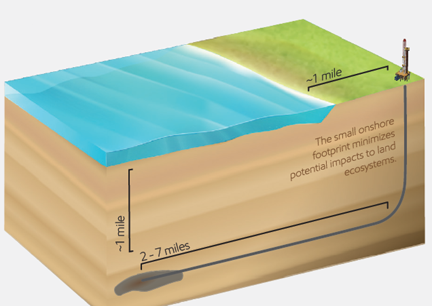

Figure 7. Illustration by EM of their extended reach well capabilities.

The other source that EM cite for increased production comes from OPEC and production gains in the Middle East. Given that Saudi Arabia have stated that 10 mbd is their intended upper limit to production (give or take a little) one presumes that the roughly 9 mbd gain is largely anticipated to come from Iraq. EM don’t actually say, nor did they last year, but it is interesting to end by comparing last year’s projection for future growth with the one shown in Figure 6.


Figure 8. The projected volumes for liquid supply growth as provided by ExxonMobil last year in their 2013 report.

On which cheerful note I wish you all the Compliments of the Season, and hopes that you have a safe and happy break.

Read more!

Monday, April 8, 2013

OGPSS - Shell looks to the future

Each year the larger oil production companies provide their views of the future, and I recently reviewed that for ExxonMobil. Shell has now produced their projections, though in a somewhat different format as the document “New Lens Scenarios” which deals with future projections as a set of differing options. That does not make these views less informative.

In reviewing where the world will go, Shell looks more to political impact as the future unrolls. They see the European Union stuck in a Trapped Transition” where:
the ‘can’ keeps being ‘kicked down the road’ while leaders struggle to create some political and social breathing space.
so there is continuing drift, punctuated by a series
of mini-crises, which will eventually culminate in either a reset involving the writing off of sign and political capital (through pooling for example) or the euro unravelling.
On the other hand countries such as China and Brazil are resilient:
in their different ways, they had the financial, social, political, or resource ‘capital’ to respond and reform, following a room to Manoeuvre pathway.
Within the next thirty years, as the population grows, so a greater percentage, up to 75%, will live in cities. And these will consume a greater fraction of the global energy supply, perhaps as high as 80%, up from the current 66%.

The document is very much slanted as a Socio-political forecast, with considerable polemic in regard to the weaknesses that the company perceives to exist in the West.

Shell postulate two different scenarios for the future. There is the Mountain scenario, where business continues very much as usual, and then there is an Oceans scenario where the” powers that are” work toward a more accommodative approach to those in the developing world, and the less fortunate layers of society.

The document begins with the impact if the Mountain scenario is to prevail, driven through a top down control, largely through existing institutions. Shell is not enamoured of this:
In the US, for example, income and wealth inequality continue to increase, with stagnating middle-class earnings, reduced social mobility, and an allegedly meritocratic higher education system, generously supported by tax exemptions, whose main beneficiaries are the children of the successful. superimposed on this class divide is an increasingly serious intergenerational divide, as commitments to the elderly via entitlement programmes crowd out discretionary expenditures that could rebuild economic and social infrastructure. Similarly, in Europe an ageing population and commitments to high levels of entitlement, which are frequently underfunded, create a mixture of social and political strains that deflect attention from the core structural economic issues facing the region.
Driven by this gloomy picture of the future Shell anticipate that global GDP growth through the 2030’s will average under 2%. This will, in turn, moderate the growth in energy demand. Increasing urbanization, the growth of the service sector and the greater use of electricity in developing countries, Shell anticipate that the strong correlation between economic and energy demand growth will be broken.


Figure 1. Shell projection of future energy supply, through 2060 under the Mountain scenario. (Shell)

N.B. All the illustrations come from the Shell New Lens Scenarios document.
Shell anticipates that hydrogen, an up and comer just a few years ago, and now largely neglected, will undergo a “phoenix-like” resurrection and find a market both in industrial and transportation as an alliance of government and private industry push a hydrogen infrastructure post-2020. They anticipate that the use of liquid fuels for passenger road transport will peak in 2035, and that by 2070 the global passenger transportation network, using roads, could be nearly oil-free, as hydrogen and electric powered vehicles take over.


Figure 2. Shell future projection of vehicular fuel sources.

The energy burden will transfer from crude oil to natural gas, which will increasingly underpin the global economies, as China joins the top tier of natural gas producers.


Figure 3. Sources of liquid fuels through 2060 (Shell)

The increase in the volumes of natural gas that become available from tight shales and coalbed sources are sufficient that, by 2035 Shell anticipates that natural gas will not only displace crude oil as the primary transportation fuel, but that it will also encourage a robust pretrochemical industry based on methane. Shell sees the possibility of US energy self-sufficiency in the 2030’s as peak oil theories are abandoned.

The availability and broad use of natural gas will also allow time for credible carbon capture and sequestration technology to be developed and demonstrated, so that by the time that coal is needed as a fuel (around 2075) it will be usable while sustaining the zero-carbon dioxide levels for electricity generation that become widespread by 2060.

In the alternative Oceans scenario, the more accommodative approach, Shell looks to a willingness to share technology and compromise on issues of ownership and profit as a way of encouraging globalization and developing productivity. Societal interconnectivity is encouraged by greater use of the Web, and this leads to significant changes, with existing leaderships yielding to allow a broadening of governance and significant reform. The greater spread of information and connectivity makes for the more fluid nature of geopolitics that names the scenario, as increasing populism is both a source of innovation and a challenge to stability. Populism is seen as a challenge to US dominance, and is considered likely to cause “destructive and violent reactions” as globalization progresses.

This progress is seen as most likely to through technological interconnection between entities that creates a new class of Mandarin who is less accountable to traditional masters. In this scenario Shell see the world increasingly run by more flexible, and decentralized governments “that have embraced radical pathways 
to economic sustainability”. And this includes both the United States and China. In this regard they quote the work of Anne-Marie Slaughter of Princeton on a New World Order.

This change from the current business-as-usual (BAU) model has an impact on fuel availability and use. The encouragement of entrepreneurship is seen to significantly increase the penetration of solar power into the energy mix, while sustaining the era in which crude oil contributes beyond that of the Mountains scenario.


Figure 4. Energy Sources under the Oceans scenario projected by Shell.

In comparison with the projections under the BAU natural gas is less of a player, though Shell don’t explain either where the additional oil will come from, or why the rush to invest in natural gas is turned off. They anticipate that the reliance on hydrocarbons will cause a rise in price that will open the door to new resources and technologies, particularly with solar power.

In this future Shell sees the developing world taking more of the energy pie, yet transitioning rapidly into a lighter industrial society, with a large service component. (One wonders where the necessary heavy industry goes, as it also transitions to become 80% more efficient?) Heat pumps become a widespread domestic unit, with their benefits in energy efficiency. And, in order to sustain their market share, internal combustion engines become increasingly efficient and technically advanced. While crude oil use will increase until the 2040’s, beyond that time the increased use of biofuels will allow liquid fuel dominance to continue in vehicular use. There are two main sources for these biofuels, first generation fuels, mainly sugar based ethanol, which will contribute some 4 mbd by 2050, and second generation biofuels from non-food crops which come to dominate beyond that time. As this transition occurs so traditional biomass use will disappear by the end of the century.

The different consequences of the two scenarios, as they impact fuel sources, and the unconventional nature of the Shell answers to “where will the resource come from” is shown in two plots that summarize the two energy futures.


Figure 5. Energy sources of the future, as seen by Shell under two different scenarios – Mountains and Oceans.

Under the BAU Mountain view the additional required energy will come in the natural gas side of the house, with Methane Hydrates being the major new source of fuel. With the competing Oceans scenario the energy comes from the development of kerogen from the oil shales of Colorado, Wyoming and Utah. By the end of the century renewable energy will supply more than half the electricity demand around the world, with solar carrying the greatest share of this. However they do not see the electricity generating industry becoming carbon neutral until the 2090’s, as CCS penetrates the industry.


Figure 6. Shell’s view of electricity power sources by 2100.

Shell foresee that the problems of energy storage (80% of the solar power in many OECD countries is generated in the summer) will be overcome through the use of electrolysis and the storage of the resulting hydrogen.

There is much to debate over the basis on which Shell have derived the scenarios that form this report. It remains more optimistic about the oil and gas futures that I can find a basis for accepting, but nevertheless it is well worth reading as it provides two views of what might come about. The impact of societal pressures and drivers produce two different energy futures, and while I suspect that reality will be quite different, with “unknown unknowns” having great influence, the effort is worthwhile.

Read more!

Friday, December 16, 2011

The 2012 Exxon Mobil view of the future

Each year the major oil companies publish their projections on fossil fuel supplies as they foresee them developing over future decades. Last year I reviewed those for BP; Exxon Mobil; and the projections from Shell. Exxon Mobil (EM) has just released their new set of projections. With this publication they have also stepped a little further into the future, looking to an end point in 2040, rather than the shorter 2030 time frame of last year’s report.

One of the immediately striking effects of the change in end date is the highlight on the growth of the global population. In last year’s document the global population was expected to reach 7.9 billion by 2030, now the projection is for the population to increase to nearly nine billion by 2040. We are at roughly 7 billion today, and the acceleration in the future growth rate of the population will make it more difficult to improve the average global lifestyle. This is particularly true when the locus of that growth is defined as coming largely from India and Africa.

Anticipated growth in population in various parts of the world (EM Outlook for Energy 2012)

More tellingly EM anticipates that the number of households will increase by 50% over the next 30 years, and with that growth comes the demand for electrical power. EM looks at both industrial and domestic energy demand growth, tying it in with this population growth, and expects that, while OECD GDP will more than double, it will do so with only a small amount of growth in energy demand, with the somewhat smaller growth in GDP in the rest of the world using a considerable amount more of the growth in energy demand that EM foresees. In countries such as China the increased demand for space and energy come as, with greater affluence, families will no longer remain crowded into multi-generational dwellings but will move more to single family occupancy.
(As an update and an illustration how two different folk can view the same document, you might find Gregor's post on the same topic of some interest).

Where the growth in demand will come from (EM Outlook for Energy 2012)

With the rising affluence of the developing countries, EM still continues to see continued improvements in energy efficiency lowering the overall average household demand for energy through the next three decades. It is an argument that I believe requires more justification than they provide. It is interesting, apropos my recent interest in Azerbaijan and Turkmenistan, that EM do not see much change in the fortunes of those who like around the Caspian Sea. It is perhaps a cynical, but realistic view of where that energy wealth will end up.

Change in domicile, and the energy demand for the average home (EM Outlook for Energy 2012)

The most important part of the Review however, since it deals with energy, is how EM decides where this future energy will come from. They see a large movement towards diesel in the transportation industry as hybrids and electric vehicles reduce gasoline demand, and increased fuel efficiency with lighter vehicles combine to stabilize the overall levels of gasoline required.

Change in the fuel mix needed for transportation.

Overall the amount of oil needed for transportation will continue to increase, overall by about 80%, and when this is combined with other needs, EM sees that global demand for oil will increase, by 2040 to around 110 mbd at a steady rate of increase overall from today, although the way in which the mix is put together is anticipated to change considerably. (And as an aside this projects less than a 1 mbd per year increase in demand, which falls below the levels which others, such as OPEC, foresee. OPEC anticipate a growth in demand of 1.1 mbd in 2012, according to the December MOMR).

Anticipated sources for oil through 2040 (EM Outlook for Energy 2012)

There are many features of interest in this summary chart. Given the decline rates that are now evident in conventional wells around the world, I do not see the discoveries being made that will justify the production levels that EM are predicting. The plot which is included, showing the production history from discoveries of different ages, is telling in this regard.

Production for well discoveries of a certain time (EM Outlook for Energy 2012)

EM notes that modern wells are more likely to be drilled with long laterals, rather than the simple vertical or slightly deviated wells of little more than a decade ago. But these new wells carry with them a much higher decline rate at the end of their lives than do the conventional wells (often more than double). Thus, as production declines from the older wells, so reliance must pass to new-found deposits, and that particular reserve is, as the above graph shows, somewhat thinner than volumes from the past, which are now starting to decline.

The savior of the next decades is foreseen to be the offshore Deepwater deposits, and certainly as one looks along the shores of Africa, South America and the Gulf of Mexico, to name but three, there is a considerable potential for some gain. Whether it will provide the sustained volumes needed to balance other declines and also produce enough to match increased demand is going to be a continuing question. With that in mind it is worth revisiting last year’s review to see where EM expect this Deepwater oil to come from.

Deepwater oil production (EM Outlook for Energy 2011)

As befitting an oil and gas company, perhaps, EM expects that oil production will remain a major part of the energy mix through 2040, with natural gas rising to carry an increasing burden of the overall picture at the expense of coal, and biomass whose shares of the global market are expected to decline starting somewhere about now.

Change in natural gas demand over the next 30 years. (EM Outlook for Energy 2012)

Composition of the fuel mix according to EM over the decades

Even though they project that coal will still be the cheapest fuel to buy and while solar will remain a luxury item, nevertheless EM anticipate that coal’s share of the electricity generating market will fall to less than 30% by 2040, and to less than 20% of the overall energy supply. This remains consistent with their opinions from last year. However they are now projecting a larger role for oil than they expected last year (when it was around 26% of total supply by 2030 and falling).

Read more!

Thursday, March 31, 2011

President Obama's Blueprint for Energy, the world situation and the current TWIP

On Wednesday President Obama used a visit to Georgetown University to draw attention to a new Blueprint for a Secure Energy Future. The document provides that path through three mechanisms:

a) To develop and Secure America’s Energy Supplies by:
Expanding Safe and Responsible Domestic Oil and Gas Development and Production
Leading the World Toward Safer, Cleaner, and More Secure Energy Supplies

b) To Provide Consumers with Choices to Reduce Costs and Save Energy by:
Reducing Consumer Costs at the Pump with More Efficient Cars and Trucks
Cutting Energy Bills with More Efficient Homes and Buildings

c) Innovating Our Way to a Clean Energy Future by:
Harnessing America’s Clean Energy Potential
Winning the future through Clean Energy Research and Development
Leading by Example:
The Federal Government and Clean Energy.

The problem that I have had with the Administration’s Energy Policy since it first came to power is that it lacks an understanding of the time element in proposing answers. And let me put up a graph from the latest This Week in Petroleum to explain why I feel that this concern is now strengthened.

As I mentioned in my comment on Dr Saleri’s remarks that oil production bounced back after the revolution in Iraq, the TWIP has put up a plot showing how neither Iran, Iraq nor Venezuela have recovered the levels of oil production that existed in country before they had problems. Only Kuwait, after two years, was able to bounce back.

The drop in production from countries following conflict (EIA TWIP )

In all cases the flow of oil was disrupted for more than a year. Consider the current situation where, with supply and demand more closely now in balance, we have the risk of more than 2 mbd of oil disappearing from the world market for a couple of years. With a concomitant rise in demand of 1.4 mbd this year that means we need NOW to find ways of addressing the coming shortfall – not in 2020, but in 2011.

In that regard, how does the President’s new Blueprint stack up? Let’s go through the three different parts that I outlined above, in turn.

a) Developing and Securing America’s Energy Supplies.
The first part of this deals with increasing domestic oil and gas production, and the blueprint notes that the United States was importing 11 mbd when the Administration took office. President Obama, in introducing the plan, pledged that this volume will be cut be a third by 2020. One of the ways of doing this is to increase domestic production, and the blueprint contains this plot:


It looks a little more impressive than it is, because of the vertical scale, which in total is less than 1 mbd, and this makes the recovery of about 0.56 mbd look more significant than it is. Remember that the promise is that imports will fall by around 3.7 mbd and the gain in domestic production is tapering off in the plot above.

The most likely production gains will be achieved from the deep waters of the Gulf of Mexico (GOM). This is recognized in the document, which notes that while on-shore production from public lands increased from 109 million barrels in 2009, to 114 million barrels in 2010, that from the Outer Continental Shelf went from 446 million barrels to 600 million barrels. Yet with the problems that the industry has seen with the Deepwater Horizon disaster last year, the reduced production over that anticipated from the Thunder Horse platform and the slowed permitting and likely new drilling schedules it will be difficult to see how industry can maintain current production, let alone much increase it. However the Administration is currently developing a longer-term plan:
the Administration is developing a 5-year (2012-2017) comprehensive plan for offshore oil and gas exploration and production, which will ensure that areas with active leases, including the Gulf of Mexico and Alaska, are considered for further leasing and development. The strategy also calls for conducting studies to assess the potential oil and gas resources available in the Mid - and South Atlantic.
Sadly plans, in and of themselves, will not produce any additional oil. The President spoke of the importance of imports from Mexico and Canada. Unfortunately Mexican production continues to decline, and imports from there were down to 1.2 mbd in February. It would be helpful if resolutions in the American House of Representatives led to increased Canadian production but with Canada now heading for new elections that isn’t likely to happen in the short-term either. And Exxon Mobil, inter alia, has already responded to explain why there may a considerable gap between the President’s implication of vast untapped leases waiting to be made productive if industry would only get busy, and reality.

The Blueprint rightly draws attention to the “vast reserves of natural gas” and the potential that they hold, but much of the rhetoric in the blueprint is directed at the investigation of hydrofracking and ensuring that it is carried out “in a safe and responsible manner,” as though the thousands of wells that have used this technique already were not. The meetings and studies proposed will not, in reality, contribute much in the way of new gas to the nations need. Production is likely to be more tied to the price that can be obtained for the gas delivered to a pipeline, in contrast with the price for LNG delivered to the same pipeline from foreign sources. And at the moment, with the world having a surplus of NG, and more countries seeking to get onto this bandwagon, it is unlikely that the shale gas operators will be able to recover the full price of production in the next year or so from sufficient new production to have that much impact.

And so we turn toward the plan for the USA to lead the world towards safer and more secure energy supplies. Part of that answer seems to be based on persuading the BRICS nations not to grow their demand for oil so fast. It is also encouraging them, where possible, to switch from burning oil for power generation to using natural gas. (As though the price differential in itself won’t be a more powerful argument). The Administration is however encouraging the collection and use of methane from agriculture, landfills and wastewater, as well as the more usual sources.

The Blueprint notes that the United States would work as an energy partner to safely develop the oil and gas reserves in the pre-salt prospects off Brazil, though I suspect that US participation is not going to change the current progress and production in those parts. Further, in working to make bio-energy sustainable:
The Global Bioenergy Partnership will soon be launching a capacity building initiative in West Africa to encourage the transition away from the traditional use of biomass through effective forest management, to improve agricultural production, and to help countries capture the benefits that sustainable modern bioenergy can provide for energy access and food security.
While more energy for Africa is certainly needed, I am not, myself, convinced that those nations will not, instead, get the majority of their new energy from the indigenous coal supplies that seem to be plentiful. (In light of current developments in Japan, the encouragement of nuclear power was more euphemistic than usual). But while the blueprint also talks of transitioning fleets to natural gas and hybrid-diesel – though the EU is less than enthused about diesel emissions – none of this is going to have much impact other than to hope that by persuading other folk to buy less, the price won’t be as high as it otherwise might be.

b) To Provide Consumers with Choices to Reduce Costs and Save Energy
So how is the consumer to be helped? Well both by making more efficient vehicles available, and by producing more biofuel production. The goal remains one of getting a million “advanced technology” vehicles by 2015 and of increasing biofuel production. There is a slight snag, hidden in the report, however.
In 2009, the U.S. had only two factories manufacturing advanced vehicle batteries that power advanced technology vehicles and produced less than two percent of the world’s advanced batteries. But over the next few years, the United States will be able to produce enough batteries and components to support 500,000 plug-in and hybrid vehicles and will have the capacity to produce 40 percent of the world’s advanced batteries (2015). In part because of these strategic Recovery Act investments, battery costs are expected to drop by half (2009-2013).
The rest of the world had better not want too many of those advanced vehicles, since there will only be a few more than a million batteries produced by 2015. The Federal Government will begin buying plug-in hybrids this year, although only a hundred at first, and this will be one place where growth may reduce oil demand, although it is questionable whether the number on the road will be sufficient to perceptibly change the gasoline demand from the nation in the next nine years. But while the volume of fluid might increase, by increasing the percentage of ethanol in the mix to 15% (now allowed) some reduction in oil volumes might be achieved. However the source of the additional volumes is left as:
DOE and USDA have provided grants, loans and loan guarantees to spur American ingenuity for the next generation of biofuels.
Unfortunately as the experience with Range Fuels has shown, such hopes are no promise of success, and without an almost immediate success it is difficult to get to sufficient production by 2020 to have any significant impact on American supply. There is little evidence that the cellulosic ethanol process can be brought up to the needed level by then, and there are few alternative processes that can promise a significant contribution. Yet the government remains optimistic that
the Administration has set a goal of breaking ground on at lest four commercial-scale cellulosic or advanced bio-refineries over the next two years. In addition, the President has challenged his Secretaries of Agriculture, Energy and the Navy to investigate how they can work together to speed the development of “drop-in” biofuel substitutes for diesel and jet fuel.
One of the more promising sources is camelina but it has a limited growing range in the United States, and is not proving popular on the US farm, though it is now to be test grown by Airbus in Romania. (I am precluded from talking about algae).

In addition there are optimistic discussions about changing the way in which people travel, and the introduction of high-speed rail. Unfortunately the willingness of Republican Governors to shoot these plans down, no matter how well intentioned, makes much progress in this area unlikely.

The Blueprint goes on to talk about improving energy efficiency in buildings and through use of renewable energy. However the major fuel sources for electric power are coal and natural gas, so that changes here will likely have little impact on the amount of oil imported. Thus, even though the projections for the near term look promising for renewables, their overall effects on American consumption is likely to have little significance for some considerable time.


c) Innovating Our Way to a Clean Energy Future
The President proposes to eliminate fossil fuel subsidies, taking that money to help fund more research into developing clean energy innovation. Beyond that the clean energy future is concerned more with finding ways of saving energy, and particularly electrical energy than it is on reducing the need by the United States to import oil.

Given that we are likely to need as much fossil fuel as we can get over the next three or four years, as conventional supply tightens under the problems of MENA popular protest and government change, I continue to believe that the Administration, at the top, does not understand the problem.

We do not have the decades that Secretary Chu’s favored bugs will need to produce enough jet fuel at scale to meet a significant part of demand. I agree that we have to press forward to find long-term solutions to the coming shortages of oil, and then natural gas – but ignoring the reality of the precariousness of the current balance between supply and demand is becoming increasingly worrisome.

In short the Blueprint has really shown nothing new, or much learned from the experiences of the past year, which is sad, given that time is starting to run out rather fast.

Read more!

Tuesday, February 15, 2011

The Shell future - a look at their new projections

I have recently reviewed the predictions made by BP and ExxonMobil as they relate to energy supply and demand in the years to 2030. Shell has just updated their predictions, which extend further out to 2050. In the opening discussion they make the point that new technologies will require, in their words significant time to develop.
New energy technologies must be demonstrated at commercial scale and require thirty years of sustained double-digit growth to build industrial capacity and grow sufficiently to feature at even 1-2% of the energy system.
Thus much of the focus of the report deals with existing fossil fuel capabilities. Specific new factors that have led to the modification of earlier predictions include the greater instability of the global economy; the growth of uncertainty over regulatory steps that will be taken both to address the concerns over climate change, and in light of the Macondo well disaster; the improved supply potential for natural gas both from shales and coal bed methane supplies; and the emergence of a re-invigorated Iraqi energy industry with a potential to develop significant new resources.

Shell has, in the past, developed two different energy scenarios – the first of which it calls Scramble, where the world moves along a Business As Usual (BUA) scenario, only making changes as these become forced upon governments and companies by the impact of changing circumstance. The second is called Blueprint, a scenario that Shell is now announcing it will advocate, where instead of the reactive approach of Scramble, a set of plans is developed to pro-actively address the issues of carbon dioxide generation, and to ensure the world has adequate energy.

The difference between the two approaches was illustrated in the initial document by the predicted sources of energy through the years to 2050. By putting these one after the other, it is possible to compare how supply changes in their two scenarios.

1. Energy supply scenarios for the future – Shell Scramble scenario

2. Energy supply scenarios for the future – Shell Blueprint scenario

One significant change between the two, apart from the lowever absolute level in the lower case, is the smaller role that biofuels play in the more distant out years. For example in the Scramble scenario they are given a much greater role in that future.

Change in biofuel energy production in the Shell Scramble scenario.

In their new set of projections Shell has more forcefully adopted the Blueprint route, and has produced an amended projection of future energy sources through 2030 that makes it easier to compare with the ExxonMobil and BP plots that I have posted in the past.

Comparison of BP and EM energy futures, (The vertical scale is in billions of tons of oil equivalent. )

However, each company having their own set of units, the conversion needed to compare with the earlier plots is that an ExaJoule (EJ) is about equivalent to a Quadrillion Btu (Quad), and a billion tons of oil is the equivalent of 41.9 EJ.

Shell energy sources for the future. Dividing the vertical scale by that 41.9 gives an equivalent full scale value of 19 billion tons of oil equivalent, not that much different from the two other plots above it.

Two things are evident from this plot, one being the increased role that Shell see natural gas playing over the next 20 years, and the other the decrease in the likelihood of biofuels being more of a significant player in that time frame.

The sources for these levels of production are left quite vague in the Shell document. Only the promise of increased production from Iraq – seeming to accept the more optimistic projections of the Iraqi government – is given as a justification for seeing sensibly no decline in overall oil production levels to 2030. However since Shell is a part of some of the new deals which that Government has struck perhaps there are reasons for this optimism. For those who forget:
Officials say the deals will boost Iraq's oil-producing capacity to around 12 million barrels a day by 2017, putting it on a par with Saudi Arabia. That, said Mr. Birol, "may be a challenge to the other oil producers."
Um! Yes!

Shell devote much more of their projection document to the impact of climate change regulation and response than do the other projections. One item that caught my attention was their comment on water needs.
Energy producers are amongst the largest industrial consumers of freshwater. The link between energy production and water will intensify as portfolio choices move increasingly towards more water-intensive production methods such as biofuels and enhanced hydrocarbon recovery methods (EOR). In the US alone, where energy currently accounts for 40% of all freshwater consumption, projected growth in energy production will require an increase of 165% in freshwater withdrawal by 2025.
Shell also tabulated, against their projections, past growth rates for different sectors of the energy supply scenario.


To sustain growth, and to change, for example, current coal burning practice to a total carbon capture and storage (CCS) system for coal use globally by 2050 will require considerable investment and continued research and development, and similar levels of continued development will be required to develop all the sources needed to meet demand needs over the next forty years. It will also require a smarter power distribution system.
Sometime between 2020 and 2030, we can expect the constraining factor for renewables deployment to move from industrial capacity building to accommodation within the energy system. This would impact land-use and require new infrastructure, such as major upgrades to grids 8, 9. These are essential for renewables to maximise their share of the energy mix.
The new report closes by citing some of the factors that might indicate that the world is following a Scramble path, and others that it might be moving toward to Blueprint option.

It will be interesting to see which one turns out, in the end, to be closer to reality. But there are plots in this document that show peak oil occurs around 2020.

Read more!