Showing posts with label Berri. Show all posts
Sunday, July 6, 2014
Tech Talk - of longer wells and drawdown pressure
There are, simply, three major parts to the coming global economic mess that will be created as we enter into the period of Peak Oil. The first of these comes from the current rising demand for oil, particularly emphasized by those countries, such as China and India, where demand is rising fastest. The second part is the declining production from existing fields as their reserves are drawn down. (Though it should be remembered that even when “exhausted” the fields will still contain vast quantities of oil, but oil which is at present not economically recoverable). And finally there is the oil in the undeveloped, and undiscovered wells and fields that can be added to the existing reserve to help ameliorate the imbalance between demand and supply from existing wells.
The high decline rates from long horizontal wells drilled into, and along the shale deposits in the United States, most particularly the Bakken and the Eagle Ford, mean that there is a constant need to drill new wells to sustain existing production. The EIA has taken note of this and calculated based on some assumptions, the number of rigs that must be operating in these fields, so that they will drill enough new wells to sustain current production.
Figure 1. The number of rigs required in the Bakken and Eagle Ford formations to sustain production at the level of the previous month (EIA).
Should the need be to increase production (which is the current assumption by most prognosticators of future equilibrium between demand and supply) then these numbers need to be significantly higher, perhaps by as many as 50 additional rigs. At present the Bakken rig count is running at around 176 rigs while there are around 270 rigs drilling in the Eagle Ford.
One of the ways in which production is anticipated to expand above earlier estimates for the wells drilled in both fields comes from the ability to drill longer horizontal wells and to increase the fracture density along these wells.
However, as the Kingdom of Saudi Arabia discovered some years ago, longer wells can only be viably effective out to a certain distance, beyond which there is no gain in productivity. As a result they have changed their drilling patterns so that the wells are shorter, with multiple laterals spreading from the original wells to more thoroughly cover the rock within the formation. Initially wells were drilled out to distances of up to 12 km, but over time the KSA found that this was too long.
Since there is a somewhat similar argument to be made for the wells in the United States, as they move to longer distances, I thought I would go over the explanation as to why this is not a very productive idea a second time.
To begin consider that regardless of whether I put a tiny glass of water or a huge glass of soda in front of you, if I glue it to the table then the amount that you can drink at one time becomes limited by the size of the straw that I give you to drink the liquid, rather than the amount in the container. And to get that liquid into the straw and up into your mouth requires that you suck on the straw.
What you are doing is reducing the pressure at the bottom of the straw, while the pressure from the atmosphere on the top of the liquid remains the same. By creating this differential pressure there is now a force to move the liquid into the straw and thence up into your mouth.
But, as Fishbuch et al showed, as the horizontal well bore gets longer the pressure at the back of the hole declines as then does the difference in pressure between the oil in the rock and the well (the drawdown pressure), and while the longer hole gives an overall increase in production to a certain point this seems to maximize at a length of around 6,000 ft. Beyond that distance the differential pressure between the formation and the well falls to a point where there is less benefit to the additional cost of drilling to that distance.
Figure 2. Drop in well pressure with increased well length, while increasing overall oil flow (Simulation by Fishbuch et al )
The answer which Aramco came up with to get around this problem was to use a main lateral from which a number of shorter laterals could then be drilled out into the formation, providing higher drawdown pressures within the wells and making it also easier to isolate any well section where the underlying water broke through into the well.
Figure 3. Schematic of a Maximum Reservoir Contact well as used in Saudi Arabia (Aramco).
The optimum length at which a well can produce is a function of the rock type and structure as well as the nature of the oil/natural gas that it contains and the water content (to name by a few of the parameters). Thus there are limits to the analogy, nevertheless it does show, even in the much more productive rocks of the fields in KSA that there are limits to how far a well can be productively driven, and these limits will also exist in the shales of the United States, although the oil locations and the optimal ways of extracting it are somewhat different.
The extraction of oil and natural gas in these shales is more sensitive to the levels of drawdown pressure, since much of the oil and gas is found in natural fractures that are not that wide (although they may be spread further apart by the fracking process itself). With exposure to the lower well pressure thus being restricted to a relatively small volume, significant reduction in the pressure because of the location relative to the heel of the well can have significant effects on lowering the overall well production.
Further as a general rule the complex valve systems used in KSA are not installed in the shale wells of the United States, making it less practical to focus the relative pressure differentials at different points along the well bore as a means of increasing production sequentially along the well.
Read more!
Sunday, September 1, 2013
Tech Talk - the difference between fracking and acidizing a well
It turns out that in the end I wrote some 929 posts on The Oil Drum, over the course of its eight-year life, 92 of them in the past two years. The posts covered the gamut from how coal mines work, to some of the innovative work being done in Saudi Arabia to extend the life of their reservoirs - sometimes straying a little from a tight focus on fossil fuel extraction but rarely for long. As I noted in last week’s post (which ran a week later on The Oil Drum as my swan song there) the audience that the site brought far exceeded any that I had during the totality of the students that sat in my classes over 40-years of teaching (a number in the low thousands).
My hope in writing was to provide a little background to some of the stories that made the news and to put some of the developments in context, so that readers might better understand. One of the most useful sources for this was always Leanan’s Drumbeat, and as this now too fades into an archive, let me pick an example from the penultimate Drumbeat as the basis for this week’s post.
The story comes from the San Francisco Chronicle and runs under the headline “Acidizing could rival fracking in Monterey Shale.” The prĂ©cis for the story reads as follows:
The process of fracking a well has been well discussed in the past couple of years as the success of the technique has helped make oil and gas deposits found in shale deposits more profitable and viably productive. During the time that I was writing posts on the technology of oil and gas well development, there was one post that dealt with fracking specifically. It was followed by a post last year in which acidizing was covered as part of the work that Saudi Aramco were using to improve the production from the Berri and Ghawar oilfields.
Since these posts are now a little old and separate let me repost just a couple of relevant bits, in part to explain that neither process is quite as dramatic as it was made out to be in the SF Chron article.
The description of acidizing is as follows:
But I’ll write more on this, and with relevance to the Monterey Shale, next time.
My hope in writing was to provide a little background to some of the stories that made the news and to put some of the developments in context, so that readers might better understand. One of the most useful sources for this was always Leanan’s Drumbeat, and as this now too fades into an archive, let me pick an example from the penultimate Drumbeat as the basis for this week’s post.
The story comes from the San Francisco Chronicle and runs under the headline “Acidizing could rival fracking in Monterey Shale.” The prĂ©cis for the story reads as follows:
Fracking hasn’t unleashed an oil production boom in California, at least not yet. Could acid?There are two parts to this story that are worthy of comment. The first is to discuss the comparison between acidizing and fracking a well, while the second is the potential for an expansion of production from the Monterey Shale. (But I will cover that later topic in the next Tech Talk).
Companies trying to pry oil from a vast shale formation beneath Central California have been pumping powerful acids underground to dissolve the rock and free the petroleum within.
And there are hints that the process, known as “acidizing” a well, may work better than hydraulic fracturing in California’s Monterey Shale, estimated to hold 15.4 billion barrels of oil.
The process of fracking a well has been well discussed in the past couple of years as the success of the technique has helped make oil and gas deposits found in shale deposits more profitable and viably productive. During the time that I was writing posts on the technology of oil and gas well development, there was one post that dealt with fracking specifically. It was followed by a post last year in which acidizing was covered as part of the work that Saudi Aramco were using to improve the production from the Berri and Ghawar oilfields.
Since these posts are now a little old and separate let me repost just a couple of relevant bits, in part to explain that neither process is quite as dramatic as it was made out to be in the SF Chron article.
You may note that, as part of the process for preparing the well for fracturing, the well bore is first cleaned by acidizing the bore to dissolve the fine materials left along the wall and in the nearby cracks and joints of the rock, before the well is pressurized.
Figure 1. Crack growing out from a drilled hole in Plexiglas, the small notch at the top of the hole controlled the direction of the growth of the crack (We put ink in the hole to show how the fluid goes into the crack).
In the above picture you can see that when the hole was pressurized, a crack grew, and ink flowed into the crack, as it formed, but, when the pressure came off, the crack closed and most of the ink was forced back out of the crack. (We created the pressure by firing an air rifle pellet into the hole).
So if we are going to have a useful crack we need to have it open after we take the pressure back off – after all we need to get the fluid back out of the well, so that the gas can pass up the well for collection.
Now it is not quite as easy to grow the crack, or prop it open as I may have suggested earlier, and to explain some of the issues in a little more detail I am going to use an example and some details from the Modern Shale Gas Primer .
When you decide to frac the well, and each well is different, as is just about every location, so there is a significant amount of preparation and knowledge required to work out the procedure required at that particular point. Bear in mind that the crack that you are going to have to grow needs to stay in the shale layer, and not go out beyond it into the surrounding rock. One of the reasons for this is, apart from giving the gas a path to the well, if it goes outside the reservoir rock then the gas can escape, or, alternately, other fluids can gain access to the well. This is particularly true of the Barnett where the rock immediately below it, the Ellenberger limestones, can hold a lot of water that can muck up the gas recovery if it gets into the fractures. (Given this degree of control and the large distance below the ground to the reservoir rock, this is why a lot of the fears that the frac job will damage the ground water tend to be dramatically overstated).
In the example cited, which is from the Marcellus shale, the treatment of the frac takes a total of 18 steps, and because some of these are fairly similar I am going to go through them in groups. First the hole is treated with an acid, to clean away any remaining debris and mud from the drilling operation and to clean any fractures around the hole, so that they can be used to help the frac grow. After the acid the hole is filled with an initial polymeric fluid, largely water, but containing the “Banana Water” that I referred to in an earlier post. This is a friction reducing agent and will help carry the particles used to hold the crack open into the crack in the first place. The problem with that polymer is that some of the choices available, while good at reducing the friction to help move the particles, aren’t that good at holding the particles in suspension, and the last thing we need is for them to settle out in the bottom of the well, and so in the subsequent steps in the process as the particles (or proppants) are added, there is usually a second polymer in the mix to hold them in suspension.
Once the hole is full of the slickwater (the official term for the first polymer solution) the initial frac is made with a fine sand suspended in the fluid. To keep the crack open all along its length we need sand along the path and the crack gets narrower as it grows deeper. So for the first several stages of the crack growth the fluid is filled with successively greater concentrations of the fine sand, so that, in this way, it can penetrate to the deepest part of the fracture.
In the example cited there are some seven of these sub-stages with the fluid being pumped into the well at some 3,000 gpm but varying the fluid:proppant density to carry more and more of the particles into the fracture. Once these stages have been completed, then the job is finished by pumping an additional eight sub-stages of fluid, with this second set containing a larger size of proppant particles. In this way the area closest to the mouth of the fracture will be held wider apart to make it easier for the gas to escape. As with the first set of sub-stages, the concentration of proppant in the fluid increases as the stages progress. In total, in the example given, some 450,000 lb of proppant was used to make the fracture, together with some 578,000 gallons of water.
Once the fracture is created, then the well is flushed to clean out the different fluids, and make it easier for the gas to get out out of the rock and into the well. (It also removes any loose and ineffective proppant so that it doesn’t later become a nuisance). If you think that this would need a lot of equipment you are right!
Figure 2. Equipment used for hydraulic fracturing a well (Primer)
The description of acidizing is as follows:
The problem of scale is also that, in the pumping of fluids into the reservoirs, and the flow of oil out, the quantities that are dealt with are significantly larger than in most other countries. Flow levels are required to reach over 10,000 bd, both in oil recovery, and in the relatively precise location of water injection to sustain reservoir pressures. This led Aramco to adopt horizontal well technology, not only for the recovery of oil, but also in the injection wells that are used to inject the seawater.Hopefully this should show that there is quite a bit of difference in the techniques and in their purpose down-hole. And while acidizing has some potential for opening existing cracks and passages in a rock it depends on the rock type as to which acid might work best, and how successful it might be.
Horizontal wells in carbonate are prone to well damage around the borehole, due to the drilling process, and this initially limits the flow of fluid through this annulus, or requires a higher driving pressure to inject the water into the formation. In one example it took an injection pressure of 2,350 psi to drive 13,000 bd through an exposed horizontal open hole section some 8,900 ft long. In order to improve the performance of the well it was to be treated with an acid bath to not only remove damaged sections of the wall, but also to eat wormholes into the formation. Where the wells are draining gas it is not that difficult to bullhead the acid into the well where the acid is injected and allowed to fill the well for a couple of hours before being removed. This can be successful in wells where the use of coiled tubing (CT) is limited and flow rates would otherwise not be as high as needed for an effective cleaning. But it requires considerable volumes of acid, and in filling the entire open hole, there is the risk of differential attack along the walls, providing an undesired result. The alternative was to use the smaller diameter of a coiled tubing rig and feed this first to the back of the hole and then inject acid as the coiled tubing was pulling out of hole (POOH). However it is sometimes a little difficult to feed the smaller pipe down the open hole all the way to the back, and the diameter limits the rate at which acid could be injected. Thus there was a debate as to which method would be the best to use.
Aramco have used two ways to get around this problem. The first was to use a down-hole tractor to overcome the frictional forces which were otherwise stalling the placement of the CT by overwhelming the driving force before the tool could reach the back of the hole. The tractor has a small series of wheels that are recessed within the tool while it is fed down the well to the point where it is deployed.Figure 3. Down-hole coiled tubing tractor (Welltec )
When the CT Well Tractor is initially powered up, the wheel sections are hydraulically extended out of the tool body and activated automatically. Each wheel contains its own independent hydraulic motor, which drives the wheels and provides the forward motion of the CT Well Tractor. . . . . . The modular structure of the drive sections makes it possible to change the traction by reducing or increasing the number of wheels needed to drive the toolstring. The CT Well Tractor 318 can provide a pull of 3,500 lbs, which doubles in tandem configuration. This can further be increased to 10,000 lbs by stacking three CT Well Tractors.
The first major test of this was in the 8,900 horizontal section water injection well I referred to above. That section of the well was divided into 16 sections each of which was treated as follows:
1. First, the treatment interval has to be washed with plain 20 wt% HCl for filter-cake clean up and provide initial wormholes. The main additives to the plain acid are a corrosion inhibitor, surfactant, and friction reducer. Plain acid was used at 10 gal/ft, including additives, resulting in a total acid volume of 77,000 gallons.
2. Plain acid was followed by 20 wt% diesel emulsified acid at 20 gal/ft with a total of 154,000 gallons for the 16 treatment stages. The higher concentration of retarded acid is meant to provide deeper wormholes.
3. To achieve better acid diversion at the end of each pumping stage, viscoelastic surfactant-based (VES) water will be used at 10 gal/ft at a total volume of 7,500 gallons.
4. Finally, water over-flush of 10,000 gallons is to be pumped following the previous 16 treatment stages to break micelles formed by VES. The over-flush contained brine water mixed with 3 vol% of mutual solvent.
The total treatment fluid to be injected in this job is 248,500 gallons; this large acid job is considered one of the biggest stimulation jobs for any well in the Ghawar field.
There were a couple of glitches with running the tool, in that the well had washouts that it took a “flying leap” for the tractor to get past and it was not able to reach the last 3,000 ft of the well, which was bullheaded. Nevertheless after the treatment the flow injection rate for the well was increased from 13,000 barrels of water per day (BWPD) to 28,000 BWPD.
In a consequent test in a multilateral water injection well some 362,700 gallons of treatment fluid were used to acidize a dual lateral horizontal water injection well with a total horizontal interval of 10,335 feet. Prior to the treatment the well required an injection pressure of 2,100 psi to inject 15,000 BWPD into the formation. After the treatment the two laterals were able to inject 30,000 BWPD at 700 psi driving pressure, and at 2,100 psi the wells became capable of deliving 80,000 BWPD. This saved the cost of adding two additional wells in the neighborhood.
But I’ll write more on this, and with relevance to the Monterey Shale, next time.
Read more!
Wednesday, April 18, 2012
OGPSS - Enhancing production at Berri
In the last post I discussed how changing technologies were improving the recovery of the final significant volumes of oil from Abqaiq. New technologies have also brought additional life to the Berri field, which lies north of Abqaiq, along the coast. Berri is/was the 22nd largest oil field in the world.
Figure 1. Location of the Berri oilfield. (JoulesBurn at The Oil Drum )
In the past Rembrandt has quoted the late Matt Simmons” “Twighlight in the Desert”, on the origins of the field and its future. The field was discovered in 1964, and the first wells to find the location of the producing reservoirs were drilled in 1967. The original estimate of the size of the reserves was made in 1978, at 8.3 billion barrels. In an earlier paper Matt had plotted the production from the field and showed that it peaked in 1976, at 800,000 bd, when water flooding under the reservoir was introduced to maintain reservoir pressure.
Figure 2. Early production from Berri (Matt Simmons)
This production came, however, from the Hanifa, Hadriya and Fadhili reservoirs since, at the time, the Arab horizons (A, B and C) had not been productive in this region, which has eight Jurassic age reservoirs. Since then, however, the Arab D horizon has been developed and is now in production. That reservoir is anticipated to contribute 25% to overall field production and to be able to sustain a relatively steady production of around 85 kbd (giving a total estimated production of around 350 kbd) for ten years, after which the reservoir will see a rapid decline in production.
Figure 3. Future estimates of production from the Arab D horizon at Berri (Jokhio et al)
One of the problems that arise when long-hole horizontal wells are used to drain a reservoir comes from the need to maintain a pressure differential between the well and the surrounding rock , so that oil will continue to flow into the well over time. Up to a certain point, the longer the well the greater the production, but beyond that point, as the drawdown pressure differential falls so production will also halt in the more distant part of the well.
Figure 4. Pressure drop and production with increasing horizontal well length (after Fischbuch et al ) (To fit the curves on one plot there is no scale on the vertical axis, but the production increased from 29 to 50 bpd/psi with the increase in length, and pressure values are discussed within the post).
In addition the geological factors in the upper reaches of reservoirs that are now smaller than when these fields were initially developed, means that the horizontal sections are often limited to around 4,000 ft in length. Nevertheless this length can still initially produce up to 4,000 bd per well. In the case of the Berri wells in the Arab D, the optimal length of each horizontal section was found to be 3,000 ft, based on geology. Further this requires that a ratio of 1.2 barrels of water be injected, for every barrel of oil removed to achieve the pressures needed.
As I noted last time, and as the above plot shows, as horizontal wells get longer it becomes more difficult to sustain that pressure differential at the back of the well, which may fall to the point that there is little additional production in the rear sections. Thus greater production can be achieved from a series of shorter laterals around the well, rather than from a single, longer well. Thus it is at Berri, where the new wells have been drilled to give Maximum Reservoir Contract (MCR) by using shorter laterals, rather than single longer wells that reach further into the formation. (However, because of the geology, these are driven as separate sidetracks from the main well, rather than as laterals from a single main horizontal well).
Figure 5. Structure map showing the well layout at Berri (Jokhio et al )
There is an additional snag that arises, because of the pressure drop problem, and that is that Aramco are using valving systems to isolate individual segments of the well. This is done to protect the rest of the well from premature water breakthrough in any one section, but each of those valves also creates a resistance that diminishes the available pressure drop beyond the valve. As a result only a limited number of valves can be used in a well, and this in turn limits the number of divisions that the well can be broken into. This is a particular problem for the Arab D reservoir since, as I noted in an earlier post, this carbonate is permeated with thin, high permeability paths that can, if not isolated or treated, lead to premature watering out of the wells. (One such horizon has been identified at Berri near the top of the field and was cased to isolate it from the well).
Seven production wells were initially drilled into the reservoir in developing the Arab D, but modeling of the reservoir suggested that the wells would rapidly fall in production, due to the inability to sustain production pressure, even with perimeter water flooding. There have been two solutions proposed for this, both of which involve the use of down-hole electric submersible pumps (ESPs). The first was to install these in the wells, to help with pumping out the oil, while the more recent study has been to see if using these pumps to increase water flow into the reservoir can help sustain production.
Figure 6. Components of a down-hole electric submersible pump (Aramco )
While the hope with the water injection pumps are that they will be able to draw water from overlying underground water reservoirs and use these as a water source, nevertheless in 2009 Aramco laid new pipes to carry more water to Berri and to remove the oil that it helped produce. (The new injection well array requires some 10,000 – 12,000 bd of water injection.)
Calculations had shown that a drop of 300 psi within a well would be sufficient to drop oil inflow to zero and that this would occur within two years of bringing the reservoir on line. ESPs were therefore installed in each of the seven wells, and when brought on line were able to sustain production at a level of 70 kbd, which was above the anticipated value.
The more recent work to install an inverted down-hole ESP to draw water from the Wasia aquifer and inject it into the Arab D has been in service since December 2008, and has shown an improvement in the pressure in adjacent wells.
Figure 7. Location of the sub-surface ESP injection well (Jokhio et al )
Figure 8. Location of the monitoring wells for the water injection (Shinaiber et al )
Figure 9. Monitoring well response to the use of a down-hole ESP ( Shinaiber et al)
This improvement in technology may well provide, as it allows production from reservoirs otherwise un-developable, some answer to the questions that, for example, Jud has raised over the long-term viability of the field.
While the development of the Arab D does give a boost to the production at Berri, it should be remembered that this post has only discussed how “new” reservoir development has, for the next decade, provided for 25% of Berri production, and does not address the production from the main reservoirs of the field.
Figure 1. Location of the Berri oilfield. (JoulesBurn at The Oil Drum ) In the past Rembrandt has quoted the late Matt Simmons” “Twighlight in the Desert”, on the origins of the field and its future. The field was discovered in 1964, and the first wells to find the location of the producing reservoirs were drilled in 1967. The original estimate of the size of the reserves was made in 1978, at 8.3 billion barrels. In an earlier paper Matt had plotted the production from the field and showed that it peaked in 1976, at 800,000 bd, when water flooding under the reservoir was introduced to maintain reservoir pressure.
Figure 2. Early production from Berri (Matt Simmons) This production came, however, from the Hanifa, Hadriya and Fadhili reservoirs since, at the time, the Arab horizons (A, B and C) had not been productive in this region, which has eight Jurassic age reservoirs. Since then, however, the Arab D horizon has been developed and is now in production. That reservoir is anticipated to contribute 25% to overall field production and to be able to sustain a relatively steady production of around 85 kbd (giving a total estimated production of around 350 kbd) for ten years, after which the reservoir will see a rapid decline in production.
Figure 3. Future estimates of production from the Arab D horizon at Berri (Jokhio et al) One of the problems that arise when long-hole horizontal wells are used to drain a reservoir comes from the need to maintain a pressure differential between the well and the surrounding rock , so that oil will continue to flow into the well over time. Up to a certain point, the longer the well the greater the production, but beyond that point, as the drawdown pressure differential falls so production will also halt in the more distant part of the well.
Figure 4. Pressure drop and production with increasing horizontal well length (after Fischbuch et al ) (To fit the curves on one plot there is no scale on the vertical axis, but the production increased from 29 to 50 bpd/psi with the increase in length, and pressure values are discussed within the post). In addition the geological factors in the upper reaches of reservoirs that are now smaller than when these fields were initially developed, means that the horizontal sections are often limited to around 4,000 ft in length. Nevertheless this length can still initially produce up to 4,000 bd per well. In the case of the Berri wells in the Arab D, the optimal length of each horizontal section was found to be 3,000 ft, based on geology. Further this requires that a ratio of 1.2 barrels of water be injected, for every barrel of oil removed to achieve the pressures needed.
As I noted last time, and as the above plot shows, as horizontal wells get longer it becomes more difficult to sustain that pressure differential at the back of the well, which may fall to the point that there is little additional production in the rear sections. Thus greater production can be achieved from a series of shorter laterals around the well, rather than from a single, longer well. Thus it is at Berri, where the new wells have been drilled to give Maximum Reservoir Contract (MCR) by using shorter laterals, rather than single longer wells that reach further into the formation. (However, because of the geology, these are driven as separate sidetracks from the main well, rather than as laterals from a single main horizontal well).
Figure 5. Structure map showing the well layout at Berri (Jokhio et al )There is an additional snag that arises, because of the pressure drop problem, and that is that Aramco are using valving systems to isolate individual segments of the well. This is done to protect the rest of the well from premature water breakthrough in any one section, but each of those valves also creates a resistance that diminishes the available pressure drop beyond the valve. As a result only a limited number of valves can be used in a well, and this in turn limits the number of divisions that the well can be broken into. This is a particular problem for the Arab D reservoir since, as I noted in an earlier post, this carbonate is permeated with thin, high permeability paths that can, if not isolated or treated, lead to premature watering out of the wells. (One such horizon has been identified at Berri near the top of the field and was cased to isolate it from the well).
Seven production wells were initially drilled into the reservoir in developing the Arab D, but modeling of the reservoir suggested that the wells would rapidly fall in production, due to the inability to sustain production pressure, even with perimeter water flooding. There have been two solutions proposed for this, both of which involve the use of down-hole electric submersible pumps (ESPs). The first was to install these in the wells, to help with pumping out the oil, while the more recent study has been to see if using these pumps to increase water flow into the reservoir can help sustain production.
Figure 6. Components of a down-hole electric submersible pump (Aramco ) While the hope with the water injection pumps are that they will be able to draw water from overlying underground water reservoirs and use these as a water source, nevertheless in 2009 Aramco laid new pipes to carry more water to Berri and to remove the oil that it helped produce. (The new injection well array requires some 10,000 – 12,000 bd of water injection.)
Calculations had shown that a drop of 300 psi within a well would be sufficient to drop oil inflow to zero and that this would occur within two years of bringing the reservoir on line. ESPs were therefore installed in each of the seven wells, and when brought on line were able to sustain production at a level of 70 kbd, which was above the anticipated value.
The more recent work to install an inverted down-hole ESP to draw water from the Wasia aquifer and inject it into the Arab D has been in service since December 2008, and has shown an improvement in the pressure in adjacent wells.
Figure 7. Location of the sub-surface ESP injection well (Jokhio et al )
Figure 8. Location of the monitoring wells for the water injection (Shinaiber et al )
Figure 9. Monitoring well response to the use of a down-hole ESP ( Shinaiber et al) This improvement in technology may well provide, as it allows production from reservoirs otherwise un-developable, some answer to the questions that, for example, Jud has raised over the long-term viability of the field.
While the development of the Arab D does give a boost to the production at Berri, it should be remembered that this post has only discussed how “new” reservoir development has, for the next decade, provided for 25% of Berri production, and does not address the production from the main reservoirs of the field.
Read more!
Labels:
Arab D,
Berri,
crude oil production,
ESPs,
MRC,
Saudi Arabia
Tuesday, April 10, 2012
OGPSS - The change in well design at Abqaiq
Current figures suggest that world liquid fuels production is running at around 90 mbd, of which roughly 74 mbd is crude. A reasonable estimate of the decline in existing well production each year lies at around 5%, so that each year new sources of oil must be brought on line that will generate 5% of 74 mbd or 3.7 mbd to cover these declines. In addition to that need, if world oil markets continue to grow as expected then an additional roughly 1 mbd of new production is going to have to be added this year to meet the growth in demand. (China imported 5.95 mbd in February, and though this dropped to 5.55 mbd in March this is still up 8.7% on March last year.) This state of affairs does not include the fall-out from political actions, such as the embargo on Iranian oil, which, in taking that production out of the market, imposes additional demands on the rest of the global suppliers of crude. As Econbrowser has just noted, the countries that are potentially capable of upping production to meet the size of this total additional demand likely foreseeable for this year seem singularly limited to a kingdom whose initials are KSA.
There is no doubt that Saudi Arabia has considerable oil assets, though I have noted in the past that they tend to use the total discovered oil volume as their reserve, without discounting the amount that they have already produced. Rather the question that will increasingly arise in the future is as to whether the country can continue to produce at the same rate, or – if they are to meet the claimed 12.5 mbd of achievable production - to be able to achieve a rate that is 25% higher than that of current levels. Not that the amount available from some of the older fields is not of some concern. Consider this plot that came from Aramco in 2004, when Mahmound Abdul Baqi and Nansen Saleri debated Matt Simmons at CSIS. And remember that production has continued from those fields in the eight years since.
Extent of Proved Reserves Depletion in Select Fields (Baqi and Saleri, 2004)
In the post last week (and my apologies to Glenn Morton for unintentionally confusing him with Greg Croft at the beginning of that piece) I pointed out that there are a significant number of rock layers under the surface in the country that contain oil. Now not all of them do this very consistently, but, as the example with Abqaiq showed, as the original oil reservoir becomes depleted so other rock layers can be tapped to produce in their turn.
However the story with Abqaiq shows the difficulty, as fields reach the end of their life, in being able to sustain production, and the increasing costs that must be incurred to do so.
In the early life of the field wells were vertical, relatively inexpensive, and produced for decades. Now it is only advances in technology that allow production to remain at high levels. The original vertical wells have been sidetracked so that a horizontal section is established in the top 10-ft of the reservoir.
Initial sidetrack from an original vertical well in Abqaiq (Abduldayem et al)
However, to reduce costs and improve production (which stalls at a certain production level as an individual horizontal well gets longer) Aramco has changed to the use of Maximum Reservoir Contact wells (MRC). These initially started out as being a series of laterals drilled out from the main horizontal well, so that, although the distance from the vertical remained quite short for each segment, the overall exposure of the well to the formation could reach, in this case, some 12 km.
Initial MRC pattern of laterals used at Shaybah (Baqi and Saleri, 2004)
However with the laterals laid out in this manner alone, the entire layout become vulnerable if there was premature water breakthrough in any of the laterals. The initial test at Abqaiq, for example, watered out in six months. A second test with five laterals to give a total reservoir contact of 6.9 km produced initially at 19,000 bd and lasted for two years..
First MRC well at Abqaiq (Sung et al )
To prevent water penetration into individual lateral having a fatal result on the whole well, a series of small valves was interposed at the entry to each lateral, so that it could be bypassed, if flooded, without impacting the rest of the well.
Flow control of laterals at Abqaiq (Abduldayem et al)
The life of each well is limited, since, as I noted last time, these technologies were introduced as the water flood reached close to the top of the reservoir, and the remaining oil (sometimes referred to as ‘Attic” oil) is thinner in depth and underlain by varying heights of water column.
Saturation log over the full height of the original oil in the main reservoir at Abqaiq taken in 2007 (Lyngra et al)
By 2008 some 30% of the field production was coming from these attic wells, with 71% of that coming from 15 medium radius horizontals, 1 MRC well and 15 MRC wells with smart completions. In 2009 the program had 98 km of reservoir contact. (Lyngra et al). The more recent innovation has been to switch to a segmented slim smart completion product (SSC) with a more sophisticated valving system.
SSC completion valve layout in well C – (Lyngra et al)
Lyngra et al note that for best success the laterals should be located in the 3-10 ft thick upper lobe of the attic oil zone, with entry being through side-tracks from wells that have been otherwise defined as dead. Life of the wells will still, however remain limited, due to the fact that this is the very last of the trapped oil that is now being recovered from Abqaiq, and then it will be over. Some of the initial wells watered out within six months.
But the technology has proved beneficial, already, in extending the life of not only Abqaiq, but also of the reservoirs in the nearby Berri field. Back in 2004 Baqi and Saleri noted that this field had the highest depletion rate of the major fields in the kingdom.
Depletion rates for different fields in KSA when compared with other major fields. The rate is given as a percentage of the original proven reserves in the field (Baqi and Saleri, 2004)
Note that these rates were reported in 2004, and that the fields have shrunk a little in size over the past eight years, so that, at a relatively constant draw-down of the oil, so the amount that is removed becomes an increasingly large fraction of that remaining, and the lifetime of the wells and now the field, shrinks accordingly.
As I just commented it is the evolution of this technology which has provided new life to Berri, but given the length of this post already, I will postpone that discussion until next time.
P.S. Although the representations of the wells shown above are relatively straight and have a smooth path, the reality is not quite that simple. Sung et al have shown the reality of the first five-lateral MRC well paths in their paper.
The actual lateral paths from the Abqaiq well, shown using a GeoMorph model (Sung et al).
There is no doubt that Saudi Arabia has considerable oil assets, though I have noted in the past that they tend to use the total discovered oil volume as their reserve, without discounting the amount that they have already produced. Rather the question that will increasingly arise in the future is as to whether the country can continue to produce at the same rate, or – if they are to meet the claimed 12.5 mbd of achievable production - to be able to achieve a rate that is 25% higher than that of current levels. Not that the amount available from some of the older fields is not of some concern. Consider this plot that came from Aramco in 2004, when Mahmound Abdul Baqi and Nansen Saleri debated Matt Simmons at CSIS. And remember that production has continued from those fields in the eight years since.
Extent of Proved Reserves Depletion in Select Fields (Baqi and Saleri, 2004) In the post last week (and my apologies to Glenn Morton for unintentionally confusing him with Greg Croft at the beginning of that piece) I pointed out that there are a significant number of rock layers under the surface in the country that contain oil. Now not all of them do this very consistently, but, as the example with Abqaiq showed, as the original oil reservoir becomes depleted so other rock layers can be tapped to produce in their turn.
However the story with Abqaiq shows the difficulty, as fields reach the end of their life, in being able to sustain production, and the increasing costs that must be incurred to do so.
In the early life of the field wells were vertical, relatively inexpensive, and produced for decades. Now it is only advances in technology that allow production to remain at high levels. The original vertical wells have been sidetracked so that a horizontal section is established in the top 10-ft of the reservoir.
Initial sidetrack from an original vertical well in Abqaiq (Abduldayem et al) However, to reduce costs and improve production (which stalls at a certain production level as an individual horizontal well gets longer) Aramco has changed to the use of Maximum Reservoir Contact wells (MRC). These initially started out as being a series of laterals drilled out from the main horizontal well, so that, although the distance from the vertical remained quite short for each segment, the overall exposure of the well to the formation could reach, in this case, some 12 km.
Initial MRC pattern of laterals used at Shaybah (Baqi and Saleri, 2004) However with the laterals laid out in this manner alone, the entire layout become vulnerable if there was premature water breakthrough in any of the laterals. The initial test at Abqaiq, for example, watered out in six months. A second test with five laterals to give a total reservoir contact of 6.9 km produced initially at 19,000 bd and lasted for two years..
First MRC well at Abqaiq (Sung et al ) To prevent water penetration into individual lateral having a fatal result on the whole well, a series of small valves was interposed at the entry to each lateral, so that it could be bypassed, if flooded, without impacting the rest of the well.
Flow control of laterals at Abqaiq (Abduldayem et al) The life of each well is limited, since, as I noted last time, these technologies were introduced as the water flood reached close to the top of the reservoir, and the remaining oil (sometimes referred to as ‘Attic” oil) is thinner in depth and underlain by varying heights of water column.
Saturation log over the full height of the original oil in the main reservoir at Abqaiq taken in 2007 (Lyngra et al) By 2008 some 30% of the field production was coming from these attic wells, with 71% of that coming from 15 medium radius horizontals, 1 MRC well and 15 MRC wells with smart completions. In 2009 the program had 98 km of reservoir contact. (Lyngra et al). The more recent innovation has been to switch to a segmented slim smart completion product (SSC) with a more sophisticated valving system.
The SSC system consists of three major components:The advantage of the SSC completion is that with valves down the laterals, it can be divided into segments and thus water inflow in one section of the lateral does not shut down the whole lateral.
1. Downhole hydraulic flow control valves: Three downhole valves were run. These valves provide the necessary controls to choke/shut-in laterals.
2. Permanent downhole pressure and temperature gauges: These provide important real-time data used for optimization of the well production. After production start up, individual lateral production tests are performed to determine the Productivity Index (PI) and reservoir pressure for each lateral. This information is used with flow modeling software to determine the optimum flow control setting for each valve to achieve the desired rate from each lateral.
3. Open hole packers: These are utilized to hydraulically isolate and compartmentalize the three laterals. The packer is a hydraulically set, open hole packer with a high expansion solid rubber element capable of setting and sealing in washouts up to 21⁄2” higher than the run- in Outer Diameter (OD) of the completion string. The packers were set in anhydrite sections to ensure complete isolation from the other laterals. The proposed packer depths were confirmed suitable by the four-arm caliper log at gauge hole intervals.
SSC completion valve layout in well C – (Lyngra et al)Lyngra et al note that for best success the laterals should be located in the 3-10 ft thick upper lobe of the attic oil zone, with entry being through side-tracks from wells that have been otherwise defined as dead. Life of the wells will still, however remain limited, due to the fact that this is the very last of the trapped oil that is now being recovered from Abqaiq, and then it will be over. Some of the initial wells watered out within six months.
But the technology has proved beneficial, already, in extending the life of not only Abqaiq, but also of the reservoirs in the nearby Berri field. Back in 2004 Baqi and Saleri noted that this field had the highest depletion rate of the major fields in the kingdom.
Depletion rates for different fields in KSA when compared with other major fields. The rate is given as a percentage of the original proven reserves in the field (Baqi and Saleri, 2004) Note that these rates were reported in 2004, and that the fields have shrunk a little in size over the past eight years, so that, at a relatively constant draw-down of the oil, so the amount that is removed becomes an increasingly large fraction of that remaining, and the lifetime of the wells and now the field, shrinks accordingly.
As I just commented it is the evolution of this technology which has provided new life to Berri, but given the length of this post already, I will postpone that discussion until next time.
P.S. Although the representations of the wells shown above are relatively straight and have a smooth path, the reality is not quite that simple. Sung et al have shown the reality of the first five-lateral MRC well paths in their paper.
The actual lateral paths from the Abqaiq well, shown using a GeoMorph model (Sung et al).Read more!
Labels:
Abqaiq,
Berri,
crude oil production,
laterals,
MRC,
Saudi Arabia
Thursday, March 15, 2012
OGPSS - The production from the Kingdom of Saudi Arabia - part 1
The United States Government has just asked the Kingdom of Saudi Arabia (KSA) to raise the levels of its oil production this summer. Oil production is otherwise anticipated to be at some 9.8 mbd this summer, with fluctuations of around 200 kbd about that number. (There are rumors it has just hit 10 mbd.) It is reported that the KSA could raise production to 12.5 mbd if needed. And the Saudi Oil Minister, Ali al-Naimi has now stated that the KSA is able to meet that commitment.
Since I started writing about peak oil back in 2005, the possible maximum sustainable production achievable from the Kingdom has been one of the recurring issues at The Oil Drum, and there have been a number of very perceptive analyses carried out by folk such as Euan Mearns, Stuart Staniford, and JoulesBurn that I do not intend to try and surpass. I will, however, try and summarize some of their conclusions as I work through a few posts that look at the overall production from the various fields that are found both on and offshore Saudi Arabia.
As an initial point, not all the oil that comes from the country is of the same quality, and this is often one of the initial factors that folk do not appreciate when they look, for example, at the two numbers I gave above, that which the KSA is producing, relative to that which it might be able to achieve. The problem arises with the heavier crudes that make up a part of the surplus, and for which there is not a great market out there, as yet. So let me begin the review with, this week, just simply looking at an overall view of the country, the oilfields that comprise regions of major production and what sort of oil that they are producing.
Back in 2005, production from the different oil fields added up to 9.07 mbd, and at the time I had figures suggesting that the total broke down as follows:
The major fields in Saudi Arabia (EIA)
Not all these fields have oil of equivalent quality, and this is a point that often fails to be understood when there is a global shortage and the KSA offers more crude to the market. If that crude is sufficiently sour (i.e. too much sulfur) and heavy (low API gravity) then it cannot be refined by some of the refineries that may be hurting the most. Thus the oil might not find a market, even though there is a shortage. What the KSA tries to do is to swap deliveries, but that does not always work as it might.
Different grades of oil supplied by Saudi Arabia.
(For those who have forgotten the API gravity classification in degrees, I explained it in an earlier post. Suffice it to say that the higher the number, as a general rule, the lighter the crude and the better the market. As the share produced from the historic fields changes, so the KSA has offered the heavier crudes to the market, but, as I noted, even with the increase in global demand, those crudes have been less successful in finding a permanent market.)
Way back when the world was more innocent, there were four major fields that produced most of the oil from KSA:
Ghawar (the King), which started producing in 1951. Peak production was at 6.6 mbd. Current production is under 5 mbd. Water inflow percentages are increasing, and overall output is decreasing. It is divided into various regions, Ain Dar oil has an API gravity of 34, and 1.66% sulfur. Shedgum is at an API gravity of 34 and sulfur content of 1.75%. Uthmaniyah has an API of 33, and 1.91% sulfur. Hawiyah is at an API gravity of 32,and 2.13% sulfur, while Haradh oil has an API gravity of 32 and 2.15% sulfur. The levels of sulfur define how “sour” the crude is, and this must be recognized by the refineries, such as the Fujian Refinery in Quanzhou, China which is designed to refine 240 kbd of sour light Arabian crude. The oil from Ghawar flows to the Abqaiq processing plant, this can handle up to 7 mbd of light and extra-light crude., and cleans the crude before sending it on to refineries at Ras Tanura, Jubail, Yanbu and Bapco.
Abqaiq (The Queen) saw peak production in 1973 at 1 mbd, has now fallen to a level of around 200 kbd. It is a field that is “rested” from time to time in order to sustain an even displacement as the water flood progresses. The oil is at API 36.
Safaniya (2nd Queen) started producing at 50 kbd from 8 wells in 1957, peak production was at 1 mbd, and is now down to about 770,000bd. The field lies offshore, and is a producer of some of the heavier crudes, with an API gravity of 26, and a sulfur content of up to 2.96%. It has a current production capacity of 1.2 mbd, but because of the heavier nature of the oil has more trouble in finding a world market, and thus often much of this production is withheld. (In 2008, for example some 700 kbd was being withheld from the market.) The field is currently being further developed with a larger pipeline being installed to allow a higher flow rate from the field onshore. It is also intended that the gas that is now flared will be captured. The upgrade will also involve the installation of submersible pumps and an upgrade to the distribution network, and is scheduled for completion in late 2013, when the capacity will rise to 1.5 mbd.
Berri (the Great Lord) saw peak production at 788,000 bd in 1977 and more recently that fell to around 300,000 bd. This was the fourth of the original set of fields in Saudi Arabia that were responsible for 93% of Saudi production back in 1978. It is slowly watering out and has been occasionally left resting except when additional production is required. The oil has an API gravity of 38, with about 1% sulfur. The field has been reworked so that it now has a capacity of 1.15 mbd though some 300 kbd of this is considered part of the reserve production in case of need, rather than normal production.
Looking back seven years, the plans that the kingdom had, back then, for sustained and increasing production (they recognized that existing wells would decline and thus planned for their replacement) were clearly stated by Abd Allah Al-Saif :
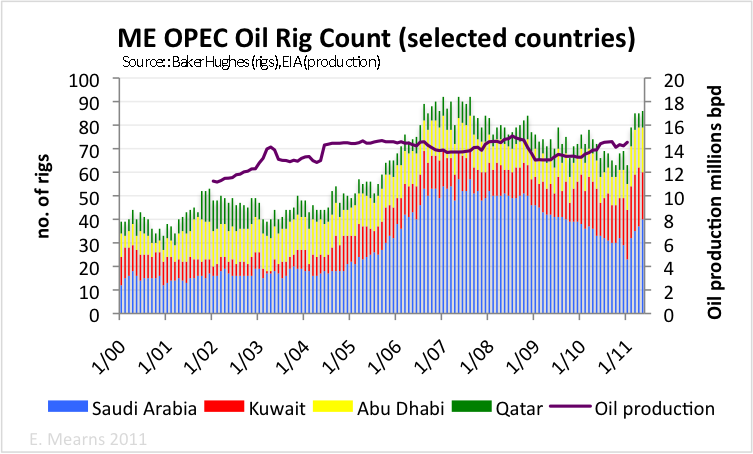
Concerns at the time, over the ability of the kingdom to meet these plans focused not only on the quality of the mix, but were more immediately initially aimed on the number of drilling rigs that the KSA had available to drill the required number of wells. Back in 2005 the country did not have a whole lot of rigs at their disposal. This has since been highlighted by Euan Mearns:
Rig Count for the Middle East (Euan Mearns 2011)
Bear in mind that when we started posting we were just coming to the end of the relatively flat section of the Saudi plot, and were, at the time, unable to see how they could continue operations with only 20 odd rigs. Well, with hindsight they could not, and as the plot suggests they rapidly acquired all the spare rigs available at the time and this allowed the increase in the number of wells that afforded the new levels of overall production. Sam Foucher has also posted on the rig count, and his plot agrees more with my memory of the dramatic transition in rigs that the KSA employed back in the 2006-7 timeframe to move them from the placid conditions pre-2005 to the sudden realization that BAU would no longer work.
Various Saudi plots from Sam, though the critical one is the rig count change (Sam Foucher)
The point of the illustration is to indicate that circumstances do change operating conditions, and that folk do respond when they have to. Up, that is, to the limits that they are able to achieve. Some of those limits are imposed by the fact that you cannot suck beer from a conventional pint glass forever, as I discovered when in college, and it is in regard to those issues as well as some more of the above that the discussion will swing toward as the next few weeks unfold.
There have been many other posts on the subject on the Oil Drum over the years, (if one includes Drumbeat there are more than 2,000) here are but a very few
JoulesBurn- Abqaiq
Intro to Satellite sleuthing
Khurais me a river
Happenings in Harmaliyah
Ghawar Numerology
Stuart Staniford
Satellite o’er the desert
Euan Mearns
Saudi Production laid bare
I will add to this list as I move on and start to address some of the concerns that have been raised.
Normandy Inn
Carmel-by-the-Sea
Since I started writing about peak oil back in 2005, the possible maximum sustainable production achievable from the Kingdom has been one of the recurring issues at The Oil Drum, and there have been a number of very perceptive analyses carried out by folk such as Euan Mearns, Stuart Staniford, and JoulesBurn that I do not intend to try and surpass. I will, however, try and summarize some of their conclusions as I work through a few posts that look at the overall production from the various fields that are found both on and offshore Saudi Arabia.
As an initial point, not all the oil that comes from the country is of the same quality, and this is often one of the initial factors that folk do not appreciate when they look, for example, at the two numbers I gave above, that which the KSA is producing, relative to that which it might be able to achieve. The problem arises with the heavier crudes that make up a part of the surplus, and for which there is not a great market out there, as yet. So let me begin the review with, this week, just simply looking at an overall view of the country, the oilfields that comprise regions of major production and what sort of oil that they are producing.
Back in 2005, production from the different oil fields added up to 9.07 mbd, and at the time I had figures suggesting that the total broke down as follows:
Abqaiq 400 kbd;JoulesBurn has since pointed to me that my initial attributions were incorrect and that, in a paper given in 2006, Mendez et al had reported that the target for Hout was only 50 kbd, while that for Khafji was 300 kbd. I will explore those issues more in later posts on this region. But a hat tip to JB for catching my error.
Abu Sa'fah 200 kbd;
Berri 300 kbd;
Ghawar 4,500 kbd;
Hawtah 200 kbd;
Hout 300 kbd;
Khurais 300 kbd;
Marjan 270 kbd;
Qatif 800 kbd;
Safaniya 700 kbd;
Shaybah 600 kbd; and
Zuluf 500 kbd.
This adds up methinks to 9.07 mbd.
The major fields in Saudi Arabia (EIA)Not all these fields have oil of equivalent quality, and this is a point that often fails to be understood when there is a global shortage and the KSA offers more crude to the market. If that crude is sufficiently sour (i.e. too much sulfur) and heavy (low API gravity) then it cannot be refined by some of the refineries that may be hurting the most. Thus the oil might not find a market, even though there is a shortage. What the KSA tries to do is to swap deliveries, but that does not always work as it might.
Different grades of oil supplied by Saudi Arabia. (For those who have forgotten the API gravity classification in degrees, I explained it in an earlier post. Suffice it to say that the higher the number, as a general rule, the lighter the crude and the better the market. As the share produced from the historic fields changes, so the KSA has offered the heavier crudes to the market, but, as I noted, even with the increase in global demand, those crudes have been less successful in finding a permanent market.)
Way back when the world was more innocent, there were four major fields that produced most of the oil from KSA:
Ghawar (the King), which started producing in 1951. Peak production was at 6.6 mbd. Current production is under 5 mbd. Water inflow percentages are increasing, and overall output is decreasing. It is divided into various regions, Ain Dar oil has an API gravity of 34, and 1.66% sulfur. Shedgum is at an API gravity of 34 and sulfur content of 1.75%. Uthmaniyah has an API of 33, and 1.91% sulfur. Hawiyah is at an API gravity of 32,and 2.13% sulfur, while Haradh oil has an API gravity of 32 and 2.15% sulfur. The levels of sulfur define how “sour” the crude is, and this must be recognized by the refineries, such as the Fujian Refinery in Quanzhou, China which is designed to refine 240 kbd of sour light Arabian crude. The oil from Ghawar flows to the Abqaiq processing plant, this can handle up to 7 mbd of light and extra-light crude., and cleans the crude before sending it on to refineries at Ras Tanura, Jubail, Yanbu and Bapco.
Abqaiq (The Queen) saw peak production in 1973 at 1 mbd, has now fallen to a level of around 200 kbd. It is a field that is “rested” from time to time in order to sustain an even displacement as the water flood progresses. The oil is at API 36.
Safaniya (2nd Queen) started producing at 50 kbd from 8 wells in 1957, peak production was at 1 mbd, and is now down to about 770,000bd. The field lies offshore, and is a producer of some of the heavier crudes, with an API gravity of 26, and a sulfur content of up to 2.96%. It has a current production capacity of 1.2 mbd, but because of the heavier nature of the oil has more trouble in finding a world market, and thus often much of this production is withheld. (In 2008, for example some 700 kbd was being withheld from the market.) The field is currently being further developed with a larger pipeline being installed to allow a higher flow rate from the field onshore. It is also intended that the gas that is now flared will be captured. The upgrade will also involve the installation of submersible pumps and an upgrade to the distribution network, and is scheduled for completion in late 2013, when the capacity will rise to 1.5 mbd.
Berri (the Great Lord) saw peak production at 788,000 bd in 1977 and more recently that fell to around 300,000 bd. This was the fourth of the original set of fields in Saudi Arabia that were responsible for 93% of Saudi production back in 1978. It is slowly watering out and has been occasionally left resting except when additional production is required. The oil has an API gravity of 38, with about 1% sulfur. The field has been reworked so that it now has a capacity of 1.15 mbd though some 300 kbd of this is considered part of the reserve production in case of need, rather than normal production.
Looking back seven years, the plans that the kingdom had, back then, for sustained and increasing production (they recognized that existing wells would decline and thus planned for their replacement) were clearly stated by Abd Allah Al-Saif :
major projects that Saudi Aramco is undertaking to ensure meeting future demand:
The Abu Sa'fah and Qatif projects came on stream in 2004 adding 650,000 bpd.
300,000 bpd of Arabian Light will come on stream in the Haradh field in mid-2006.
500,000 bpd of Arabian Light will be added to capacity through the Khursaniyah development, planned for 2007.
2008 is the target date of approved expansion plans that would add 300,000 bpd of lighter crude at Shaybah and central Arabian fields.
A Khurais increment of 1.2 million bpd of Arabian Light will be commissioned in 2009.
"This is a very aggressive program that will require the mobilization of immense resources, such as rigs, material and manpower, but which we are confident to successfully execute, as we have done for the past 70 years," he said.
Concerns at the time, over the ability of the kingdom to meet these plans focused not only on the quality of the mix, but were more immediately initially aimed on the number of drilling rigs that the KSA had available to drill the required number of wells. Back in 2005 the country did not have a whole lot of rigs at their disposal. This has since been highlighted by Euan Mearns:
Rig Count for the Middle East (Euan Mearns 2011) Bear in mind that when we started posting we were just coming to the end of the relatively flat section of the Saudi plot, and were, at the time, unable to see how they could continue operations with only 20 odd rigs. Well, with hindsight they could not, and as the plot suggests they rapidly acquired all the spare rigs available at the time and this allowed the increase in the number of wells that afforded the new levels of overall production. Sam Foucher has also posted on the rig count, and his plot agrees more with my memory of the dramatic transition in rigs that the KSA employed back in the 2006-7 timeframe to move them from the placid conditions pre-2005 to the sudden realization that BAU would no longer work.
Various Saudi plots from Sam, though the critical one is the rig count change (Sam Foucher)The point of the illustration is to indicate that circumstances do change operating conditions, and that folk do respond when they have to. Up, that is, to the limits that they are able to achieve. Some of those limits are imposed by the fact that you cannot suck beer from a conventional pint glass forever, as I discovered when in college, and it is in regard to those issues as well as some more of the above that the discussion will swing toward as the next few weeks unfold.
There have been many other posts on the subject on the Oil Drum over the years, (if one includes Drumbeat there are more than 2,000) here are but a very few
JoulesBurn- Abqaiq
Intro to Satellite sleuthing
Khurais me a river
Happenings in Harmaliyah
Ghawar Numerology
Stuart Staniford
Satellite o’er the desert
Euan Mearns
Saudi Production laid bare
I will add to this list as I move on and start to address some of the concerns that have been raised.
Normandy Inn
Carmel-by-the-Sea
Read more!
Labels:
Abqaiq,
API gravity,
Berri,
Ghawar,
rig counts,
Safaniya,
Saudi Arabia,
sulfur content
Subscribe to:
Posts (Atom)