Showing posts with label KSA. Show all posts
Wednesday, December 31, 2014
Tech Talk - Projections 2
It is the end of another year, or more optimistically the start of a new one. Last year I was tempted to make a couple of predictions for the future. And while I can make the case that they were not too wrong, they did not include the drop in oil prices, which has now taken the price of our local gas to below $1.85 a gallon. China has, in recent months, seemed less belligerent about claiming large sections of the China Seas. Whether this has anything to do with the relative success of rigs that have drilled in those waters is something that still remains an unknown.
But it is the changing price of gasoline, itself reflective of the drop in oil prices that is the big news. WTI closed at $53.56 today, and Brent at $57.50 a barrel. Predictions include some who would suggest that the price will continue to fall, until it reaches $20 a barrel, and there it may stay for some time. Well it certainly grabs a headline, but that is about all the value that particular forecast contains. The futures prices suggest that the price has yet to bottom out, though it may be getting close to that value.
Figure 1. Crude oil futures prices (EIA TWIP)
None of the recent news suggests that there will be a further increase in supply to sustain the current imbalance between available supply and demand. Libya is descending even further into a mess, with the oil facilities at the port of Es Sider now being destroyed. The likelihood of significant increases in production and the return to export levels achieved earlier this summer seems increasingly nonexistent. Neither Russia nor Saudi Arabia are likely to increase production, although the latter are continuing to produce the increased volume that they originally put on the market to replace Libyan losses. And so this leaves Iraq and the United States as the key producers who can significantly change the current supply:demand balance in any significant way.
It is probable that, with the agreement between the Kurds and the Central Government now having generated a second payment of $500 million to the KRG that the agreement may be sustained and grow. At present the Kurds are to supply about 550 kbd, of which 300 kbd will travel through the new pipeline to Turkey and thence onto the world market. The rest will be supplied to Baghdad. Meanwhile production in the south (which gets exported through Basra) has seen some increase.
Whether the Kurdish production can increase to over 1 mbd by the end of next year remains open to some doubt, given the ongoing conflict, and the target 6 mbd by the end of the decade for the entire country will likely require changes that the current conflict, which shows no signs of ending, will inhibit.
One of my responses, when the drop in price first started, was to note that the oil supply system has a certain inertia to it. And here I am not talking about the fluctuations in price that one sees in the stock market, and in the price of the crude, but rather in the time that it takes to stop current drilling, postpone future plans and to reduce the production from existing and new developments.
Thus the drop in investment in new production, whether in Russia, Iraq or the United States takes some time to have an impact. Unfortunately for those expecting the price to continue to fall, in the face of the overabundant supply, the situation has changed since historic times, where well production was relatively stable and the oversupply situation was corrected by shutting in production (mainly by Saudi Arabia). Even then it was the perception of the response that drove price rebounds, rather than the immediate reality of the changes.
The system this time is different. The increase in production in the United States has been sustained, and over the last two years has produced more than 2 mbd more than at the start of that period.
Figure 2. US crude oil production over the past two years. (EIA TWIP)
The rig count in North Dakota has already fallen to 170 rigs compared with 187 at this time last year. Concern about the oil price has led companies to cut their investment plans for next years, in some case by 20% so that the rig count is likely to continue to fall. And with the short life at high production values for most wells that will soon affect production. The North Dakota Oil and Gas Division of DMR shows the consequences of this:
Figure 3. Future production estimates from the ND DMR Oil and Gas Division.
The blue line requires about 225 rigs in continuous action, so that won’t happen. By the same token the black line is with no more drilling, and that won’t happen either. The result will be somewhere in between, probably moving the peak out beyond the current projection, but also lowering it as the existing baseline drops with less wells significantly contributing. (Bear in mind it is taking 11,892 wells to sustain current production levels.) But in the short term the line will likely dip down until the price rebounds.
The question now becomes how soon that drop in US production will become evident, and have some impact. I doubt that it will be before June of 2015.
On which note may I wish all readers a Happy, Healthy, Successful and Prosperous 2015.
Read more!
Monday, October 13, 2014
Tech Talk - Pessimistic Talk in a time of surplus
The oil markets are concerned that there is too much oil currently available on the market, and that, as a consequence, oil prices may continue to tumble. Saudi Arabia is reportedly telling Reuters that it is happy with prices that may fall as low as $80 a barrel. As I mentioned the other day, some of this has to do with market share, and the KSA increasing production, and thereby seeking to weaken the likelihood of investment in other places, in turn ensuring their share holds up, not just now, but also down the road. The effect on gas prices has been rapid, with prices in parts of Missouri down to $2.65 a gallon – about a dollar less than I was paying only a week ago.
The effect will also have the benefit of a boost to the economy, which of course can’t hurt in the run-up to an election. But in the longer term it is hard to see how this boost can be sustained for more than a year. In the last post on this I mentioned that, outside of the US, Russia and KSA global oil production had dropped around 3 mbd over the past couple of years. Yet increased production (KSA raised production by 100 kbd in September as part of a total 400 kbd increase from OPEC overall) has, for now, been able to match and surpass this in order to meet the global demand. OPEC continues to expect that demand will increase by a million barrels a day this year and 1.19 mbd next. They further expect that the increased production to meet this will be met from outside the cartel, with the gain declining from 1.68 mbd this year, to 1.24 mbd next year, holding OPEC production to a decline of 300 kbd from the current 29.5 mbd. Simplistically the gains are maximized in increased production from the United States (880 kbd); Canada (250 kbd) and Brazil (190 kbd). They are anticipating a slight drop in Russian production, as part of an overall decline of 80 kbd for the FSU countries.
Part of the problem in projecting the balance revolves around estimating the production from Libya, Iraq and Iran (LII). Libya has reported raising production back to around 800 kbd, but some of that comes from the Shahara field, which was still involved in factional fighting, even as it came back on line at some 20% of normal. The three countries produce around 7 mbd (Iran 3 mbd, Iraq 3.2 mbd; Libya .8 mbd) so that the fluctuations in their production and sales can have a very significant impact on the global oil market, and the prices that are paid – but they function within OPEC, and it may be that the current drops in price are reminder that the big dog in that trailer is KSA, currently running at around 9.7 mbd.
It is foolish to try and predict, over the immediate short-term, how the fighting in Libya and Iraq will progress. Similarly it is hard to see how relations with Iran will change, potentially easing sanctions and allowing them to sell more product into the global market would upset the current balance in trade, and could, in the short-term, increase the glut and lower prices.
But supplies from those outside the cartel and the Americas are continuing to decline. That is not going to change. The rates may fluctuate a little (though the current drop in prices is not going to encourage large scale investment in declining fields) but the overall trend is steadily downward. And it is within that picture that potential changes in the production from the three LII countries have to be placed.
Figure 1. Libyan oil production through September 2013. (EIA)
Yet, as the fields have brought oil back to the market, there is a concurrent fall in global prices, as the EIA note.
Figure 2. Recent oil production from Libya and the price of Brent Crude (EIA)
Pre-conflict Libya was producing over 1.6 mbd, it recovered to 1.4 and is now struggling at around 0.8 mbd. But the prospects for the levels of peace required to sustain even that level do not seem promising. The conflict is worsening and seen as spiraling out of control.
Moving East to Iraq, despite the use of air power, the situation in the North is not improving, although the Kurds have now a pipeline to carry oil up into Turkey that is not controlled by the Islamic State. While it is still a matter of debate how much oil they will be able to sell, they hope that, by the end of next year they may be able to pump as much as 1 mbd, up from the initial 0.1 mbd when the pipeline went on line. At the same time, in the South, the oil fields lie some distance from the conflict, and there seems little threat, at the moment, to the plans to increase production, and move the majority of the oil to the coast for export. It is, therefore possible to foresee an increase in Iraqi production of perhaps a million barrels a day in the next couple of years. Is it likely? It is hard to say. Factional fighting is always hard to predict, and the willingness of those involved to use explosives makes it even more of a problem to predict what will occur, given the vulnerability of pipelines to attack.
Predicting how Iran will change is similarly conflicted, in that it is hard to predict the behavior of those who control the country, and in turn impact oil exports.
But putting this within the context of OPEC, I suspect that overall production will not fall much outside of the current volumes that the MOMR are predicting – which is sensibly overall stable output over the next year or so. And if that is the case, then I would, as mentioned last time, expect to see that the global surplus of oil supply over demand will gradually disappear over the next year, with the impact becoming evident once we reach the summer of 2016. It would be nice to be wrong, but I think it unlikely.
Read more!
Labels:
FSU,
Iran,
Iran oil exports,
Iraq,
KSA,
Kurdistan,
Libya,
OPEC MOMR,
Russian production
Sunday, August 31, 2014
Global oil supply and Bárðarbunga
Some time ago magma started rising in the rocks near the Bárðarbunga volcano in Iceland, and after weeks of increasingly intensified earthquake activity, the first signs of eruption were found to have occurred under thick ice within the last week. These were not that visible to the general public. That eruption was followed by a second, where there were some streamers of magma across the surface, without causing any significant airborne dust to interfere with aircraft.
The delays in dramatic eruption footage, and the early decay in immediate activity has led a number of folk to anticipate that the risk has declined and for some the risks from the eruption are over, with one scientist commenting::
Figure 1. The eruption at Bárðarbunga (from the first webcam) at 5:40 pm Aug 31.
Figure 2. The eruption at Bárðarbunga (from the second webcam) at 9:00 pm Aug 31.
The eruption is continuing and will likely continue, and potentially significantly worsen, over the next several months. Yet, in the world of instant highlights, headlines and Twitter the risks from the long-term eruption (which can be horrendously severe) are immediately glossed over as the eruption fails the “dramatic event” test.
This is uncomfortably similar to the situation that one sees when writing about “Peak Oil”. One can, on any individual day, find comforting headlines that tend to gloss over the longer-term problem that is being written, in increasingly large letters on the predictive wall of our future. But that does not hide the potential disaster that it presages, it merely conceals it from the general public.
The headlines are those that are short-term, and deal with the drivers for the daily fluctuations in oil price, rarely do they back off to look at the overall threat that the situation may presage. Similarly the eruption in Iceland looks relatively tranquil at the moment, but may be of a similar nature to that of 1783, which created, over a period of months, an absolute disaster in Europe, and may have been one of the contributing causes to the French Revolution. The problem with the oil crisis is that there is no similar history to look back on. (Not that this would matter to those “editors of the moment” who control the daily press).
If one were to step back from concerns over daily price fluctuations for oil and gasoline, and consider the import of the trend in international politics one could very easily be aghast at the situation. Not that one might tell this from the headlines.
Consider that, of the three international leaders in oil production, one – Russia – is currently set on a course that may well lead the rest of us into World War 3. As a consequence is likely to be unable to attract the financing that will allow it to even approach the current levels of oil production that it need to retain current production levels in the years to come.
The second of the three is Saudi Arabia. Glossing over any problems that the Kingdom may run into in the next couple of years with the terrorism that is sweeping though its neighbors, it is a country that has realized that today’s cornucopia is about over, and it must seriously invest in exploration and development. The KSA recognizes that if it is to have a chance at being able to even meet the bills for domestic consumption, let alone export income, as the years move onward, it must find new oil. Again it would seem that global commentators fail to realize that, while KSA is recognizing the problem, any finds of “elephantine fields” would require huge investments of money and time, given that they are now likely to be off-shore and sour (as with Safaniya and Manifa, even if such fields exist, which is very doubtful).
The Kingdom has repeatedly stated that it will not increase its production over current levels, despite the assumption of many commentators that they will have to, if global balance is to be retained between supply and demand. Put bluntly, their analysts have realized that, without new reserves that are currently still to be found, they will be unlikely to be able to meet even current targets without major new field finds. Yes, they have fields that are found and available, but in relative terms they are tiny when set against the current levels of production. (Bearing in mind that a 5% reduction in production per year from existing fields, a level now increasingly found to be overly optimistic, would still cut existing production by 450 kbd).
And so, gentle readers, as we have so often in the past, we return to prognostications of future American production. This should, realistically, be focused on the production from the USA, since that in Canada is tied to production from the oil sands and that is only likely to change at a slow (one might suggest geological, but that would be a little harsh) time frame.
And in the United States hope continues to focus on an assumed linear increase in production, month on month, from the Bakken and Eagle Ford Shales. That this is denied by even the local authorities (who also note that the Bakken is named after a local farming family). Their current estimate (assuming more than 200 drilling rigs, and there are currently only 192 is that the fields will peak in 2017, and will start to decline in around 2026. The problem with that estimate relates both to the number of rigs employed (which have to be higher) and the quality of the remaining reserve (which is highly unlikely to be of equivalent value to that which is now, or has been, developed in the past.
I would venture into the second tier producers, but they include those that lie in the MENA (such as Iraq and Libya) and are in even worse condition than KSA, and yet, as documented here repeatedly, these states seem increasingly unlikely to meet projections and thus are an ongoing and significant threat to a balance between global production and demand.
The global economy, and particularly the economies of the Western countries, are tied to a cheap source of energy and power – on which their industrial clout is based. Remove that underpinning, and the writing is clear on the wall about this, and current levels cannot be sustained.
But, as with the wish of the press to get “beyond” the “yesterday’s story" of Bárðarbunga, so the reality of the energy situation is unlikely to be recognized until, as with the Iceland volcano. its effects become too evident to ignore.
The delays in dramatic eruption footage, and the early decay in immediate activity has led a number of folk to anticipate that the risk has declined and for some the risks from the eruption are over, with one scientist commenting::
"If this eruption persists it could become a tourist attraction, as it will be relatively safe to approach, although the area is remote,"
Figure 1. The eruption at Bárðarbunga (from the first webcam) at 5:40 pm Aug 31.
Figure 2. The eruption at Bárðarbunga (from the second webcam) at 9:00 pm Aug 31.
The eruption is continuing and will likely continue, and potentially significantly worsen, over the next several months. Yet, in the world of instant highlights, headlines and Twitter the risks from the long-term eruption (which can be horrendously severe) are immediately glossed over as the eruption fails the “dramatic event” test.
This is uncomfortably similar to the situation that one sees when writing about “Peak Oil”. One can, on any individual day, find comforting headlines that tend to gloss over the longer-term problem that is being written, in increasingly large letters on the predictive wall of our future. But that does not hide the potential disaster that it presages, it merely conceals it from the general public.
The headlines are those that are short-term, and deal with the drivers for the daily fluctuations in oil price, rarely do they back off to look at the overall threat that the situation may presage. Similarly the eruption in Iceland looks relatively tranquil at the moment, but may be of a similar nature to that of 1783, which created, over a period of months, an absolute disaster in Europe, and may have been one of the contributing causes to the French Revolution. The problem with the oil crisis is that there is no similar history to look back on. (Not that this would matter to those “editors of the moment” who control the daily press).
If one were to step back from concerns over daily price fluctuations for oil and gasoline, and consider the import of the trend in international politics one could very easily be aghast at the situation. Not that one might tell this from the headlines.
Consider that, of the three international leaders in oil production, one – Russia – is currently set on a course that may well lead the rest of us into World War 3. As a consequence is likely to be unable to attract the financing that will allow it to even approach the current levels of oil production that it need to retain current production levels in the years to come.
The second of the three is Saudi Arabia. Glossing over any problems that the Kingdom may run into in the next couple of years with the terrorism that is sweeping though its neighbors, it is a country that has realized that today’s cornucopia is about over, and it must seriously invest in exploration and development. The KSA recognizes that if it is to have a chance at being able to even meet the bills for domestic consumption, let alone export income, as the years move onward, it must find new oil. Again it would seem that global commentators fail to realize that, while KSA is recognizing the problem, any finds of “elephantine fields” would require huge investments of money and time, given that they are now likely to be off-shore and sour (as with Safaniya and Manifa, even if such fields exist, which is very doubtful).
The Kingdom has repeatedly stated that it will not increase its production over current levels, despite the assumption of many commentators that they will have to, if global balance is to be retained between supply and demand. Put bluntly, their analysts have realized that, without new reserves that are currently still to be found, they will be unlikely to be able to meet even current targets without major new field finds. Yes, they have fields that are found and available, but in relative terms they are tiny when set against the current levels of production. (Bearing in mind that a 5% reduction in production per year from existing fields, a level now increasingly found to be overly optimistic, would still cut existing production by 450 kbd).
And so, gentle readers, as we have so often in the past, we return to prognostications of future American production. This should, realistically, be focused on the production from the USA, since that in Canada is tied to production from the oil sands and that is only likely to change at a slow (one might suggest geological, but that would be a little harsh) time frame.
And in the United States hope continues to focus on an assumed linear increase in production, month on month, from the Bakken and Eagle Ford Shales. That this is denied by even the local authorities (who also note that the Bakken is named after a local farming family). Their current estimate (assuming more than 200 drilling rigs, and there are currently only 192 is that the fields will peak in 2017, and will start to decline in around 2026. The problem with that estimate relates both to the number of rigs employed (which have to be higher) and the quality of the remaining reserve (which is highly unlikely to be of equivalent value to that which is now, or has been, developed in the past.
I would venture into the second tier producers, but they include those that lie in the MENA (such as Iraq and Libya) and are in even worse condition than KSA, and yet, as documented here repeatedly, these states seem increasingly unlikely to meet projections and thus are an ongoing and significant threat to a balance between global production and demand.
The global economy, and particularly the economies of the Western countries, are tied to a cheap source of energy and power – on which their industrial clout is based. Remove that underpinning, and the writing is clear on the wall about this, and current levels cannot be sustained.
But, as with the wish of the press to get “beyond” the “yesterday’s story" of Bárðarbunga, so the reality of the energy situation is unlikely to be recognized until, as with the Iceland volcano. its effects become too evident to ignore.
Read more!
Labels:
Bárðarbunga,
crude oil,
eruption,
French Revolution,
Iceland volcano,
KSA,
Libya,
oil demand,
oil supply,
peak oil,
press blinkers,
twitter
Sunday, August 10, 2014
Tech Talk - Rig Counts in the Middle East
In recent posts about the situation in the Middle East, I have noted the need for Aramco to increase the number of drilling rigs that it must use, since it is now looking for natural gas in their tight sand deposits rather than finding the large reserves that they had hoped in the shale reservoirs. It is interesting in this regard to plot the number of rigs that have been working in the Middle East.
Getting the overall data from Baker Hughes the rig count can be plotted, over time, to give the following:
Figure 1. Rig Counts in the Middle East (Baker Hughes)
If one looks at the trend for the last twelve months, it has remains on a fairly consistent upward trend, following that of the longer time interval plot of Figure 1.
Figure 2. Recent trend in Middle East Rig count (Baker Hughes)
Back in the days of The Oil Drum, Euan Mearns and I had this concern, which occasionally surfaced, about these numbers. From my early post on the subject which noted that back in 2005 the KSA were running around 20 rigs, which would not be enough to get them the production they were claiming to need in the future, to Euan’s in 2011, the topic was revisited regularly over the time that the count steadily mounted as the Kingdom had to drill an increasing number of wells just to keep production at around the same overall level.
I am using the KSA as the example, given the large volume of its production relative to that of the others in the Middle East, but as the numbers show, the trend toward increased drilling rate to create enough productive wells to sustain production as the larger volume wells dry up is starting to become a steadily more frantic race across the region.
Rune Likvern used the phrase “Red Queen” in discussing the overall long-term need of the companies in the Bakken to have to drill an increasing number of wells, with individually reducing production, in order to remain in place with regard to overall production. As the production from the Bakken now exceeds a million barrels a day it may seem foolish to be predicting this “squirrel cage” view of the future, but the rig count up there is still running at around 190 rigs, which is not enough to sustain future growth for long, given that access to the sweet spots is limited, and they are beginning to run out of new sites.
So it is in the Middle East. The rig count numbers are mounting steadily, it is reported that there were 88 rigs drilling in the country in October 2012. Last year this rose to 170, and the number is expected to rise to 210 by the end of this year.
Aramco have done remarkably well, over the past decade, in developing new technologies to harvest the attic oil left around the tops of the major producing formations such as Ghawar, as the main body of the fields begin to be exhausted. But the problem with these secondary rig operations is that they were directed at the smaller pools around the field, rather than tapping into the major volume, and thus they had an expected and finite life. That life is starting to come to a close. Just as, when sucking a thick milk shake through a single immovable straw, when it stops drawing fluid, there is still a fair amount left in the cup. But as you move the straw around and slide it up and down the sides, the amount that you recover gets less, and it takes greater and greater effort to get it, to the point where you quit and discard the carton. And that is where the Middle Eastern oilfields are beginning to find themselves.
The high-quality light oils of the mainland are rapidly running out, and the remaining fields with the promise for sustaining Saudi production at around 10 mbd for the next few years, are the heavier sour crudes from the offshore fields such as Safaniya and Manifa. At the same time there is a need to reduce the increasing amount of oil (now at 3 mbd) being consumed in country, with the hope that this can be replaced by domestic natural gas. But those hopes are being reduced as the shales are found to be less productive than anticipated, and hopes are now switching to the slower production that can, hopefully, be achieved from the tight sands – but at the cost of an increased number of wells, inter alia.
This is the writing on the wall for global oil production, and in the short-term it will be neglected. Increasing the number of rigs will, in that interval, increase the number of wells that will produce, even though the volume from each well will be less, and the overall life of the wells will similarly reduce, as higher production techniques tap into smaller fields.
But we are now on the treadmill in the squirrel cage, or, as Rune would have it, we have wrapped ourselves in the cape and crown of the Red Queen, and must run faster and faster just to stay in place. (There are additional concerns since, as an example, Manifa could not be brought on line until there were refineries built that could process that crude, and so the options for increasing production beyond the capacity of refineries to absorb that increase is a futile exercise).
There will soon come a time when the gain from the overall increase in new wells will not match the decline in production from older wells, particularly if the effort to “run faster” is restricted to only a few players (Russia for example is not yet putting the effort and investment into increased drilling rates in order to sustain their overall levels of production, and given the age of their major fields are likely now in terminal decline).
Ouch!
Read more!
Labels:
Baker Hughes,
Bakken,
Ghawar,
KSA,
Manifa,
Red Queen,
rig counts,
Safaniya,
Saudi crude production
Sunday, July 13, 2014
Tech Talk - Here we go again, again
A couple of posts or so ago I mentioned that there are three major problems sitting relatively un-noticed as we head into the mess of Peak Oil. Of these, perhaps the one that gets the least attention is the steady decline in production from existing wells. We are just about at the point where the Alaskan Pipeline will tip over into feeding less than half-a-million barrels a day down from the North Slope. (It sent 501 kbd down the pipe in June with a 98.6% reliability factor). At the same time those in control of the oilfields in the Russia are reporting that Russian exports have fallen to the lowest level in 6 years. This brings back the relatively unrecognized reality of the Export Land Model which Jeffrey Brown first introduced on The Oil Drum back in 2007.
It is worth resurrecting that thinking (which time has proven to be only too true) as we look at the continued declines in production from the UK, as an example. It is not easily discernable from the official Department of Energy and Climate Change, which plots oil production on a monthly basis (with different months having a variety of days):
Figure 1. Monthly production of oil from the fields of the UK continental shelf (DECC ).
Euan Mearns has, however, done the necessary arithmetic and clearly shows the reality of the situation once one converts it back to barrels per day:
Figure 2. UK production of oil and natural gas over the past decade (Euan Mearns)
The steady decline has also been noted by the EIA who commented that UK production fell by 9% from 2012 to 2013. There was a time, back in the days of The Oil Drum, where we debated whether an estimate of 5% for field decline rates was or was not too high. Obviously those days are now behind us, and reality is starting to show numbers that far exceed the rates that, at the time, some thought rather pessimistic. To continue the UK numbers, as OPEC recently anticipated, the decline this year will take the total down to 800 kbd with an 8% decline expected for this year.
The Export Land Model, in its simplest form, can be illustrated with the following plot:
Figure 3. A simplified illustration of the changing production, internal use and exports for an oil producing country, once it reaches a peak in production (Sam Foucher )
The argument that produces the above plot goes along the lines that, as an oil producer (think for a moment of Russia for eg) produces larger volumes of oil, so the economy of that country starts to grow. As that growth continues it demands an increasing amount of energy to sustain the increased internal demand (the green line). However, once production stabilizes or starts to decline (the blue line above) so the amount available for export becomes reduced (the red line).
The three top producers of petroleum products in the world are the United States, Russia and the Kingdom of Saudi Arabia. The United States consumes far more than it produces, and thus is already a net importer of petroleum products, although in the short term, as I noted earlier production gains from the Bakken and Eagle Ford are hiding the problems of decline rate. It is increasingly unlikely that any significant volume of US oil will make it onto the world market.
Saudi Arabia has, for years, controlled the amount of oil that it puts on the market, based on the anticipated global demand, and the supply available from the rest of the world - so that the global price remains at a level to sustain OPEC economies. That has been illustrated over the past couple of years by the increase in production from the KSA to cover the decline from Libya as about a million barrels a day disappeared from the global market. The gains in production from the US helped in meeting global demand and the strain in supply was thus relatively easily hidden. But the KSA has an imminent problem that has largely disappeared from public view now that the eyes of The Oil Drum correspondents have lost that focus.
The major oilfields of the Kingdom are old, and to sustain production perimeter wells were located around the oilfields that injected millions of barrels of seawater a day, to drive the oil towards the center of the fields, where it could be relatively easily recovered from Maximum Reservoir Contact wells drilled along the very top of the reservoirs. But as folk such as JoulesBurn have noted, those wells slowly change in nature, over time, as the oil migration continues, and water injection must move inwards to ensure continued production.
Figure 4. Layout of initial wells at the Haradh III development in the Ghawar oilfield in Saudi Arabia (JoulesBurn at The Oil Drum)
He noted, in the original post, that Aramco had to drill some 52 wells, rather than the estimated 32, to get the production they needed, and that was back in 2010. Since then Ghawar has continued to produce for the Kingdom, but with daily levels of up around 10 mbd, the volumes in the crests of the anticlines along which the oil wells sit within the Ghawar field have been steadily contracting, and although they have carried out some of the most advanced oilwell engineering to sustain production from the attic oil in the older parts of the fields, there are only so many ways you can squeeze a rock before you get out all the oil that you will – and those days are approaching fast.
At the same time (relating back to the ELM) while Saudi production has remained at just under 10 mbd for the past few years, internal demand has been rising at a steadily more rapid rate.
Figure 5. Internal consumption of oil in Saudi Arabia (Index Mundi ).
Hoping to transition some of the current internal demands to natural gas, the KSA has been looking for internal resources to allow it to move away from oil. However the search has not been as successful as hoped, particularly with the search for natural gas, Shell having backed out of the program as a result of the poor results to date.
With internal consumption continuing to rise at more than twice the rate anticipated by the ELM shown in Figure 3, and, at best, stable production, global exports from the Kingdom are of increasing concern.
Which brings us back to Russia, where the new fields that must be exploited to sustain production are in remote parts of Eastern Siberia and the Yamal Peninsula – if not offshore in the Arctic.
Russian oil production has been peaking for some time (falling from 3.4% growth in 2012 to 1.3% in 2013) and is now reported to likely fall by 6.3% over the next two years. Since this implies that Russia is now at peak, the decline in overall production initially will fall below that of Figure 3, though likely only for a year or so, before the rate will be, at minimum, that shown. (The reason for this conclusion comes from the lack of enough investment in the fields where growth can be expected). At the same time internal demand is rising at around 100 kbd or 3% pa slightly above the value assumed for Figure 3.
If none of the three largest producers can even sustain exports, and the ELM explains why they can’t, and world demand continues to rise at the rates projected, then, in even the short-term, something is going to have to give. The logical weakest link is price, with the consequence, that invalidates a lot of the other arguments, of a significant impact on global economic health. As we have seen before, significant increases in price lowers the demand for oil, and thus demand from the various nations will become even more skewed.
The only problem, with this next iteration, is that there isn’t another Bakken or Eagle Ford conveniently sitting waiting to be tapped.
Read more!
Sunday, July 6, 2014
Tech Talk - of longer wells and drawdown pressure
There are, simply, three major parts to the coming global economic mess that will be created as we enter into the period of Peak Oil. The first of these comes from the current rising demand for oil, particularly emphasized by those countries, such as China and India, where demand is rising fastest. The second part is the declining production from existing fields as their reserves are drawn down. (Though it should be remembered that even when “exhausted” the fields will still contain vast quantities of oil, but oil which is at present not economically recoverable). And finally there is the oil in the undeveloped, and undiscovered wells and fields that can be added to the existing reserve to help ameliorate the imbalance between demand and supply from existing wells.
The high decline rates from long horizontal wells drilled into, and along the shale deposits in the United States, most particularly the Bakken and the Eagle Ford, mean that there is a constant need to drill new wells to sustain existing production. The EIA has taken note of this and calculated based on some assumptions, the number of rigs that must be operating in these fields, so that they will drill enough new wells to sustain current production.
Figure 1. The number of rigs required in the Bakken and Eagle Ford formations to sustain production at the level of the previous month (EIA).
Should the need be to increase production (which is the current assumption by most prognosticators of future equilibrium between demand and supply) then these numbers need to be significantly higher, perhaps by as many as 50 additional rigs. At present the Bakken rig count is running at around 176 rigs while there are around 270 rigs drilling in the Eagle Ford.
One of the ways in which production is anticipated to expand above earlier estimates for the wells drilled in both fields comes from the ability to drill longer horizontal wells and to increase the fracture density along these wells.
However, as the Kingdom of Saudi Arabia discovered some years ago, longer wells can only be viably effective out to a certain distance, beyond which there is no gain in productivity. As a result they have changed their drilling patterns so that the wells are shorter, with multiple laterals spreading from the original wells to more thoroughly cover the rock within the formation. Initially wells were drilled out to distances of up to 12 km, but over time the KSA found that this was too long.
Since there is a somewhat similar argument to be made for the wells in the United States, as they move to longer distances, I thought I would go over the explanation as to why this is not a very productive idea a second time.
To begin consider that regardless of whether I put a tiny glass of water or a huge glass of soda in front of you, if I glue it to the table then the amount that you can drink at one time becomes limited by the size of the straw that I give you to drink the liquid, rather than the amount in the container. And to get that liquid into the straw and up into your mouth requires that you suck on the straw.
What you are doing is reducing the pressure at the bottom of the straw, while the pressure from the atmosphere on the top of the liquid remains the same. By creating this differential pressure there is now a force to move the liquid into the straw and thence up into your mouth.
But, as Fishbuch et al showed, as the horizontal well bore gets longer the pressure at the back of the hole declines as then does the difference in pressure between the oil in the rock and the well (the drawdown pressure), and while the longer hole gives an overall increase in production to a certain point this seems to maximize at a length of around 6,000 ft. Beyond that distance the differential pressure between the formation and the well falls to a point where there is less benefit to the additional cost of drilling to that distance.
Figure 2. Drop in well pressure with increased well length, while increasing overall oil flow (Simulation by Fishbuch et al )
The answer which Aramco came up with to get around this problem was to use a main lateral from which a number of shorter laterals could then be drilled out into the formation, providing higher drawdown pressures within the wells and making it also easier to isolate any well section where the underlying water broke through into the well.
Figure 3. Schematic of a Maximum Reservoir Contact well as used in Saudi Arabia (Aramco).
The optimum length at which a well can produce is a function of the rock type and structure as well as the nature of the oil/natural gas that it contains and the water content (to name by a few of the parameters). Thus there are limits to the analogy, nevertheless it does show, even in the much more productive rocks of the fields in KSA that there are limits to how far a well can be productively driven, and these limits will also exist in the shales of the United States, although the oil locations and the optimal ways of extracting it are somewhat different.
The extraction of oil and natural gas in these shales is more sensitive to the levels of drawdown pressure, since much of the oil and gas is found in natural fractures that are not that wide (although they may be spread further apart by the fracking process itself). With exposure to the lower well pressure thus being restricted to a relatively small volume, significant reduction in the pressure because of the location relative to the heel of the well can have significant effects on lowering the overall well production.
Further as a general rule the complex valve systems used in KSA are not installed in the shale wells of the United States, making it less practical to focus the relative pressure differentials at different points along the well bore as a means of increasing production sequentially along the well.
Read more!
Sunday, January 5, 2014
Tech Talk - Predictions
From time to time I have written about the dubious assumptions that lie behind some of the predictions made by Energy Agencies and some of the larger oil producing companies as they predict the energy supplies and demands of the next few years.
It is relatively simple to make those criticisms given that one has only to compare ongoing reality with the assumptions to be able to judge that the future is unlikely to be as rosy as any of these folk imagine.
However there is this strong tradition of making the odd prediction at the start of the New Year. Yet having just spent about 2 hours digging snow out of my drive (an hour and a half for the first session which moved most of the snow and then thirty minutes to remove all the snow shifted back into the drive when the snowplow came by clearing the center of the road) my creative buds are a little slow this evening, but I would suspect that it is not hard to make one or two suggestions, and then go back and so how they panned out.
Last year I was quite pessimistic about the future, given the pull back in Arctic drilling following the grounding of the Shell drillship and had some question on the stability of the domestic production levels. Well a year later the situation in the Arctic has perhaps grown a little less encouraging for those who would anticipate early development of those resources, but on the other hand domestic production has continued to increase.
For next year I suspect that the situation with China, in terms of its attitude to acquiring sufficient energy reserves, will not improve. There are already suggestions that China will adjust its position in regard to the importation of Iranian oil and may increase purchases, despite the ongoing sanctions. Similarly it is refusing to recognize arbitration in its dispute over ownership of the China Seas (East and South). To keep the projection vague (and thus less likely to be too far off) I would expect that this will get worse over the next year, and the steps China is willing to take to ensure future energy supplies will become more obvious.
In this regard I suspect China will continue to beat out India in the pursuit of available resources around the world, though the consequences for this in India won’t likely become evident for a couple of years yet.
There will likely continue to be enough available crude to meet demand through next year (depending on how the various conflicts in the different countries of the Middle East develop) but it may be the last year in which this holds true. With the Kingdom of Saudi Arabia determined to hold production at a maximum of around 10 mbd, with Iraq increasingly troubled by growing sectarian violence and with other regional countries similarly destabilizing there are only a few places where increased production can be brought on line to meet demand – and that problem may become evident in 2015.
So having made a couple of relatively obvious suggestions let’s see how 2014 turns out for us all – though I hope it brings you Prosperity and Success!
Read more!
Sunday, November 3, 2013
Tech Talk - of Alaska, Libya and the belated bleat of awareness of a problem
I have written in earlier posts about the problems that the Trans-Alaskan Pipeline System (TAPS) will face, as production declines below 500,000 bd. The conclusions from that post are pictorially summarized in a graph in the recent edition of the Oil and Gas Journal.
Figure 1. Declining throughput through TAPS showing the points of concern (OGJ)
Looking at current figures, in September the pipeline had an average throughput of 524,181 bpd against the year-to-date average of 528,092 bpd. It has just passed below the upper limit at which operational difficulties can be anticipated, due in part to the flow being too slow to keep the temperature high enough to prevent wax from separating from the fluid, and starting to block valves and critical infrastructure. Because of the long lead times, and high capital requirements for the development of new fields in the Arctic, and the likely probability that these will not yield significant production until at least 2025, the article is pessimistic about both the fate of the pipeline, and future Alaskan production.
Despite those declines OPEC remains optimistic, in their October Monthly Oil Market Report that the world producers can continue to meet global demand as they foresee it rising to an average of 89.7 mbd this year, and then going up to 90.8 mbd on average next year. They foresee, for example, that non-OPEC supply will increase this year by 1.1 mbd (to 54.1 mbd) led by production gains from the USA, Brazil, Kazakhstan, South Sudan and Sudan. Next year they see an additional non-OPEC growth of 1.2 mbd with Canada replacing Kazakhstan among the five countries that will make up this additional production. In contrast OPEC itself is reducing production, with overall production reported to be down 390 kbd in September.
The gain in crude oil production seen in the US, which has risen from 5 mbd to an average of 7.3 mbd in the first seven months of this year has had a significant impact on these projections, though the change in the mix of product now available to the Gulf refineries will continue to have some impact on the overall import picture. This is because, as the EIA note, some of the heavier crude refineries along the Gulf are tied to foreign producers including Pemex of Mexico, PDVSA of Venezuela, and Saudi Refining (for a combined total of just under 2 mbd).
Yet it remains difficult to sustain the optimism that OPEC project. Libyan exports, at one time running up around 1.25 mbd remain down at some 90 kbd, due to tribal disruptions and internal political disputes that show little sign of resolution.
Figure 2. Recent Libyan oil production (Energy Policy Info)
Certainly the physical ability to return to around pre-disruption levels has been demonstrated, but the weakness of the central government does not indicate that the political problems will be resolved in the near future. And until they are there is the best part of 1 mbd being with-held from the market. This drain from global supply is not yet disruptive since it has, to date, been largely picked up by the Kingdom of Saudi Arabia (KSA).
The picture from the combination of Sudan and South Sudan following the division of the one country into two has not been promising, however it appears that the overall total decline has now been halted, and recent reports have raised production to somewhere between 190 kbd and 240 kbd.
Figure 3. Change in oil production from Sudan and South Sudan following the division of one country into two. (Council on Foreign Relations )
The IEA is not optimistic that the return to production will be as smooth as others think:
The increased production from the Kashagan field in Kazakhstan – anticipated to rise to 75 kbd - has again been hit following system leaks so that this increased production that OPEC had anticipated has, again, been postponed.
And while production has now started from the Espirito Santo in the pre-salt fields off Brazil, it is not clear whether the production gains will offset the declines that have occurred in Brazilian production in recent months.
Figure 4. The Espirito Santo floating production storage and offloading (FPSO) vessel (Shell )
Just as there is a perception that the United States is heading toward independence in energy needs (a fallacy I have written about several times in the past), so there is a perception that OPEC is becoming a less critical supplier. This is far from the case. KSA has been producing over 10 mbd for the last months, in order to offset the loss in Libyan oil to the market, and the combined production of KSA, UAE, Kuwait and Qatar now supplies 18% of global demand. This is only the second time that this number has been that high in the past 30 years. It comes at a time when the Middle East is supplying 25% of Chinese oil demand, as that country passes the United States to become the largest importer of oil.
Figure 5. OPEC oil production (numbers compiled from secondary sources (OPEC MOMR October )
This comes at a time when the world still wonders about the actual oil balance as it flows in and out of China.
Unfortunately the picture that is emerging continues to show that OPEC is tending to be overly optimistic in its forecasts for production, which does not bode well for future supplies of fossil fuel.
Given that a group of environmental scientists have just released a letter calling for increased investment in nuclear power since, to quote James Hansen:
Figure 1. Declining throughput through TAPS showing the points of concern (OGJ)
Looking at current figures, in September the pipeline had an average throughput of 524,181 bpd against the year-to-date average of 528,092 bpd. It has just passed below the upper limit at which operational difficulties can be anticipated, due in part to the flow being too slow to keep the temperature high enough to prevent wax from separating from the fluid, and starting to block valves and critical infrastructure. Because of the long lead times, and high capital requirements for the development of new fields in the Arctic, and the likely probability that these will not yield significant production until at least 2025, the article is pessimistic about both the fate of the pipeline, and future Alaskan production.
Despite those declines OPEC remains optimistic, in their October Monthly Oil Market Report that the world producers can continue to meet global demand as they foresee it rising to an average of 89.7 mbd this year, and then going up to 90.8 mbd on average next year. They foresee, for example, that non-OPEC supply will increase this year by 1.1 mbd (to 54.1 mbd) led by production gains from the USA, Brazil, Kazakhstan, South Sudan and Sudan. Next year they see an additional non-OPEC growth of 1.2 mbd with Canada replacing Kazakhstan among the five countries that will make up this additional production. In contrast OPEC itself is reducing production, with overall production reported to be down 390 kbd in September.
The gain in crude oil production seen in the US, which has risen from 5 mbd to an average of 7.3 mbd in the first seven months of this year has had a significant impact on these projections, though the change in the mix of product now available to the Gulf refineries will continue to have some impact on the overall import picture. This is because, as the EIA note, some of the heavier crude refineries along the Gulf are tied to foreign producers including Pemex of Mexico, PDVSA of Venezuela, and Saudi Refining (for a combined total of just under 2 mbd).
Yet it remains difficult to sustain the optimism that OPEC project. Libyan exports, at one time running up around 1.25 mbd remain down at some 90 kbd, due to tribal disruptions and internal political disputes that show little sign of resolution.
Figure 2. Recent Libyan oil production (Energy Policy Info)
Certainly the physical ability to return to around pre-disruption levels has been demonstrated, but the weakness of the central government does not indicate that the political problems will be resolved in the near future. And until they are there is the best part of 1 mbd being with-held from the market. This drain from global supply is not yet disruptive since it has, to date, been largely picked up by the Kingdom of Saudi Arabia (KSA).
The picture from the combination of Sudan and South Sudan following the division of the one country into two has not been promising, however it appears that the overall total decline has now been halted, and recent reports have raised production to somewhere between 190 kbd and 240 kbd.
Figure 3. Change in oil production from Sudan and South Sudan following the division of one country into two. (Council on Foreign Relations )
The IEA is not optimistic that the return to production will be as smooth as others think:
“Industry sources have been quoted as saying that restarting oil production could take six months or even longer, since the lines have been filled with water and because some wells were not closed properly.”The OPEC projection that overall Sudanese production has returned to the 240 kbd level may, therefore, be still an optimistic estimate. The increase to 175 kbd following the repair to the pipelines from the Majnoon field in Iraq is encouraging (although the high level of violence that continues in that country does not give high confidence that the pipeline might not be struck again.)
The increased production from the Kashagan field in Kazakhstan – anticipated to rise to 75 kbd - has again been hit following system leaks so that this increased production that OPEC had anticipated has, again, been postponed.
And while production has now started from the Espirito Santo in the pre-salt fields off Brazil, it is not clear whether the production gains will offset the declines that have occurred in Brazilian production in recent months.
Figure 4. The Espirito Santo floating production storage and offloading (FPSO) vessel (Shell )
Just as there is a perception that the United States is heading toward independence in energy needs (a fallacy I have written about several times in the past), so there is a perception that OPEC is becoming a less critical supplier. This is far from the case. KSA has been producing over 10 mbd for the last months, in order to offset the loss in Libyan oil to the market, and the combined production of KSA, UAE, Kuwait and Qatar now supplies 18% of global demand. This is only the second time that this number has been that high in the past 30 years. It comes at a time when the Middle East is supplying 25% of Chinese oil demand, as that country passes the United States to become the largest importer of oil.
Figure 5. OPEC oil production (numbers compiled from secondary sources (OPEC MOMR October )
This comes at a time when the world still wonders about the actual oil balance as it flows in and out of China.
Unfortunately the picture that is emerging continues to show that OPEC is tending to be overly optimistic in its forecasts for production, which does not bode well for future supplies of fossil fuel.
Given that a group of environmental scientists have just released a letter calling for increased investment in nuclear power since, to quote James Hansen:
Hansen, who’s now at Columbia University, said it’s not enough for environmentalists to simply oppose fossil fuels and promote renewable energy.This comes a bit late, since as I noted recently, it takes over a decade to build a new nuclear power plant, and with the current schedule for existing plant closures moving inexorably along their timetable, this may presage a decade of power shortages. We shall see!! But in the meanwhile we had better hope that those folk concerned over the possible shut down of the Trans Alaskan Pipeline because of inadequate flow are being just a tad pessimistic.
“They’re cheating themselves if they keep believing this fiction that all we need” is renewable energy such as wind and solar, Hansen told the AP.
Read more!
Labels:
Alaska pipeline,
China,
James Hansen,
KSA,
Libya,
nuclear power,
OPEC oil production,
South Sudan,
Sudan,
TAPS
Monday, October 7, 2013
Tech Talk - complacency does not see the slow erosion of supply
There has been some talk this week over the volumes of oil and natural gas that is being produced in America, with the WSJ, for example, noting that the US is on track to surpass the volumes produced by Russia. Given that Russia is the leading producer of crude oil at the moment, in August OPEC noted that their production was running at 10.51 mbd, in which month they noted that Saudi Arabia was producing 9.96 mbd. OPEC carefully give two numbers for US oil production, total production is given, for August, as 10.88 mbd, but of this only around 7.2 mbd is crude oil. (While the 9.96 mbd of Saudi production is their crude output, and they also produce some NGL’s from their gas production, as well as seeing some refineries gains as their processing capacity increases). However the WSJ notes that the grand total for the US also contains oil, natural gas and other related fuels to reach the 22 mbdoe, relative to the 21.8 mbdoe that Russia is estimated to be producing.
While the overall impression that is being bandied about, that the US will become energy independent, has been shot down more than enough times (see for example Chris Nelder, last year) there remains, however, a broad complacency that, with increasing production from tight rock, in both oil and natural gas, there is no reason to have concern over future supplies.
If one looks at the make-up of the US supply of energy, natural gas has been steadily increasing its share, as has crude oil, to the cost of the coal market.
Composition of the US energy supply sources, supply shown in quadrillion Btu’s (EIA )
The break-out for June gives more explicit figures:
Figure 2. US Energy supply by Source for June, 2013.
The gap between supply and demand for petroleum products (particularly for transportation) can then be assessed by looking at the consumption side of the equation.
Figure 3. US energy consumption by sector (in quads, EIA )
The bull stirring in our China shop (pottery variety) continues to be the levels of petroleum that we need, and that is unlikely to decline all that much in the intermediate term.
The problem that the world faces is that the balance between available supply of crude oil and the demands for it now lie within very narrow range of production. It is still not that much more of a concern that additional oil this month comes from the US, rather than the Kingdom of Saudi Arabia (KSA) since, give or take a few weeks, supplies can still be purchased from different sources and rapidly shipped by tanker to where it is needed. But if the US were to be asked to meet an additional production need of 1 mbd over existing supply, because of even a short-term failure of supply from another country, it would not be able to meet that demand. (Short, that is, of draining the strategic supply).
Most of the other countries in the world are in a similar predicament. And that includes Russia. Russia gets more than half of its budget from oil and gas revenues, and with their economy flattening out it needs more revenue. It would help considerably if that help came in increasing volumes of oil and gas for export. But the remaining oil and gas deposits are being found in more remote parts of the country, where the expense of not only drilling the wells, but also of getting the product to market, requires a very large capital and time investment. Thus, while it would be nice if they could, they can’t be expected to meet an upsurge in external demand by turning the odd tap on an oilfield to produce additional supply.
And if one goes around the world, as I have been noting recently, outside of the KSA, there is virtually no-one else who can relatively rapidly respond to bring the global market into balance. But even the KSA capabilities to meet that demand are limited. I would suspect that they would get uncomfortable if they had to produce over 10 mbd for any length of time.
And this is where the kicker in the story lies, because, if that is the case, and conflicts around the globe continue to nibble away at the production capabilities in places such as Sudan, Iraq, Libya and their neighbors, then the additional global reserve between available supply and demand is going to increasingly tighten. It is a relatively imperceptible change every month. A little less oil flows down the Alaskan pipeline (439,686 bd in August against the average ytd of 528,572 bd); South Sudan is running about 100 kbd behind the figures for January 2012; Libya continues to suffer from the actions of the militia that control two of their oilfields to the point that production is now around 1 mbd below normal production for the country. There are some indications that the situation is now improving, with flows returning to around 700 kbd but this is still only half of the original volumes. And while the problem is political, rather than technical, the optimism of the Libyan oil minister who projects a return to production levels of 1.6 mbd is perhaps difficult to justify realistically.
Figure 4. Recent changes in Libyan oil production (WSJ )
Libya is, perhaps, with Iran, an exemplar of the nations with the potential to produce more, but who are constrained by immediate political problems. Iraq, who might otherwise also be in the group, is challenged also to develop the fields that are required for it to bring in the additional volumes of oil to the world market.
If these countries remain at their current levels of production, and there is little to indicate any positive change in the near term, then the narrow band over which KSA production fluctuates to keep the balance may not be enough for much longer.
Complacency that there is currently enough oil and natural gas to go around, at current levels of price, lets the market focus on other, more immediately pressing issues. But the slow erosion of the remaining global production surplus continues, and accumulates, and the time when this becomes evident may only be when that reserve no longer exists. And that may not be nearly as far into the future as most seem to expect.
Read more!
Labels:
Alaska pipeline,
crude oil,
Iran,
Iraq,
KSA,
Libya,
Russia,
South Sudan,
US energy
Sunday, September 29, 2013
Tech Talk - Iran and a slight cough toward CNN
There has been considerable comment this week over the telephone call between President Obama and the President Rouhani of Iran. Certainly the election of a new President in Iran gives the opportunity for a fresh start, particularly given the belligerent attitudes of his predecessor. However the cynical side of me does wonder if there is more driving this than simply the change of personalities.
There are two points that need to be considered, as a possible new relationship between the two countries might slowly coalesce out of the mists of diplomatic effort. Firstly the major driver seen in moving Iran toward a more positive position is said to be the increasing bite that sanctions, and particularly oil sanctions, are having on their economy. As sanctions have tightened, so Iranian oil production has fallen, with reports suggesting that oil exports have fallen from 2.2 mbd to May’s value of 0.7 mbd. The reduction in income that this has had on the Iranian economy is significant, with the currency officially devalued to half, though the effect has been more of an 80% fall from peak, as inflation has reached 42%.
Easing sanctions to allow more oil flow would significantly improve the situation, although there is concern, expressed for example at CNN, that the increase in oil flow would weaken the positions of the Kingdom of Saudi Arabia and Iraq. They suggest that the advent of Iranian oil (presuming that they can bring 1.5 mbd to the market relatively quickly) is foreseen as having a potential impact on the United States in that it may, at least transiently, produce a glut in the market. That would drive down prices, until such time as KSA could drop production and bring the supply and demand back into balance, raising prices back to around $100.
In a peaceful world such a scenario might have some viability, but consider what is really happening in the world of global supply. Instead of the KSA moving toward a supply of 12.5 mbd (which was only a capacity number in the first place) they have backed this down to 12 mbd and have talked recently as lowering that number further as they hire more and more rigs to help sustain existing production at just under 10 mbd. Iraq, which was promising to rapidly increase production toward a target of 11 mbd, is instead considered by the IEA likely to reach no more than 6 mbd by 2020. Further with the ongoing increase in violence in the country being able to sustain current production at around 3 mbd and increase it beyond 3.5 mbd as the Majnoon field comes on line. However Shell’s target for the field is already below initial estimates for this year, and it is discussing lowering the 2017 target from 1.8 mbd to 1.0 mbd. There has recently been an outbreak of violence in Kurdistan, which might portend that even in this relatively stable part of the country oil production and security is becoming a greater target.
These events suggest that future increases in production from around the region are not as assured as one might hope. At the same time, while there are those who continue to expect the United States to become oil-independent in the next few years, the reality is somewhat different, and further increases in production much above current figures become more difficult to justify. If Russia, similarly, is unlikely to increase production – which it is not – then the questions that should be asked are rather where is the world going to get the additional 1 mbd that it requires every year to balance increasing demand against supply.
Over the course of this year Saudi Arabia has had to increase production from 9.1 to 9.96 mbd to keep supply in balance, and prices stable. At the same time production from Libya, which has run at around 1.6 mbd had fallen to 150 kbd at the beginning of this month. Hopes that this could be increased back up to 700 kbd rely on tribal militias that control strategic parts of the country, and their long term co-operation is dubious, while the fields and pipelines in the east remain shut down. It seems reasonable to anticipate that there will be at least a million barrels a day of Libyan production held off the market for some time.
If one goes around the world one sees that Brazilian promises of production increase are behind schedule, as are promises of production increases from countries such as Veneuela. And suddenly one is left with not much in the way of places left to balance off the current declines in supply and increases in demand.
At this point that 1.5 mbd of potential supply from Iran starts to look a little more promising as an answer. It might allow KSA to ease back on production levels that might be starting to impose a little strain on their infrastructure. It would help to provide balance if production increases around the world fail to show on time. One should recognize that negotiations to bring Iran back into the fold are going to take at least a year or two before it is realistic to anticipate full return to supply, but even the easing of sanctions a little might cause the flow to China, India and Asia to increase to meet the burgeoning demands that they have, and oil is still to some degree fungible.
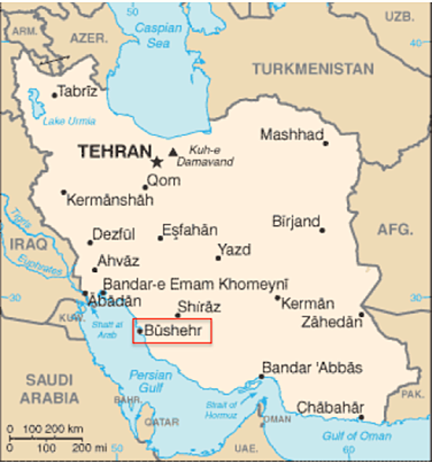
But in that regard, Iran has also just recently reached 100% output from the first of the nuclear power stations at Bushehr and is about to start construction of the second unit. Nuclear fuel will be provided by Russia, and spent fuel returned to Russia. It is a 1,000-megawatt unit, and since the unit was built under supervision by the International Atomic Energy Agency it is not subject to sanctions.
Figure 1. Bushehr Nuclear Plant
If the protocols that worked to make this happen can be expanded, then it is possible that, though negotiation, the tension in the region can be eased. This could well have benefits all around, most particularly for ensuring that, for at least a sadly few more years, there will be enough oil on the market to meet demand at a reasonable price.
Figure 2. Location of the Bushehr Plant
Read more!
Labels:
Brazil,
Bushehr nuclear plant,
China,
CNN,
crude oil production,
Iran,
Iraq,
KSA,
Libya,
Majnoon,
oil demand,
Russia
Sunday, August 11, 2013
Tech Talk - Oil Supply, Oil Prices and the Kingdom of Saudi Arabia
From the time that The Oil Drum first began, and through the years up to the Recession of 2008-9 there was an increase in the price of oil, and that resumed following the initial period of that recession, and, in contrast to the price of natural gas, oil has recovered a lot of the price that it lost.
Figure 1. Comparable price of oil from 1946 (Inflation data)
And if one were to draw a straight line on that graph from the low point in 1999 though now there hasn’t been a huge variation away from the slope of that line for long. That, of course, does not stop folk from pointing to the very short, roughly flat, bit at the end and saying that oil prices are going to remain at that level, or are even about to decline.
To address that final point first, I would suggest that those making such a foolish prediction should go away and read the OPEC Monthly Oil Market Reports. Remember that, for just a little while longer, oil is a fungible product. OPEC make no secret of the fact that they continuously examine the global economy and make estimates on how it is going to behave. This month they note that the economies aren’t doing quite as well as expected, and have revised down global growth to 2.9%, though they expect next year to be better, and hold to their estimate of a 3.5% growth rate.
But OPEC go beyond just making that prediction, they use it, and data that they have on consumption and oil supplies around the world, to estimate how much OPEC should produce each month to balance supply against demand, so that the price will remain at a comfortable level for the OPEC economies. And based on those numbers they tailor production.
This month, for example, they note that global oil demand is anticipated to grow by 0.8 mbd this year (and by 1.04 mbd in 2014). They anticipate growth in production of around 1.0 mbd from the non-OPEC nations, with projected increases from Canada, the United States, Brazil, the Sudans and Kazakhstan contributing to an additional 1.1 mbd next year. From these numbers they can project that demand for OPEC oil will be slightly down this year, at 29.9 mbd down 0.4 mbd on last year, with next year seeing an additional fall of 0.3 mbd on average.
Figure 2. Projected oil demand for 2013 (OPEC MOMR )
Thus slight reductions in production from OPEC, and particularly the Kingdom of Saudi Arabia, (KSA) can keep the world supply in balance with demand and more critically for them keep the price up at a level that they are comfortable with. Note that in relation to the overall volumes of oil being traded they are not talking much adjustment in their overall volume (around 1% of the total 30 mbd) in order to sustain prices. The USA produces more, OPEC produces less – not much less because global demand is growing – and the price is sustained.
This has virtually nothing to do with the speculators on Wall Street and the corrections they might impose, this is all about supplying a needed volume to meet a demand and controlling that supply to ensure that the price is sustained.
There are a number of caveats to this simplified explanation, one being the short-term willingness and ability of some producers to keep to their targets. One of the imponderables is the production from Iraq. Although Iraq has been given a waiver through 2014 on the need to limit their production, the increasing violence has led to a drop in production, back below 3 mbd.
Figure 3. OPEC production based on data from secondary sources (OPEC MOMR)
As I have noted in the past, OPEC is sufficiently suspicious of the reported numbers from the countries themselves that they check from secondary sources, and provide both sets of numbers.
Figure 4. OPEC production numbers from the originating countries. (OPEC MOMR August 2013)
Note, for example, that Iran says that it is producing over 1 mbd more than other sources report, and Venezuela is around 400 kbd light. The balancing act is largely the charge of KSA, since it produces the largest amount and can adjust more readily to balance the need.
One of the other caveats is that the internal demand in these countries is rising, and that lowers the amount that can be exported. This will in time require that OPEC produce more, just to sustain the amounts that they export. And the problem here is the biggest caveat of all. Because KSA cannot continue to produce ever increasing amounts of oil.
Just exactly how much the country can produce is the subject of much debate, and has been at The Oil Drum since its inception. But if I can now gently admonish those who think it can keep increasing forever, and that it has vast reserves that can flood the market at need. This fails to recognize that the major fields on which the country has relied are no longer capable of their historic production levels, and that, over the time that TOD has been in existence, production has switched to the new fields that KSA had promised it would, back in time.
But these new fields, including Manifa and Safaniya produce a heavier crude that, for years, KSA struggled, usually in vain, to find a market for internationally. It is only now that it is building its own refineries to process the oil that it can find a global market for the product. Yet those refineries have only a limited capacity. If you can’t ship, refine and market your product in the form that the customer needs, it can’t be sold, regardless of how much, instantaneously, you can pump out of the ground. And so KSA is starting to look harder for other fields. They have increased the number of rigs employed to 170 by the end of the year (in 2005 they had about 20 oil and 10 gas rigs operating), going beyond the 160 estimated earlier, seeking both to raise production from existing fields, but also to find new ones. This is almost double the number that Euan reported at the end of last year. That this is being expedited is not good news! Because new fields will very likely be smaller, and more rapidly exhausted, and may not have the quality of the oil produced from Ghawar and the other old faithfuls.
Realistically, over a couple of years, I would suspect that the oil price line, that I mentioned was rising at the beginning of the piece will continue to rise and we are just going to have to accommodate to it.
Read more!
Friday, May 4, 2012
OGPSS - a little more detail on hydraulic fracturing
There is a real, practical limit to the amount of oil that can be recovered from a reservoir. Depending on the availability and economic viability of different technical approaches that limit might be less than 25% of the total volume of oil originally in place, or it can be more than 50%, as has been achieved in some of the fields in the Kingdom of Saudi Arabia(KSA). But one cannot get out more oil than is originally there, and in most cases it is difficult to reach even half that value. However, where the volumes of oil that have been left by conventional methods remains high, as it does in the KSA, then the use of advanced technology, as I began to explain last time, become easier to justify.
KSA is now reaching the point where the easy production of oil, as in sink vertical wells at kilometer intervals and watch an average of 10 kbd merrily bubble to the surface, is now largely over. Increasingly the oilfields are moving into the more advanced, and costly, procedures that help sustain a production that would, under earlier production regimes, by now have long faded into memory. Ghawar, for example, is moving into CO2 injection and some steam assist (likely with the areas with heavier, tar-ier deposits) seeking to maintain an overall 5 mbd production. But today I want to talk a little about their increasing use of hydraulic fracturing of their horizontal wells, and a little more technical detail about growing cracks through rocks. Consider the problem that high production fields have, when a horizontal well runs through a high permeability, or densely fractured zone. The impact of this on premature water breakthrough is well documented. The relative preferential movement, for example of water along faults can be seen in this model from Ghawar.
Figure 1, Relative water movement along faults in Ghawar (Dogru et al)
It is also evidenced by this simulated model of the effect of high fracture densities on the performance of MRC wells, where increasing the drawdown pressure to pull fluid into the wells can lead to premature watering out of the well.
Figure 2. Use of a low draw down pressure to maintain oil flow.
With low draw down, the flow rates are reduced, but the fluid entering the well remains largely oil (Mubarak et al) In contrast if the differential pressure is increased (by lowering well pressure) then the greater flow rates allows the underlying water to flow up the fractures and prematurely waterflood the well.
Figure 3. The use of a higher draw down pressure preferentially encourages water migration up the fractures, killing the well prematurely. (Mubarak et al)
It has been obvious to Aramco (who run the KSA fields) for some time that adding their own fracture paths to the field would result in better performance, and could also help overcome the problem of natural fractures and high-permeability zones such as those known as the Super-K in Ghawar.
Figure 4. Section through conventional dolomite at Ghawar (Cantrell et al)
Figure 5. Section through the super-K dolomite (0nly 5-ft from the sample in figure 2, in the same well. (Cantrell et al)
Figure 8. Crack grown from a shorter notch, with a higher speed of advance in the sample, note the smooth surface.
Figure 10. Induced fracture and the evidence for it from the temperature log (Rahim and Al-Qatani )
Figure 11. Pressure plot during the generation of a hydraulic fracture (Al-Naimi et al).
KSA is now reaching the point where the easy production of oil, as in sink vertical wells at kilometer intervals and watch an average of 10 kbd merrily bubble to the surface, is now largely over. Increasingly the oilfields are moving into the more advanced, and costly, procedures that help sustain a production that would, under earlier production regimes, by now have long faded into memory. Ghawar, for example, is moving into CO2 injection and some steam assist (likely with the areas with heavier, tar-ier deposits) seeking to maintain an overall 5 mbd production. But today I want to talk a little about their increasing use of hydraulic fracturing of their horizontal wells, and a little more technical detail about growing cracks through rocks. Consider the problem that high production fields have, when a horizontal well runs through a high permeability, or densely fractured zone. The impact of this on premature water breakthrough is well documented. The relative preferential movement, for example of water along faults can be seen in this model from Ghawar.
It is also evidenced by this simulated model of the effect of high fracture densities on the performance of MRC wells, where increasing the drawdown pressure to pull fluid into the wells can lead to premature watering out of the well.
Figure 2. Use of a low draw down pressure to maintain oil flow.
With low draw down, the flow rates are reduced, but the fluid entering the well remains largely oil (Mubarak et al) In contrast if the differential pressure is increased (by lowering well pressure) then the greater flow rates allows the underlying water to flow up the fractures and prematurely waterflood the well.
Figure 3. The use of a higher draw down pressure preferentially encourages water migration up the fractures, killing the well prematurely. (Mubarak et al)
It has been obvious to Aramco (who run the KSA fields) for some time that adding their own fracture paths to the field would result in better performance, and could also help overcome the problem of natural fractures and high-permeability zones such as those known as the Super-K in Ghawar.
Contrast this with the blue epoxy-filled pores of the super-K layers which indicate the high permeability.
There is thus an incentive to provide paths for the oil to make it as easy to reach the well. What follows is a more advanced discussion of hydraulic fracturing, but for those who are not that interested, the earlier simpler description is given here (TOD and BTE).
Now just a little bit of extra tech talk. If you take a rectangular piece of Plexiglas (which gets around the geological variations in properties that occur with rock) as an example, and carefully cut a notch into the center of the block, you can grow a crack out from that notch, by putting the beam into simple 3-point bending. (We started doing this because we wanted some experimental results to compare with the various theories predominant at the time over the stresses required to initiate fractures).
Figure 6. Crack grown out from a wire-sawn notch in Plexiglas, under 3-point bending.
One of the first practical steps you take is to stop using a wire saw for the entire crack but cut most of the notch with a milling tool, and only use the wire saw for the last few mm. (The reason is that the heat on the wire causes a high failure rate of the cutting wire, particularly with a set of neophyte graduate students, and the wire, being diamond impregnated, is very expensive).
The next thing that you learn is that if you adjust the crack length, you can grow the crack very slowly and stop if where you want, so that it is fairly easy to work out how much work you are putting in relative to the crack surface generated, and the force required to start the crack. Further the surface of the fractured surface has a characteristic look, which we called “river lines.”
However if you changed the notch length so that so that it was less of a percentage of the sample width, the crack almost immediately moved much faster, and unless you made a special effort, could not be stopped within the sample (as occurred in Figure 4). And further the crack surface was very smooth, in contrast with the "river lines" of the slower moving crack.
Figure 8. Crack grown from a shorter notch, with a higher speed of advance in the sample, note the smooth surface.
What this shows is something that Dick Bieniawski was also finding in rock itself (as we later also demonstrated). Depending on the initial length of the crack, so the speed that the crack grows at changes, and at the higher speed it moves, not around the particles of rock, but often through them. (In our case we were seeing the effects of discontinuities in the Plexiglas as the cause of the deviations in the surface). Dick’s work is given here and here, though I found it in the International Journal of Rock Mechanics and Mining Science (vol 4 no. 4 pp 395 – 430).
Essentially he found (and this has been confirmed by others that based on initial geometry a crack begins to grow relatively slowly, but then accelerates to a terminal velocity, which remains relatively constant. Unfortunately the papers are behind a paywall, so I cannot use the exact curve that Dick drew, but I am going to approximate it, as follows:
(Half lengths are used, since for many theories the crack is anticipated to initiate as an oval shape. For the fractures in the field these are usually measured in tens of feet. (Rahim and Al-Qatani)
There are two critical points that come out of this work. The first is that it is preferable to start with a crack of a significant length so that the acceleration rapidly moves to a trans-granular surface, rather than just growing around the grains. The reason for this is practical in that small cracks can be stopped if they reach an area with a large radius (as in the reason you drill a hole at the end of a crack to stop it growing through a sheet of metal). Having the crack initially moving faster means that it can overcome small open spaces, but also that it can create a smoother, slicker path along which fluid can flow with less resistance.
The other aspect of growing the crack is that if you try putting too much energy into it (for example by over-pressuring the borehole) the crack will not grow faster, rather it will expend the additional energy by splitting into a number of cracks that deviate off somewhat from the original direction. That also tends not to be a good thing if you are trying to open a single passage way through the rock, wide enough to push particles into, along with the fracturing fluid. To stop that happening one can, for example pulse the pressure in the well so that only enough energy gets to the crack tip so as to keep only a single fracture growing out. One also has to ensure that the crack is initiated within the right orientation to the existing stress fields. Aramco have, however, become skilled in determining the effectiveness of the fractures by monitoring, among other things, the temperature flows of fluids into the well.
Figure 10. Induced fracture and the evidence for it from the temperature log (Rahim and Al-Qatani )
Aramco have started to use hydraulic fractures in their horizontal wells, including those with open hole completions with the interval between packers ranging from 100 to 1000 ft, depending on geology.
The pressure within the packed off section of the horizontal well is then increased until the wall fractures and the crack grows out into the formation. An example of how the pressure changes in the well as the fracture grows is given by Al-Naimi et al.
Getting the rest of the oil, after the best is gone, is an ongoing effort, particularly in older fields such as Ghawar. But understanding some of the technology makes it possible to further appreciate what Aramco are developing to further produce some of the more difficult regions within the field. (But that is a topic for another day).
Read more!
Labels:
Arab D,
Aramco,
cracks,
Ghawar,
horizontal wells,
hydraulic fracture,
KSA
Subscribe to:
Posts (Atom)