Showing posts with label South Africa. Show all posts
Wednesday, August 7, 2013
Waterjetting 12A - The heat involved in cutting - Part A - Cutting Rock
As I was beginning to write these posts Bob Pedrazas, who is kind enough to transcribe these words over to the KMT Waterjet page, gave me some questions that had been asked about the technology of high-pressure and ultra-high pressure water jet cutting. At the time I gave an academic answer, pointing out that I would have to explain some background material, before the average reader might be able to follow the logic of some of my answers. Thus I did not plan to answer specific questions (though I would respond to comments) in the early days of the site.
It is almost a year since I first began putting these posts together. Along the way I have tried to answer some of the questions on his list without specifically calling out the question – for example the answer to the question as to whether selecting the right system was important was, I hope, shown by a plot early in the series. I presented a comparative graph that showed that despite different systems having nominally the same power, water and abrasive values, when comparative cuts were made, in similar materials that there was a considerable difference between the depths of cut that could be achieved using the different designs. (So obviously selecting the best system has considerable benefit to the operator, over selecting another).
One question that was raised relates to the heat of the cutting process. And while it has a relatively simple short answer (waterjet cutting used to be sometimes called “cold cutting”) I am going to take a few posts to explain the answer in a little more detail. Part of the reason for this is that the information that I have comes from several sources, some in cutting rock, and some in cutting metal, and there are some different applications along the way that all fold into the general topic of heat in the cutting process.
Let me begin with the work of a friend of mine, Mike Hood, who was working in the South African gold mines at the time he decided to go for his doctoral degree (Hood, M. (1978) "A Study of Methods to Improve the Performance of Drag Bits Used to Cut Hard Rock," Ph.D. thesis, University of Witwatersrand, R.S.A."). To understand the problem that he addressed you should know that in some of the mines in South Africa the gold-bearing rock is contained in a very thin layer, within a surrounding host rock, which is a quartzite and very hard to cut.
Figure 1. Drilling the rock around a gold seam in South Africa (New Scientist )
However if miners are to get in and extract that thin vein (which is often only six-inches to a foot thick they have to drive passages that are big enough to work in (perhaps six-feet high). Thus rock on either side of the thin vein of gold-bearing material is drilled and then the entire rock face is blasted out using explosive. Now the gold ore is mixed in with all the other rock from the blast. This means that all that material must be lifted perhaps two miles to the surface, and then ground to a fine powder to release the gold. Both of these are very energy intensive operations.
Consider instead if, before the rock on either side of the vein was blasted out, the face could be cut with two slots, one above and one below the gold reef. That could then be removed, and the rock on either side could then be blasted, but instead of being hauled away it could be packed into the open space behind the working area, holding up the roof and saving a huge amount of the processing energy otherwise required. (There is less than half an ounce of gold in a ton of the reef ore, and when the rock on either side is included then this concentration becomes much less).
Figure 2. Design of cutting tool to carve a channel into the quartzite (Mike Hood )
Mike was initially looking to used carbide cutting teeth to cut into the rock and make these slots. However, he rapidly discovered that as he dragged the bit across the rock, that even at relatively shallow cutting depths (about 2/10ths of an inch) the cutting tool was getting very hot very quickly, to the point that the carbide was starting to melt.
Figure 2. Temperatures building up on the carbide cutting tool (after Hood ibid)
Obviously, if the bit could be kept cool, then the carbide would not soften, and thus remain sharp and able to cut better. Yet the temperatures that the bit was reaching very early in the cutting process meant that there was a lot of heat being generated during the cutting.
As a result he decided to run a series of tests in which he played water onto the leading edge of the bit to cool it. But because of the heat involved he wanted to get a fairly high flow rate to the bit, which was almost buried in the rock, and otherwise hard to get to. So to ensure the flow got to the right place he used higher-pressure waterjets that flowed through small nozzles, mounted to shoot the jets at different points on the carbide:rock cutting face.
Figure 4. Location of the jets on the carbide bits in the initial tests carried out by Dr Hood. ( hood Dissertation )
There are two forces needed to make the drag bit cut into the rock as it moves forward. The first of these is the Thrust Force, which is the force which pushed the tool into the rock, so that it will cut to the required depth. The second is the drag or Cutting Force that is used to pull the bit along the face at the required depth.
Without the waterjets on the bit, the load on the machine was exceeded when the drag bit was cutting to about 5 mm deep (2/10ths of an inch) into the rock. But when the waterjets were added to the bit, not only did the bit stay cool, but it was able to cut more than twice as deep, at lower forces onto the bit, and thus with a lower power demand on the machine.
Figure 5. Change in thrust force when waterjets are placed in front of the drag bit (Hood Dissertation)
Figure 6. Change in cutting force when waterjets are placed in front of the drag bit (Hood Dissertation )
This result has since been repeated by a number of different laboratories around the world, and led on to the development of mining machines, and other applications.
In the next post I will explain why what happens does, and why adding such jets to a cutting tool can, in the right place, save considerable amounts of money and time.
It is almost a year since I first began putting these posts together. Along the way I have tried to answer some of the questions on his list without specifically calling out the question – for example the answer to the question as to whether selecting the right system was important was, I hope, shown by a plot early in the series. I presented a comparative graph that showed that despite different systems having nominally the same power, water and abrasive values, when comparative cuts were made, in similar materials that there was a considerable difference between the depths of cut that could be achieved using the different designs. (So obviously selecting the best system has considerable benefit to the operator, over selecting another).
One question that was raised relates to the heat of the cutting process. And while it has a relatively simple short answer (waterjet cutting used to be sometimes called “cold cutting”) I am going to take a few posts to explain the answer in a little more detail. Part of the reason for this is that the information that I have comes from several sources, some in cutting rock, and some in cutting metal, and there are some different applications along the way that all fold into the general topic of heat in the cutting process.
Let me begin with the work of a friend of mine, Mike Hood, who was working in the South African gold mines at the time he decided to go for his doctoral degree (Hood, M. (1978) "A Study of Methods to Improve the Performance of Drag Bits Used to Cut Hard Rock," Ph.D. thesis, University of Witwatersrand, R.S.A."). To understand the problem that he addressed you should know that in some of the mines in South Africa the gold-bearing rock is contained in a very thin layer, within a surrounding host rock, which is a quartzite and very hard to cut.
Figure 1. Drilling the rock around a gold seam in South Africa (New Scientist )
However if miners are to get in and extract that thin vein (which is often only six-inches to a foot thick they have to drive passages that are big enough to work in (perhaps six-feet high). Thus rock on either side of the thin vein of gold-bearing material is drilled and then the entire rock face is blasted out using explosive. Now the gold ore is mixed in with all the other rock from the blast. This means that all that material must be lifted perhaps two miles to the surface, and then ground to a fine powder to release the gold. Both of these are very energy intensive operations.
Consider instead if, before the rock on either side of the vein was blasted out, the face could be cut with two slots, one above and one below the gold reef. That could then be removed, and the rock on either side could then be blasted, but instead of being hauled away it could be packed into the open space behind the working area, holding up the roof and saving a huge amount of the processing energy otherwise required. (There is less than half an ounce of gold in a ton of the reef ore, and when the rock on either side is included then this concentration becomes much less).
Figure 2. Design of cutting tool to carve a channel into the quartzite (Mike Hood )
Mike was initially looking to used carbide cutting teeth to cut into the rock and make these slots. However, he rapidly discovered that as he dragged the bit across the rock, that even at relatively shallow cutting depths (about 2/10ths of an inch) the cutting tool was getting very hot very quickly, to the point that the carbide was starting to melt.
Figure 2. Temperatures building up on the carbide cutting tool (after Hood ibid)
Obviously, if the bit could be kept cool, then the carbide would not soften, and thus remain sharp and able to cut better. Yet the temperatures that the bit was reaching very early in the cutting process meant that there was a lot of heat being generated during the cutting.
As a result he decided to run a series of tests in which he played water onto the leading edge of the bit to cool it. But because of the heat involved he wanted to get a fairly high flow rate to the bit, which was almost buried in the rock, and otherwise hard to get to. So to ensure the flow got to the right place he used higher-pressure waterjets that flowed through small nozzles, mounted to shoot the jets at different points on the carbide:rock cutting face.
Figure 4. Location of the jets on the carbide bits in the initial tests carried out by Dr Hood. ( hood Dissertation )
There are two forces needed to make the drag bit cut into the rock as it moves forward. The first of these is the Thrust Force, which is the force which pushed the tool into the rock, so that it will cut to the required depth. The second is the drag or Cutting Force that is used to pull the bit along the face at the required depth.
Without the waterjets on the bit, the load on the machine was exceeded when the drag bit was cutting to about 5 mm deep (2/10ths of an inch) into the rock. But when the waterjets were added to the bit, not only did the bit stay cool, but it was able to cut more than twice as deep, at lower forces onto the bit, and thus with a lower power demand on the machine.
Figure 5. Change in thrust force when waterjets are placed in front of the drag bit (Hood Dissertation)
Figure 6. Change in cutting force when waterjets are placed in front of the drag bit (Hood Dissertation )
This result has since been repeated by a number of different laboratories around the world, and led on to the development of mining machines, and other applications.
In the next post I will explain why what happens does, and why adding such jets to a cutting tool can, in the right place, save considerable amounts of money and time.
Read more!
Labels:
drag bit,
jet assist,
mechanical cutting,
Mike Hood,
quartzite,
South Africa
Tuesday, July 19, 2011
Katla continues to develop toward an upcoming volcanic eruption
The Icelandic press is reporting that there are ponds collecting as the ice in the Myrdalsjokull glacier continues to melt from the increasing heat coming from the underlying volcano, Katla, in Iceland. (h/t Jón Frímann ).
Collapsing ice cap above Katla (Iceland Review – English, and Icelandic ) (Remember that the black cover is because of the ash from Eyjafjallajokull last year)
As the fractures from the earthquakes continue to fracture to the surface, so the paths that they create allow water to migrate down to the underlying hotter rock. This then converts to steam, and flows back up helping to further melt the underside of the ice sheet, with some water possibly escaping down the mountain, under the ice. These floods can be sudden, as was the one that took out the ring road around Iceland. That has now been repaired, a week after the flood took it out.
The narrowness of the fracture paths, at least initially, will slow magma migration and this will likely allow more additional activity at the surface, although Katla does not give a lot of warning before it erupts, apparently.
One of the misfortunes of having retired and given away many of my books is that I no longer have the references that relate quake size to rock damage. A lot of this work was done in the South African gold mines, which go down over 3 km (2 miles) and are thus at the depths of many of the current quakes around Katla. As the mines extended the workings so the weight of the surrounding rock shifted, and the speed of this (usually following a mine blast with explosives that broke out some rock) would cause rock fracture in the area.
Quakes could be created that were up to a magnitude 4, similar to some of those around Katla recently, and resulted in significant rock movement and fracture. Underground this leads to problems with keeping the tunnels open and safe for the workers (since the rock bursts can be violent and hurl rock fragments a long way, as well as creating air blasts that can also be dangerous). There have also been larger ones.
But I was trying to get some sense of displacement and damage as a function of seismic strength, since when the rock fractures there is often some crushing of the rock along the interface of the fracture, and this would then be removable by the upward pressure of magma, and the fractures released the overlying confinement. The initial crushed zone probably measures just a few inches, but will be eroded out by water/steam passage and the later passage of magma, since fractured rock is easily removed. This then gives the open passages for magma to move. If the fractures intersect then the intervening rock will likely also be removed since the magma has a higher density and thus more power than mere water or steam flows. There have now been several dozen quakes within the region of the Katla caldera, and knowing the damage zone from each would allow a better estimate of how damaged the rock is. Bear in mind that the re-healed fractures (healed by cooling magma) from earlier eruptions are likely the weakest links that are now failing and opening, and in the process, therefore rebuilding the network of passages that are needed for flow. The levels of permeability generated are orders of magnitude greater than that from a typical oil well.
Where the rock is attached to the overlying ice, then cracks in the rock can also occur in the overlying ice. And you may note that in the above picture apart from the circular rings of fractures, there are three well defined line cracks that cross the circular fractures. If you also look at the web cam you can see (in daylight) some of the lines where magma has flowed up to the surface in earlier eruptions (the picture shown in the last post).
So we now watch as the process continues to unfold.
Collapsing ice cap above Katla (Iceland Review – English, and Icelandic ) (Remember that the black cover is because of the ash from Eyjafjallajokull last year)As the fractures from the earthquakes continue to fracture to the surface, so the paths that they create allow water to migrate down to the underlying hotter rock. This then converts to steam, and flows back up helping to further melt the underside of the ice sheet, with some water possibly escaping down the mountain, under the ice. These floods can be sudden, as was the one that took out the ring road around Iceland. That has now been repaired, a week after the flood took it out.
The narrowness of the fracture paths, at least initially, will slow magma migration and this will likely allow more additional activity at the surface, although Katla does not give a lot of warning before it erupts, apparently.
One of the misfortunes of having retired and given away many of my books is that I no longer have the references that relate quake size to rock damage. A lot of this work was done in the South African gold mines, which go down over 3 km (2 miles) and are thus at the depths of many of the current quakes around Katla. As the mines extended the workings so the weight of the surrounding rock shifted, and the speed of this (usually following a mine blast with explosives that broke out some rock) would cause rock fracture in the area.
Quakes could be created that were up to a magnitude 4, similar to some of those around Katla recently, and resulted in significant rock movement and fracture. Underground this leads to problems with keeping the tunnels open and safe for the workers (since the rock bursts can be violent and hurl rock fragments a long way, as well as creating air blasts that can also be dangerous). There have also been larger ones.
But I was trying to get some sense of displacement and damage as a function of seismic strength, since when the rock fractures there is often some crushing of the rock along the interface of the fracture, and this would then be removable by the upward pressure of magma, and the fractures released the overlying confinement. The initial crushed zone probably measures just a few inches, but will be eroded out by water/steam passage and the later passage of magma, since fractured rock is easily removed. This then gives the open passages for magma to move. If the fractures intersect then the intervening rock will likely also be removed since the magma has a higher density and thus more power than mere water or steam flows. There have now been several dozen quakes within the region of the Katla caldera, and knowing the damage zone from each would allow a better estimate of how damaged the rock is. Bear in mind that the re-healed fractures (healed by cooling magma) from earlier eruptions are likely the weakest links that are now failing and opening, and in the process, therefore rebuilding the network of passages that are needed for flow. The levels of permeability generated are orders of magnitude greater than that from a typical oil well.
Where the rock is attached to the overlying ice, then cracks in the rock can also occur in the overlying ice. And you may note that in the above picture apart from the circular rings of fractures, there are three well defined line cracks that cross the circular fractures. If you also look at the web cam you can see (in daylight) some of the lines where magma has flowed up to the surface in earlier eruptions (the picture shown in the last post).
So we now watch as the process continues to unfold.
Read more!
Labels:
eruption,
Eyjafjallajokull,
Iceland volcano,
Katla,
Myrdalsjokull,
rock burst,
South Africa
Thursday, November 12, 2009
Looking back at Peak Global Production of Gold
Yesterday the President of the largest gold mining and production company, Barrick Gold, noted that after ten years of declining production it is time to recognize that the world has seen the peak in gold production. To maintain production ore is being mined with increasingly less gold in it. (The grade of the ore, or metal content, defines whether it is profitable to mine).
Gold roof to the Small Gold Tile Hall of the Ta’er Temple in Qinghai Province, China.
As with peak oil, the fact that global production has peaked, does not mean that there is no gold left to mine. Rather it means that less gold will be mined each year into the future. It will likely, in time, bring back into debate the environmental costs of mining.
For there are deposits of gold still in the ground that are not mined, in part because of the environmental cost. If you go, for example, to the Malakoff Diggins in California (A state park north of American Hill) you will find tall sandstone cliffs that used to be mined using streams of water from large monitors. However, in excavating the rock it was also disintegrated, and the clay particles were carried down into the Sacramento River, gradually filling the river bed, to the point that in heavy rains the river flooded the surrounding communities. Thus, back in 1886 Judge Sawyer restricted the practice, which largely fell into abeyance. But the gold is still “in them thar hills.” Similarly if one goes up to the valleys outside Fairbanks in Alaska, there is gold in the gravel beds – but is has been largely too expensive, both commercially and environmentally, to recover to this point. One of the more recent discoveries in Alaska has become known as the Pebble Mine Project, but while there may be up to 3 million ounces of gold in the region, there has been strong opposition to development. even though that development continues.
Gold has been a valuable mineral for a long time and for nations all around the world. All the good and easy places to find it, therefore, have been sought after and largely found. The gold deposits that are worked have become smaller of lower value and found in places that are harder to get to. With lower availability, greater demand and higher price, it became more practical to mine and process lower grade deposits and to go deeper into the Earth for the higher grades. Mines in South Africa , and in South Dakota worked down to more than 2 miles below the surface, to recover the ore. And techniques have been developed that recover it in even very small quantities – 3 gm per tonne is an ore that contains very little gold (3 divided by 1000 = 0.003 kg divided by 1000 = 0.000003 tonnes or 3 parts per million). So, while miners can still find the odd nugget when they pan for gold in streams around the country (and there are lots of maps available to tell you where to look), for the large scale levels of production that make a significant impact on the market, you need large deposits of gold with the potential for greater yields, and those places are getting harder and harder to find. And even as one goes deeper the grade of the gold doesn’t necessarily continue.
We haven’t run out of gold yet
So, as the oil industry starts its travels down a similar path past peak and into decline, there are a couple of thoughts I would offer.
Firstly it could be pointed out that the gold industry has been able to see the declining production and lack of available prospects for some time. But it is only now, some 9 – 10 years after the decline started, that the industry is publically recognizing the problem.
Secondly one might ask whether there should not be an agency of the government that can independently warn the government and the nation of this before it happens, so that either better mining methods, access to restricted reserves or the development of alternate materials could be hastened. Well actually there was, it was called the U.S. Bureau of Mines and all those tasks were in its charter. But the mining community is a small one, and has not nearly the clout or popularity in Washington that it is though to have, and thus, in 1996 the agency was closed.
Thirdly, even though the story is out there it is unlikely, for a while, to get much media attention, and the vast majority of the world’s population will not either know of the predicament that is now approaching, nor understand why it is going to be something that will impact many aspects of their lives. Until, of course, it does.
And of course gold is only a pre-cursor of other minerals that will soon run short. Few folk realize the role that metals and minerals play in providing their lifestyle, and do not recognize that the value of many metals comes, in part, because there is nothing that can substitute as well for that particular metal in doing a particular job. Unfortunately doing something about it requires vision for an industry that is not favorably viewed by much of the population. It will be interesting to see if that perception changes, or if the industry becomes the target of blame as shortages lead to even further cost increases.
And then, of course, will come oil . . . . .
Ore grades have fallen from around 12 grams per tonne in 1950 to nearer 3 grams in the US, Canada, and Australia. South Africa's output has halved since peaking in 1970.Gold serves two purposes, firstly it has provided, down through history, a form of currency, though it is not clear whether it was Croesus or the Egyptians who used it in trade, both date back to around 5-600 B.C. and gold coins have flourished since that time. (But before then gold was mined around Mestia, in what is now Georgia, back at the time of Jason and the Golden Fleece (before 1300 B.C.) and used for ornamental wear and art objects). But gold also has a useful function as a metal.
The supply crunch has helped push gold to an all-time high, reaching $1,118 an ounce at one stage yesterday.
Gold conducts electricity, does not tarnish, is very easy to work, can be drawn into wire, can be hammered into thin sheets, alloys with many other metals, can be melted and cast into highly detailed shapes, has a wonderful color and a brilliant luster. Gold is a memorable metal that occupies a special place in the human mind.It is even, on occasion, used as a roofing material.
Gold roof to the Small Gold Tile Hall of the Ta’er Temple in Qinghai Province, China. As with peak oil, the fact that global production has peaked, does not mean that there is no gold left to mine. Rather it means that less gold will be mined each year into the future. It will likely, in time, bring back into debate the environmental costs of mining.
For there are deposits of gold still in the ground that are not mined, in part because of the environmental cost. If you go, for example, to the Malakoff Diggins in California (A state park north of American Hill) you will find tall sandstone cliffs that used to be mined using streams of water from large monitors. However, in excavating the rock it was also disintegrated, and the clay particles were carried down into the Sacramento River, gradually filling the river bed, to the point that in heavy rains the river flooded the surrounding communities. Thus, back in 1886 Judge Sawyer restricted the practice, which largely fell into abeyance. But the gold is still “in them thar hills.” Similarly if one goes up to the valleys outside Fairbanks in Alaska, there is gold in the gravel beds – but is has been largely too expensive, both commercially and environmentally, to recover to this point. One of the more recent discoveries in Alaska has become known as the Pebble Mine Project, but while there may be up to 3 million ounces of gold in the region, there has been strong opposition to development. even though that development continues.
Gold has been a valuable mineral for a long time and for nations all around the world. All the good and easy places to find it, therefore, have been sought after and largely found. The gold deposits that are worked have become smaller of lower value and found in places that are harder to get to. With lower availability, greater demand and higher price, it became more practical to mine and process lower grade deposits and to go deeper into the Earth for the higher grades. Mines in South Africa , and in South Dakota worked down to more than 2 miles below the surface, to recover the ore. And techniques have been developed that recover it in even very small quantities – 3 gm per tonne is an ore that contains very little gold (3 divided by 1000 = 0.003 kg divided by 1000 = 0.000003 tonnes or 3 parts per million). So, while miners can still find the odd nugget when they pan for gold in streams around the country (and there are lots of maps available to tell you where to look), for the large scale levels of production that make a significant impact on the market, you need large deposits of gold with the potential for greater yields, and those places are getting harder and harder to find. And even as one goes deeper the grade of the gold doesn’t necessarily continue.
Harmony Gold said yesterday that it may close two more mines over coming months due to poor ore grades.Gold production in South Africa had fallen 9.3% year-on-year last September, this in the country that once led the world in gold production.
We haven’t run out of gold yet
Barrick produced 1.9 m ounces of gold last quarter, down from 1.95 m a year earlier. Costs have been "trending down" to $456 an ounce, though rising energy prices pose a fresh threat. Total reserves are 139 m ounces, far ahead of rival Newmont Mining at 86 m.But production will continue to fall as the reserves become even harder to extract. Beyond a certain point there is not a lot that technology can do, except perhaps to fund ways of getting gold out of veins that are too small and costly to mine at present. But that won’t yield the millions of ounces that are needed to maintain supply. And the industry was not one, in recent years, to invest in that future. When gold can be recovered by soaking crushed rock in a solvent at relatively low cost, there is not a lot of incentive for new ideas. The days of the industrial innovations that used to come from the research labs in South Africa are likely now over.
So, as the oil industry starts its travels down a similar path past peak and into decline, there are a couple of thoughts I would offer.
Firstly it could be pointed out that the gold industry has been able to see the declining production and lack of available prospects for some time. But it is only now, some 9 – 10 years after the decline started, that the industry is publically recognizing the problem.
Secondly one might ask whether there should not be an agency of the government that can independently warn the government and the nation of this before it happens, so that either better mining methods, access to restricted reserves or the development of alternate materials could be hastened. Well actually there was, it was called the U.S. Bureau of Mines and all those tasks were in its charter. But the mining community is a small one, and has not nearly the clout or popularity in Washington that it is though to have, and thus, in 1996 the agency was closed.
Thirdly, even though the story is out there it is unlikely, for a while, to get much media attention, and the vast majority of the world’s population will not either know of the predicament that is now approaching, nor understand why it is going to be something that will impact many aspects of their lives. Until, of course, it does.
And of course gold is only a pre-cursor of other minerals that will soon run short. Few folk realize the role that metals and minerals play in providing their lifestyle, and do not recognize that the value of many metals comes, in part, because there is nothing that can substitute as well for that particular metal in doing a particular job. Unfortunately doing something about it requires vision for an industry that is not favorably viewed by much of the population. It will be interesting to see if that perception changes, or if the industry becomes the target of blame as shortages lead to even further cost increases.
And then, of course, will come oil . . . . .
Read more!
Labels:
Barrick,
Malakoff,
Peak gold,
South Africa,
South Dakota
Saturday, March 21, 2009
P54. Pick Points
So here it is the weekend, and I would usually be putting up Saturday Pick Points, and the Saturday post, with Sunday’s Tech Talk in the wings. However, since I am still wandering around Europe (tonight I am in London, but leave early in the morning for Dumfries and Burns Country) I am, instead going to take a quick peak around and do sort of an abbreviated Pick Points, looking at some half-a-dozen or so stories that are worth a quick look.
Getting around as I do involves a fair bit of travel by plane, and I’ve noticed that the planes seem to be getting smaller, and thus fuller, as the economy spins away. Of course the increased traffic might be because some travelers, can’t have a new jet of their own, though I doubt it. China is now providing its suppliers with increasing quantities of jet fuel, perhaps suggesting that while the rest of the world is cutting back , they continue to grow. Cutting back is almost the universal cry, and certainly the restaurant business has to be hurting. And I have eaten in a number of places recently where I was one of only few customers. Of course sometimes it is because, when I go to places like the Fem Sma Hus in Stockholm I show up at American dinner times not European (most of my meal I was alone in the cellar, but just before I left it became crowded). This lack of demand hurts chef employment, in NYC the restaurant trade lost more than 10,000 employees in the three months over the end of the year, nationally the drop has been more than 100,000. And with reduced waitstaff, in more popular places this can catch management out when there is an evening surge in demand. Which may “earn” you a free glass of wine as it did for me tonight in London. Sadly, however, sales of alcohol often pick up in troubled times, as they are now in Russia, while the harsher economic environment means that the smaller firms are pushed out of the trade.
Robert Rapier has noted that this is a good time to pick up alcohol – though he is talking of the ethanol variety in his most recent column at R-Squared Energy Blog: Valero Now in the Ethanol Business. As he notes VeraSun, the nations second largest ethanol manufacturer, filed for Chapter 11 at the end of October. The corporate assets are now on the block, and Valero Energy stand to pick up the seven ethanol refineries, at a quarter of the construction costs. Other ethanol companies have already filed for bankruptcy protection, and it appears Aventine may soon be in similar straits. Yet even as these sales start, the scale of the volume that ethanol will contribute, relative to the coming need is small, and while it provides, as Robert notes, an easy way to pick up a fuel that is being mandated as part of future supply, for small change to the oil companies, it is not going to be more than a contributory part to the answer. Yet, at the moment, despite that mandate, farmers are planting a greater fraction of the crop in soy beans this year, anticipating a bust in corn prices (which prophecy might be self-defeating). On the other hand if the import tariffs are reduced, as some in the Senate suggest, we may be able to import all we need. (But wasn’t there this slogan about freeing ourselves from imported fuel dependency?) Even the Wall Street Journal has weighed in against ethanol, though that also gives me the chance to make a small technical note. Unless I am doing something stupidly wrong (not unlikely) American Kindles can’t yet pick up magazines and papers in Europe (neither Sweden nor the UK). So much for my plan to save weight in my carry-on baggage by just loading the papers to it – Rabbits! Though I guess they may have other bigger troubles.
Solar panel advocates can no doubt breathe a sigh (though they said it was rather a shout) as the final Space Station panels were successfully installed. The station now has enough power to allow double the crew. Down on Earth the Administration is making its first Federal loan guarantee for alternative energy. The guarantee is for $535 million and will help construct a PV facility that can generate panels to produce up to 500 MW per year. The panels are designed for use on rooftops. The world’s solar PV installations are stated to have reached a combined total of almost 6 GW by the end of last year with Europe getting 82% of the business to date. (The ranking by country is Spain, Germany, USA, Korea, Italy and Japan). Sales are thus on a positive upward trend, with DuPont estimating a trebling of sales by 2012. First Solar have also just announced that they have now produced 1 GW of their solar modules, so with manufacture gearing up, all we need now is the market growth.
The other major renewable, wind power, is also gaining market, with a new effort to put turbines into South Africa. The country, as you may remember, has had problems with suppling power, not only for its own needs, but that of its neighbors. The first 30 MW farm is not scheduled until 2011, which won’t help the intervening shortages. It will, however, quadruple capacity. Eskom – the main SA power provider needs a rate increase, but is having trouble getting its act together, and having a power failure at a rally to improve their public posture sure doesn’t help. It is frustrating enough to Botswana, who got most of their power from SA, that they have started seeing pink elephants. (Would I lie to you ?). Of course it’s not just the South Africans that can run into infighting over turf relative to wind power, though the new Interior Secretary promises to get it stopped.
And finally (as the clock kicks over here in London) it is 4 years ago that Kyle Saunders and I first posted our collaborative effort that was, and is, The Oil Drum. I have posted a short history of the site, over there, and repeat the very best wishes that I have for the site. It has filled a valuable need, and that will not diminish in the months and years ahead, and so my wish that the site “Live long, and Prosper.”
More stories can be found at The Energy Bulletin and Drumbeat at The Oil Drum.
Getting around as I do involves a fair bit of travel by plane, and I’ve noticed that the planes seem to be getting smaller, and thus fuller, as the economy spins away. Of course the increased traffic might be because some travelers, can’t have a new jet of their own, though I doubt it. China is now providing its suppliers with increasing quantities of jet fuel, perhaps suggesting that while the rest of the world is cutting back , they continue to grow. Cutting back is almost the universal cry, and certainly the restaurant business has to be hurting. And I have eaten in a number of places recently where I was one of only few customers. Of course sometimes it is because, when I go to places like the Fem Sma Hus in Stockholm I show up at American dinner times not European (most of my meal I was alone in the cellar, but just before I left it became crowded). This lack of demand hurts chef employment, in NYC the restaurant trade lost more than 10,000 employees in the three months over the end of the year, nationally the drop has been more than 100,000. And with reduced waitstaff, in more popular places this can catch management out when there is an evening surge in demand. Which may “earn” you a free glass of wine as it did for me tonight in London. Sadly, however, sales of alcohol often pick up in troubled times, as they are now in Russia, while the harsher economic environment means that the smaller firms are pushed out of the trade.
Robert Rapier has noted that this is a good time to pick up alcohol – though he is talking of the ethanol variety in his most recent column at R-Squared Energy Blog: Valero Now in the Ethanol Business. As he notes VeraSun, the nations second largest ethanol manufacturer, filed for Chapter 11 at the end of October. The corporate assets are now on the block, and Valero Energy stand to pick up the seven ethanol refineries, at a quarter of the construction costs. Other ethanol companies have already filed for bankruptcy protection, and it appears Aventine may soon be in similar straits. Yet even as these sales start, the scale of the volume that ethanol will contribute, relative to the coming need is small, and while it provides, as Robert notes, an easy way to pick up a fuel that is being mandated as part of future supply, for small change to the oil companies, it is not going to be more than a contributory part to the answer. Yet, at the moment, despite that mandate, farmers are planting a greater fraction of the crop in soy beans this year, anticipating a bust in corn prices (which prophecy might be self-defeating). On the other hand if the import tariffs are reduced, as some in the Senate suggest, we may be able to import all we need. (But wasn’t there this slogan about freeing ourselves from imported fuel dependency?) Even the Wall Street Journal has weighed in against ethanol, though that also gives me the chance to make a small technical note. Unless I am doing something stupidly wrong (not unlikely) American Kindles can’t yet pick up magazines and papers in Europe (neither Sweden nor the UK). So much for my plan to save weight in my carry-on baggage by just loading the papers to it – Rabbits! Though I guess they may have other bigger troubles.
Solar panel advocates can no doubt breathe a sigh (though they said it was rather a shout) as the final Space Station panels were successfully installed. The station now has enough power to allow double the crew. Down on Earth the Administration is making its first Federal loan guarantee for alternative energy. The guarantee is for $535 million and will help construct a PV facility that can generate panels to produce up to 500 MW per year. The panels are designed for use on rooftops. The world’s solar PV installations are stated to have reached a combined total of almost 6 GW by the end of last year with Europe getting 82% of the business to date. (The ranking by country is Spain, Germany, USA, Korea, Italy and Japan). Sales are thus on a positive upward trend, with DuPont estimating a trebling of sales by 2012. First Solar have also just announced that they have now produced 1 GW of their solar modules, so with manufacture gearing up, all we need now is the market growth.
The other major renewable, wind power, is also gaining market, with a new effort to put turbines into South Africa. The country, as you may remember, has had problems with suppling power, not only for its own needs, but that of its neighbors. The first 30 MW farm is not scheduled until 2011, which won’t help the intervening shortages. It will, however, quadruple capacity. Eskom – the main SA power provider needs a rate increase, but is having trouble getting its act together, and having a power failure at a rally to improve their public posture sure doesn’t help. It is frustrating enough to Botswana, who got most of their power from SA, that they have started seeing pink elephants. (Would I lie to you ?). Of course it’s not just the South Africans that can run into infighting over turf relative to wind power, though the new Interior Secretary promises to get it stopped.
And finally (as the clock kicks over here in London) it is 4 years ago that Kyle Saunders and I first posted our collaborative effort that was, and is, The Oil Drum. I have posted a short history of the site, over there, and repeat the very best wishes that I have for the site. It has filled a valuable need, and that will not diminish in the months and years ahead, and so my wish that the site “Live long, and Prosper.”
More stories can be found at The Energy Bulletin and Drumbeat at The Oil Drum.
Read more!
Labels:
alcohol,
bankruptcy,
Botswana,
China,
corn ethanol,
ethanol,
jet fuel,
Kindle,
pink elephant,
PV,
restaurants,
solar cells,
South Africa,
soy beans,
The Oil Drum,
wind
Sunday, March 8, 2009
P50. Pick Points
Iraq has taken a look at the current state of the world oil market and is becoming concerned to the point of suggesting that OPEC should cut production some more this month. Iraq is currently producing 2.4 mbd, of which 1.9 mbd are exported. They are looking to raise production by 0.5 mbd. (though some say that exports dropped to 1.8 mbd in February). 75% of this goes through Basra, and 25% up through the Turkish port of Ceyhan. Iran has looked at the same data and is suggesting that OPEC might want to get some help from the non-OPEC group in order to get production down to where everyone can go back to making money. They feel that the 4.2 mbd cut that OPEC has now achieved is still not enough. According to the latest figures however, with production cuts of 13%, world inventories of oil are dropping at a rate of 1.4 mbd around the world. A majority of Bloomberg analysts are expecting OPEC to continue to cut. The question is, how much further will demand drop, and the IEA is projecting about another 1 mbd.
Iran is threatening to sue Turkmenistan over the gas cut it received in January, when Turkmenistan cut off the 23 million cu . m. (812 million cu. ft) supply to Iran. This is normally about 5% of Iranian consumption and is used to supply areas of the Northeast of Iran that are difficult to get to from the South. It was particularly arduous for Iran because of the cold weather, this was the first time in a hundred years that it snowed in Baghdad, for example. At the same time Russia is trying to convince Iran to send natural gas to Europe, via Russia, rather than Turkey . For another view of Iran you might want to check here .
Russia is promising to work with Indonesia to find ways to resurrect abandoned oil fields. Perhaps if they can be brought back to life Gazprom will find some use for the ships that it is currently buying. Although with the anticipated drop in demand, due to the global recession, Gazprom is reducing the amount of gas that it is taking from some of its independent suppliers. Output, to meet demand, is down 20% over last February.
In these times when most fields are in decline, Brazil had its most productive day yet, producing just over 2 mbd last Wednesday, 12,420 bd over the previous record. In Saudi Arabia, meanwhile, Chevron is reported to be getting ready to start steam flooding as a way of enhancing oil recovery from some of the older reservoirs. (Hmm, wonder if that is what the Russians have in mind for Indonesia???) These are techniques that are already being adopted in Oman.
With the energy crisis biting as hard as it is in India, they have just taken out the first coal option for South African coal. Half-a-dozen or so stories of interest:
The price for the April call is $57 a tonne. A year ago coal was selling out of South Africa at $160 a tonne , but has settled back to around the $57 figure. But India needs around 10 million tonnes a year from South Africa, and ended up paying the higher figures for part of last year. They import a total of around 34 million tonnes and will soon need more
More stories can be found at The Energy Bulletin and Drumbeat at The Oil Drum.
Iran is threatening to sue Turkmenistan over the gas cut it received in January, when Turkmenistan cut off the 23 million cu . m. (812 million cu. ft) supply to Iran. This is normally about 5% of Iranian consumption and is used to supply areas of the Northeast of Iran that are difficult to get to from the South. It was particularly arduous for Iran because of the cold weather, this was the first time in a hundred years that it snowed in Baghdad, for example. At the same time Russia is trying to convince Iran to send natural gas to Europe, via Russia, rather than Turkey . For another view of Iran you might want to check here .
Russia is promising to work with Indonesia to find ways to resurrect abandoned oil fields. Perhaps if they can be brought back to life Gazprom will find some use for the ships that it is currently buying. Although with the anticipated drop in demand, due to the global recession, Gazprom is reducing the amount of gas that it is taking from some of its independent suppliers. Output, to meet demand, is down 20% over last February.
In these times when most fields are in decline, Brazil had its most productive day yet, producing just over 2 mbd last Wednesday, 12,420 bd over the previous record. In Saudi Arabia, meanwhile, Chevron is reported to be getting ready to start steam flooding as a way of enhancing oil recovery from some of the older reservoirs. (Hmm, wonder if that is what the Russians have in mind for Indonesia???) These are techniques that are already being adopted in Oman.
With the energy crisis biting as hard as it is in India, they have just taken out the first coal option for South African coal. Half-a-dozen or so stories of interest:
The price for the April call is $57 a tonne. A year ago coal was selling out of South Africa at $160 a tonne , but has settled back to around the $57 figure. But India needs around 10 million tonnes a year from South Africa, and ended up paying the higher figures for part of last year. They import a total of around 34 million tonnes and will soon need more
India is planning to build nine 4,000 megawatt capacity power stations to double coal-fired electricity production by 2017, according to Australia’s commodity forecaster. . . . Indian energy coal imports will more than triple to as much as 100 million metric tons by 2012 as new power plants are built, Coal and Oil Group, the country’s largest importer of the fuel, said last month.The country has been trying unsuccessfully to buy resources abroad, and is frequently outbid by the Chinese, but India has just gained success in Mozambique in being awarded mining blocks anticipated to hold over a billion tonnes of coal, which, it is anticipated, could be mined at around 5 million tonnes/year. Fifteen percent of the coal will be left in country for Mozambique to use.
The nine planned power stations will each consume as much as 15 million metric tons of coal annually, the Canberra-based Australian Bureau of Agricultural and Resource Economics said in a report this week.
More stories can be found at The Energy Bulletin and Drumbeat at The Oil Drum.
Read more!
Labels:
Coal,
India,
Iran,
Iraq,
Natural gas,
oil production,
OPEC,
South Africa,
Turkmenistan
Monday, January 26, 2009
Coal in South Asia
Over at Salon, Joseph Romm has a column today explaining the deep credentials of the current Administration team that will be addressing the global warming issue, and more particularly the controls on coal-powered electricity generation that they can expect to bring with them. This post is not however about the arguments that make up that decision, but rather to suggest that if the Administration is going to address this as a global problem, then they need to talk to many more countries than just China.
Consider, if you will, just two parts of the world – Southern Asia (and I will include India, Pakistan and Bangladesh in this) and Southern Africa. For these countries, none of whom yet have full rural electrification, the rising price of oil and gas is already causing serious impacts on their ability to function. When load shedding is more common than load supply then running a plant/factory/restaurant that relies on electricity becomes more difficult and more expensive, and the entire economy suffers in consequence. If fuel is not available for the irrigation pumps needed for the rice harvest, then the national ability to feed itself becomes threatened. But if the cost of importing fuel exceeds the ability of the country to pay, then domestic alternatives, and in these cases that means coal, become more attractive.
It is becoming grimly clear to the three Asian countries that I listed above that they can no longer afford the rising prices the world is being asked to pay for oil and natural gas. Bangladesh is facing a 30% shortfall in electricity as it goes into the growing season for rice, Pakistan can no longer pay the bills to provide oil for its power stations, and India is looking at a shortfall of 25% between electricity demand and affordable supply. India and Pakistan are hoping for pipelines to bring natural gas from Iran and Turkmenistan, since India can only produce 60% of the natural gas that it needs, but the tensions with Pakistan, through which both pipelines would have to run, are making their viability less certain.
The problem only gets worse as those nations that are exporting natural gas, such as Turkmenistan, have now persuaded the Russian government to pay the “going price” for their product. This is, in part to stop competing pipelines, such as Nabucco, that bypass Russia, from cutting the Russians out of their deal with the West. But in the process this price rise is making it harder and harder for other countries to compete in this marketplace for a viable quantity of fuel. There is no pipeline as yet to carry Turkmen gas into South Asia, and while talks still continue, the price for the product, in the end, may be more than the recipients can afford.
Domestic supplies of natural gas are insufficient to meet demand, and what then is left? Certainly nuclear energy can play a part, but the remaining cheap alternative (and these are generally poor countries) is increasingly seen to be coal. And so Bangladesh is biting the bullet, and going forward with a national policy on coal. It is also building coal-fired power stations, since at present it only has one mine and one power station and gets less than 5% of its energy from coal. The problem now comes for the mines that are planned on the surface, since while the existing underground mine has little surface impact, surface mines can be expected to displace all those currently living on the site. This has previously led to riots but in the need for fuel politicians are changing to see coal as being something, perhaps the only something, that can meet their needs. The coal that they have is of good quality, and production is planned to increase to over 20 million tons/year within the decade.
India already gets some 53% of its electrical energy from coal , and has estimated reserves of 264 billion tons, with a proven reserve of 102 billion tons, 80 years at current rates of consumption. Coal India Limited (CIL) mines 84% of India’s coal feeding 72 of the 75 thermal power stations in the country (64,285 MW) with the 380 million tons they mine. Their sales brought in $9.69 billion of which $1 billion went in tax.
Because of growing demand, expected to rise to 730 million tons by 2011-2012, CIL will increase its production to 520 million tons, rising to 664 million tons by 2016-2017. At present 84% of the coal is mined at the surface, though this may only last some 30 more years. It is not of very high quality. CIL recognize that mining will thus have to focus more in the future on underground production. Indian coal needs to be cleaned to meet international standards at higher prices, and so the company will also invest in larger coal washeries. It has planted 69 million trees as part of land reclamation after mining. With 473 mines and 424,000 employees, CIL claims to be the largest coal producing company in the world. However because it currently can’t meet demand, India is increasing coal imports to more than 8 million tons.
As for Pakistan, coal has fallen considerably in grace from earlier years, and now only supplies 7% of the fuel, and 0.2% of the electricity to the country from a single power plant. Natural gas has largely come from Balochistan, but increasingly unrest in that region of the country, the poorest region in the country, is making the supply less reliable, and demand is outstripping supply, leading to load shedding. Pakistan has very large deposits of coal (it claims the fourth largest reserves) and the Chinese are interested in helping them exploit these.
Space limits my comments on Southern Africa today, but it should be noted that the Chinese are helping Botswana exploit their coal deposits and build new power plants, and, after the debacle over power shortages last year Eskom in South Africa is expanding their coal and power production to try and catch up with demand, and the new power stations may be coal-fired, rather than the original plan for a nuclear plant.
Consider, if you will, just two parts of the world – Southern Asia (and I will include India, Pakistan and Bangladesh in this) and Southern Africa. For these countries, none of whom yet have full rural electrification, the rising price of oil and gas is already causing serious impacts on their ability to function. When load shedding is more common than load supply then running a plant/factory/restaurant that relies on electricity becomes more difficult and more expensive, and the entire economy suffers in consequence. If fuel is not available for the irrigation pumps needed for the rice harvest, then the national ability to feed itself becomes threatened. But if the cost of importing fuel exceeds the ability of the country to pay, then domestic alternatives, and in these cases that means coal, become more attractive.
It is becoming grimly clear to the three Asian countries that I listed above that they can no longer afford the rising prices the world is being asked to pay for oil and natural gas. Bangladesh is facing a 30% shortfall in electricity as it goes into the growing season for rice, Pakistan can no longer pay the bills to provide oil for its power stations, and India is looking at a shortfall of 25% between electricity demand and affordable supply. India and Pakistan are hoping for pipelines to bring natural gas from Iran and Turkmenistan, since India can only produce 60% of the natural gas that it needs, but the tensions with Pakistan, through which both pipelines would have to run, are making their viability less certain.
The problem only gets worse as those nations that are exporting natural gas, such as Turkmenistan, have now persuaded the Russian government to pay the “going price” for their product. This is, in part to stop competing pipelines, such as Nabucco, that bypass Russia, from cutting the Russians out of their deal with the West. But in the process this price rise is making it harder and harder for other countries to compete in this marketplace for a viable quantity of fuel. There is no pipeline as yet to carry Turkmen gas into South Asia, and while talks still continue, the price for the product, in the end, may be more than the recipients can afford.
Domestic supplies of natural gas are insufficient to meet demand, and what then is left? Certainly nuclear energy can play a part, but the remaining cheap alternative (and these are generally poor countries) is increasingly seen to be coal. And so Bangladesh is biting the bullet, and going forward with a national policy on coal. It is also building coal-fired power stations, since at present it only has one mine and one power station and gets less than 5% of its energy from coal. The problem now comes for the mines that are planned on the surface, since while the existing underground mine has little surface impact, surface mines can be expected to displace all those currently living on the site. This has previously led to riots but in the need for fuel politicians are changing to see coal as being something, perhaps the only something, that can meet their needs. The coal that they have is of good quality, and production is planned to increase to over 20 million tons/year within the decade.
India already gets some 53% of its electrical energy from coal , and has estimated reserves of 264 billion tons, with a proven reserve of 102 billion tons, 80 years at current rates of consumption. Coal India Limited (CIL) mines 84% of India’s coal feeding 72 of the 75 thermal power stations in the country (64,285 MW) with the 380 million tons they mine. Their sales brought in $9.69 billion of which $1 billion went in tax.
Because of growing demand, expected to rise to 730 million tons by 2011-2012, CIL will increase its production to 520 million tons, rising to 664 million tons by 2016-2017. At present 84% of the coal is mined at the surface, though this may only last some 30 more years. It is not of very high quality. CIL recognize that mining will thus have to focus more in the future on underground production. Indian coal needs to be cleaned to meet international standards at higher prices, and so the company will also invest in larger coal washeries. It has planted 69 million trees as part of land reclamation after mining. With 473 mines and 424,000 employees, CIL claims to be the largest coal producing company in the world. However because it currently can’t meet demand, India is increasing coal imports to more than 8 million tons.
As for Pakistan, coal has fallen considerably in grace from earlier years, and now only supplies 7% of the fuel, and 0.2% of the electricity to the country from a single power plant. Natural gas has largely come from Balochistan, but increasingly unrest in that region of the country, the poorest region in the country, is making the supply less reliable, and demand is outstripping supply, leading to load shedding. Pakistan has very large deposits of coal (it claims the fourth largest reserves) and the Chinese are interested in helping them exploit these.
Space limits my comments on Southern Africa today, but it should be noted that the Chinese are helping Botswana exploit their coal deposits and build new power plants, and, after the debacle over power shortages last year Eskom in South Africa is expanding their coal and power production to try and catch up with demand, and the new power stations may be coal-fired, rather than the original plan for a nuclear plant.
Read more!
Labels:
Bangladesh,
Botswana,
Coal,
India,
Natural gas,
Pakistan,
South Africa
Thursday, January 8, 2009
Load Shedding, Blackouts or becoming more vulnerable
Load Shedding is one of those terms that has started popping up in more stories than it used to. Mainly they are stories that relate to distant, foreign parts, such as South Africa, and are thought to be avoidable events for more advanced countries. Load shedding occurs where demand for power from an electrical utility exceeds the amount of power that the utility has available. In order to avoid creating undue havoc (there are a lot of systems that can only operate when power is supplied within a very narrow envelope of voltage) the power company then selects part of the load (i.e. which unlucky customers) it will no longer supply. It then shuts off the power to that group (shedding the load) so that the rest of the customers can continue to have power. It might be considered as a localized blackout, (as is happening in Western Ireland) except that if it is handled correctly it might have much less of an impact
I teach a class that involves, among other things, the use of power in mines. I was discussing how, in looking at the way in which power is used in those mines, prudent managers would designate the power going to different parts of the operation as vital, sheddable and avoidable. Some things, for example the large fans that keep air circulating through an underground mine, are vital to its operation. Some things, such as the operation of the pumps that drain the water from areas of the mine prone to flooding, can be rescheduled, in many cases, to off-peak periods, and some power use – such as running a conveyor when there is no production taking place, or keeping the lights on at the surface during daylight, can be eliminated. So I was talking about this, and three of the folk in the class commented that they had worked in mines in the United States, during the summer, and the mine had been asked to shed some load by the utility.
The most dramatic visible load shedding was, perhaps, the collapse of the power distribution network in Southern Africa, about this time last year. Essentially the power company ESKOM, had failed to keep up with demand, by properly maintaining the power stations and supplies, and planning ahead to match available production with the increasing demand that they were facing. The problem was not, however, limited to South Africa alone.
In the northern part of South Africa around Johannesburg, there are a number of coal mines and power plants. Surplus power could be sold into the neighboring countries to the North, so that they did not need to build their own plants, or start to develop their own deposits of coal. One such place was Botswana, just across the border, which had, at the time, one power plant, fed with coal from one mine, and with that mine having one mining machine to produce the needed coal.
Botswana is not yet a fully developed country. Only 35% of the population has access to electricity and until January 2008, they had assumed that their shortfall in domestically generated power would be made up by imports from South Africa. Their economy was booming, and their increased demand for power was being driven more by industrial growth than by rural electrification. And then in January, South Africa discovered that they no longer had enough power, and started load shedding. Given that they didn’t bother to inform the average person in Botswana before they did, a little disruption ensued. (http://allafrica.com/stories/200801280174.html).
I was down in Botswana a little later in the year (February) and this was the story that I posted to The Oil Drum at that time.
“I had mentioned earlier the problems that that country suddenly encountered when the source for 75% of its electric power – Eskom of South Africa – started to use it as a load-sheddable part of its distribution chain. It has since given Botswana the amounts that it can expect over the next four years. From a supply of 410 MW in 2007; it will get 350 MW in 2008; 250 MW in 2009; and 150 MW in 2010 through 2012. While the country has in-house generation, it decided some time ago that it was less costly to import power than to increase internal supply. Now it will take some time to create that internal power, from coal, of which the country has a more than adequate supply.
The expansion of the current plant, already in process, will not occur until 2010, and was planned to only add 120 MW, less by then, than the lost imports. And current growth in demand has been at 5.6% per annum. It does not help that:
Flying into Gaborone, the capital, from Johannesburg, after reading the articles that had lead to the earlier pieces, I had expected to see that there would be some impact on behavior. But, crossing the veldt, there were lace points of light that reached out as long as I could see the ground. Once landed the streets were lit, and gas stations were running normally (at about $1 a liter). Going into meetings the following morning, it seemed to have been, at that scale, an irritant. We continued to meet, and then the lights went out, and the air conditioner shut off.
There were a couple of remarks, and we continued with the meeting (which wasn't about this), and about fifteen minutes later power came back on. There is no sense, from those I talked to, as to when each outage will occur, nor how long it will last. And what is an inconvenience in a discussion, becomes much worse, for a business. Longer outages have led to spoiled meat at restaurants and it is perhaps not surprising that virtually all the meals we had were served as buffets.
The problem was foreseen, and, as with the current world oil situation, there were voices that expressed concern. But while demand continued to grow, supply did not. Maintenance was not adequate, and there has been a continuing economic crisis in neighboring Zimbabwe which has led to their power stations shutting down, and power distribution collapsing.
The nation was sitting at the start of what looks to be a very promising future. As commodity prices rise it has the world’s second largest diamond mine as well as other, increasingly valuable minerals. The second largest industry is tourism, with beef production running third (it is the size of Texas, but has perhaps a sixth the size of that herd). Plans were well underway to increase electrification of villages, which had been only at around 12% toward universal access to power by 2016. Unfortunately, due in part to lack of training, use of solar power has not been as successful as had been hoped. And now, not only is there no new power to meet these future needs, there is not enough even for today.
So the Power Company has been scrambling to find answers wherever they can. Obviously there are some conservation measures, which include

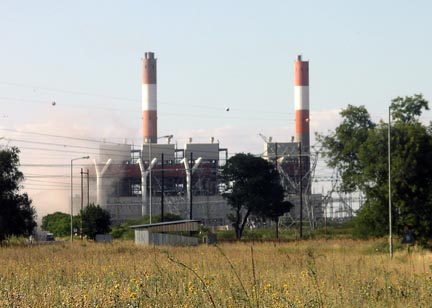
Morupule Power Plant
For the longer term, the plan is to increase power from the Morupule Power Plant, to a new level of 300 MW, helped by the Chinese , tenders have been accepted to expand the Morupule plant to 300 MW by 2010, with incentives for fast-tracking. In the more immediate short term, Botswana has agreed to work with Zimbabwe in restoring and operating the currently dysfunctional power station at Bulawayo in Zimbabwe, with countries sharing 50:50 in the power produced from the coal that Botswana will supply. This will require new transmission lines.

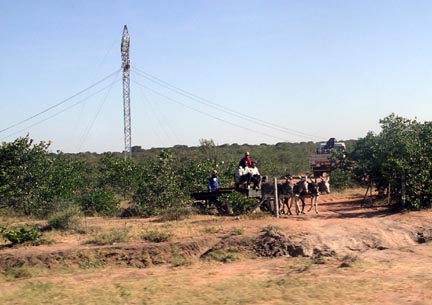
New Power Transmission Lines near the Zimbabwean border in Botswana
In short – depending on how successful the arrangement with Zimbabwe turns out to be, Botwsana may have less than a year of discomfort, and, if the Chinese can perform to schedule, no more than a couple before becoming sufficiently independent of outside power supply that it can return to its planned progress forward. Much of that progress will likely build on the growth of the local mining industry, which is fairly energy dependent (as the South Africans are now well aware). Thus the plan is to continue to increase the size of the Moruplule plant with another 300 MW, once the first phase is completed.
Following the visit, and that story, I was pointed to a Web site – Energy Shortage that illustrates the places around the world where energy shortages are currently occurring. Among the countries that are listed for today (January 8,2009) are:
Argentina; India; Indonesia; Ireland; Nepal, and South Africa.
Note Ireland, it is a reminder, as power stations have started cancelling plans for expansion in the United States, of what might be coming to our light switch, if the correct planning is not put in place, now!
I teach a class that involves, among other things, the use of power in mines. I was discussing how, in looking at the way in which power is used in those mines, prudent managers would designate the power going to different parts of the operation as vital, sheddable and avoidable. Some things, for example the large fans that keep air circulating through an underground mine, are vital to its operation. Some things, such as the operation of the pumps that drain the water from areas of the mine prone to flooding, can be rescheduled, in many cases, to off-peak periods, and some power use – such as running a conveyor when there is no production taking place, or keeping the lights on at the surface during daylight, can be eliminated. So I was talking about this, and three of the folk in the class commented that they had worked in mines in the United States, during the summer, and the mine had been asked to shed some load by the utility.
The most dramatic visible load shedding was, perhaps, the collapse of the power distribution network in Southern Africa, about this time last year. Essentially the power company ESKOM, had failed to keep up with demand, by properly maintaining the power stations and supplies, and planning ahead to match available production with the increasing demand that they were facing. The problem was not, however, limited to South Africa alone.
In the northern part of South Africa around Johannesburg, there are a number of coal mines and power plants. Surplus power could be sold into the neighboring countries to the North, so that they did not need to build their own plants, or start to develop their own deposits of coal. One such place was Botswana, just across the border, which had, at the time, one power plant, fed with coal from one mine, and with that mine having one mining machine to produce the needed coal.
Botswana is not yet a fully developed country. Only 35% of the population has access to electricity and until January 2008, they had assumed that their shortfall in domestically generated power would be made up by imports from South Africa. Their economy was booming, and their increased demand for power was being driven more by industrial growth than by rural electrification. And then in January, South Africa discovered that they no longer had enough power, and started load shedding. Given that they didn’t bother to inform the average person in Botswana before they did, a little disruption ensued. (http://allafrica.com/stories/200801280174.html).
I was down in Botswana a little later in the year (February) and this was the story that I posted to The Oil Drum at that time.
“I had mentioned earlier the problems that that country suddenly encountered when the source for 75% of its electric power – Eskom of South Africa – started to use it as a load-sheddable part of its distribution chain. It has since given Botswana the amounts that it can expect over the next four years. From a supply of 410 MW in 2007; it will get 350 MW in 2008; 250 MW in 2009; and 150 MW in 2010 through 2012. While the country has in-house generation, it decided some time ago that it was less costly to import power than to increase internal supply. Now it will take some time to create that internal power, from coal, of which the country has a more than adequate supply.
The expansion of the current plant, already in process, will not occur until 2010, and was planned to only add 120 MW, less by then, than the lost imports. And current growth in demand has been at 5.6% per annum. It does not help that:
It has also emerged that at the beginning of this year, the desperate BPC signed a no guarantees contract that allows Eskom to cut power supplies to Botswana within as little as ten minutes notice.
Flying into Gaborone, the capital, from Johannesburg, after reading the articles that had lead to the earlier pieces, I had expected to see that there would be some impact on behavior. But, crossing the veldt, there were lace points of light that reached out as long as I could see the ground. Once landed the streets were lit, and gas stations were running normally (at about $1 a liter). Going into meetings the following morning, it seemed to have been, at that scale, an irritant. We continued to meet, and then the lights went out, and the air conditioner shut off.
There were a couple of remarks, and we continued with the meeting (which wasn't about this), and about fifteen minutes later power came back on. There is no sense, from those I talked to, as to when each outage will occur, nor how long it will last. And what is an inconvenience in a discussion, becomes much worse, for a business. Longer outages have led to spoiled meat at restaurants and it is perhaps not surprising that virtually all the meals we had were served as buffets.
The problem was foreseen, and, as with the current world oil situation, there were voices that expressed concern. But while demand continued to grow, supply did not. Maintenance was not adequate, and there has been a continuing economic crisis in neighboring Zimbabwe which has led to their power stations shutting down, and power distribution collapsing.
The nation was sitting at the start of what looks to be a very promising future. As commodity prices rise it has the world’s second largest diamond mine as well as other, increasingly valuable minerals. The second largest industry is tourism, with beef production running third (it is the size of Texas, but has perhaps a sixth the size of that herd). Plans were well underway to increase electrification of villages, which had been only at around 12% toward universal access to power by 2016. Unfortunately, due in part to lack of training, use of solar power has not been as successful as had been hoped. And now, not only is there no new power to meet these future needs, there is not enough even for today.
So the Power Company has been scrambling to find answers wherever they can. Obviously there are some conservation measures, which include
replacement of incandescent lamps, which consume a lot of power. The director of transmission at BPC, Edward Rugoyi said the project is aimed at reducing power consumption to 30 MW by June this year.(The currency is the Pula, at about 6 to the dollar. They are coming out of summer, so air conditioning will not be an immediate burden, though it can get cool in the winter, that is still some months away.
Implementation will cost the corporation at least P20 million. Another initiative BPC will look at is load shifting, where the organisation will control domestic water heating by switching off water geysers during the peak period by using controls installed in their systems. Rugoyi said the exercise will cost P60 million and it is planned for May 2009.

Morupule Power Plant
For the longer term, the plan is to increase power from the Morupule Power Plant, to a new level of 300 MW, helped by the Chinese , tenders have been accepted to expand the Morupule plant to 300 MW by 2010, with incentives for fast-tracking. In the more immediate short term, Botswana has agreed to work with Zimbabwe in restoring and operating the currently dysfunctional power station at Bulawayo in Zimbabwe, with countries sharing 50:50 in the power produced from the coal that Botswana will supply. This will require new transmission lines.

New Power Transmission Lines near the Zimbabwean border in Botswana
In short – depending on how successful the arrangement with Zimbabwe turns out to be, Botwsana may have less than a year of discomfort, and, if the Chinese can perform to schedule, no more than a couple before becoming sufficiently independent of outside power supply that it can return to its planned progress forward. Much of that progress will likely build on the growth of the local mining industry, which is fairly energy dependent (as the South Africans are now well aware). Thus the plan is to continue to increase the size of the Moruplule plant with another 300 MW, once the first phase is completed.
Following the visit, and that story, I was pointed to a Web site – Energy Shortage that illustrates the places around the world where energy shortages are currently occurring. Among the countries that are listed for today (January 8,2009) are:
Argentina; India; Indonesia; Ireland; Nepal, and South Africa.
Note Ireland, it is a reminder, as power stations have started cancelling plans for expansion in the United States, of what might be coming to our light switch, if the correct planning is not put in place, now!
Read more!
Wednesday, January 7, 2009
P12. Pick Points
Half-a-dozen or so stories of interest.
The main one continues to be the Russia:Ukraine dispute, the parties in which are going to sit down with a Czech official and Andris Piebalgs, the EU Energy Commissioner tomorrow, the dispute comes as relative Russian consumption is taking a larger fraction of their overall production. However the thought of higher gas prices in general has led Uzbekistan to also increase the price of its natural gas to $240 per tcm, from $145, making life harder in Tajikistan, which has also just lost its electric feed from Turkmenistan. Last year they had the same sort of problems and went through a lot of the winter without power Lots of folk may have died. This year there are folk in Bulgaria who have already lost all power and heating from the current dispute even as Europe faces bitter cold.
On the other side of the World China braces for their Spring Festival, last year disrupted by bad weather, even as the same sort of disruptions start again. To help prevent future problems, the Chinese plan to double natural gas production by 2015, as well as upping coal production by 30% and oil production by 7%. (They also hope to get 10 billion cu m of methane from coal mine drainage each year).
Citgo Petroleum has decided to continue the distribution of free oil to the US, which may be a relief to Joseph Kennedy and his salary, even though Venezuela is cutting production by 189,000 bbl/day, 166,000 bbl of which comes to the US, earlier it was reported that the program would end.
Wandering the sites on the blogroll I note that Luis de Sousa is reviewing the European Commission’s Second Energy Review (SER-2), wonder if it includes the new plan for a nuclear reactor in Wales, while Jerome has been on France 24.
Pakistan, which you may remember is having gas supply problems, has agreed to a new price formula for the gas that it will buy from Iran. They currently buy 10,000 bbl/day but wish to increase this to 50,000 bbl/day , and they are still talking about putting in the Iran-Pakistan-India Pipeline (the Peace Pipeline), despite Indian concerns.
And for those who remember the disruptions in South Africa last year, due to a drop in coal-fired power production, the situation is better this year, though largely because of the world-wide recession, and overall production is still down.
There are more stories to be found at the Energy Bulletin, and at Drumbeat on The Oil Drum.
The main one continues to be the Russia:Ukraine dispute, the parties in which are going to sit down with a Czech official and Andris Piebalgs, the EU Energy Commissioner tomorrow, the dispute comes as relative Russian consumption is taking a larger fraction of their overall production. However the thought of higher gas prices in general has led Uzbekistan to also increase the price of its natural gas to $240 per tcm, from $145, making life harder in Tajikistan, which has also just lost its electric feed from Turkmenistan. Last year they had the same sort of problems and went through a lot of the winter without power Lots of folk may have died. This year there are folk in Bulgaria who have already lost all power and heating from the current dispute even as Europe faces bitter cold.
On the other side of the World China braces for their Spring Festival, last year disrupted by bad weather, even as the same sort of disruptions start again. To help prevent future problems, the Chinese plan to double natural gas production by 2015, as well as upping coal production by 30% and oil production by 7%. (They also hope to get 10 billion cu m of methane from coal mine drainage each year).
Citgo Petroleum has decided to continue the distribution of free oil to the US, which may be a relief to Joseph Kennedy and his salary, even though Venezuela is cutting production by 189,000 bbl/day, 166,000 bbl of which comes to the US, earlier it was reported that the program would end.
Wandering the sites on the blogroll I note that Luis de Sousa is reviewing the European Commission’s Second Energy Review (SER-2), wonder if it includes the new plan for a nuclear reactor in Wales, while Jerome has been on France 24.
Pakistan, which you may remember is having gas supply problems, has agreed to a new price formula for the gas that it will buy from Iran. They currently buy 10,000 bbl/day but wish to increase this to 50,000 bbl/day , and they are still talking about putting in the Iran-Pakistan-India Pipeline (the Peace Pipeline), despite Indian concerns.
And for those who remember the disruptions in South Africa last year, due to a drop in coal-fired power production, the situation is better this year, though largely because of the world-wide recession, and overall production is still down.
There are more stories to be found at the Energy Bulletin, and at Drumbeat on The Oil Drum.
Read more!
Labels:
Bulgaria,
China,
Iran,
Russia,
South Africa,
Tajikistan,
Turkmenistan,
Ukraine,
Venezuela
Subscribe to:
Posts (Atom)