Today the British Government are announcing the construction of the first new nuclear-powered electricity generating station in 20-years. The new plant, which will replace plants that will close will go up at Hinkley Point, and will be constructed by a French firm, with significant Chinese investment, and with a promised subsidy from the Government. It won’t, however, start producing electricity until 2023, and even then only if everything goes well.
Euan Mearns has been pointing out some of the problems that the country faces as it closes existing power stations in order to meet environmental directives from the EU. The long-term supply of power at an affordable price is being increasingly challenged as the margin between demand and available supply shrinks. The leader of the Labor Party is promising that prices will be fixed by edict, an action that is unlikely to encourage investment at a time when it is clearly needed to help provide additional plants to replace the lost capacity.
The information on the new power station construction highlights the problems that the county will increasingly face. Although it is relatively quick and straightforward to close a plant (and then to demolish it), funding, permitting and constructing a new plant will, in this case, take ten years. In the interim it will likely prove increasingly challenging to find an adequately priced source of power for the 7% of the British market that will be supplied from the new facility.
Power generation requires both that a power station exists to transform fuel into electricity, and also that there is a steady supply of that fuel (or energy source in the case of the renewable generators that rely on wind, the sun or water). The ten-year time frame for construction of the new plant means that it will not appear in the energy equation until there has been a considerable change in the available supplies of the different power sources needed to keep the electricity flowing. In the meanwhile it would appear that the UK will increasingly rely on diesel generators to provide more than just back-up power.
It is a time-scale that will see a continued decline in domestically produced oil and natural gas in the UK, and with domestically produced coal-fired power still viewed negatively, the country will be forced to increasingly rely on imports from the rest of the world to provide the fuel needed. But in that time frame the evidence that oil supply is finite is going to become much more visible to the general public. A steady growth in demand of around 1 mbd for oil cannot be sustained over the next ten years, since there are an inadequate number of new prospective fields capable of providing that increment, especially when the need to replace an annual decline of around 4.5 to 5 mbd in existing production is also factored into the equation. (Remember, in that time-frame, that current fields such as the Bakken and the off-shore Brazilian fields now coming on line will have moved well into post-peak production).
Oil-fired power, whether through use of major power plants, or through the more widespread use of diesel generators, will become an increasingly impractical part of the answer. The anticipated solution is expected to be through the more widespread use of natural gas.
The advent of large volumes of shale gas, and easier access to some of the large fields in Asia continues to radically change the potential supply sources and prices that will be charged for a fuel that can arrive either through pipeline or by LNG tanker. Yet, as the large conventional fields such as those in Turkmenistan are tapped to feed the growing Chinese market, the supply to the rest of the world will have to come from the more expensive shale gas and from regions more expensive to develop. Well costs are now quoted routinely at around the $10 million mark, and can only be anticipated to continue to rise. As the global market for natural gas at a higher price provides an incentive for increasing levels of exports from the United States, the current glut in supply will disappear and prices will to more closely follow those on the global market. This could well stop the migration of industry from the more energy-expensive parts of Europe to the USA, but it is unlikely that US prices will reach those of Europe, and so although overall prices will rise the relative ratio of prices will not change and that drift will likely continue.
But putting too much expectation on natural gas to become the energy savior of the world is unwise, given the very rapid decline in yield from existing wells, and the consequent need to continually drill new ones to sustain supply. Further the potential supply from some anticipated reserves has been reduced, as exploration shows that limits to both what is there and what can be reasonably recovered. (The Polish experience is a good example of this). This is likely to become increasingly clear over the next decade, as global natural gas reserves are asked to carry a significantly greater portion of global energy demand. Natural gas-fired power plants are cheaper and faster to produce than nuclear plants, and coal-fired plants can be converted to gas use. (The power plant at Missouri S&T, for example, although fired by coal and wood, was fitted with gas burners that were, for most of its operational life not used).
But there are limits to the practical volumes of natural gas that can be supplied, at reasonable cost. As these bounds start to appear over the next decade the questions that will arise will start to focus on what can be used to replace it. To date renewable sources have not provided the panacea that was heralded to occur as they were eased into the market place. The economic subsidies used to encourage more widespread use of solar and wind have become less acceptable to Governments and their budgets, and it seems unlikely that the subsidies can continue to be used to foster future growth at greater levels of scale.
Domestically produced coal-fired power will likely continue to be a major part of energy production in the less well-developed nations, simply because it will provide a viable way of providing power at an acceptable financial cost. Whether the vehement denunciations of its use in more advanced countries, as a source of greenhouse gases, is still dominant in ten years, particularly if global temperatures continue to remain relatively stable, is more a political rather than an energy source debate. But the decisions on what to build post-Hinkley Point will have to be made soon, and the choice may be more limited than is yet to be recognized.
My apologies, this is being posted from Terminal 5 at Heathrow, where I am frantically charging my laptop, as I travel through the UK. Posting will be a bit spotty for this week until I return home.
Showing posts with label Turkmenistan. Show all posts
Showing posts with label Turkmenistan. Show all posts
Monday, October 21, 2013


Sunday, October 13, 2013
Tech Talk - life gets more difficult at Gazprom
There was a time, not that long ago, when if I was short of a topic for a post, I could Google “Gazprom” and there was sure to be a story out there about another expansion, or take over of a national pipeline – or some other sign of the companies growth and power. But in the natural gas industry there has always been a certain volatility. In the United States Chesapeake, the second-largest natural gas producer in the US, is laying off 800 workers as it completes its plans to re-organize by the end of the month. The price for natural gas is around $3.79 per kcf which still falls below the price required to make many wells in tight shale adequately profitable. I have written about gas price problems a number of times in the past, dating back to at least 2009 and though the price is now up over $1 per kcf from those times, as the recent report in the OGJ noted, Chesapeake had, in estimating returns, anticipated it would be up around $7.21.
Gazprom’s problems however relate more than just to the price of natural gas, and the continuing difficulties in defining future price, although those too still exist. In the agreement that the company signed with China last month, for example, although it says:
Gazprom had been hoping to market the liquefied natural gas (LNG) from the ExxonMobil fields at Sakhalin Island as well as from their own wells, but that discussion has now fallen through so that this becomes a competitive rather than complimentary source of supply. Concurrently China has just confirmed the increase in purchases of natural gas from Turkmenistan.
Not that many years ago all the exported natural gas from Turkmenistan had to run through Gazprom pipes, and thus the company could charge a hefty premium in carrying the gas to Europe and elsewhere. With the opening of pipelines from Turkmenistan to China, that monopoly disappeared, and now the Chinese have agreed to take some 2.3 trillion cubic feet (Tcf) (65 billion cubic meters) of Turkmen natural gas per year, increasing their take by 882 bcf and requiring an additional pipeline to carry this new volume. Given that the country already supplies over half of Chinese natural gas imports, this will continue to squeeze Gazprom’s ability to control prices in Asia.
This new volume will come from a new field in Turkmenistan, the Galkynysh, which is expected to hold a reserve of 900 Tcf. China is investing $8 billion in the development of the field, and the new pipeline to China.

Figure 1. The location of the Galkynysh field within Turkmenistan (Trend)
And Gazprom’s problems don’t end in Asia. Part of the problem that they ran into at Sakhalin Island is that ExxonMobil is working with Rosneft to build an LNG plant through which to market their product by tanker. This circumvents the pipeline monopoly which has allowed Gazprom to dictate terms in the past. The plant is expected to handle 5 million tons of LNG per year, and is anticipated to come on line in 2018. Initial construction contracts have now been signed.
Roseneft, and Novatek have both now been given permission to export LNG, overturning the Gazprom monopoly, and Novatek has the deposits in the Yamal Peninsula that could be more conveniently marketed to Europe, but with LNG tankers that could also reach Asia and beyond. The natural gas will initially come from the South Tambeyskoye field, which has an anticipated reserve of 17 Tcf, with an expected production of around 1 Tcf per year.

Figure 2. Location of the South Tambeyskoye natural gas field, and the planned site of the LNG plant (Novatek )
The plant will operate three trains, each with a capacity of some 5 – 5.5 mmt. It is perhaps no surprise that China is backing the plan with a 20% investment, for which it anticipates being able to purchase at least 3 million tons of LNG pa. An additional 10% of the funding is likely to come from either Japanese or Indian investors. Total of France also has a 20% investment and presumably will gain a proportionate share of the shipments.
As if these challenges to Gazprom’s dominance were not enough trouble, Gazprom is seeking to have two German companies EON SE and BASF SE pony up another billion dollars because Gazprom has been able to increase the reserves at the Yuzhno-Russkoye field in Siberia.

Figure 3. The Yuzhno-Russkoye gas plant in Siberia that feeds into the Nord Stream pipeline (Nord Stream )
Figure 4. Location of the Yuzhno-Russkoye field (Wikipedia)
And just to rub it in, the European Union is planning on hitting the company with anti-trust charges. Given that the company has been able to dominate natural gas sales into Europe though pipelines, and thus has also been able, in the past, to control prices, this new step could prove expensive to the company, just as it faces greater competition in all its export markets. (This does not even consider the potential for LNG competition out of the United States).
The company is getting its supplies from increasingly expensive locations (hence the need for the cash from the German companies) and the income losses that it has seen in the market due to Turkmen competition are already hurting – but it needs more money if it is to be able to keep up its market share.
Before leaving there is an intriguing graph that Ron Patterson has posted at his site.

Figure 5. Process gain in refineries around the world and in the United States (Peak Oil Barrel )
The plot is at the end of a discussion on the difference between counting all the oil produced in a country and the break-down into crude and other sources that add into the total. One part of this is the gain in volume, process gain, that comes when crude is refined. It therefore acts as a marker of the volume of crude that is running through refineries, and as Ron notes, this has now plateaued for the past few years. Interesting!!!
Gazprom’s problems however relate more than just to the price of natural gas, and the continuing difficulties in defining future price, although those too still exist. In the agreement that the company signed with China last month, for example, although it says:
All the major terms and conditions of future Russian natural gas supplies to the Chinese market via the eastern route were agreed on, namely, the export volume and starting date, the take-or-pay level, the period of supply buildup, the level of guaranteed payments, the gas delivery point on the border as well as other basic conditions of gas offtake. The price conditions will not be linked to the Henry Hub index.It turns out that the price has yet to be determined. Gazprom is expected to sell its gas into Europe this winter at around $10.62 per kcf, which is down about 7.5% over last year. Nevertheless the Chinese are hoping to pay no more than $7.10 per kcf. And they have more than a little leverage.
Gazprom had been hoping to market the liquefied natural gas (LNG) from the ExxonMobil fields at Sakhalin Island as well as from their own wells, but that discussion has now fallen through so that this becomes a competitive rather than complimentary source of supply. Concurrently China has just confirmed the increase in purchases of natural gas from Turkmenistan.
Not that many years ago all the exported natural gas from Turkmenistan had to run through Gazprom pipes, and thus the company could charge a hefty premium in carrying the gas to Europe and elsewhere. With the opening of pipelines from Turkmenistan to China, that monopoly disappeared, and now the Chinese have agreed to take some 2.3 trillion cubic feet (Tcf) (65 billion cubic meters) of Turkmen natural gas per year, increasing their take by 882 bcf and requiring an additional pipeline to carry this new volume. Given that the country already supplies over half of Chinese natural gas imports, this will continue to squeeze Gazprom’s ability to control prices in Asia.
This new volume will come from a new field in Turkmenistan, the Galkynysh, which is expected to hold a reserve of 900 Tcf. China is investing $8 billion in the development of the field, and the new pipeline to China.

Figure 1. The location of the Galkynysh field within Turkmenistan (Trend)
And Gazprom’s problems don’t end in Asia. Part of the problem that they ran into at Sakhalin Island is that ExxonMobil is working with Rosneft to build an LNG plant through which to market their product by tanker. This circumvents the pipeline monopoly which has allowed Gazprom to dictate terms in the past. The plant is expected to handle 5 million tons of LNG per year, and is anticipated to come on line in 2018. Initial construction contracts have now been signed.
Roseneft, and Novatek have both now been given permission to export LNG, overturning the Gazprom monopoly, and Novatek has the deposits in the Yamal Peninsula that could be more conveniently marketed to Europe, but with LNG tankers that could also reach Asia and beyond. The natural gas will initially come from the South Tambeyskoye field, which has an anticipated reserve of 17 Tcf, with an expected production of around 1 Tcf per year.

Figure 2. Location of the South Tambeyskoye natural gas field, and the planned site of the LNG plant (Novatek )
The plant will operate three trains, each with a capacity of some 5 – 5.5 mmt. It is perhaps no surprise that China is backing the plan with a 20% investment, for which it anticipates being able to purchase at least 3 million tons of LNG pa. An additional 10% of the funding is likely to come from either Japanese or Indian investors. Total of France also has a 20% investment and presumably will gain a proportionate share of the shipments.
As if these challenges to Gazprom’s dominance were not enough trouble, Gazprom is seeking to have two German companies EON SE and BASF SE pony up another billion dollars because Gazprom has been able to increase the reserves at the Yuzhno-Russkoye field in Siberia.

Figure 3. The Yuzhno-Russkoye gas plant in Siberia that feeds into the Nord Stream pipeline (Nord Stream )

Figure 4. Location of the Yuzhno-Russkoye field (Wikipedia)
And just to rub it in, the European Union is planning on hitting the company with anti-trust charges. Given that the company has been able to dominate natural gas sales into Europe though pipelines, and thus has also been able, in the past, to control prices, this new step could prove expensive to the company, just as it faces greater competition in all its export markets. (This does not even consider the potential for LNG competition out of the United States).
The company is getting its supplies from increasingly expensive locations (hence the need for the cash from the German companies) and the income losses that it has seen in the market due to Turkmen competition are already hurting – but it needs more money if it is to be able to keep up its market share.
Before leaving there is an intriguing graph that Ron Patterson has posted at his site.

Figure 5. Process gain in refineries around the world and in the United States (Peak Oil Barrel )
The plot is at the end of a discussion on the difference between counting all the oil produced in a country and the break-down into crude and other sources that add into the total. One part of this is the gain in volume, process gain, that comes when crude is refined. It therefore acts as a marker of the volume of crude that is running through refineries, and as Ron notes, this has now plateaued for the past few years. Interesting!!!
Read more!
Thursday, February 14, 2013
OGPSS - Ukraine moves to escape Gazprom's grip
You know it is winter when Russia and Ukraine publically row about supplies of natural gas. On Tuesday Ukraine completed the signing of an agreement with Turkmenistan for the supply of natural gas. In the past the purchases have been for up to 36 billion cu m per year, although this was historically through Russian intermediaries. That deal ended in 2006, and Turkmenistan has been able to find a customer in China that now provides an alternate sale that does not leave it dependent on whatever price Russia was willing to provide.
But this does not mean that Ukraine has been able to escape having to pay whatever price Russia wished to impose, since to get from Turkmenistan to Ukraine the natural gas still requires passage through a pipeline that runs through Kazakhstan and Russia. There is no prize for guessing that Gazprom owns those pipelines.

Figure 1. The Central Asia Center pipeline and the route of the projected Pre-Caspian pipeline – both owned by Gazprom. (Gazprom).
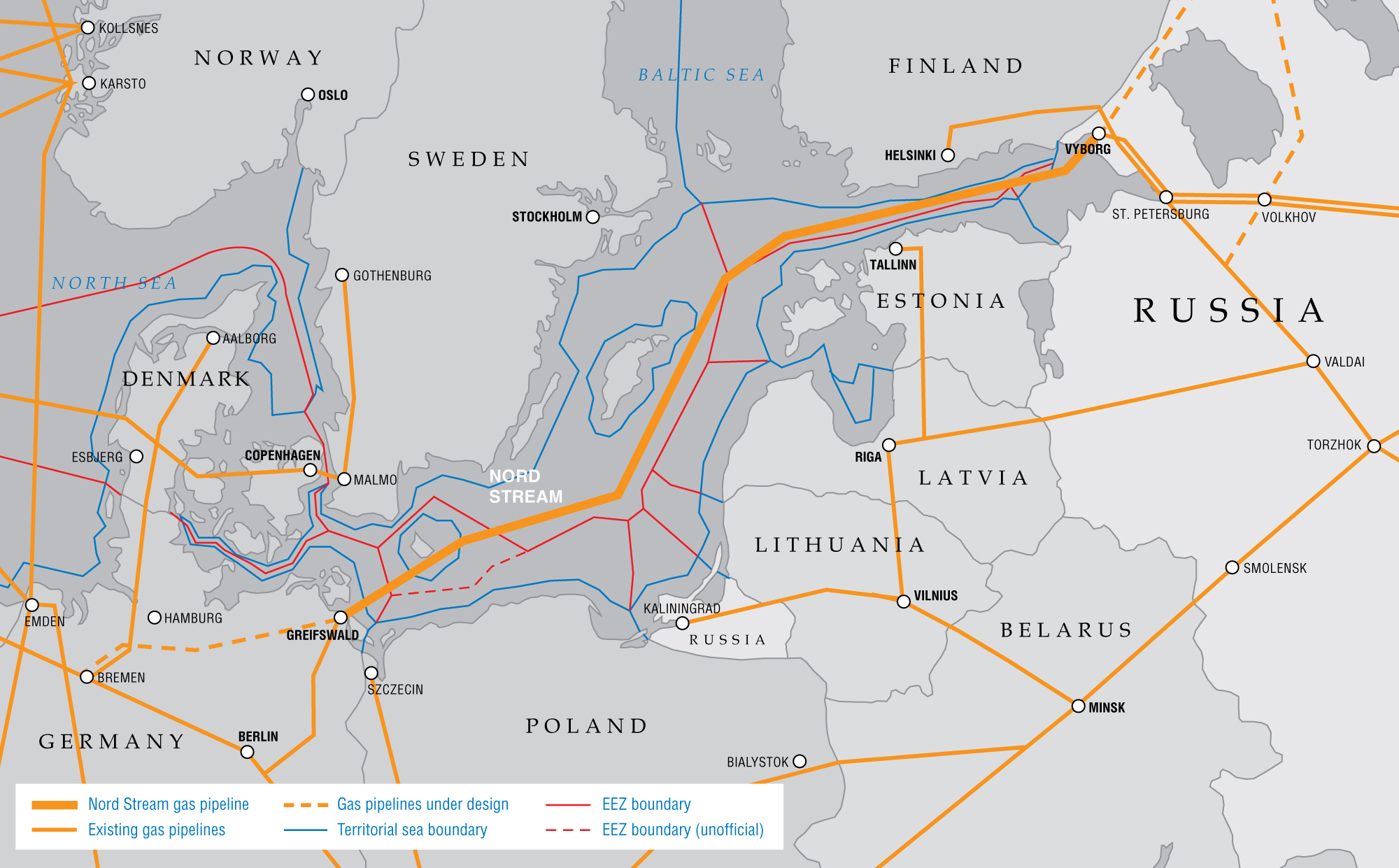
This continues to give Gazprom leverage over Ukraine, and with the North Stream pipeline now approaching its full potential after the second string was commissioned last October, Europe can receive up to 55 billion cu m per year without the gas having to pass through Ukraine.

Figure 2. Path of the North Stream (NordStream) pipeline from Russia to Germany (Gazprom)
There is now talk of adding additional capacity so that there can be a direct feed from Russia to the UK. BP is taking the lead on this, apparently with Gazprom support, although previous experience would suggest that Gazprom may end up as the major shareholder in the end, after all the bills have been paid. And speaking of which, their current dispute with Ukraine involves payment for $7 billion worth of natural gas,that Ukraine contracted for but did not, in the end use during 2012. Ukraine is paying $430 per thousand cubic meters ($12.18 per thousand cu ft) for a fixed volume per year, whether they use it or not, under an agreement signed in 2009.
There is some implication that this pressure may be related to the recent 50-year production sharing agreement that Ukraine signed with Shell to develop natural gas from shale deposits. The country is believed to have the third largest shale-bound natural gas resource in Europe (behind France and Norway ) estimated at around 42 trillion cu ft (1.2 trillion cu m).
The deposits are centered around the Yuzivskaya region, with production anticipated to start in 2017, rising to levels of around 8 – 10 bcm in ten years. Although there is some domestic opposition to the development, the schedule is aggressive.
Chevron is expected to develop deposits in the Olesska region with start dates of around the same time. Opposition to their plans seems to be growing, and they have yet to sign a production sharing agreement. They are, however hoping to get the same sort of deal that Shell negotiated.
It is worth injecting a note of caution into this optimistic view of the future. Just a year ago Poland was anticipating a similar bonanza from the natural gas in its shale deposits. Events have limited that dream. Although a 2011 EIA report stated that Poland had 187 tcf of technically recoverable natural gas, the Polish Geological Institute has now cut the estimates of the viable size of the resource by 90%, and there are other problems.
Secondly Ukraine is working with the Chinese to gasify some of their coal from their large deposits, with the intent of producing the equivalent of 4 bcm of natural gas to displace Russian imports.
But this does not mean that Ukraine has been able to escape having to pay whatever price Russia wished to impose, since to get from Turkmenistan to Ukraine the natural gas still requires passage through a pipeline that runs through Kazakhstan and Russia. There is no prize for guessing that Gazprom owns those pipelines.

Figure 1. The Central Asia Center pipeline and the route of the projected Pre-Caspian pipeline – both owned by Gazprom. (Gazprom).
This continues to give Gazprom leverage over Ukraine, and with the North Stream pipeline now approaching its full potential after the second string was commissioned last October, Europe can receive up to 55 billion cu m per year without the gas having to pass through Ukraine.

Figure 2. Path of the North Stream (NordStream) pipeline from Russia to Germany (Gazprom)
There is now talk of adding additional capacity so that there can be a direct feed from Russia to the UK. BP is taking the lead on this, apparently with Gazprom support, although previous experience would suggest that Gazprom may end up as the major shareholder in the end, after all the bills have been paid. And speaking of which, their current dispute with Ukraine involves payment for $7 billion worth of natural gas,that Ukraine contracted for but did not, in the end use during 2012. Ukraine is paying $430 per thousand cubic meters ($12.18 per thousand cu ft) for a fixed volume per year, whether they use it or not, under an agreement signed in 2009.
There is some implication that this pressure may be related to the recent 50-year production sharing agreement that Ukraine signed with Shell to develop natural gas from shale deposits. The country is believed to have the third largest shale-bound natural gas resource in Europe (behind France and Norway ) estimated at around 42 trillion cu ft (1.2 trillion cu m).
The deposits are centered around the Yuzivskaya region, with production anticipated to start in 2017, rising to levels of around 8 – 10 bcm in ten years. Although there is some domestic opposition to the development, the schedule is aggressive.
Shell is to work with Nadra Yuzivska, a joint venture in which the state-owned resources company Nadra Ukrayiny owns 90%. SPK-Geoservice, a small private company, owns the remaining 10% in Nadra Yuzivska.An adjacent well drilled by Hutton has shown promising signs of “interpreted pay in three intervals.”
Shell is expected to invest $410 million to drill the first 15 wells, Oleh Proskuriakov, the environment and natural resources minister, said earlier in January.
The total area of the Yuzivska field is 7,886 sq km. The deposit could hold 4.05 Tcm of gas, according to the government. Proskuriakov has also projected output from Yuzivska could hit 10 Bcm/year in 10 years and 20 Bcm/year in 15. Ukraine's Stavytskiy characterized the latter figure as representing the "optimistic scenario."
"We can project that in an optimistic scenario, the project will produce 20 Bcm/year of gas, while under a pessimistic scenario, 7-8 Bcm/year," Stavytskiy said.
Chevron is expected to develop deposits in the Olesska region with start dates of around the same time. Opposition to their plans seems to be growing, and they have yet to sign a production sharing agreement. They are, however hoping to get the same sort of deal that Shell negotiated.
It is worth injecting a note of caution into this optimistic view of the future. Just a year ago Poland was anticipating a similar bonanza from the natural gas in its shale deposits. Events have limited that dream. Although a 2011 EIA report stated that Poland had 187 tcf of technically recoverable natural gas, the Polish Geological Institute has now cut the estimates of the viable size of the resource by 90%, and there are other problems.
Difficult geology, an uncompetitive service sector, poor infrastructure, and lack of rigs have hampered development. Poland has a venerable oil and gas sector, but most of the transmission pipelines are based in the southwest, while major shale gas areas are in the northeast. Strict EU environmental laws, as well as unclear regulatory and tax frameworks have further eroded prospects. And while exploration has been going on for a few years now, only 33 wells have been drilled, with just eight of them fracked (at least 200 would have to be drilled in the exploratory stage, just to assess the actual size of reserves).And there are two more factors that should be considered. Ukraine is planning an LNG plant on the Black Sea to be ready by 2015, but even this is controversial. To reach the Black Sea tankers will have to pass through the Bosphorus and Dardanelles straits, and Turkey has intimated that it may not allow LNG tankers rights to that passage. That is because the terminal would compete with two that already exist in Turkey.
Preliminary results have not been encouraging, either: This summer, resource giant ExxonMobil withdrew from Poland after the failure of commercial gas flows, while its competitor ConocoPhillips decided not to exercise its 70 percent option in three concessions in northern Poland. Overall, costs per well have increased to $15 million, according to interviews with industry officials, roughly three times the cost in the United States.
Secondly Ukraine is working with the Chinese to gasify some of their coal from their large deposits, with the intent of producing the equivalent of 4 bcm of natural gas to displace Russian imports.
The projects are two-fold: first, heat-producing facilities will be converted to use coal-water slurry as fuel; second, new plants will be built to enable the gasification of brown and bituminous coal in three regions: Luhansk, Donetsk and Odessa. While most of the media reports claim that Ukraine will be using Chinese coal-slurry technology, it’s actually Shell’s technology.How soon Ukraine (and Poland) can stop imports of energetic fuels from Russia is not clear, but obviously this should happen before long, and the winters of their discontent may well disappear from the headlines.
Read more!
Friday, December 21, 2012
OGPSS - Iranian potential and the Caspian disputes
As we come to the end of the year, Leanan continues to point to the many stories that now fill the media reporting on the perception that the time to worry about peak oil is over. However, as Darwinian perceptively points out the global supply of oil (crude and condensate) is not going up with the celerity that most commentators are envisaging.

Figure 1. EIA reported global crude and condensate production through September 2012, (Darwinian at The Oil Drum)
The global balance between available supply and demand is in a balance, where the amount of oil remaining available to meet a surge in market demand is quite small. OPEC (and largely Saudi Arabia), by adjusting their production, ensures that the balance is maintained and prices remain at a level with which they are comfortable.
In the December 19th TWIP, the EIA has explained, without endorsing the statement that the US might surpass Saudi Arabia in global fuel production, why that is a less important statistic than folk are generally making it out to be.
The EIA note, in their review, that this balance is predicated on a sustained production from the Middle East. Yet, for several years now, reliance on maintaining current supplies, and guaranteeing adequate supplies in the future has assumed a steadily growing production from Iraq. The EIA notes that it is in the combined production from Iran, Iraq and Saudi Arabia that contains the additional oil needed for significantly greater production. (Venezuela is also mentioned, though there are more obstacles to overcome before their oil production can increase).
There is, unfortunately, a down-side to the glee which many commentators have greeted the news of potential US production gains. With the assumption that North America (and for this Mexico and Canada are included) can reach the higher targets projected, there is less concern with ensuring that alternate supplies remain available, as world demand continues to rise. This failure to ensure “insurance” may well cause some significant changes in the global market in the non-too-distant future, should the existing projections prove overly optimistic. (And Leanan referenced Kurt Cobb’s more realistic assessment, on Friday).
China, for example, is aware of the Iraqi potential to increase production and is moving to take over Exxon’s stake in the West Qurna oilfield, as part of their ongoing program to increase the reserves available to China in coming years. This comes as relations between the US and Iraq seem to be cooling, as Iraq becomes more friendly with Iran. Iranian exports are continuing to increase, despite the sanctions, although there are some problems arising with repatriating the payments to Tehran. The EIA note that Iran has some 137 billion barrels of proved reserves, some 9.3% of global reserves, and over 12% of total OPEC reserves. However, as with many countries, its internal consumption is keeping pace with or growing faster than overall production.

Figure 2. Iranian Production and Consumption (EIA )
In a recent post on Iraqi oil, Euan included a map showing the main distribution of fields in Iran.

Figure 3. Map showing the oil and gas fields of the Zagros fold belt. (Greg Croft via Euan Mearns)
Nevertheless Iran has significant potential reserves outside of this strip, as well as further discoveries within it. As the EIA notes:

Figure 4. Location of the discovery off Iran (Eurasia net)
Exploration in the southern end of the Caspian has been somewhat sporadic, given the territorial disputes as to who owns which part of the seabed, and this discovery is not likely to ease those tensions. Azerbaijan and Turkmenistan are both concerned over their individual territories, and are now in dispute over the Kyapaz (Serdar) field. And as the size of the field becomes more evident the dispute is continuing to raise tensions in the area.

Figure 5. Sunset over an Iranian drilling rig in the Caspian (rashidi4u on Google Earth).
And so, as we come to the end of 2012 disputes seem to be the order of the day in this part of the Middle East. Not forgetting the conflict in Syria, the disputes in Iraq over who gets to control what part of their oil future continues to evolve. Increasingly in the North the Turkish government is dealing with the regional government in Kurdish Iraq instead of the Government in Baghdad. These actions do not fill one with confidence that any of the predictions for future production are likely to come through in the time frame projected. Which will, unfortunately, tighten supplies in the non-too distant future.
Oh, and just in case you thought that Gazprom had changed its spots, it turns out that with the current cold spell in Kyrgyzstan, Gazprom has found the opportunity to take over the state gas company Kyrgyzgaz. The company has so many problems that the price will be nominal, given the amount of debt that comes with it. But it also gives Gazprom access to some of the Kyrgyz gas fields.

Figure 1. EIA reported global crude and condensate production through September 2012, (Darwinian at The Oil Drum)
The global balance between available supply and demand is in a balance, where the amount of oil remaining available to meet a surge in market demand is quite small. OPEC (and largely Saudi Arabia), by adjusting their production, ensures that the balance is maintained and prices remain at a level with which they are comfortable.
In the December 19th TWIP, the EIA has explained, without endorsing the statement that the US might surpass Saudi Arabia in global fuel production, why that is a less important statistic than folk are generally making it out to be.
The EIA note, in their review, that this balance is predicated on a sustained production from the Middle East. Yet, for several years now, reliance on maintaining current supplies, and guaranteeing adequate supplies in the future has assumed a steadily growing production from Iraq. The EIA notes that it is in the combined production from Iran, Iraq and Saudi Arabia that contains the additional oil needed for significantly greater production. (Venezuela is also mentioned, though there are more obstacles to overcome before their oil production can increase).
There is, unfortunately, a down-side to the glee which many commentators have greeted the news of potential US production gains. With the assumption that North America (and for this Mexico and Canada are included) can reach the higher targets projected, there is less concern with ensuring that alternate supplies remain available, as world demand continues to rise. This failure to ensure “insurance” may well cause some significant changes in the global market in the non-too-distant future, should the existing projections prove overly optimistic. (And Leanan referenced Kurt Cobb’s more realistic assessment, on Friday).
China, for example, is aware of the Iraqi potential to increase production and is moving to take over Exxon’s stake in the West Qurna oilfield, as part of their ongoing program to increase the reserves available to China in coming years. This comes as relations between the US and Iraq seem to be cooling, as Iraq becomes more friendly with Iran. Iranian exports are continuing to increase, despite the sanctions, although there are some problems arising with repatriating the payments to Tehran. The EIA note that Iran has some 137 billion barrels of proved reserves, some 9.3% of global reserves, and over 12% of total OPEC reserves. However, as with many countries, its internal consumption is keeping pace with or growing faster than overall production.

Figure 2. Iranian Production and Consumption (EIA )
In a recent post on Iraqi oil, Euan included a map showing the main distribution of fields in Iran.

Figure 3. Map showing the oil and gas fields of the Zagros fold belt. (Greg Croft via Euan Mearns)
Nevertheless Iran has significant potential reserves outside of this strip, as well as further discoveries within it. As the EIA notes:
There were a number of new discoveries in Iran over the past couple of years. In May 2011, NIOC announced a discovery of a deposit of light oil (35° API gravity) in the Khayyam field, offshore in the Hormuzgan province. The field had been discovered in 2010 but was originally classified as a gas field. According to the NIOC, the volume of in-place oil at this field is 758 million barrels, of which around 170 million barrels are recoverable. Also in May 2011, Iran announced the discovery of new onshore oil fields in its south and west with an estimated half a billion barrels of reserves. In late 2010, Iran claimed the discovery of new crude finds near gas reservoirs in the Persian Gulf, holding total in-place reserves of more than 40 billion barrels of oil, however recoverable reserves could be less than 10 billion barrels.And just this year a significant discovery was announced in Iranian waters in the Caspian. The field promises a 10 billion barrel resource, which could add around 7% to the Iranian reserves.But there is a dispute over the location of the field, with Azerbaijan claiming that the region belongs to them.

Figure 4. Location of the discovery off Iran (Eurasia net)
Exploration in the southern end of the Caspian has been somewhat sporadic, given the territorial disputes as to who owns which part of the seabed, and this discovery is not likely to ease those tensions. Azerbaijan and Turkmenistan are both concerned over their individual territories, and are now in dispute over the Kyapaz (Serdar) field. And as the size of the field becomes more evident the dispute is continuing to raise tensions in the area.

Figure 5. Sunset over an Iranian drilling rig in the Caspian (rashidi4u on Google Earth).
And so, as we come to the end of 2012 disputes seem to be the order of the day in this part of the Middle East. Not forgetting the conflict in Syria, the disputes in Iraq over who gets to control what part of their oil future continues to evolve. Increasingly in the North the Turkish government is dealing with the regional government in Kurdish Iraq instead of the Government in Baghdad. These actions do not fill one with confidence that any of the predictions for future production are likely to come through in the time frame projected. Which will, unfortunately, tighten supplies in the non-too distant future.
Oh, and just in case you thought that Gazprom had changed its spots, it turns out that with the current cold spell in Kyrgyzstan, Gazprom has found the opportunity to take over the state gas company Kyrgyzgaz. The company has so many problems that the price will be nominal, given the amount of debt that comes with it. But it also gives Gazprom access to some of the Kyrgyz gas fields.
Read more!
Wednesday, October 10, 2012
OGPSS - Iran and the possibility of natural gas exports
There has been much talk in the current Presidential debates about possible changes in US Energy Policy, with Governor Romney suggesting that more Federal land be opened for prospecting for oil. Historically one of the regions included in such lists has been up in the National Petroleum Reserve in Alaska. And, perhaps anticipating the debate, the current Administration has already and recently moved toward opening those territories up for development.** However those fields have now been determined to be more natural gas than oil, and so hopes for finding more oil reserves has shifted into moves offshore, where Shell continues to be optimistic as it begins to sink new wells in the Chukchi sea – although well completions have now moved into next year. However it should be noted that there have been suggestions in the past that more of the hydrocarbons under the Arctic are gas deposits than oil, and this argument has been strengthened by the recent discovery in the Barents Sea of more gas, when oil had been anticipated.
The current large volumes of natural gas that are being developed and marketed, whether in the United States or from Turkmenistan, are making considerable changes in the economies of many countries. Russia, who lost the sales battle to supply natural gas to China now can no longer justify the expense of opening the Shtockman field, as alternate supplies are coming to the market at lower costs, and this will, in turn, cascade on to prices in Europe, where the advent of more gas in the UK is making it more difficult to justify a switch into a greater reliance on renewable sources such as wind and solar.
This entire scenario means that it is not necessarily a good time to have a huge reserve of natural gas, and to go to the market with this as a resource to generate income. This is particularly true, if the country in question is Iran.

Figure 1, The South Pars field which lies between Qatar and Iran in the Persian Gulf (PetroPars Annual Report )
Qatar has been exporting Liquefied Natural Gas for a number of years, and has been well able to manage a steady growth in market penetration, as noted in a previous post, and this quote from two years ago:
But Iran has other problems. At present, as noted last time, natural gas supplies are barely keeping pace with an acceleration in the volumes required to meet internal demand. Any move to increase production will face competition not only from Russia (with available natural gas supplies once anticipated to be sold to the USA, and, when that fell through, then to China) and Qatar but also potentially from the United States itself, since as The OGJ recently noted
So can Iran also move its natural gas by pipeline, it is, after all connected by land to potential customers. Well, apart from the relatively obvious problems of trying to do this at a time when the nations concerned with Iranian nuclear policy are tightening their sanctions on Iran, as they are being seen to have more effect, the question comes back to who might be a potential customer. At present Turkey buys the bulk of Iranian natural gas exports but the European Union is expected to include natural gas in the list of banned exports at the meeting on October 15th. (Armenia and Azerbaijan buy the remainder of the current export volumes). There was a recent explosion in a gas pipeline carrying natural gas from Iran into Turkey, stopping the flow. But while that initially imposed a supply problem for Turkey, this has been met through increased purchases from Russia which currently has plenty. Thus it would appear that while Iran has more than sufficient supplies to move into an increased export position, the current political situation will likely preclude this happening in the short term, and the global over supply may well restrict Iranian penetration into that market in the longer term.
** September Alaskan pipeline flows were at 517 kbdm against the average for this year of 537 kbd, however as winter gets established the latest volume reported for 10/09/12 was 580 kbd, moving the pipeline away for the critical numbers.
The current large volumes of natural gas that are being developed and marketed, whether in the United States or from Turkmenistan, are making considerable changes in the economies of many countries. Russia, who lost the sales battle to supply natural gas to China now can no longer justify the expense of opening the Shtockman field, as alternate supplies are coming to the market at lower costs, and this will, in turn, cascade on to prices in Europe, where the advent of more gas in the UK is making it more difficult to justify a switch into a greater reliance on renewable sources such as wind and solar.
This entire scenario means that it is not necessarily a good time to have a huge reserve of natural gas, and to go to the market with this as a resource to generate income. This is particularly true, if the country in question is Iran.
Iranian Oil Minister Rostam Qasemi has announced that Iran’s exploitation of the South Pars gas field will equal Qatar’s exploitation of the gas field by the end of Iranian calendar year 1392 (ends March 20, 2014) if $54 billion is invested in gas projects.Iran and Qatar share the largest natural gas field in the world, a reserve that is known as the North Field in Qatar, and as South Pars in Iran.

Figure 1, The South Pars field which lies between Qatar and Iran in the Persian Gulf (PetroPars Annual Report )
Qatar has been exporting Liquefied Natural Gas for a number of years, and has been well able to manage a steady growth in market penetration, as noted in a previous post, and this quote from two years ago:
Ras Laffan 3 Train 7 is the fourth 7.8 million tons per year LNG plant brought online by Qatar Petroleum and ExxonMobil joint ventures within the past 12 months. It matches the capacity of Ras Laffan 3 Train 6, one of the largest operating LNG production facilities in the world, inaugurated in October 2009. These mega facilities have sufficient scale to competitively reach markets around the globe. Qatar's giant North Field, which is estimated to contain in excess of 900 trillion cubic feet of natural gas, will supply both trains.For Iran to anticipate that they can generate the infrastructure to compete with Qatar in the short term, given the time taken to invest, not only in the surface plant, but also in the tankers that become dedicated to the customers and the routes that must be followed, is more than naïve. That they can expect to do this at a time when, more than in any time in the recent past, there is an adequacy of supply unseen in a generation, suggests a message that can be meant for local consumption only.
But Iran has other problems. At present, as noted last time, natural gas supplies are barely keeping pace with an acceleration in the volumes required to meet internal demand. Any move to increase production will face competition not only from Russia (with available natural gas supplies once anticipated to be sold to the USA, and, when that fell through, then to China) and Qatar but also potentially from the United States itself, since as The OGJ recently noted
“U.S. LNG export potential is a major issue in Asia, particularly in Seoul and Tokyo,” said Mikkal E. Herberg, research director at the National Bureau of Asian Research (NBR)’s Energy Security Program and the report’s editor, “That’s especially true for the next 5 years until major Australian and other export projects come on line.”With China getting more of its supply through pipelines this may also weaken the LNG market, even as Iran moves to step into these waters.
So can Iran also move its natural gas by pipeline, it is, after all connected by land to potential customers. Well, apart from the relatively obvious problems of trying to do this at a time when the nations concerned with Iranian nuclear policy are tightening their sanctions on Iran, as they are being seen to have more effect, the question comes back to who might be a potential customer. At present Turkey buys the bulk of Iranian natural gas exports but the European Union is expected to include natural gas in the list of banned exports at the meeting on October 15th. (Armenia and Azerbaijan buy the remainder of the current export volumes). There was a recent explosion in a gas pipeline carrying natural gas from Iran into Turkey, stopping the flow. But while that initially imposed a supply problem for Turkey, this has been met through increased purchases from Russia which currently has plenty. Thus it would appear that while Iran has more than sufficient supplies to move into an increased export position, the current political situation will likely preclude this happening in the short term, and the global over supply may well restrict Iranian penetration into that market in the longer term.
** September Alaskan pipeline flows were at 517 kbdm against the average for this year of 537 kbd, however as winter gets established the latest volume reported for 10/09/12 was 580 kbd, moving the pipeline away for the critical numbers.
Read more!
Friday, September 7, 2012
OGPSS - Chinese gas shale development
On occasion, the British Government goes through an internal shake-up that leads to various pundits trying to explain to us lesser mortals what it all means. Thus, with changes in the Ministers who work in the Department of Energy and Climate Change, there is a suggestion that the UK is pulling back from their commitment to wind energy, and instead beginning to look more seriously at shale gas supplies.
The UK is not unique. The success of the American development of long horizontal well drilling, with follow-on multiple fracture of the shale beds to release gas at economic volumes into the well, has caught the world’s attention, and with it a desire to emulate that success. Though it should be said that the American success comes in part with the volume of the release in supply and the consequent fall induced in the price of natural gas. That, in turn, is providing a less well recognized boost to the US economy, through lower energy costs.
This has not been lost on the Chinese, who are fully aware of their own need to keep finding resources at as cheap a price as possible to keep their own economy growing. It is, in relative terms, however, still an industry in its infancy. Earlier this year China agreed to buy 65 billon cu m of more conventionally produced natural gas from Turkmenistan – about twice the initial buy - roughly the equivalent of 6.3 billion cu ft/day (bcf/d). In addition, from April 1, China has started to import natural gas from Uzbekistan. That sale has been projected to be at around 10 bcm/year (1 bcf/day) and there has been a move in Uzbekistan to increase coal-fired power generation in the country in order to free up more gas to meet export demands as the sales to China ramp up to perhaps double this level in the next few years.
Further China still has the option of buying more natural gas from Russia, which has the potential to supply an additional 65 bcm/year into China. (6.3 bcf/d)

Figure 1. Path of the natural gas pipeline from Turkmenistan to China (Hydrocarbons technology )
To put these numbers into perspective China consumed around 12.5 billion cu ft/day (bcf/d) in 2011, which translates into roughly 130 bcm/year, but this rate increased 20% (23 bcm) from 2010 to 2011. (BP 2012 Statistical Review). It is also on track with the stated Government plan that China will consume some 375 bcm/yr (36 bcf/day) of natural gas by 2020, roughly tripling the current volume.

Figure 2. Changes in Chinese use of Natural Gas (Energy Export Data Browser )
Thus, although China has been able to provide for most of its needs until relatively recently, it is now starting to buy increasingly large volumes of natural gas on the international market, just to keep up with demand.
There is a flexibility in the supply of natural gas, through pipelines, that make it easier for a country with much mountainous terrain in the West to be able more easily to supply energy to more remote corners, without the heavy infrastructure demands that would be required, for example, to run new rail lines for coal delivery.

Figure 3. New gas pipeline being laid in China in 2009.
This June Sinopec has started drilling for natural gas in the shales under Chongqing in Sichuan Province. It is the opening step in developing a resource that might be as large as 1,275 Tcf, according to the EIA.

Figure 4. Main Sinopec natural gas trunk lines. (after Sinopec )
Note that while the supplies coming in from Turkmenistan and Ukbekistan are more easily connected to the northern of the trans-country pipelines, the new drilling in Chongqing looking for shale gas, will supply that into the more southerly of the two major pipelines that Sinopec runs across the country.
It is hoped that with the development of the shale gas in the two Basins that shale gas will provide some 6.5 bcm/yr by 2015. As with the Chongqing field, there are existing pipelines at the Ordos field that will allow a fairly simple tie in to the national network to bring the new fuel to market, once produced.

Figure 5. Potential gas shale fields in China (IEA via Washington Post )
The potential of this new market for technology has already led Schlumberger to buy into a Chinese Oilfield Services company that will likely be used in the fracturing of the wells, necessary to China since they still lack expertise in the new technologies as they are evolving.
That evolution was highlighted recently by articles that have highlighted a number of different technologies that are now both lowering the costs, and increasing the performance of well fracking.
These have included the Hiway technology that is now being introduced and which, as with some of the other innovations, allows a significant savings in water, and proppant use during operations, while lowering costs and increasing productivity. These factors, particularly the significant lowering of cost, are likely to help in improving the economics of a shale gas industry which continues, at least in the United States, to have problems with return on investment, despite, or perhaps because of the large volumes of resource that it is making available. That is, however, much less likely to be a problem with the Chinese resource.
The UK is not unique. The success of the American development of long horizontal well drilling, with follow-on multiple fracture of the shale beds to release gas at economic volumes into the well, has caught the world’s attention, and with it a desire to emulate that success. Though it should be said that the American success comes in part with the volume of the release in supply and the consequent fall induced in the price of natural gas. That, in turn, is providing a less well recognized boost to the US economy, through lower energy costs.
This has not been lost on the Chinese, who are fully aware of their own need to keep finding resources at as cheap a price as possible to keep their own economy growing. It is, in relative terms, however, still an industry in its infancy. Earlier this year China agreed to buy 65 billon cu m of more conventionally produced natural gas from Turkmenistan – about twice the initial buy - roughly the equivalent of 6.3 billion cu ft/day (bcf/d). In addition, from April 1, China has started to import natural gas from Uzbekistan. That sale has been projected to be at around 10 bcm/year (1 bcf/day) and there has been a move in Uzbekistan to increase coal-fired power generation in the country in order to free up more gas to meet export demands as the sales to China ramp up to perhaps double this level in the next few years.
Further China still has the option of buying more natural gas from Russia, which has the potential to supply an additional 65 bcm/year into China. (6.3 bcf/d)

Figure 1. Path of the natural gas pipeline from Turkmenistan to China (Hydrocarbons technology )
To put these numbers into perspective China consumed around 12.5 billion cu ft/day (bcf/d) in 2011, which translates into roughly 130 bcm/year, but this rate increased 20% (23 bcm) from 2010 to 2011. (BP 2012 Statistical Review). It is also on track with the stated Government plan that China will consume some 375 bcm/yr (36 bcf/day) of natural gas by 2020, roughly tripling the current volume.

Figure 2. Changes in Chinese use of Natural Gas (Energy Export Data Browser )
Thus, although China has been able to provide for most of its needs until relatively recently, it is now starting to buy increasingly large volumes of natural gas on the international market, just to keep up with demand.
There is a flexibility in the supply of natural gas, through pipelines, that make it easier for a country with much mountainous terrain in the West to be able more easily to supply energy to more remote corners, without the heavy infrastructure demands that would be required, for example, to run new rail lines for coal delivery.

Figure 3. New gas pipeline being laid in China in 2009.
This June Sinopec has started drilling for natural gas in the shales under Chongqing in Sichuan Province. It is the opening step in developing a resource that might be as large as 1,275 Tcf, according to the EIA.

Figure 4. Main Sinopec natural gas trunk lines. (after Sinopec )
Note that while the supplies coming in from Turkmenistan and Ukbekistan are more easily connected to the northern of the trans-country pipelines, the new drilling in Chongqing looking for shale gas, will supply that into the more southerly of the two major pipelines that Sinopec runs across the country.
The Sichuan-Eastern China Natural Gas Transmission Pipeline passes through eight provinces including Sichuan, Chongqing, Jiangxi, Hubei, Anhui, Jiangsu, Zhejiang and Shanghai;the length is 2,246 km.There will be nine wells in the initial test site, with the anticipation that this will yield some 11 to 18 billion feet of gas (per year). Outside this unconventional source of natural gas, Sinopec produced some 517 bcf of natural gas in 2011, up 76 bcf from 2010. Much of this came from the Sulidge gas field in the Ordos Basin , which is also considered to have the second largest potential natural gas resource in shale in the country.
It is hoped that with the development of the shale gas in the two Basins that shale gas will provide some 6.5 bcm/yr by 2015. As with the Chongqing field, there are existing pipelines at the Ordos field that will allow a fairly simple tie in to the national network to bring the new fuel to market, once produced.

Figure 5. Potential gas shale fields in China (IEA via Washington Post )
The potential of this new market for technology has already led Schlumberger to buy into a Chinese Oilfield Services company that will likely be used in the fracturing of the wells, necessary to China since they still lack expertise in the new technologies as they are evolving.
That evolution was highlighted recently by articles that have highlighted a number of different technologies that are now both lowering the costs, and increasing the performance of well fracking.
These have included the Hiway technology that is now being introduced and which, as with some of the other innovations, allows a significant savings in water, and proppant use during operations, while lowering costs and increasing productivity. These factors, particularly the significant lowering of cost, are likely to help in improving the economics of a shale gas industry which continues, at least in the United States, to have problems with return on investment, despite, or perhaps because of the large volumes of resource that it is making available. That is, however, much less likely to be a problem with the Chinese resource.
Read more!
Sunday, December 19, 2010
OGPSS - pipelines, a help that can be costly
I have written about the limitations in the free flow of oil because of the increasingly heavy and sour nature of the reserves that are now being developed, and the need for suitable refineries to process that oil. I then wrote about how it’s not just oil from oilwells, but also the non-gas-liquids (NGLs) that count toward the total volume of oil that is consumed in the world. There are other constraints to production, and the one that I’m going to talk about today is that of transportation. It seemed appropriate at a time when Chevron has just announced a doubling of the size of the pipeline from the Tengiz field in western Kazakhstan to Novorosslysk on the Black Sea. It will now carry some 1.4 mbd of oil to the port, whence it will be transshipped in tankers.
Transportation is, of course, a major problem for many energy forms, as Leanan caught, the Chinese are already facing problems this winter over the distribution of power.
The oil and gas industries flourish largely because of these pipelines, which carry liquids easily over long distances. Perhaps the most famous is the pipeline that carries oil from the North Slope to Valdez. It has survived the varying Alaskan weather conditions, passing over permafrost and rivers, or being buried, depending on the geology. It was the only viable way to effectively develop that reserve.
 Alaskan pipeline just North of Fairbanks. Note the radiators on the support legs. These disperse the heat from the pipe (and the oil) which keep the permafrost, in which the support legs sit, from melting. The 48-inch line was sized to carry 2.1 mbd of oil. Today it only carries around 660,000 bd.
Pipelines don’t just allow reserves to be extracted, consider the Rockies Express Pipeline that is bringing natural gas from Colorado through the 1,679 miles to Ohio. Before it was installed Colorado would have a surplus of natural gas in the winter, while the North East had a shortage. To a degree (Caribou Maine being still some distance from Ohio) that has now been ameliorated.
 The pipeline route (Kinder Morgan )
Pipelines need to be sized for the volumes that flow. In order that the oil/gas flow down the pipe the fluid is pumped into the line at pressure, and at stages along the pipe, as the pressure is “used up” on overcoming friction from the pipe walls, there are booster stations that raise the pressure back to the driving pressure, to keep it moving. (And yes these use some of the fuel, particularly if it is gas, as a power source).
One of the problems with running the pipe under that pressure is that if there is any corrosion or damage to the pipe then the pressure may have to be lowered to stop the pipe from bursting. Since the flow velocity is a function of the square root of this driving pressure, then as the pressure drops so does the volume pumped.
As a result inspection to make sure there is little or no corrosion should be a regular feature of pipeline maintenance. Given that the pipe can run for miles above or below the surface, external inspection can be difficult, and, instead companies will run “pigs” down the line. (The name comes from the “squeal” as they move) These are put into the pipe at the “top” end and pumped down with the oil. Instruments and sensors within the central compartment can monitor conditions as the pig moves. Pigs are also fitted with wipers the ensure that deposits from the fluid don’t build up along the pipe and cause problems.
 Example pig used in the Alaskan pipeline – see the wipers and note the central compartment within the pig.
It is difficult to stop all corrosion, and over time segments of the pipe may need to be replaced because of damage that can build up in the normal course of operations. If inspections are not regular, then, as BP found in 2006, corrosion can lead to a leak, and big problems.
Unfortunately pipelines are not just prone to mechanical problems. Their presence is hard to hide, and thus, become targets for theft. Whether in Mexico this weekend, or Nigeria almost every day, theft by physically extracting fuel from pipelines can be a very dangerous game, with explosions and loss of life a not-infrequent result.
And that is just the small scale operations. On a larger scale the risk can be a lot less. Remember that Western Europe is becoming increasingly dependent on Russian natural gas for supplies, particularly in the winter months. That natural gas travels between the two passing down a pipeline through Ukraine. The financial woes of that country meant that it did not always pay its gas bill, and, usually in January, this led to confrontations between Russia and Ukraine, with Western Europe the frequent loser. To overcome this dependence Russia is now putting in place two smaller pipelines that will circumvent Ukraine to the North (Nordstream) and the South.
One of the key players in that game was Turkmenistan, which supplied its natural gas through pipelines that only went through Russia to their customers. Russia for years was able to dictate the price that it paid Turkmenistan, often considerably less than it was getting from Europe. But since it was the only game in town . . . .
That recently changed, however, with the construction of a pipeline from Turkmenistan to China and this broke the monopoly that Russia held over the sale of Turkmen gas. The pipeline is now being upgraded and the flow increased to 1.25 billion cu ft/day, four times the volume that flowed, on average, last year. The pipeline is 4,350 miles long. Ultimately the flow will be three times that size – about the volume that Turkmenistan used to sell to Russia. (The last reference has the picture of what may be the one Soviet attempt to extinguish a burning gas fire with a nuclear device that didn’t work).
The Russians haven’t forgotten the benefits that come from owning the pipelines and the control that this gives over the producers. BP learned that lesson the hard way. Gazprom is the Russian company that owns the pipelines (and on a slow news day I could always find a story by seeing what new machinations had been revealed in a Google seach for Gazprom). By controlling the pipelines they could dictate what flowed when. As an example let me remind you of the situation that BP faced in developing the Kovykta gas field back in 2007. The deal was that after BP developed the field, they had to produce 9 billion cubic meters (bcm) per year, as the license stipulated. But local consumers could only handle a small fraction of this, and Gazprom, who owned the only pipeline in town, was only willing to allow a flow of 1.7 bcm. Oops! You guessed it, BO was held liable for not meeting the terms of the license and . . . . .
You will note that Gazprom has been quite efficient at getting control of a large portion of the pipelines and (as a result) the distribution networks across Europe.
That story brings to mind another caveat, that illustrates the bind that pipeline owners can impose on their clients. Bear in mind that these pipelines are not cheap, and while they can be installed relatively rapidly, they have to be paid for. Thus, before they are installed the owners require long-term commitments from both the seller at one end and the vendor at the other. The Rockies Express has such commitments.
However, if the pipeline owner then changes the rules, there is not a whole lot that the other two partners can do – as a whole list of countries who have been squeezed by Russia would be glad to remind you.
But it is not just over Russia that the world should have a concern. One should not forget the new pipelines that are being constructed across Asia. Whether the Chinese pipeline from Turkmenistan, or the TAPI pipeline from Turkmenistan to India, these mark a switch in the destiny of future fuel production. It is a future that means that a considerable volume of the worlds fuel may no longer be available to the West. And where that fuel is natural gas, and the nations of Europe are building gas-fired power plants to back-up wind and other renewable sources, then if the gas isn’t there . . . . .
No problem, you say, old HO is being his usual alarmist self. Well you might want to note how many times this winter there is a “Gas Balancing Alert” action in the UK. Rune Likvern has already highlighted the start of a possible problem as stocks were drawn down at the start of the winter and it has not got any better. The first Alert has been issued for this season.
Further information can be found on the National Grid Website. The normal daily usage at this time of year, according to that site, is 364 million scm (standard cubic meters). The trigger for a GBA is 452 mscm, and tomorrow’s demand is forecast at 463 mscm. Interruptions seem most likely to occur in the North.
Oh, and just to give you a better sense of the scale of some of these pipes - here is me beside the one in Alaska.

Transportation is, of course, a major problem for many energy forms, as Leanan caught, the Chinese are already facing problems this winter over the distribution of power.
Most of China's resource production bases, including coal and and oil, are either concentrated in the northern or western provinces, away from the key demand areas located in the southern and eastern region, such as Shanghai and Guangdong.And it turns out that they are not the only ones. As the new snowfall wraps over the United Kingdom there are concerns over the distribution of fuel oil.
Any supply shortfall could prompt a surge in import demand as utilities and firms seek alternative fuel supplies to feed their power plants.
Downing Street was forced to respond to reports that heating oil might need to be rationed over the winter because of rocketing prices and restricted deliveries, admitting there was a problem moving it around the country.All of which serve to emphasize a point that I wanted to make today about how the presence of a pipeline can, but not always, help the situation.
The energy minister, Charles Hendry, sparked alarm yesterday when he warned the House of Commons that the situation could become "very serious" if there was further snow over the Christmas period.Thousands of public buildings and an estimated 660,000 homes rely on oil for heating and Hendry told MPs some had been told supplies would not be available for four weeks.
The oil and gas industries flourish largely because of these pipelines, which carry liquids easily over long distances. Perhaps the most famous is the pipeline that carries oil from the North Slope to Valdez. It has survived the varying Alaskan weather conditions, passing over permafrost and rivers, or being buried, depending on the geology. It was the only viable way to effectively develop that reserve.
 Alaskan pipeline just North of Fairbanks. Note the radiators on the support legs. These disperse the heat from the pipe (and the oil) which keep the permafrost, in which the support legs sit, from melting. The 48-inch line was sized to carry 2.1 mbd of oil. Today it only carries around 660,000 bd.
 Pipelines don’t just allow reserves to be extracted, consider the Rockies Express Pipeline that is bringing natural gas from Colorado through the 1,679 miles to Ohio. Before it was installed Colorado would have a surplus of natural gas in the winter, while the North East had a shortage. To a degree (Caribou Maine being still some distance from Ohio) that has now been ameliorated.
 The pipeline route (Kinder Morgan )
 Pipelines need to be sized for the volumes that flow. In order that the oil/gas flow down the pipe the fluid is pumped into the line at pressure, and at stages along the pipe, as the pressure is “used up” on overcoming friction from the pipe walls, there are booster stations that raise the pressure back to the driving pressure, to keep it moving. (And yes these use some of the fuel, particularly if it is gas, as a power source).
One of the problems with running the pipe under that pressure is that if there is any corrosion or damage to the pipe then the pressure may have to be lowered to stop the pipe from bursting. Since the flow velocity is a function of the square root of this driving pressure, then as the pressure drops so does the volume pumped.
As a result inspection to make sure there is little or no corrosion should be a regular feature of pipeline maintenance. Given that the pipe can run for miles above or below the surface, external inspection can be difficult, and, instead companies will run “pigs” down the line. (The name comes from the “squeal” as they move) These are put into the pipe at the “top” end and pumped down with the oil. Instruments and sensors within the central compartment can monitor conditions as the pig moves. Pigs are also fitted with wipers the ensure that deposits from the fluid don’t build up along the pipe and cause problems.
 Example pig used in the Alaskan pipeline – see the wipers and note the central compartment within the pig.
It is difficult to stop all corrosion, and over time segments of the pipe may need to be replaced because of damage that can build up in the normal course of operations. If inspections are not regular, then, as BP found in 2006, corrosion can lead to a leak, and big problems.
Unfortunately pipelines are not just prone to mechanical problems. Their presence is hard to hide, and thus, become targets for theft. Whether in Mexico this weekend, or Nigeria almost every day, theft by physically extracting fuel from pipelines can be a very dangerous game, with explosions and loss of life a not-infrequent result.
And that is just the small scale operations. On a larger scale the risk can be a lot less. Remember that Western Europe is becoming increasingly dependent on Russian natural gas for supplies, particularly in the winter months. That natural gas travels between the two passing down a pipeline through Ukraine. The financial woes of that country meant that it did not always pay its gas bill, and, usually in January, this led to confrontations between Russia and Ukraine, with Western Europe the frequent loser. To overcome this dependence Russia is now putting in place two smaller pipelines that will circumvent Ukraine to the North (Nordstream) and the South.
One of the key players in that game was Turkmenistan, which supplied its natural gas through pipelines that only went through Russia to their customers. Russia for years was able to dictate the price that it paid Turkmenistan, often considerably less than it was getting from Europe. But since it was the only game in town . . . .
That recently changed, however, with the construction of a pipeline from Turkmenistan to China and this broke the monopoly that Russia held over the sale of Turkmen gas. The pipeline is now being upgraded and the flow increased to 1.25 billion cu ft/day, four times the volume that flowed, on average, last year. The pipeline is 4,350 miles long. Ultimately the flow will be three times that size – about the volume that Turkmenistan used to sell to Russia. (The last reference has the picture of what may be the one Soviet attempt to extinguish a burning gas fire with a nuclear device that didn’t work).
The Russians haven’t forgotten the benefits that come from owning the pipelines and the control that this gives over the producers. BP learned that lesson the hard way. Gazprom is the Russian company that owns the pipelines (and on a slow news day I could always find a story by seeing what new machinations had been revealed in a Google seach for Gazprom). By controlling the pipelines they could dictate what flowed when. As an example let me remind you of the situation that BP faced in developing the Kovykta gas field back in 2007. The deal was that after BP developed the field, they had to produce 9 billion cubic meters (bcm) per year, as the license stipulated. But local consumers could only handle a small fraction of this, and Gazprom, who owned the only pipeline in town, was only willing to allow a flow of 1.7 bcm. Oops! You guessed it, BO was held liable for not meeting the terms of the license and . . . . .
You will note that Gazprom has been quite efficient at getting control of a large portion of the pipelines and (as a result) the distribution networks across Europe.
That story brings to mind another caveat, that illustrates the bind that pipeline owners can impose on their clients. Bear in mind that these pipelines are not cheap, and while they can be installed relatively rapidly, they have to be paid for. Thus, before they are installed the owners require long-term commitments from both the seller at one end and the vendor at the other. The Rockies Express has such commitments.
REX is a joint venture of KMP (we own 50 percent and operate the pipeline), Sempra Pipelines and Storage and ConocoPhillips. Long-term, binding firm commitments have been secured for virtually all of the pipeline's capacity. The pipeline is enabling producers to deliver gas from the Rocky Mountains eastward and is helping to ensure that there will be adequate supplies of natural gas to meet growing demand in the Midwest and eastern parts of the country.There is an underlying point here that is sometimes missed when these projects are discussed, and that is that the agreements between all parties will usually establish a price for the product, at the time that the contracts are signed, that run well into the future. Those prices do not reflect the current market price of the fuel. It is a point that often gets overlooked in discussions over fuel distribution. But many of the ways in which fuel is shipped require considerable investments not only for the production, but also for the transportation, and then for the distribution. Thus the need for commitment and guarantees before the process of construction begins. (This has just been evident in the wait in starting new coal mines in Australia, for example, until long-term contracts with China had been signed.)
However, if the pipeline owner then changes the rules, there is not a whole lot that the other two partners can do – as a whole list of countries who have been squeezed by Russia would be glad to remind you.
But it is not just over Russia that the world should have a concern. One should not forget the new pipelines that are being constructed across Asia. Whether the Chinese pipeline from Turkmenistan, or the TAPI pipeline from Turkmenistan to India, these mark a switch in the destiny of future fuel production. It is a future that means that a considerable volume of the worlds fuel may no longer be available to the West. And where that fuel is natural gas, and the nations of Europe are building gas-fired power plants to back-up wind and other renewable sources, then if the gas isn’t there . . . . .
No problem, you say, old HO is being his usual alarmist self. Well you might want to note how many times this winter there is a “Gas Balancing Alert” action in the UK. Rune Likvern has already highlighted the start of a possible problem as stocks were drawn down at the start of the winter and it has not got any better. The first Alert has been issued for this season.
On Monday the National Grid issued a gas balancing alert (GBA) for only the second time, asking power suppliers to use less gas as more was sourced overseas. Extra gas - including supplies from Belgium and Norway - was necessary to meet rising demand after a 30% rise on normal seasonal use during the cold snap.This is only the second such alert, the first coming last January.
Further information can be found on the National Grid Website. The normal daily usage at this time of year, according to that site, is 364 million scm (standard cubic meters). The trigger for a GBA is 452 mscm, and tomorrow’s demand is forecast at 463 mscm. Interruptions seem most likely to occur in the North.
Oh, and just to give you a better sense of the scale of some of these pipes - here is me beside the one in Alaska.

Read more!
Friday, December 18, 2009
The changing state of Turkmen gas exports
As the Financial Times has noted, while all the world watched Copenhagen, a rather more ultimately significant event took place in Turkmenistan.
 The Turkmenistan to China pipeline
Russia is trying to suggest that the change is of little moment, however the potential loss in revenue from the gas that it would transport from Turkmenistan to Western Europe (with a considerable increase in price) cannot but cause them a little worry, since that supply significantly supplemented what they were making available themselves. However the Uzbek’s are also in line to send any additional supplies they have through the same pipeline (since it crosses their territory). And the President of Kazakhstan was also at the opening of the pipeline. And they are just another link in the chain that China is building under the Russian border.
All four Presidents (China, Turkmenistan, Kazakhstan and Uzbekistan) joined in turning the ceremonial wheel that inaugurated the pipeline. There are actually two parallel pipelines being put into place, the first is now working, while the second is expected to start delivering gas next year. The pipeline ties into natural gas pipelines that were installed to the Chinese border earlier, and tie into the existing Chinese network.
New gas pipeline being laid in China this year.
UPDATE. I have added a comment from the Moscow Times which tries to put a different "Russian" slant to the story.
Uzbekistan has more than 171 oil and gas fields , of which 52 are natural gas fields, with an estimated reserve of some 66 tcf. It has been producing around 2 tcf per year, with about 0.5 tcf being exported. It is considered to be the eighth largest producer in the world. Historically exports from the country (as with Turkmen gas) has been delivered to Russia. There has been little interest in joining the Nabucco pipeline, though with the advent of the Chinese pipeline they consider that they can increase exports by perhaps 25%, perhaps making up some of the shortfall to Russia from Turkmenistan with their own supply.
And apropos an earlier post where I mentioned dredging the Amu Darya river, which runs along the border, the two countries are seeking to collaborate more on hydro-technical matters.
 Production and domestic consumption of natural gas in Uzbekistan
It is interesting to note that the Ukbeks have not been averse, in the past, to a little profit from their gas.
Meanwhile the Russian deals to restart gas supplies from Turkmenistan, which have floundered since the “accidental” blowing up of a pipeline last April, have not yet reached the point where gas is anywhere close to starting to flow. And while President Medvedev is supposed to be visiting Ashgabat again before the end of the year, no final agreement is yet in place. The Turkmen are trying to reassure the Russians that there is no cause for alarm.
And in Turkmenistan they still have enough natural gas available that a well that collapsed at Darvaza, and caught fire, is still a burning pit in the desert some 30 to 40 years later.
 Darvaza – The gate to hell (photo N Griener Google Earth at 40 deg 10’56” N, 58 deg 24’27” E)
UPDATE: The Moscow Times, in reporting the story,
as all eyes were set on Copenhagen, a 4,350-mile gas pipeline was opened by Hu Jintao, the Chinese president, in a tectonic shift that western eyes can ill-afford to ignore. The pipeline starts at the Samandepe gas field in Turkmenistan, crosses Uzbekistan and Kazakhstan and ends in north-west China. With little publicity and at the turn of a wheel, Russia’s post-Soviet dominance of gas export routes from central Asia has been undermined. Likewise, the European Union’s chances of winning Turkmen supplies for its Nabucco pipeline project now seem severely diminished.The new route solves a problem for both parties. China needed a reliable source of natural gas, with pipelines being better than tankers, and Turkmenistan needed a customer who would not be as predatory and fickle as Russia has been. Both are thus satisfied.
 The Turkmenistan to China pipeline
 Russia is trying to suggest that the change is of little moment, however the potential loss in revenue from the gas that it would transport from Turkmenistan to Western Europe (with a considerable increase in price) cannot but cause them a little worry, since that supply significantly supplemented what they were making available themselves. However the Uzbek’s are also in line to send any additional supplies they have through the same pipeline (since it crosses their territory). And the President of Kazakhstan was also at the opening of the pipeline. And they are just another link in the chain that China is building under the Russian border.
All four Presidents (China, Turkmenistan, Kazakhstan and Uzbekistan) joined in turning the ceremonial wheel that inaugurated the pipeline. There are actually two parallel pipelines being put into place, the first is now working, while the second is expected to start delivering gas next year. The pipeline ties into natural gas pipelines that were installed to the Chinese border earlier, and tie into the existing Chinese network.
New gas pipeline being laid in China this year.UPDATE. I have added a comment from the Moscow Times which tries to put a different "Russian" slant to the story.
Uzbekistan has more than 171 oil and gas fields , of which 52 are natural gas fields, with an estimated reserve of some 66 tcf. It has been producing around 2 tcf per year, with about 0.5 tcf being exported. It is considered to be the eighth largest producer in the world. Historically exports from the country (as with Turkmen gas) has been delivered to Russia. There has been little interest in joining the Nabucco pipeline, though with the advent of the Chinese pipeline they consider that they can increase exports by perhaps 25%, perhaps making up some of the shortfall to Russia from Turkmenistan with their own supply.
And apropos an earlier post where I mentioned dredging the Amu Darya river, which runs along the border, the two countries are seeking to collaborate more on hydro-technical matters.
Since becoming independent, Uzbekistan has increased its natural gas production by over 30%, from 1.51 Tcf in 1992 to 1.99 Tcf in 2000. According to preliminary 2001 data, Uzbek natural gas production increased to 2.03 Tcf for the year. However, Uzbekistan's natural gas fields were heavily exploited in the 1960's and 1970's by the Soviet Union, and as a result several older fields, such as Uchkyr and Yangikazgan, are beginning to decline in production. In order to offset those declines, Uzbekistan is speeding up development at existing fields, such as Garbi and Shurtan, as well as developing new fields and exploring for new reserves. The Shurtan field, which began producing in 1980 and is the second biggest in the country after Gazli, accounted for approximately 36% of Uzbekistan's total natural gas output in 2000.Shurtan is located some 215 miles southwest of Tashkent, and is now the site of a major gas chemical complex.
 Production and domestic consumption of natural gas in Uzbekistan
 It is interesting to note that the Ukbeks have not been averse, in the past, to a little profit from their gas.
the Uzbeks charge Kyrgyzstan $240 per 1,000 cubic meters of natural gas, while only charging Kazakhstan $84 for the same amount.Kazakstan has thus had some problems with its neighbor
The two branches of the Central Asia Centre (CAC) gas pipeline, the main gas export pipeline from Central Asia, meet in the south-western Kazakh city of Beyneu before crossing into Russia at Alexandrov Gay and feeding into the Russian pipeline system. Therefore, Kazakhstan is a major transit route for gas from Turkmenistan to Russia and on to other FSU markets.It is anticipated that the pipeline to China will deliver about a quarter of its 40 bcm volume to Kazakhstan, where it will be sent down south. This will offset the 8 bcm that the Kazakhs have sent to Russia. But it is also hoped that the pipeline will be connected to the Kazakh fields which are up near the Caspian.
Southern Kazakhstan receives its gas needs from Uzbekistan via the Tashkent-Bishkek-Almaty pipeline. In 2008 Uzbekistan will supply a small amount of gas to Kazakhstan's southern regions, including the area around Almaty, for $100/1,000 CM, a price unchanged from 2007. This pipeline snakes through Uzbekistan before reaching Shymkent, crosses Kyrgyzstan, and terminates in Almaty. Dependence on imported gas for its southern regions has at times been problematic since erratic pricing and supplies from Uzbekistan, combined with illegal tapping of the pipeline by Kyrgyzstan, have resulted in significant supply disruptions to Almaty in the middle of the heating season.
Meanwhile the Russian deals to restart gas supplies from Turkmenistan, which have floundered since the “accidental” blowing up of a pipeline last April, have not yet reached the point where gas is anywhere close to starting to flow. And while President Medvedev is supposed to be visiting Ashgabat again before the end of the year, no final agreement is yet in place. The Turkmen are trying to reassure the Russians that there is no cause for alarm.
And in Turkmenistan they still have enough natural gas available that a well that collapsed at Darvaza, and caught fire, is still a burning pit in the desert some 30 to 40 years later.
 Darvaza – The gate to hell (photo N Griener Google Earth at 40 deg 10’56” N, 58 deg 24’27” E)
 UPDATE: The Moscow Times, in reporting the story,
In the current plan for the gas balance from 2010 to 2012, Gazprom aims at reducing the annual import from Turkmenistan to 10.5 billion cubic meters, while the target figure in the 2009-11 plan was to increase the intake from 42 billion to 50 billion cubic meters. China has come to the rescue in a desperate situation where Turkmenistan stood to lose about a quarter of its gross domestic product, despite the fact that it increased volumes to Iran at agreed-upon low prices. The main issue for Gazprom was actually to ensure that the redundant gas would not find a channel to the European market, so blocking the plans for a trans-Caspian pipeline has been a high-priority goal for Russia’s foreign policy.The only problem with that story is the chronology of the actual events.
Read more!
Tuesday, December 8, 2009
Pakistan load shedding, IPI, TAPI and what chance of change
While for many in the West the thought of fuel shortages is a “sometime” future thing, and there is enough energy supply around that there is little short term concern about, for example, having enough heat this winter. That, sadly, is not the case for many parts of the world, but in writing about them I have some caution in case I seem to be harping on the conditions in some countries, relative to the plight of others. The “Energy Shortage” website does not update information every day (looking at it on Dec 8th it was last updated on Nov 23rd) but the woes that it documents around the world consistently bear the same country names. And of these Pakistan is all too frequently at the top of the list. In the headline that day was the news that Karachi Electric Supply Company had confessed that it was load shedding customers for three hours every day. It had previously threatened to cut off power to local police stations if their power bill was not paid.
Yes this is that Karachi, Pakistan’s commercial center and also where
Part of the problem has arisen with the need to maintain the power stations that supply the area. Two stations are currently down for “preventative maintenance” but as they return to power, they will be followed in succession by others.
 Possible supply pipelines for India and Pakistan (Source EIA)
Perhaps this has been due to some pressure from Iran since they have already started the project with Pakistan with more than 60 miles of the 1,725 mile project already completed in Iran. The pipe will use 44-inch diameter tubes through Iran and Pakistan, dropping down to 36-inch in India, with a terminus in New Dehli. The target delivery is some 5.25 BCF/day, with initial supplies starting at around 1 BCF/day to both India and Pakistan scheduled initially for delivery in 2011.
In terms of Indian need this is anticipated to meet about 16% of demand, but with the possible current world glut, there are both positive and negative aspects to the deal (ppt presentation) and there is some concern that Iran does not have enough available gas to meet both this commitment and one of about 2/3 this size to the Nabucco pipeline.
The other likely source of gas (for both Pakistan and Nabucco) is Turkmenistan. That pipeline (shortened to TAPI) has had a long and varied history.
But by itself it won’t supply all of Pakistan’s needs, and while news reports continue to tout progress it is proving hard to get that final commitment from Ashgabat (the Turkmen capital). And with the pipeline running through Afghanistan before it gets to Pakistan, and with the possible withdrawal of troops from the region now being discusses, long term security concerns may slow progress yet again. And reports out of Ashgabat suggest that the West is still viewed with suspicion.
Deliveries to Iran through a new internal pipeline within Turkmenistan are supposed to start soon (feeding from the South Yolaton field) but the concern over the conflict in Afghanistan is also seen as limiting investment interest.
As that story concludes “the game continues,” (A reference to the “Great Game, ” immortalized by Kipling, between Britain (then – the West in general now) and Russia for influence in the region – particularly historically Afghanistan.) Unfortunately as it continues to play the folk in Pakistan are going to continue to be short of natural gas, which means more load shedding in Karachi.
Yes this is that Karachi, Pakistan’s commercial center and also where
“Terrorists are fleeing to areas that are as far away as possible from the conflict and populated enough to hide,” Syed Mazhar Mashwani, Karachi’s senior superintendent of investigations, said in an interview. “In Karachi, they find places to shelter and it will take a couple of months to clean them out after the operation ends.”It is apparently possibly soon to see fighting again. Yet they are having consistent problems with power supply!
Part of the problem has arisen with the need to maintain the power stations that supply the area. Two stations are currently down for “preventative maintenance” but as they return to power, they will be followed in succession by others.
the KESC has planned closure of two more units for overhauling in January for at least two months. The annual overhauling of Units 2 and 5 of the Bin Qasim plant will begin in January and continue into mid-February.The stations are largely powered by natural gas, which has not, locally, come down in price. For some years Pakistan has been seeking additional supplies, since they continue to come up short, and next year the anticipated shortfall is projected to be around 2 billion cu ft (BCF)/day . The hope has been for a pipeline coming from either Turkmenistan or Iran, with India being included as the customer at the end of the line in both cases. The Iranian project, which is likely to cost around $7.4 billion has had a fitful life. It has not been popular with the previous Administration because of the support that it would give Iran. It is now however, moving forward, with the Indian government sounding more positive.
In March, the annual overhauling of Units 3 and 6 will be initiated and by the end of March all the six generation units of the plant will be available and be giving more than 900MW electricity for the next summer, said the sources.
 Possible supply pipelines for India and Pakistan (Source EIA)
 Perhaps this has been due to some pressure from Iran since they have already started the project with Pakistan with more than 60 miles of the 1,725 mile project already completed in Iran. The pipe will use 44-inch diameter tubes through Iran and Pakistan, dropping down to 36-inch in India, with a terminus in New Dehli. The target delivery is some 5.25 BCF/day, with initial supplies starting at around 1 BCF/day to both India and Pakistan scheduled initially for delivery in 2011.
In terms of Indian need this is anticipated to meet about 16% of demand, but with the possible current world glut, there are both positive and negative aspects to the deal (ppt presentation) and there is some concern that Iran does not have enough available gas to meet both this commitment and one of about 2/3 this size to the Nabucco pipeline.
The other likely source of gas (for both Pakistan and Nabucco) is Turkmenistan. That pipeline (shortened to TAPI) has had a long and varied history.
The 48-inch diameter pipeline will extend 790 miles (1,271 kilometers) from the Afghanistan-Turkmenistan border, generally follow the Herat-to-Kandahar Road through Afghanistan, cross the Pakistan border in the vicinity of Quetta, and terminate at Multan, Pakistan where it will tie into an existing pipeline system. A potential 400-mile (644 kilometers) extension from Multan to New Delhi is also under consideration. . . . Dauletabad Field is one of the largest gas fields in the world. DeGolyer & MacNaughton, an internationally recognized petroleum engineering firm, has thoroughly evaluated the field’s reserves. These evaluations clearly show that the field’s resources are adequate for project needs, assuming production rates of roughly 1.5 BCF of gas per day (15 BCM of gas per year) for 30 years or more. The Government of Turkmenistan has guaranteed deliverability of 25 TCF (709 BCM) of natural gas exclusively for this project. . . The proposed pipeline will carry natural gas at a rate of up to 2 BCF per day (20 BCM per year/700 BCF per year).This “alternative” has also found more favor with the American Administration, since it would cut out the Iranians.
But by itself it won’t supply all of Pakistan’s needs, and while news reports continue to tout progress it is proving hard to get that final commitment from Ashgabat (the Turkmen capital). And with the pipeline running through Afghanistan before it gets to Pakistan, and with the possible withdrawal of troops from the region now being discusses, long term security concerns may slow progress yet again. And reports out of Ashgabat suggest that the West is still viewed with suspicion.
Deliveries to Iran through a new internal pipeline within Turkmenistan are supposed to start soon (feeding from the South Yolaton field) but the concern over the conflict in Afghanistan is also seen as limiting investment interest.
As that story concludes “the game continues,” (A reference to the “Great Game, ” immortalized by Kipling, between Britain (then – the West in general now) and Russia for influence in the region – particularly historically Afghanistan.) Unfortunately as it continues to play the folk in Pakistan are going to continue to be short of natural gas, which means more load shedding in Karachi.
Read more!
Wednesday, November 11, 2009
Russia, Ukraine and the annual gas game
There is a developing tradition at the end of the year, in which Russia gets into a spat with Ukraine about the payment of the Ukrainian gas bill. Gas supplies are curtailed to Ukraine, which immediately passes on the cuts to the Western European nations on the other end of the pipeline, and there is a short-term, very public row, at the end of which gas supplies are re-started and the situation gets pushed under the rug for another year.
In trying to develop a longer term solution to the problem, Gazprom (the Russian gas company) and its partners have been developing two pipelines, one around the North, and one following a Southern route, to bring natural gas to Western Europe without going through Ukraine. Austria was asked to join the southern branch (South Stream) today. At the same time the West has been trying to line up enough gas supplies to run its own pipeline from Azerbaijan and Turkmenistan into Europe without going through Russia; the pipeline is called Nabucco.
None of these pipelines is yet in place, and so, as the winter season starts to arrive one would naturally begin to worry that the traditional drama would play out again this year. Thus Gazprom has hastened to proclaim, in an interview with Bloomberg that this year will be different. Ukraine is paying its bills each month, and as long as that continues then gas will continue to flow. Although, at the same time, there have been the usual heavy hints that if bills aren’t paid then taps will again close. And Ukraine is hinting that to meet those bills it will need money from the International Money Fund. However it is also seeking a loan from Europe. And the latest comments from Ukraine suggest that this years bargaining round is only just starting. The reassurances that Ukraine is providing, while superficially calming, also retain the caveat that could warn of future problems.
UPDATE: Coincidentally Jerome has written an article that explains in much greater detail the background to this situation and yet comes to somewhat the same conclusion I draw. His article is well worth the read in understanding why, however.
And unfortunately it has been trouble in the pipelines supplying gas either to or from Russia that has caused earlier problems around the Russian perimeter, and there seems to be no indication that this year will be any different.
Unfortunately the situation is not that cut and dried. I have written about the concern that Turkmen gas, normally a significant supplier, through Russia into Ukraine, may not be available this year. Further the drop in prices and demand for Russian gas is giving Gazprom some financial problems, since they have not sold some 8.5 billion cubic meters of gas or so that they had anticipated, on top of the actual 142.5 billion cu m they actually have sold the west this year to date. (In context Gazprom would normally sell about 45 bcm to Europe in the fourth quarter, and that is about the amount of gas that they normally buy from Turkmenistan in a year). Because of the contract sales language Gazprom is thinking of fining its customers for not buying their full allocation.
And as Turkey and Azerbaijan negotiate on getting Azer natural gas for the pipelines through Turkey, the prices for transport that are being negotiated appear similar to those that Russia charges:
Meanwhile Russian companies are coming under pressure to reduce gas flaring since Prime Minister Putin sees this as a loss in revenue. At the moment Russia is flaring about 20 bcm a year (apparently about a third of that which comes out as a byproduct of Russian oil production).
Incidentally, in regard to my earlier post on Saudi Arabian production, Platts ( has noted that it is not only Asia that saw the reduction in Saudi exports, but that the United States also got a reduced allocation, with imports falling to 745 kbd in August. Whether this is a simple monthly aberration or portends something more dramatic, only time will tell.
In trying to develop a longer term solution to the problem, Gazprom (the Russian gas company) and its partners have been developing two pipelines, one around the North, and one following a Southern route, to bring natural gas to Western Europe without going through Ukraine. Austria was asked to join the southern branch (South Stream) today. At the same time the West has been trying to line up enough gas supplies to run its own pipeline from Azerbaijan and Turkmenistan into Europe without going through Russia; the pipeline is called Nabucco.
None of these pipelines is yet in place, and so, as the winter season starts to arrive one would naturally begin to worry that the traditional drama would play out again this year. Thus Gazprom has hastened to proclaim, in an interview with Bloomberg that this year will be different. Ukraine is paying its bills each month, and as long as that continues then gas will continue to flow. Although, at the same time, there have been the usual heavy hints that if bills aren’t paid then taps will again close. And Ukraine is hinting that to meet those bills it will need money from the International Money Fund. However it is also seeking a loan from Europe. And the latest comments from Ukraine suggest that this years bargaining round is only just starting. The reassurances that Ukraine is providing, while superficially calming, also retain the caveat that could warn of future problems.
"Ukraine is ready to comply with its obligations on gas transit through its territory within the next half a year at least," he (Ukrainian presidential envoy for international energy security Bohdan Sokolovsky) said at a press conference in Kyiv on Nov. 9. . . . . Having 27 billion cubic meters of gas and repaired gas transportation system, Ukraine can guarantee the transit of the Russian gas provided it comes to Ukraine's GTS (Gas Transportation Services)," he said.It’s that little catch phrase at the end that always seems to generate trouble.
UPDATE: Coincidentally Jerome has written an article that explains in much greater detail the background to this situation and yet comes to somewhat the same conclusion I draw. His article is well worth the read in understanding why, however.
And unfortunately it has been trouble in the pipelines supplying gas either to or from Russia that has caused earlier problems around the Russian perimeter, and there seems to be no indication that this year will be any different.
Unfortunately the situation is not that cut and dried. I have written about the concern that Turkmen gas, normally a significant supplier, through Russia into Ukraine, may not be available this year. Further the drop in prices and demand for Russian gas is giving Gazprom some financial problems, since they have not sold some 8.5 billion cubic meters of gas or so that they had anticipated, on top of the actual 142.5 billion cu m they actually have sold the west this year to date. (In context Gazprom would normally sell about 45 bcm to Europe in the fourth quarter, and that is about the amount of gas that they normally buy from Turkmenistan in a year). Because of the contract sales language Gazprom is thinking of fining its customers for not buying their full allocation.
And as Turkey and Azerbaijan negotiate on getting Azer natural gas for the pipelines through Turkey, the prices for transport that are being negotiated appear similar to those that Russia charges:
According to him,( Turkish Minister of Energy and Natural Resources Taner Yildiz) Turkey has offered Azerbaijan a fee of $2.36 per 100 km for transporting every 1,000 cubic meters of the South Caucasus republic’s gas.The attempts by Ukraine to get that higher fee have not stopped.
“The proposed fees are completely competitive. Russia charges $2.6 for transporting the same volume,” the Turkish minister said.
We recall that during the “gas war” between Russia and Ukraine this January, Kyiv sought to raise transit fees for Russian gas giant Gazprom to $3 per 100 km in case prices for Russian gas increased.
Meanwhile Russian companies are coming under pressure to reduce gas flaring since Prime Minister Putin sees this as a loss in revenue. At the moment Russia is flaring about 20 bcm a year (apparently about a third of that which comes out as a byproduct of Russian oil production).
Incidentally, in regard to my earlier post on Saudi Arabian production, Platts ( has noted that it is not only Asia that saw the reduction in Saudi exports, but that the United States also got a reduced allocation, with imports falling to 745 kbd in August. Whether this is a simple monthly aberration or portends something more dramatic, only time will tell.
Read more!
Subscribe to:
Posts (Atom)

 Posts
Posts