One of the great concerns that I have expressed in the pieces I write here relates to the high decline rates, and increasing costs of fossil fuel extraction from oil shales. Just recently Oilprice discussed this with Arthur Berman, and have allowed me to reproduce the interview here. Since Arthur is more articulate than I on this subject I am glad to do so.
Oilprice.com: Almost on a daily basis we have figures thrown at us to demonstrate how the shale boom is only getting started. Mostly recently, there are statements to the effect that Texas shale formations will produce up to one-third of the global oil supply over the next 10 years. Is there another story behind these figures?
Arthur Berman: First, we have to distinguish between shale gas and liquids plays. On the gas side, all shale gas plays except the Marcellus are in decline or flat. The growth of US supply rests solely on the Marcellus and it is unlikely that its growth can continue at present rates. On the oil side, the Bakken has a considerable commercial area that is perhaps only one-third developed so we see Bakken production continuing for several years before peaking. The Eagle Ford also has significant commercial area but is showing signs that production may be flattening. Nevertheless, we see 5 or so more years of continuing Eagle Ford production activity before peaking. The EIA has is about right for the liquids plays--slower increases until later in the decade, and then decline.
The idea that Texas shales will produce one-third of global oil supply is preposterous. The Eagle Ford and the Bakken comprise 80% of all the US liquids growth. The Permian basin has notable oil reserves left but mostly from very small accumulations and low-rate wells. EOG CEO Bill Thomas said the same thing about 10 days ago on EOG's earnings call. There have been some truly outrageous claims made by some executives about the Permian basin in recent months that I suspect have their general counsels looking for a defibrillator.
Recently, the CEO of a major oil company told The Houston Chronicle that the shale revolution is only in the "first inning of a nine-inning game”. I guess he must have lost track of the score while waiting in line for hot dogs because production growth in U.S. shale gas plays excluding the Marcellus is approaching zero; growth in the Bakken and Eagle Ford has fallen from 33% in mid-2011 to 7% in late 2013.
Oil companies have to make a big deal about shale plays because that is all that is left in the world. Let's face it: these are truly awful reservoir rocks and that is why we waited until all more attractive opportunities were exhausted before developing them. It is completely unreasonable to expect better performance from bad reservoirs than from better reservoirs.
The majors have shown that they cannot replace reserves. They talk about return on capital employed (ROCE) these days instead of reserve replacement and production growth because there is nothing to talk about there. Shale plays are part of the ROCE story--shale wells can be drilled and brought on production fairly quickly and this masks or smoothes out the non-productive capital languishing in big projects around the world like Kashagan and Gorgon, which are going sideways whilst eating up billions of dollars.
None of this is meant to be negative. I'm all for shale plays but let's be honest about things, after all! Production from shale is not a revolution; it's a retirement party.
OP: Is the shale “boom” sustainable?
Arthur Berman: The shale gas boom is not sustainable except at higher gas prices in the US. There is lots of gas--just not that much that is commercial at current prices. Analysts that say there are trillions of cubic feet of commercial gas at $4 need their cost assumptions audited. If they are not counting overhead (G&A) and many operating costs, then of course things look good. If Walmart were evaluated solely on the difference between wholesale and retail prices, they would look fantastic. But they need stores, employees, gas and electricity, advertising and distribution. So do gas producers. I don't know where these guys get their reserves either, but that needs to be audited as well.
There was a report recently that said large areas of the Barnett Shale are commercial at $4 gas prices and that the play will continue to produce lots of gas for decades. Some people get so intrigued with how much gas has been produced and could be in the future, that they don't seem to understand that this is a business. A business must be commercial to be successful over the long term, although many public companies in the US seem to challenge that concept.
Investors have tolerated a lot of cheerleading about shale gas over the years, but I don't think this is going to last. Investors are starting to ask questions, such as: Where are the earnings and the free cash flow. Shale companies are spending a lot more than they are earning, and that has not changed. They are claiming all sorts of efficiency gains on the drilling side that has distracted inquiring investors for awhile. I was looking through some investor presentations from 2007 and 2008 and the same companies were making the same efficiency claims then as they are now. The problem is that these impressive gains never show up in the balance sheets, so I guess they must not be very important after all.
The reason that the shale gas boom is not sustainable at current prices is that shale gas is not the whole story. Conventional gas accounts for almost 60% of US gas and it is declining at about 20% per year and no one is drilling more wells in these plays. The unconventional gas plays decline at more than 30% each year. Taken together, the US needs to replace 19 billion cubic feet per day each year to maintain production at flat levels. That's almost four Barnett shale plays at full production each year! So you can see how hard it will be to sustain gas production. Then there are all the efforts to use it up faster--natural gas vehicles, exports to Mexico, LNG exports, closing coal and nuclear plants--so it only gets harder.
This winter, things have begun to unravel. Comparative gas storage inventories are near their 2003 low. Sure, weather is the main factor but that's always the case. The simple truth is that supply has not been able to adequately meet winter demand this year, period. Say what you will about why but it's a fact that is inconsistent with the fairy tales we continue to hear about cheap, abundant gas forever.
I sat across the table from industry experts just a year ago or so who were adamant that natural gas prices would never get above $4 again. Prices have been above $4 for almost three months. Maybe "never" has a different meaning for those people that doesn't include when they are wrong.
OP: Do you foresee any new technology on the shelf in the next 10-20 years that would shape another boom, whether it be fossil fuels or renewables?
Arthur Berman: I get asked about new technology that could make things different all the time. I'm a technology enthusiast but I see the big breakthroughs in new industries, not old extractive businesses like oil and gas. Technology has made many things possible in my lifetime including shale and deep-water production, but it hasn't made these things cheaper.
That's my whole point about shale plays--they're expensive and need high oil and gas prices to work. We've got the high prices for oil and the oil plays are fine; we don't have high prices for the gas plays and they aren't working. There are some areas of the Marcellus that actually work at $4 gas price and that's great, but it really takes $6 gas prices before things open up even there.
OP: In Europe, where do you see the most potential for shale gas exploitation, with Ukraine engulfed in political chaos, companies withdrawing from Poland, and a flurry of shale activity in the UK?
Arthur Berman: Shale plays will eventually spread to Europe but it will take a longer time than it did in North America. The biggest reason is the lack of private mineral ownership in most of Europe so there is no incentive for local people to get on board. In fact, there are only the negative factors of industrial development for them to look forward to with no pay check. It's also a lot more expensive to drill and produce gas in Europe.
There are a few promising shale plays on the international horizon: the Bazherov in Russia, the Vaca Muerte in Argentina and the Duvernay in Canada look best to me because they are liquid-prone and in countries where acceptable fiscal terms and necessary infrastructure are feasible. At the same time, we have learned that not all plays work even though they look good on paper, and that the potentially commercial areas are always quite small compared to the total resource. Also, we know that these plays do not last forever and that once the drilling treadmill starts, it never ends. Because of high decline rates, new wells must constantly be drilled to maintain production. Shale plays will last years, not decades.
Recent developments in Poland demonstrate some of the problems with international shale plays. Everyone got excited a few years ago because resource estimates were enormous. Later, these estimates were cut but many companies moved forward and wells have been drilled. Most international companies have abandoned the project including ExxonMobil, ENI, Marathon and Talisman. Some players exited because they don't think that the geology is right but the government has created many regulatory obstacles that have caused a lack of confidence in the fiscal environment in Poland.
The UK could really use the gas from the Bowland Shale and, while it's not a huge play, there is enough there to make a difference. I expect there will be plenty of opposition because people in the UK are very sensitive about the environment and there is just no way to hide the fact that shale development has a big footprint despite pad drilling and industry efforts to make it less invasive.
Let me say a few things about resource estimates while we are on the subject. The public and politicians do not understand the difference between resources and reserves. The only think that they have in common is that they both begin with “res.” Reserves are a tiny subset of resources that can be produced commercially. Both are always wrong but resource estimates can be hugely misleading because they are guesses and have nothing to do with economics.
Someone recently sent me a new report by the CSIS that said U.S. shale gas resource estimates are too conservative and are much larger than previously believed. I wrote him back that I think that resource estimates for U.S. shale gas plays are irrelevant because now we have robust production data to work with. Most of those enormous resources are in plays that we already know are not going to be economic. Resource estimates have become part of the shale gas cheerleading squad's standard tricks to drum up enthusiasm for plays that clearly don't work except at higher gas prices. It's really unfortunate when supposedly objective policy organizations and research groups get in on the hype in order to attract funding for their work.
OP: The ban on most US crude exports in place since the Arab oil embargo of 1973 is now being challenged by lobbyists, with media opining that this could be the biggest energy debate of the year in the US. How do you foresee this debate shaping up by the end of this year?
Arthur Berman: The debate over oil and gas exports will be silly.
I do not favor regulation of either oil or gas exports from the US. On the other hand, I think that a little discipline by the E&P companies might be in order so they don't have to beg the American people to bail them out of the over-production mess that they have created knowingly for themselves. Any business that over-produces whatever it makes has to live with lower prices. Why should oil and gas producers get a pass from the free-market laws of supply and demand?
I expect that by the time all the construction is completed to allow gas export, the domestic price will be high enough not to bother. It amazes me that the geniuses behind gas export assume that the business conditions that resulted in a price benefit overseas will remain static until they finish building export facilities, and that the competition will simply stand by when the awesome Americans bring gas to their markets. Just last week, Ken Medlock described how some schemes to send gas to Asia may find that there will be a lot of price competition in the future because a lot of gas has been discovered elsewhere in the world.
The US acts like we are some kind of natural gas superstar because of shale gas. Has anyone looked at how the US stacks up next to Russia, Iran and Qatar for natural gas reserves?
Whatever outcome results from the debate over petroleum exports, it will result in higher prices for American consumers. There are experts who argue that it won't increase prices much and that the economic benefits will outweigh higher costs. That may be but I doubt that anyone knows for sure. Everyone agrees that oil and gas will cost more if we allow exports.
OP: Is the US indeed close to hitting the “crude wall”—the point at which production could slow due to infrastructure and regulatory restraints?
Arthur Berman: No matter how much or little regulation there is, people will always argue that it is still either too much or too little. We have one of the most unfriendly administrations toward oil and gas ever and yet production has boomed. I already said that I oppose most regulation so you know where I stand. That said, once a bureaucracy is started, it seldom gets smaller or weaker. I don't see any walls out there, just uncomfortable price increases because of unnecessary regulations.
We use and need too much oil and gas to hit a wall. I see most of the focus on health care regulation for now. If there is no success at modifying the most objectionable parts of the Affordable Care Act, I don't suppose there is much hope for fewer oil and gas regulations. The petroleum business isn't exactly the darling of the people.
OP: What is the realistic future of methane hydrates, or “fire ice”, particularly with regard to Japanese efforts at extraction?
Arthur Berman: Japan is desperate for energy especially since they cut back their nuclear program so maybe hydrates make some sense at least as a science project for them. Their pilot is in thousands of feet of water about 30 miles offshore so it's going to be very expensive no matter how successful it is.
OP: Globally, where should we look for the next potential “shale boom” from a geological perspective as well as a commercial viability perspective?
Arthur Berman: Not all shale is equal or appropriate for oil and gas development. Once we remove all the shale that is not at or somewhat above peak oil generation today, most of it goes away. Some shale plays that meet these and other criteria didn't work so we have a lot to learn. But shale development is both inevitable and necessary. It will take a longer time than many believe outside of North America.
OP: We've spoken about Japan's nuclear energy crossroads before, and now we see that issue climaxing, with the country's nuclear future taking center-stage in an election period. Do you still believe it is too early for Japan to pull the plug on nuclear energy entirely?
Arthur Berman: Japan and Germany have made certain decisions about nuclear energy that I find remarkable but I don't live there and, obviously, don't think like them.
More generally, environmental enthusiasts simply don't see the obstacles to short-term conversion of a fossil fuel economy to one based on renewable energy. I don't see that there is a rational basis for dialogue in this arena. I'm all in favor of renewable energy but I don't see going from a few percent of our primary energy consumption to even 20% in less than a few decades no matter how much we may want to.
OP: What have we learned over the past year about Japan's alternatives to nuclear energy?
Arthur Berman: We have learned that it takes a lot of coal to replace nuclear energy when countries like Japan and Germany made bold decisions to close nuclear capacity. We also learned that energy got very expensive in a hurry. I say that we learned. I mean that the past year confirmed what many of us anticipated.
OP: Back in the US, we have closely followed the blowback from the Environmental Protection Agency's (EPA) proposed new carbon emissions standards for power plants, which would make it impossible for new coal-fired plants to be built without the implementation of carbon capture and sequestration technology, or “clean-coal” tech. Is this a feasible strategy in your opinion?
Arthur Berman: I'm not an expert on clean coal technology either but I am confident that almost anything is possible if cost doesn't matter. This is as true about carbon capture from coal as it is about shale gas production. Energy is an incredibly complex topic and decisions are being made by bureaucrats and politicians with little background in energy or the energy business. I don't see any possibility of a good outcome under these circumstances.
OP: Is CCS far enough along to serve as a sound basis for a national climate change policy?
Arthur Berman: Climate-change activism is a train that has left the station. If you've missed it, too bad. If you're on board, good luck.
The good news is that the US does not have an energy policy and is equally unlikely to get a climate change policy for all of the same reasons. I fear putting climate change policy in the hands of bureaucrats and politicians more than I fear climate change (which I fear).
The interview was with James Stafford of Oilprice.com, and I am grateful for the chance to reproduce it. Arthur Berman writes at Petroleum Truth Report.
Showing posts with label gas shale. Show all posts
Showing posts with label gas shale. Show all posts
Tuesday, March 11, 2014


Thursday, February 14, 2013
OGPSS - Ukraine moves to escape Gazprom's grip
You know it is winter when Russia and Ukraine publically row about supplies of natural gas. On Tuesday Ukraine completed the signing of an agreement with Turkmenistan for the supply of natural gas. In the past the purchases have been for up to 36 billion cu m per year, although this was historically through Russian intermediaries. That deal ended in 2006, and Turkmenistan has been able to find a customer in China that now provides an alternate sale that does not leave it dependent on whatever price Russia was willing to provide.
But this does not mean that Ukraine has been able to escape having to pay whatever price Russia wished to impose, since to get from Turkmenistan to Ukraine the natural gas still requires passage through a pipeline that runs through Kazakhstan and Russia. There is no prize for guessing that Gazprom owns those pipelines.

Figure 1. The Central Asia Center pipeline and the route of the projected Pre-Caspian pipeline – both owned by Gazprom. (Gazprom).
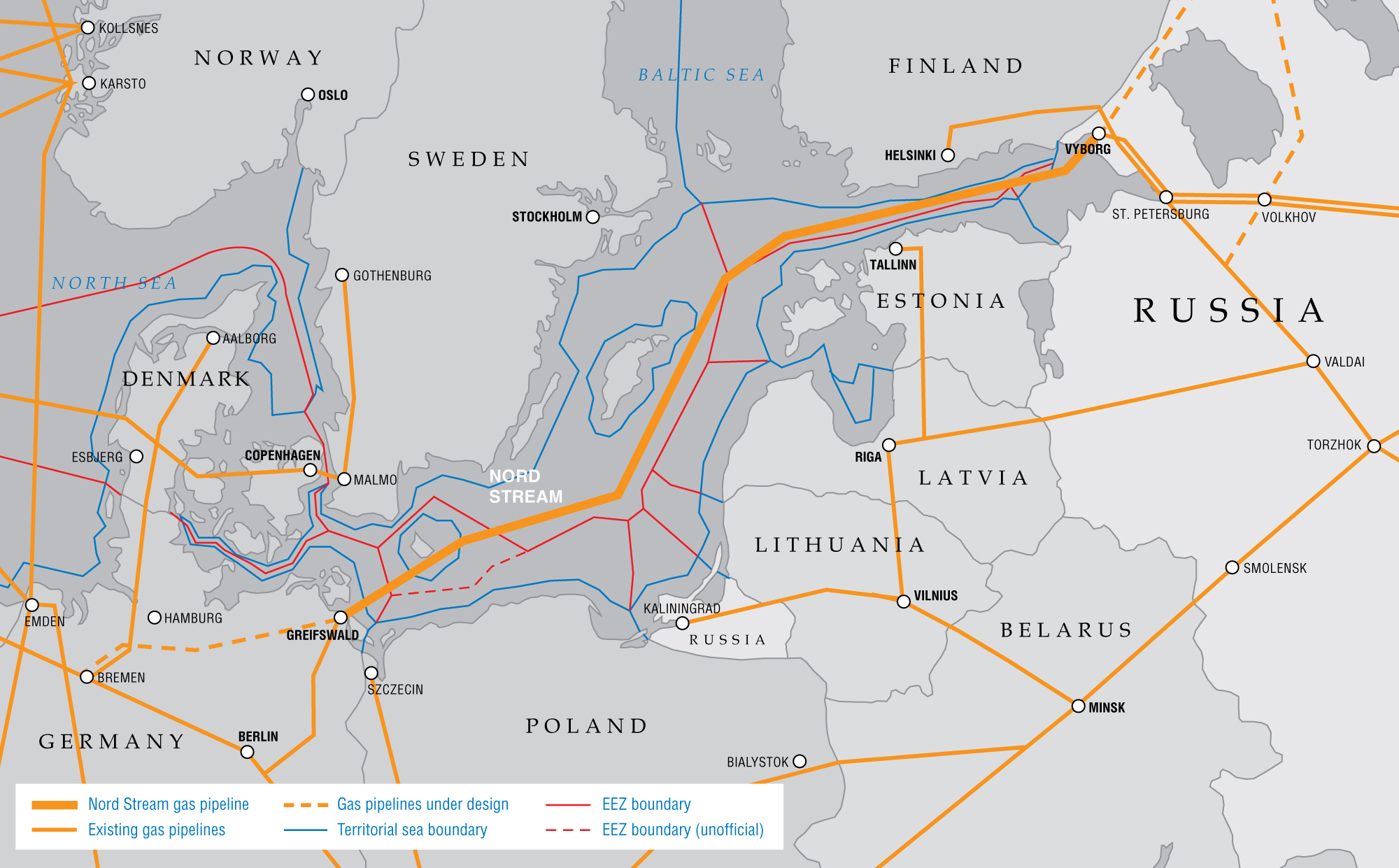
This continues to give Gazprom leverage over Ukraine, and with the North Stream pipeline now approaching its full potential after the second string was commissioned last October, Europe can receive up to 55 billion cu m per year without the gas having to pass through Ukraine.

Figure 2. Path of the North Stream (NordStream) pipeline from Russia to Germany (Gazprom)
There is now talk of adding additional capacity so that there can be a direct feed from Russia to the UK. BP is taking the lead on this, apparently with Gazprom support, although previous experience would suggest that Gazprom may end up as the major shareholder in the end, after all the bills have been paid. And speaking of which, their current dispute with Ukraine involves payment for $7 billion worth of natural gas,that Ukraine contracted for but did not, in the end use during 2012. Ukraine is paying $430 per thousand cubic meters ($12.18 per thousand cu ft) for a fixed volume per year, whether they use it or not, under an agreement signed in 2009.
There is some implication that this pressure may be related to the recent 50-year production sharing agreement that Ukraine signed with Shell to develop natural gas from shale deposits. The country is believed to have the third largest shale-bound natural gas resource in Europe (behind France and Norway ) estimated at around 42 trillion cu ft (1.2 trillion cu m).
The deposits are centered around the Yuzivskaya region, with production anticipated to start in 2017, rising to levels of around 8 – 10 bcm in ten years. Although there is some domestic opposition to the development, the schedule is aggressive.
Chevron is expected to develop deposits in the Olesska region with start dates of around the same time. Opposition to their plans seems to be growing, and they have yet to sign a production sharing agreement. They are, however hoping to get the same sort of deal that Shell negotiated.
It is worth injecting a note of caution into this optimistic view of the future. Just a year ago Poland was anticipating a similar bonanza from the natural gas in its shale deposits. Events have limited that dream. Although a 2011 EIA report stated that Poland had 187 tcf of technically recoverable natural gas, the Polish Geological Institute has now cut the estimates of the viable size of the resource by 90%, and there are other problems.
Secondly Ukraine is working with the Chinese to gasify some of their coal from their large deposits, with the intent of producing the equivalent of 4 bcm of natural gas to displace Russian imports.
But this does not mean that Ukraine has been able to escape having to pay whatever price Russia wished to impose, since to get from Turkmenistan to Ukraine the natural gas still requires passage through a pipeline that runs through Kazakhstan and Russia. There is no prize for guessing that Gazprom owns those pipelines.

Figure 1. The Central Asia Center pipeline and the route of the projected Pre-Caspian pipeline – both owned by Gazprom. (Gazprom).
This continues to give Gazprom leverage over Ukraine, and with the North Stream pipeline now approaching its full potential after the second string was commissioned last October, Europe can receive up to 55 billion cu m per year without the gas having to pass through Ukraine.

Figure 2. Path of the North Stream (NordStream) pipeline from Russia to Germany (Gazprom)
There is now talk of adding additional capacity so that there can be a direct feed from Russia to the UK. BP is taking the lead on this, apparently with Gazprom support, although previous experience would suggest that Gazprom may end up as the major shareholder in the end, after all the bills have been paid. And speaking of which, their current dispute with Ukraine involves payment for $7 billion worth of natural gas,that Ukraine contracted for but did not, in the end use during 2012. Ukraine is paying $430 per thousand cubic meters ($12.18 per thousand cu ft) for a fixed volume per year, whether they use it or not, under an agreement signed in 2009.
There is some implication that this pressure may be related to the recent 50-year production sharing agreement that Ukraine signed with Shell to develop natural gas from shale deposits. The country is believed to have the third largest shale-bound natural gas resource in Europe (behind France and Norway ) estimated at around 42 trillion cu ft (1.2 trillion cu m).
The deposits are centered around the Yuzivskaya region, with production anticipated to start in 2017, rising to levels of around 8 – 10 bcm in ten years. Although there is some domestic opposition to the development, the schedule is aggressive.
Shell is to work with Nadra Yuzivska, a joint venture in which the state-owned resources company Nadra Ukrayiny owns 90%. SPK-Geoservice, a small private company, owns the remaining 10% in Nadra Yuzivska.An adjacent well drilled by Hutton has shown promising signs of “interpreted pay in three intervals.”
Shell is expected to invest $410 million to drill the first 15 wells, Oleh Proskuriakov, the environment and natural resources minister, said earlier in January.
The total area of the Yuzivska field is 7,886 sq km. The deposit could hold 4.05 Tcm of gas, according to the government. Proskuriakov has also projected output from Yuzivska could hit 10 Bcm/year in 10 years and 20 Bcm/year in 15. Ukraine's Stavytskiy characterized the latter figure as representing the "optimistic scenario."
"We can project that in an optimistic scenario, the project will produce 20 Bcm/year of gas, while under a pessimistic scenario, 7-8 Bcm/year," Stavytskiy said.
Chevron is expected to develop deposits in the Olesska region with start dates of around the same time. Opposition to their plans seems to be growing, and they have yet to sign a production sharing agreement. They are, however hoping to get the same sort of deal that Shell negotiated.
It is worth injecting a note of caution into this optimistic view of the future. Just a year ago Poland was anticipating a similar bonanza from the natural gas in its shale deposits. Events have limited that dream. Although a 2011 EIA report stated that Poland had 187 tcf of technically recoverable natural gas, the Polish Geological Institute has now cut the estimates of the viable size of the resource by 90%, and there are other problems.
Difficult geology, an uncompetitive service sector, poor infrastructure, and lack of rigs have hampered development. Poland has a venerable oil and gas sector, but most of the transmission pipelines are based in the southwest, while major shale gas areas are in the northeast. Strict EU environmental laws, as well as unclear regulatory and tax frameworks have further eroded prospects. And while exploration has been going on for a few years now, only 33 wells have been drilled, with just eight of them fracked (at least 200 would have to be drilled in the exploratory stage, just to assess the actual size of reserves).And there are two more factors that should be considered. Ukraine is planning an LNG plant on the Black Sea to be ready by 2015, but even this is controversial. To reach the Black Sea tankers will have to pass through the Bosphorus and Dardanelles straits, and Turkey has intimated that it may not allow LNG tankers rights to that passage. That is because the terminal would compete with two that already exist in Turkey.
Preliminary results have not been encouraging, either: This summer, resource giant ExxonMobil withdrew from Poland after the failure of commercial gas flows, while its competitor ConocoPhillips decided not to exercise its 70 percent option in three concessions in northern Poland. Overall, costs per well have increased to $15 million, according to interviews with industry officials, roughly three times the cost in the United States.
Secondly Ukraine is working with the Chinese to gasify some of their coal from their large deposits, with the intent of producing the equivalent of 4 bcm of natural gas to displace Russian imports.
The projects are two-fold: first, heat-producing facilities will be converted to use coal-water slurry as fuel; second, new plants will be built to enable the gasification of brown and bituminous coal in three regions: Luhansk, Donetsk and Odessa. While most of the media reports claim that Ukraine will be using Chinese coal-slurry technology, it’s actually Shell’s technology.How soon Ukraine (and Poland) can stop imports of energetic fuels from Russia is not clear, but obviously this should happen before long, and the winters of their discontent may well disappear from the headlines.
Read more!
Thursday, July 21, 2011
OGPSS - Natural gas production, as shale gas arrives
The natural gas industry in the United States has undergone significant changes in the last twenty years. As I noted last time, until 1993 the industry was beset by regulation that controlled both price and flows. With the removal of those regulations the industry was able to make considerable strides to increase market share. As it became able to do so, the problems perceived from the burning of coal in particular as a power plant fuel, led to moves to increase the amount of electricity that is produced using natural gas. By 2009 the installed capacity to generate electricity included 34% that could be supplied from natural gas.
 Sources for installed electricity generating power 2009 (Newell EIA )
The EIA further anticipate that over the next 25 years that natural gas will continue to dominate new plant construction, comprising about 60% of the 223 gigawatts anticipated, with wind, at 11% coming second, while other renewable sources (which include a number of varieties) has about 12% of the growth. Now that doesn’t mean that the US actually produces 34% of its power from natural gas. In fact it is down at around a quarter of the current total, the difference being that companies prefer to use nuclear and coal -fired stations for their base load, and use natural gas more to meet variations in the demand cycle.
Because of this increased use US natural gas consumption has been rising in the past few years.
 U.S. natural gas consumption over the past decade (EIA) Note that 68 bcf/day is equivalent to 24.8 Tcf per year.
The total withdrawals of natural gas from domestic sources in 2009 totaled 28 trillion cubic feet (Tcf) of which 78% came from domestic gas wells, and 22% from oil wells. 13% of the 2009 total came from shale gas wells, and 8% from coal beds. Of the gas produced some 14% was re-injected to help maintain pressure in producing wells, and about 1% was flared. 3% of the volume was of non-hydrocarbon gases. The United States also imports around 11% of the gas that is consumed.
I am indebted to Gail Tverberg for the following plot that shows the longer trend in production, as well as the price (note that the difference in production volumes, relative to my numbers above, is that the figure below is just for natural gas wells).
 Production of natural gas from US wells, and price of that NG. (Gail Tverberg)
Natural gas production by State, which I previously just ranked, shows that Texas continues to be primary, but that the combination of states outside of the big 5 is rising steadily.
 Production of natural gas from different states (source EIA ).
It is worth noting that New Mexico, Oklahoma, Wyoming and the Federal offshore Gulf of Mexico (GOM) are declining while Louisiana is showing the greatest growth. In fact it is so great that Cheniere Energy will convert their LNG plant in the state so that it will be able to export Liquefied Natural Gas (LNG) rather than just store and re-gasify supplies after they have been imported. The hope is to have it on line and allowing the export of LNG by 2015. That growth in production has come largely from the development of the natural gas found in the Haynesville shale.
 Location of the Haynesville gas shale drilling (Geology.com )
It was in February of this year that the Haynesville took over the lead in gas production from the Barnett Shale in Texas producing 5.5 bcf/day to the Barnett’s 5.25 bcf. The field has more than a thousand wells in production, with around 2,000 permitted, and over 500 having been drilled but not completed. Part of the more rapid success of the Haynesville, the first successful well was only 3 years ago, has been because the gas could be fed more easily into existing pipelines than the case in Texas. The well location lies south of Shreveport.
The EIA plot of drilling activity in the gas shales shows the growing popularity of the Eagle Ford and Marcellus, presaging future production increases and a challenge to Louisiana.
 Drilling activity in the gas shales of the United States (Smith International via EIA )
The changing emphasis also is an indicator that the day of the Barnett shale appears to now be passing into afternoon.
 Production from the different gas shales (EIA Newell )
One of the big questions, however, with gas shale production relates to how long they will continue to produce if the production decline rates fall at levels of 85% per annum that have been reported in the past. The long term production from these fields also depends on their profitability, and in this regard it is interesting to see how the EIA sees the price of natural gas moving over the course of the next 25 years.
 EIA price projections for natural gas made in the past three years (EIA )
One question, since this price ties in to the volumes of gas that will be produced, continues to lie in the costs required to produce and transport the gas. If that remains below the selling price, and the new estimate price would appear to keep that distinction for the full 25 years, then the amount of gas produced will be much less. The EIA appear to hang their hat on long term sustained production from these wells. That may not be as true for the tighter shale rock than it is for more conventional gas reservoirs of the country.
The EIA has just noted, in their Energy Today post that stripper gas wells produce 11% of the volume of natural gas produced in the United States.
 Stripper well numbers and contribution to US natural gas production (EIA)
To put the percentage in context, one should also look at the volumes of natural gas that are being consumed and produced in the United States. Consumption over the past decade simplistically declined until 2006, whereafter it has increased, though the EIA now anticipate that it will now stabilize.
The 11% of volume thus translates to about 2 Tcf per year. They are most commonly found in Appalachia, Texas and Oklahoma. The roughly 300,000 stripper gas well total should be put in the context of a total of around 493,000 total gas wells in the USA in 2009.
There is likely thus to be some engagement in terms of the price of the product and thus volumes sold, between imported LNG, domestic conventional gas and shale gas. It will be interesting to see how that develops in the near future.
 Sources for installed electricity generating power 2009 (Newell EIA )
 The EIA further anticipate that over the next 25 years that natural gas will continue to dominate new plant construction, comprising about 60% of the 223 gigawatts anticipated, with wind, at 11% coming second, while other renewable sources (which include a number of varieties) has about 12% of the growth. Now that doesn’t mean that the US actually produces 34% of its power from natural gas. In fact it is down at around a quarter of the current total, the difference being that companies prefer to use nuclear and coal -fired stations for their base load, and use natural gas more to meet variations in the demand cycle.
Because of this increased use US natural gas consumption has been rising in the past few years.
 U.S. natural gas consumption over the past decade (EIA) Note that 68 bcf/day is equivalent to 24.8 Tcf per year.
The total withdrawals of natural gas from domestic sources in 2009 totaled 28 trillion cubic feet (Tcf) of which 78% came from domestic gas wells, and 22% from oil wells. 13% of the 2009 total came from shale gas wells, and 8% from coal beds. Of the gas produced some 14% was re-injected to help maintain pressure in producing wells, and about 1% was flared. 3% of the volume was of non-hydrocarbon gases. The United States also imports around 11% of the gas that is consumed.
I am indebted to Gail Tverberg for the following plot that shows the longer trend in production, as well as the price (note that the difference in production volumes, relative to my numbers above, is that the figure below is just for natural gas wells).
 Production of natural gas from US wells, and price of that NG. (Gail Tverberg)
Natural gas production by State, which I previously just ranked, shows that Texas continues to be primary, but that the combination of states outside of the big 5 is rising steadily.
 Production of natural gas from different states (source EIA ).
 It is worth noting that New Mexico, Oklahoma, Wyoming and the Federal offshore Gulf of Mexico (GOM) are declining while Louisiana is showing the greatest growth. In fact it is so great that Cheniere Energy will convert their LNG plant in the state so that it will be able to export Liquefied Natural Gas (LNG) rather than just store and re-gasify supplies after they have been imported. The hope is to have it on line and allowing the export of LNG by 2015. That growth in production has come largely from the development of the natural gas found in the Haynesville shale.
 Location of the Haynesville gas shale drilling (Geology.com )
 It was in February of this year that the Haynesville took over the lead in gas production from the Barnett Shale in Texas producing 5.5 bcf/day to the Barnett’s 5.25 bcf. The field has more than a thousand wells in production, with around 2,000 permitted, and over 500 having been drilled but not completed. Part of the more rapid success of the Haynesville, the first successful well was only 3 years ago, has been because the gas could be fed more easily into existing pipelines than the case in Texas. The well location lies south of Shreveport.
The EIA plot of drilling activity in the gas shales shows the growing popularity of the Eagle Ford and Marcellus, presaging future production increases and a challenge to Louisiana.
 Drilling activity in the gas shales of the United States (Smith International via EIA )
 The changing emphasis also is an indicator that the day of the Barnett shale appears to now be passing into afternoon.
 Production from the different gas shales (EIA Newell )
 One of the big questions, however, with gas shale production relates to how long they will continue to produce if the production decline rates fall at levels of 85% per annum that have been reported in the past. The long term production from these fields also depends on their profitability, and in this regard it is interesting to see how the EIA sees the price of natural gas moving over the course of the next 25 years.
 EIA price projections for natural gas made in the past three years (EIA )
One question, since this price ties in to the volumes of gas that will be produced, continues to lie in the costs required to produce and transport the gas. If that remains below the selling price, and the new estimate price would appear to keep that distinction for the full 25 years, then the amount of gas produced will be much less. The EIA appear to hang their hat on long term sustained production from these wells. That may not be as true for the tighter shale rock than it is for more conventional gas reservoirs of the country.
The EIA has just noted, in their Energy Today post that stripper gas wells produce 11% of the volume of natural gas produced in the United States.
Individual natural gas stripper wells produce no more than about 90 thousand cubic feet of natural gas-equivalent per day over a twelve-month period (some wells also produce natural gas liquids), but because there are so many (nearly 340,000) they collectively account for a significant portion the Nation's total natural gas production—2,912 billion cubic feet, or over 11% in 2009.
 Stripper well numbers and contribution to US natural gas production (EIA)
 To put the percentage in context, one should also look at the volumes of natural gas that are being consumed and produced in the United States. Consumption over the past decade simplistically declined until 2006, whereafter it has increased, though the EIA now anticipate that it will now stabilize.
The 11% of volume thus translates to about 2 Tcf per year. They are most commonly found in Appalachia, Texas and Oklahoma. The roughly 300,000 stripper gas well total should be put in the context of a total of around 493,000 total gas wells in the USA in 2009.
There is likely thus to be some engagement in terms of the price of the product and thus volumes sold, between imported LNG, domestic conventional gas and shale gas. It will be interesting to see how that develops in the near future.
Read more!
Sunday, June 26, 2011
A Panel on Peak Coal and Natural Gas Viability
For the second week running I am participating in a panel for the Focus group tomorrow. The title is
The Viability of Coal and Natural Gas as Alternative Fuel Sources
Given the NYT story on oil industry e-mails that came out today, and the challenge it provides to the prevailing view on our entering "The Golden Age of Natural Gas", I'll write a further post on this later in the week, but it is hard to imagine the topic won't be coming up tomorrow. That is especially true since Art Berman (quoted in the story) will be taking part, as will Gail Tverberg, and (arguing more for peak coal) David Rutledge and Tad Patzek.
It starts at 2 pm Eastern, 11 am Pacific
You gain access to the discussion by going to the site reached by clicking on the above title. The recording of the discussion will be reached through the above site in a couple of days, followed by a transcript about a week later. Listen in, it could be fun.
The Viability of Coal and Natural Gas as Alternative Fuel Sources
Given the NYT story on oil industry e-mails that came out today, and the challenge it provides to the prevailing view on our entering "The Golden Age of Natural Gas", I'll write a further post on this later in the week, but it is hard to imagine the topic won't be coming up tomorrow. That is especially true since Art Berman (quoted in the story) will be taking part, as will Gail Tverberg, and (arguing more for peak coal) David Rutledge and Tad Patzek.
It starts at 2 pm Eastern, 11 am Pacific
You gain access to the discussion by going to the site reached by clicking on the above title. The recording of the discussion will be reached through the above site in a couple of days, followed by a transcript about a week later. Listen in, it could be fun.
Read more!
Tuesday, January 18, 2011
API and some thoughts on America's Energy Future
There seems to be a little drop in the intensity of the debate over the arrival of Peak Oil. Given that crude oil prices are hovering around $100 a barrel, and quite likely to go higher over the course of the year, it is perhaps only the recent history of oil at $147 a barrel that stops a more intense debate. After all we have been there - done that, before so why worry? Unfortunately this may be the lull before the storm.
Consider that there has been a change or two, even in the short period of time since our last visit to this price range. Last time it was possible to see an increase in production from places such as the United States, and from Russia. Not huge amounts, but symbolic, that production could respond, somewhat to a potentially more expensive product. But this time around it is likely that we will see both United States and Russian production fall this year, even as prices rise. And with a certain complacency evident in the politicians, whose constituents are now paying higher prices for product, things that might be properly done to at least help out, are not seen as that important at the moment.
The API addressed this issue, at the beginning of the year, through the speech of Jack Gerard, their President. Looking at the “State of American Energy”, he was able to point to the number of new jobs that the industry has been able to create both with the development of the Marcellus gas shales in the East, and with the Bakken developments in the North West. He also pointed to the $95 million in taxes, rents, royalties and bonus payments that the Treasury gets from the industry each day. The totality of current jobs was counted as 2.1 million directly employed in the oil and gas industry and 7.1 million in the affiliated industries that work to support it.
Yet, as he noted,
The fact that they are playing in a shrinking sandbox, as producing countries take over more and more of the profit generating parts of production is not seen as a concern.. Yet, as we have seen in places such as Venezuela, the results of government involvement is quite often to reduce the level of investment in the industry, just as investment costs should, in reality, increase to allow discovery and development of the more difficult reserves that will be needed in the future.
As the Venezuelan experience shows “Twenty billion here, and twenty billion there, and soon they are talking real money,” (to misquote Senator Dirksen). And yet those monies are likely to be inadequate to properly develop the resources of that country. Jack Gerard seems the future in the further development of the gas shales, in increasing production from the Canadian oil sands, and in the development of a significant oil shale industry.
At the present there is too much natural gas available for the growth of the gas shale industry to be assured over the next five years. This is not because of the problems that are being stirred up over the chemistry of the fracking fluids, nor the ability of the companies to properly protect the ground water around the sites, those issues have realistically been solved decades ago, and the furor will die away in time. The problem at the moment relates more to the cost of developing the reserves at a time when the market has natural gas available that is cheaper than can be extracted from some of the gas shale wells. And as long as that holds true the industry is unlikely to grow much.
One thing that API did not mention much in the speech, but which came later, in one of Jane Van Ryan’s blog posts, is a valid concern over the march toward E15, that is the use of 15% ethanol in gasoline. That original target was predicated on the assumption that, by now, cellulosic ethanol would be at or close to large-scale commercial production. Well that has not proved to be the case. EPA backed off a little on the targets last year, as Robert Rapier noted at the time. More recently he has drawn attention to the failure of the Range Fuels plant in Soperton GA , which is now closing. After spending $320 million, and producing one batch of ethanol, the company needs more money to solve technical issues.
As far as the national target is concerned:
That decline is now, however, the concern expressed by API. Among other issues, there are two problems that higher concentrations of ethanol in the mix may cause that are not necessarily that evident. The first is that those of us who use small engines for mowers, chain saws, trimmers etc may find these running unexpectedly hot if they use the new mix. And albeit the manufacturers warn against its use, most of us fill the can while we are refueling the car, and from the same pump.
The other concern relates to the seals in tanks and underground storage.
Of course we could talk of alternate investments in geothermal, the less popular renewable. But maybe I’ll hold off on that for another day.
Consider that there has been a change or two, even in the short period of time since our last visit to this price range. Last time it was possible to see an increase in production from places such as the United States, and from Russia. Not huge amounts, but symbolic, that production could respond, somewhat to a potentially more expensive product. But this time around it is likely that we will see both United States and Russian production fall this year, even as prices rise. And with a certain complacency evident in the politicians, whose constituents are now paying higher prices for product, things that might be properly done to at least help out, are not seen as that important at the moment.
The API addressed this issue, at the beginning of the year, through the speech of Jack Gerard, their President. Looking at the “State of American Energy”, he was able to point to the number of new jobs that the industry has been able to create both with the development of the Marcellus gas shales in the East, and with the Bakken developments in the North West. He also pointed to the $95 million in taxes, rents, royalties and bonus payments that the Treasury gets from the industry each day. The totality of current jobs was counted as 2.1 million directly employed in the oil and gas industry and 7.1 million in the affiliated industries that work to support it.
Yet, as he noted,
Over the past few years, revenues to the U.S Treasury from lease sales have decreased, due in part to a lack of opportunities.Part of that uncertainty comes from the changes in regulation that will control drilling offshore from the United States. Some rigs that could have continued to drill in the GOM, but were halted after the Deepwater Horizon disaster have now moved abroad, and may be gone years before they return to American prospects. But until there is a clear commitment to facilitating American production, that exodus may well continue. The severity of the coming crisis is still not evident in the eyes of the politicians and the general public. Further, as the price of oil rises, it is assumed that the wealth of the companies producing the oil is also increasing, and so (despite rising costs that are not mentioned nearly as often) it is assumed that companies can afford higher payments. And with new quarterly and annual profit statements coming out soon, it is going to be a little difficult to defend that position against what is quite likely to be a set of overall record, or close to record, earnings. Even BP had returned to profit at the end of the 3rd Quarter of 2010.
Our industry is eager to initiate new projects. But without an adequate level of business certainty, with concerns about policies that might curtail this industry’s ability to access new resources, those projects might never get off the drawing board
The fact that they are playing in a shrinking sandbox, as producing countries take over more and more of the profit generating parts of production is not seen as a concern.. Yet, as we have seen in places such as Venezuela, the results of government involvement is quite often to reduce the level of investment in the industry, just as investment costs should, in reality, increase to allow discovery and development of the more difficult reserves that will be needed in the future.
As the Venezuelan experience shows “Twenty billion here, and twenty billion there, and soon they are talking real money,” (to misquote Senator Dirksen). And yet those monies are likely to be inadequate to properly develop the resources of that country. Jack Gerard seems the future in the further development of the gas shales, in increasing production from the Canadian oil sands, and in the development of a significant oil shale industry.
At the present there is too much natural gas available for the growth of the gas shale industry to be assured over the next five years. This is not because of the problems that are being stirred up over the chemistry of the fracking fluids, nor the ability of the companies to properly protect the ground water around the sites, those issues have realistically been solved decades ago, and the furor will die away in time. The problem at the moment relates more to the cost of developing the reserves at a time when the market has natural gas available that is cheaper than can be extracted from some of the gas shale wells. And as long as that holds true the industry is unlikely to grow much.
One thing that API did not mention much in the speech, but which came later, in one of Jane Van Ryan’s blog posts, is a valid concern over the march toward E15, that is the use of 15% ethanol in gasoline. That original target was predicated on the assumption that, by now, cellulosic ethanol would be at or close to large-scale commercial production. Well that has not proved to be the case. EPA backed off a little on the targets last year, as Robert Rapier noted at the time. More recently he has drawn attention to the failure of the Range Fuels plant in Soperton GA , which is now closing. After spending $320 million, and producing one batch of ethanol, the company needs more money to solve technical issues.
As far as the national target is concerned:
Congress initially set 100 million gallons as the 2010 target for cellulosic biofuel, but the EPA cut that to 6.5 million gallons. It appears that the industry might have produced less than 1 million gallons last year, reported ClimateWire on Tuesday, citing an estimate by a government analyst.(On the other hand Valero is moving ahead with plans to invest $50 million in the Mascoma plant in upstate New York, that move will include the purchase of just under a million barrels of cellulosic ethanol) .
That decline is now, however, the concern expressed by API. Among other issues, there are two problems that higher concentrations of ethanol in the mix may cause that are not necessarily that evident. The first is that those of us who use small engines for mowers, chain saws, trimmers etc may find these running unexpectedly hot if they use the new mix. And albeit the manufacturers warn against its use, most of us fill the can while we are refueling the car, and from the same pump.
The other concern relates to the seals in tanks and underground storage.
Just as there are seals in gaskets in cars that can be affected by E15, similar seals and gaskets can be found at the service station and the pump above the ground and the underground storage tank. The DOE recently released some test results of gas station dispensers and the results were pretty sobering. About 70 percent of the older equipment in existence failed these tests and about 30 percent of the new equipment failed these tests. That is a real liability concern because if you are a service station owner and have to determine whether to use E15 in an existing underground storage tank when the replacement costs for that storage tank could be $50,000 to $200,000. The testing that the DOE did was only above ground.If that weren’t enough – since we won’t have much cellulosic ethanol, we’re going to have to rely on corn. And what is the story on the price of corn? March prices are $6.59 a bushel, and still rallying.
Output in the U.S., the world’s largest grain exporter, dropped 4.9 percent last year, leaving supply before the 2011 harvest at the lowest in 15 years, the Department of Agriculture said last week. The agency also cut its forecast for global inventories to 127 million metric tons, the lowest since 2007.I guess one of the interesting questions becomes as to whether we will see $5 a gallon gasoline in 2011 or 2012?
“Prices have not risen high enough to slow demand,” said Greg Grow, the director of agribusiness for Archer Financial Services Inc. in Chicago. “The attitude among consumers is that you have to buy the breaks to accumulate tightening inventories.”
Of course we could talk of alternate investments in geothermal, the less popular renewable. But maybe I’ll hold off on that for another day.
Read more!
Wednesday, November 17, 2010
Me, This Week in Energy, and why Halliburton might refuse EPA
This afternoon I was an invited guest on “This Week in Energy” with Nikki Gordon-Bloomfield and Bob Tregelus. Among other things we talked about the fracking process that is being used to help produce the natural gas from shales such as the Marcellus and Haynesville. In the course of the discussion I was asked why of the nine fracking companies that EPA asked for their formulae, only Halliburton had refused the request. Bob pointed out that they were going to be subpoenaed and thus would have to give up the information anyway. I have discussed some of the problems of stimulating a well with hydraulic fracturing, both real and less so, on this site last March when the public perception of the technology began to change.
In the possible explanation I am going to give, you need to know that this is purely a supposition and the chemicals that I am going to mention are put forward out of my own head, as it were. I have no real clue as to why Halliburton are acting the way that they are, and am only building a hypothesis that might only through some slight possibility have any approximate relation to the truth.
In the evolution of the technology that has made production of the gas shales possible several different technologies had to be developed. The rock (which is actually a mudstone) has a very poor natural permeability. I.e. it is very difficult for fluid to flow through the rock, because the passage ways are very narrow and not very well connected. Thus the normal vertical wells would not produce very much oil or gas when drilled through the shale reservoir, certainly not enough to be profitable. The first beneficial development was, therefore, the ability to drill horizontally after the well had reached the reservoir depth. Once this was possible, then the length of the well that was exposed to the reservoir (which might be only 30 ft thick) would increase from that 30 ft to perhaps 10,000 ft. Since the amount of fluid flowing into the well is a function of the length of the exposed well in the rock, when the reservoir rock has a normal permeability this is enough to increase production significantly (as for example in the new wells in Saudi Arabia).
However when the rock has a very poor permeability even the long wells will only very slowly accumulate fluid from the surrounding rock, since there are no easy passages to the well through that rock. Thus the next benefit that was needed was the ability to crack the rock around the well. This is known as hydraulic fracturing or hydrofracking for short. In modern wells, by isolating and then pressurizing different segments of the well in turn, these cracks can be created (when the pressure inside the well exceeds the rock strength) at regular intervals (say 30 to 120 ft apart) along the length of the borehole.
The cracks are controlled in length (since if they go outside the reservoir all the fluid can drain away through the other end of the cracks, not to the well). But the problem is that once the crack is made, the pressure inside the well is lowered and the equipment moved to the next segment. Without any other changes as the pressure comes off the crack it will close back up, and there will not be much gain from the effort. So to keep the crack open what the industry calls a proppant, but you or I might just call it a carefully sized sand, is mixed with the fracking fluid before it is injected into the well.
As a result, when the cracks open in the rock, and the fracking fluid flows into the crack, the sand is carried with it, and is then trapped in the crack, holding it open after the pressure is lowered. A passage then exists for the gas or oil to travel to the well and production of most of the rock volume becomes possible.
Well that was when the development of the gas shale deposits began, however it had not been going on very long when it was noticed that the sand was not flowing easily into the fractures, and without enough sand being carried far enough back into the cracks, production wasn’t nearly as good as it should have been.
At this point another development was needed. This came about when an additional chemical – what is known as a long-chain polymer (typically a polyacrylamide) - was added to the fracking fluid. These fluids are known as Friction Reducing Agents (FRAs) because they tend to make water stick together a bit, and create extremely slippery surfaces when they coat them. By adding these FRAs to the fracking fluid, the crack walls became slipperier and the sand particles could thus travel deeper into the cracks, holding them open more effectively and increasing gas production. The fluids were given the generic name “slick water”, so that the current state-of-the-art is a horizontal well that has had a multi-fracture, slickwater-hydrofracking operation run on it.
But the problems of the wells are not over. As I noted in my post yesterday, the mudstones contain a significant amount of clays. And the problem when clays get wet is that they get softer and clay particles can break away from the wall of the fracture (slaking). Over the different gas shale deposits the problems are not consistent, since each shale is made of a different set of constituent rock types and clays. But overall the problem that is now being evidenced, as Art Berman has commented a number of times, is that the wells are losing production faster and earlier than predicted, so that they cannot meet the overall targets that make the well profitable. Instead of the well lasting perhaps a decade, they are losing perhaps 60% of the flow in the first year, and are no longer worth operating after maybe three years.
With all that as background, here is a hypothesis to explain Halliburton’s actions. It is quite possible that the well failures are due to the clay failure in the shale reducing the crack effectiveness. Clay content failure can do this, once the fracking fluid has cracked and wetted it, by a long term softening (which will allow the walls of the crack to fold around the proppant particles, and close the crack as the walls move in), or simply swelling into some of the crack space, with the same effect. Alternately the clay particles may slake and break away from the walls of the crack, and over time build up small dams along the crack path, again blocking the fluid flow through the crack – any one of these mechanisms explains the production falls that are being seen in the industry.
So lets say that Halliburton has realized the problem and, for merely the sake of a discussable solution, changes the polymer that they use from a pure polyacrylamide (PA) to include polyethylene oxide (PO). One thing that PO does at much lower concentrations than PA is that it stops the fracking fluid from wetting the shale, and interacting with the clay. Because it is (or at least was when we did this) much more expensive than PA there is not normally any reason to use PO in the fracking fluid.
But let us say that Halliburton have tried this, and it works. Because it is a step change in the process (in the same way as horizontal drilling; fracking; and slick water use were each, in turn) then the company selling the new idea has a tremendous commercial advantage. They can promise you that your well will stay in production long enough for you to make a profit, while the competition cannot.
The world of hydrofracking contractors is small and engineers move around, so that commercial advantage does not last very long, and word gets out as to how it was done. But that takes time, first to find out what is causing the problem, then what the answer is in general, and then what the answer is in detail. Each of those steps might take a competitor a year. That gives you three years of advantage, when you can charge higher rates, and possibly put some of that competition out of business.
The problem is that if the competition sees that you have put PO in your fluid, instead of PA then they can immediately go and look up what difference that makes to the fluid. Knowing that it stops wetting immediately gets them past stages one and two and cuts the term of your commercial advantage from three years to one.
Would you want to give that up if, by lawyering and all those fancy tricks they get up to in Washington you could get the time that you have to release the content postponed by at least a year? Likely not, and since dragging out the process can extend the period of your commercial advantage, the longer you can keep kicking the ball down the street the greater your advantage, and the more benefit.
And I re-iterate this is purely a hypothesis that I came up with, and I have no connections that would suggest that this has any connection to reality.
In the possible explanation I am going to give, you need to know that this is purely a supposition and the chemicals that I am going to mention are put forward out of my own head, as it were. I have no real clue as to why Halliburton are acting the way that they are, and am only building a hypothesis that might only through some slight possibility have any approximate relation to the truth.
In the evolution of the technology that has made production of the gas shales possible several different technologies had to be developed. The rock (which is actually a mudstone) has a very poor natural permeability. I.e. it is very difficult for fluid to flow through the rock, because the passage ways are very narrow and not very well connected. Thus the normal vertical wells would not produce very much oil or gas when drilled through the shale reservoir, certainly not enough to be profitable. The first beneficial development was, therefore, the ability to drill horizontally after the well had reached the reservoir depth. Once this was possible, then the length of the well that was exposed to the reservoir (which might be only 30 ft thick) would increase from that 30 ft to perhaps 10,000 ft. Since the amount of fluid flowing into the well is a function of the length of the exposed well in the rock, when the reservoir rock has a normal permeability this is enough to increase production significantly (as for example in the new wells in Saudi Arabia).
However when the rock has a very poor permeability even the long wells will only very slowly accumulate fluid from the surrounding rock, since there are no easy passages to the well through that rock. Thus the next benefit that was needed was the ability to crack the rock around the well. This is known as hydraulic fracturing or hydrofracking for short. In modern wells, by isolating and then pressurizing different segments of the well in turn, these cracks can be created (when the pressure inside the well exceeds the rock strength) at regular intervals (say 30 to 120 ft apart) along the length of the borehole.
The cracks are controlled in length (since if they go outside the reservoir all the fluid can drain away through the other end of the cracks, not to the well). But the problem is that once the crack is made, the pressure inside the well is lowered and the equipment moved to the next segment. Without any other changes as the pressure comes off the crack it will close back up, and there will not be much gain from the effort. So to keep the crack open what the industry calls a proppant, but you or I might just call it a carefully sized sand, is mixed with the fracking fluid before it is injected into the well.
As a result, when the cracks open in the rock, and the fracking fluid flows into the crack, the sand is carried with it, and is then trapped in the crack, holding it open after the pressure is lowered. A passage then exists for the gas or oil to travel to the well and production of most of the rock volume becomes possible.
Well that was when the development of the gas shale deposits began, however it had not been going on very long when it was noticed that the sand was not flowing easily into the fractures, and without enough sand being carried far enough back into the cracks, production wasn’t nearly as good as it should have been.
At this point another development was needed. This came about when an additional chemical – what is known as a long-chain polymer (typically a polyacrylamide) - was added to the fracking fluid. These fluids are known as Friction Reducing Agents (FRAs) because they tend to make water stick together a bit, and create extremely slippery surfaces when they coat them. By adding these FRAs to the fracking fluid, the crack walls became slipperier and the sand particles could thus travel deeper into the cracks, holding them open more effectively and increasing gas production. The fluids were given the generic name “slick water”, so that the current state-of-the-art is a horizontal well that has had a multi-fracture, slickwater-hydrofracking operation run on it.
But the problems of the wells are not over. As I noted in my post yesterday, the mudstones contain a significant amount of clays. And the problem when clays get wet is that they get softer and clay particles can break away from the wall of the fracture (slaking). Over the different gas shale deposits the problems are not consistent, since each shale is made of a different set of constituent rock types and clays. But overall the problem that is now being evidenced, as Art Berman has commented a number of times, is that the wells are losing production faster and earlier than predicted, so that they cannot meet the overall targets that make the well profitable. Instead of the well lasting perhaps a decade, they are losing perhaps 60% of the flow in the first year, and are no longer worth operating after maybe three years.
With all that as background, here is a hypothesis to explain Halliburton’s actions. It is quite possible that the well failures are due to the clay failure in the shale reducing the crack effectiveness. Clay content failure can do this, once the fracking fluid has cracked and wetted it, by a long term softening (which will allow the walls of the crack to fold around the proppant particles, and close the crack as the walls move in), or simply swelling into some of the crack space, with the same effect. Alternately the clay particles may slake and break away from the walls of the crack, and over time build up small dams along the crack path, again blocking the fluid flow through the crack – any one of these mechanisms explains the production falls that are being seen in the industry.
So lets say that Halliburton has realized the problem and, for merely the sake of a discussable solution, changes the polymer that they use from a pure polyacrylamide (PA) to include polyethylene oxide (PO). One thing that PO does at much lower concentrations than PA is that it stops the fracking fluid from wetting the shale, and interacting with the clay. Because it is (or at least was when we did this) much more expensive than PA there is not normally any reason to use PO in the fracking fluid.
But let us say that Halliburton have tried this, and it works. Because it is a step change in the process (in the same way as horizontal drilling; fracking; and slick water use were each, in turn) then the company selling the new idea has a tremendous commercial advantage. They can promise you that your well will stay in production long enough for you to make a profit, while the competition cannot.
The world of hydrofracking contractors is small and engineers move around, so that commercial advantage does not last very long, and word gets out as to how it was done. But that takes time, first to find out what is causing the problem, then what the answer is in general, and then what the answer is in detail. Each of those steps might take a competitor a year. That gives you three years of advantage, when you can charge higher rates, and possibly put some of that competition out of business.
The problem is that if the competition sees that you have put PO in your fluid, instead of PA then they can immediately go and look up what difference that makes to the fluid. Knowing that it stops wetting immediately gets them past stages one and two and cuts the term of your commercial advantage from three years to one.
Would you want to give that up if, by lawyering and all those fancy tricks they get up to in Washington you could get the time that you have to release the content postponed by at least a year? Likely not, and since dragging out the process can extend the period of your commercial advantage, the longer you can keep kicking the ball down the street the greater your advantage, and the more benefit.
And I re-iterate this is purely a hypothesis that I came up with, and I have no connections that would suggest that this has any connection to reality.
Read more!
Tuesday, November 16, 2010
An update on fuels from shale, and The Giant Toaster
This afternoon I was able to drop in on a talk by Jeremy Boak, who runs the Center for Oil Shale Technology and_Research (COSTAR) in Golden. He was speaking to the topic of “Finding Billions in Ancient Mud? Shale gas, shale-hosted oil and oil shale.” It is likely to become an increasingly contentious subject over the next few years as oil prices go higher, and the availability of the oils, kerogens and gases within the shales of the world become more economically viable. Jeremy drew attention to the annual Oil Shale Symposia that he has recently been chairing at Colorado School of Mines and which run each year. He provided the site where the papers from the last four of these Symposia are freely available. (The 29th, 28th, 27th and 26th Symposia, papers from the 30th, held in October, have not yet been posted).
His talk began with a review of the geology and the reality of the definition of the deposits – he quoted Walter Youngquist
The only places that are producing oil from the shale are currently in Estonia (with about 8,000 barrels a day); Brazil with about 4,000 barrels a day (bd), and China which is producing about 10,000 bd. However he also noted that China is building about 100 retorts a year to convert the kerogen to oil on the surface, and these retorts are located around China near significant deposits. (Typically the shale must be heated to over 300 degC before the kerogen will turn to oil, and be released from the rock – though the product of this treatment is generally thicker and quite heavy).
The potential for the continued production of liquid fossil fuels is encouraging other countries to take a serious look at developing their own resources. He cited Jordan, which is estimated to have 100 billion barrels, and testing is now going on in Morocco. However he cautioned that production levels would not rise rapidly and this could not be accepted, in the short term, as the answer to the coming shortages. He provided the following predictive plot (which I copied from an earlier talk), showing over a 60 year period the early development of conventional oil in the US against that of the tar sands of Canada, and the oil shales of the US.
 (From Boak)
The hottest developments however are not in shale oil, but rather in shale gas. The most active search for which appears, at the moment to be in Poland. Conoco Phillips has apparently drilled two wells and is looking at a third, with over 900,000 acres now being leased. Not that the road to success in that county is predicted to be easy.
The talk moved on to describe the technological breakthroughs that have made oil and gas recovery from these shales possible. While part of this has been the ability to drill long horizontal holes, which is of relatively recent origin, the evolution of the multi-stage fracking process to put a multiplicity of cracks out from the well into the reservoir has been the real key. And hydrofracking has been developing and evolving for over 50 years.
It is that hydrofracking that has led to one of the more interesting novel approaches being developed by Exxon Mobil now in Colorado. While officially this is known as the Electro-frac process, almost everyone now is calling it the Giant Toaster.

Moving one step beyond the conventional horizontal drill, and then fracking of the rock, in the oil shale the fractures will be filled with a conductive material, so that, after the pressure is removed and the crack partially closes, the pressure squeezes this proppant , calcined coke and Portland cement, together to form a conductive sheet. By passing current through this (as in your toaster) the surrounding rock can slowly be brought up to temperature and then cooked slowly to transform the kerogen to oil.
Exxon Mobil are encouraged in this by the results that Shell have reported for their in-situ retorting (which I described in my series on oil shale – which are listed on the right hand side at the top of the BTE site). As I noted on the future of oil shale when Shell carried out their slow heating of the oil shale in-situ they were able to draw off a clear, golden oil which could easily be separated into gasoline, jet fuel and diesel.
The updates on the Exxon Mobil process show that they have been able to load the conductive material into the fractures as planned, and have been able to then run current through the material and heat the rock. They have not yet done the sustained higher temperature heating that will be required for full transition of the kerogen.
The Exxon-Mobil process has the benefit of being able to move the fractures further apart to some 125 ft spacing, over the 25 ft planned for the field tests of the Shell process.
His talk began with a review of the geology and the reality of the definition of the deposits – he quoted Walter Youngquist
"Bankers won’t invest a dime in organic mudstone, but find oil shale an entirely different matter.”And then pointed out why the proper name is the mudstone, but that the MSM and bankers and those seeing their interest have been quite willing to allow the name change. Looking at numbers of around 1.5 trillion barrels of kerogen in the shales of Colorado, about 1.3 trillion in Utah, and 1.3 trillion in Wyoming, gives the United States in those states alone about 4 trillion barrels of oil. None of which, at present is being produced in any significant volume. However he noted that a production rate of 3 mbd is equivalent to a billion barrels a year (i.e. the current world production of around 87 mbd would be around 29 billion barrels a year). And a billion barrels is about the quantity of kerogen that can be found in one square mile of the basin. Normally reserves are only considered if the organic carbon content is about 30% (or roughly 70 gallons/ton).
The only places that are producing oil from the shale are currently in Estonia (with about 8,000 barrels a day); Brazil with about 4,000 barrels a day (bd), and China which is producing about 10,000 bd. However he also noted that China is building about 100 retorts a year to convert the kerogen to oil on the surface, and these retorts are located around China near significant deposits. (Typically the shale must be heated to over 300 degC before the kerogen will turn to oil, and be released from the rock – though the product of this treatment is generally thicker and quite heavy).
The potential for the continued production of liquid fossil fuels is encouraging other countries to take a serious look at developing their own resources. He cited Jordan, which is estimated to have 100 billion barrels, and testing is now going on in Morocco. However he cautioned that production levels would not rise rapidly and this could not be accepted, in the short term, as the answer to the coming shortages. He provided the following predictive plot (which I copied from an earlier talk), showing over a 60 year period the early development of conventional oil in the US against that of the tar sands of Canada, and the oil shales of the US.
 (From Boak)
The hottest developments however are not in shale oil, but rather in shale gas. The most active search for which appears, at the moment to be in Poland. Conoco Phillips has apparently drilled two wells and is looking at a third, with over 900,000 acres now being leased. Not that the road to success in that county is predicted to be easy.
The talk moved on to describe the technological breakthroughs that have made oil and gas recovery from these shales possible. While part of this has been the ability to drill long horizontal holes, which is of relatively recent origin, the evolution of the multi-stage fracking process to put a multiplicity of cracks out from the well into the reservoir has been the real key. And hydrofracking has been developing and evolving for over 50 years.
It is that hydrofracking that has led to one of the more interesting novel approaches being developed by Exxon Mobil now in Colorado. While officially this is known as the Electro-frac process, almost everyone now is calling it the Giant Toaster.

Moving one step beyond the conventional horizontal drill, and then fracking of the rock, in the oil shale the fractures will be filled with a conductive material, so that, after the pressure is removed and the crack partially closes, the pressure squeezes this proppant , calcined coke and Portland cement, together to form a conductive sheet. By passing current through this (as in your toaster) the surrounding rock can slowly be brought up to temperature and then cooked slowly to transform the kerogen to oil.
Exxon Mobil are encouraged in this by the results that Shell have reported for their in-situ retorting (which I described in my series on oil shale – which are listed on the right hand side at the top of the BTE site). As I noted on the future of oil shale when Shell carried out their slow heating of the oil shale in-situ they were able to draw off a clear, golden oil which could easily be separated into gasoline, jet fuel and diesel.
The updates on the Exxon Mobil process show that they have been able to load the conductive material into the fractures as planned, and have been able to then run current through the material and heat the rock. They have not yet done the sustained higher temperature heating that will be required for full transition of the kerogen.
The Exxon-Mobil process has the benefit of being able to move the fractures further apart to some 125 ft spacing, over the 25 ft planned for the field tests of the Shell process.
Read more!
Monday, May 3, 2010
Gazprom and Ukraine - natural gas and the shale gas potential
Well now that is interesting. Quietly, while everyone’s attention was, increasingly focused either on the British Election or the oil spill in the Gulf (this was before the attempted bombing in NY) Russian Prime Minister made one of those almost un-noticed Friday announcements. He suggested that Gazprom, the Russian gas company, merge with the Ukrainian natural gas company Naftogaz.
In February the election in Ukraine switched the country from a Westward leaning Administration to one that favored Russia This could be one result of that, and it has a couple of implications. Firstly it ties the country much more tightly to Russian energy strings. Secondly it stops the embarrassing headlines that have occurred in recent winters as Ukraine and Russia have quarreled over the price Ukraine will pay for its natural gas.
The statement has apparently caught many Ukrainian administrators a little off guard. They might perhaps want to take the hint.
But at the same time there is a potential to break the dependence on Russian natural gas.
As for Poland, it was at the end of last year that the energy advisor suggested that they could be self-sufficient in 4-5 years.
Shale gas has even fueled interest up in New Brunswick
But this international move to indigenous resources does not install confidence in the Kremlin that they can sustain the markets which they need to generate the funds to support their budgets. And so, in the hope perhaps that the change in Administration in Ukraine will help them, they have begun to possibly look at other ways of keeping themselves in business.
In February the election in Ukraine switched the country from a Westward leaning Administration to one that favored Russia This could be one result of that, and it has a couple of implications. Firstly it ties the country much more tightly to Russian energy strings. Secondly it stops the embarrassing headlines that have occurred in recent winters as Ukraine and Russia have quarreled over the price Ukraine will pay for its natural gas.
The statement has apparently caught many Ukrainian administrators a little off guard. They might perhaps want to take the hint.
“It’s no secret that Russia continues work on its two pipelines by-passing Ukraine, specifically the South Stream project, which is soon to take off the ground. We’ve finished preparing all legal documents. What will this project mean for Ukraine? Serious losses,” Peskov explained.The first paragraph is, I suspect, just to ensure that Ukraine understands the underlying ground rules. And it is reported that this was no sudden whim, but rather has been under consideration for some time.
“Ukraine is interested to have a co-owner, Gazprom, for its Naftogaz. On the other hand, Gazprom is interested in Ukraine’s pipelines undergoing modernization and operating at full transit capacity,” the Russian official argued. Gazprom wants to merge with Naftogaz as it will provide a guaranteed route for meeting Gazprom’s obligations with regard to clients in Western Europe, the official said.
"We have talked about integration in the nuclear field. We are prepared to do the same in the gas field," Putin said. "I propose merging Gazprom and Naftogaz."One point that is perhaps adding a little momentum to the discussion is the growing interest in gas shale and other resources. Gas shale may make Poland independent in energy and there is Western interest in providing some support.
Although a spokesman for Azarov described Putin's comments as "impromptu," Putin's spokesman, Dmitry Peskov, said the proposal was in fact "a thought-out, calculated proposal."
Such a merger would allow Moscow to control its own gas transit to Europe, 20 percent of whose gas imports flow through Naftogaz's pipelines.
EuroGas, Inc. today announced that through its subsidiary, EuroGas Polska sp.z o.o., it has entered into a confidentiality agreement with Total E&P Activites Petrolieres (Total), a wholly owned subsidiary of Total S.A., one of the world’s largest oil companies. The agreement was entered into in connection with the evaluation and possible acquisition by Total of certain rights held by EuroGas Polska’s wholly-owned West Ukrainian subsidiary in an onshore region in Western Ukraine. Total has also been evaluating the Bieszczady concession in Poland, in which EuroGas owns a 24% interest.These properties are, however, coal bed methane related, and thus more readily accessible.
But at the same time there is a potential to break the dependence on Russian natural gas.
The International Energy Agency has estimated that Europe, which gets 25 percent of its gas from Russia, has around 35 trillion cubic meters of unconventional gas reserves – half of which is in shale. That’s around six times its remaining conventional gas reserves.Russia had already agreed to lower the price it charged Ukraine for natural gas by 30%, provided it extended the lease for the Russian Black Sea Fleet.
Energy giants such as ExxonMobil and ConocoPhilips are parked in Ukraine’s backyard. ExxonMobil is already drilling in Germany, ConocoPhillips is exploring in Poland and Austria’s OMV is test drilling at home.
The new technology requires work in wide-open spaces, making it more suitable to a country like Ukraine, which could possess some of the most promising shale deposits, than densely-populated Europe.
As for Poland, it was at the end of last year that the energy advisor suggested that they could be self-sufficient in 4-5 years.
We already know ConocoPhillips, Exxon Mobil and Marathon among big players (and there are plenty of independents: Aurelian, San Carlo, BNK, 3 Legs etc)are investing in Poland. December 9 saw what should be the story of the month, where the energy adviser to the Polish Prime Minister predicted enough gas to export in 4 to 5 years.The whole of Europe is undergoing a geological re-evaluation to determine the potential for natural gas from shale, and with the high cost of developing some of the larger deposits in Russia, thinking particularly of Yamal and Shtokman, shale may also be attractive to Gazprom.
Shale gas has even fueled interest up in New Brunswick
North of the border, oil and gas companies are beginning to pour money into surveying, drilling and producing gas from land in British Columbia, Alberta, Saskatchewan, Quebec and the Maritimes in the hopes they'll discover the next jackpot.
In March, New Brunswick issued its largest tender to date for oil and gas exploration - more than one million hectares of land - to Southwestern Energy Co. (NYSE:SW), a Texas firm known for pioneering exploitation of the Fayetteville shale in Arkansas for natural gas.
The Canadian division of Houston oil and gas major Apache Corp. (NYSE:APA) is interested, too, and plans on drilling two wells this summer for shale gas near Elgin.
But this international move to indigenous resources does not install confidence in the Kremlin that they can sustain the markets which they need to generate the funds to support their budgets. And so, in the hope perhaps that the change in Administration in Ukraine will help them, they have begun to possibly look at other ways of keeping themselves in business.
Read more!
Monday, March 30, 2009
P57. Pick Points
Over at The Oil Drum, Jon Friese has a guest post with an interesting plot of the relative drilling activity in the four major gas shale fields. It shows that while drilling in the Fayetteville and Woodford shale has remained relatively stable, there has been considerably more activity in the Haynesville shale, and a rapid drop-off in rig count in the Barnett. Overall the number of rigs drilling in gas shale has held remarkably constant over recent months at around 230 rigs, though this is down from the peak of 311 rigs last December. This is happening just as a new pipeline extension is connecting into the Barnett field. The Sherman extension to the Enterprise Texas Intrastate connector will carry up to 1 bcf out to markets as far apart as the North East and Florida. The Barnett had increased production in 2008 to nearly 1.4 tcf, and had 10,500 wells with 222 companies operating. But over the last few months the rig count had fallen 57% from 214 rigs to 91. With an average of 25 people per rig this is a loss of some 3,000 jobs. Meanwhile Exxon Mobil has leases on 19,400 acres in the Marcellus shale.
Oh, and in the great game of Azerbaijani natural gas, the Russians are now trying to get the gas that might go West to Turkey, to go instead North to Russia (who could then sell it into Europe). It is part of the ongoing struggle over supplies for the Nabucco pipeline. Gazprom is also trying to raise $500 million on the Eurobond market. Further East, the pipeline from Turkmenistan to China should have the Turkmen leg finished this year. Gas should reach peak flow (30 bcm per year) in 2011. And the Turkmen are still talking about possibly piping natural gas down to India and Pakistan. It is needed since even exports of goods from Pakistan are now being reduced due to shortages of natural gas. India, meanwhile is bringing new gas on stream and using natural gas increases from current fields to improve fertilizer production.
While Mt Redoubt is relatively quiet today, there are signs of new eruptions from a volcano in the Congo that last erupted in 2002, nearly destroying the nearby town of Goma.
Financing for wind power in the UK appears to be rapidly fading
Oh, and in the great game of Azerbaijani natural gas, the Russians are now trying to get the gas that might go West to Turkey, to go instead North to Russia (who could then sell it into Europe). It is part of the ongoing struggle over supplies for the Nabucco pipeline. Gazprom is also trying to raise $500 million on the Eurobond market. Further East, the pipeline from Turkmenistan to China should have the Turkmen leg finished this year. Gas should reach peak flow (30 bcm per year) in 2011. And the Turkmen are still talking about possibly piping natural gas down to India and Pakistan. It is needed since even exports of goods from Pakistan are now being reduced due to shortages of natural gas. India, meanwhile is bringing new gas on stream and using natural gas increases from current fields to improve fertilizer production.
While Mt Redoubt is relatively quiet today, there are signs of new eruptions from a volcano in the Congo that last erupted in 2002, nearly destroying the nearby town of Goma.
Financing for wind power in the UK appears to be rapidly fading
Despite the fact that the UK has richer ambient energy resources than any other country in Europe, the government managed to beat its target for renewable power down to 15% of total energy supply, rather than the 20% adopted across the EU. Even so, this means that by 2020 35% of our electricity must be produced by wind, hydro, wave, tidal, solar or biomass generators. The technology that could be most widely deployed is wind power, but investment is melting away faster than an Andean glacier.On the other hand the British government has just offered increased financial support in order to get production closer to target.
Shell has pulled out completely. Centrica, E.ON and BT are reviewing their plans. Sun Microsystems has suspended its projects. The Spanish company Iberdrola is cutting its investment in the UK by 40%. Scores of smaller firms are going bust.
The government is also planning to sign contracts with companies by the end of the year to develop up to 25 gigawatts of offshore wind power that will be awarded from its Round 3 development phase.
But developers are anxious about financing the investments, which, at about GBP3 million a megawatt, are roughly double that of onshore wind.
The recent banking crisis has also made project finance difficult to come by and more expensive.
Read more!
Subscribe to:
Posts (Atom)

 Posts
Posts