Showing posts with label Three Forks. Show all posts

Sunday, June 29, 2014

Tech Talk - the numbers keep going down

One problem with defining a peak in global oil production is that it is only really evident some time after the event, when one can look in the rearview mirror and see the transition from a growing oil supply to one that is now declining. Before that relatively absolute point, there will likely come a time when global supply can no longer match the global demand for oil that exists at that price. We are beginning to approach the latter of these two conditions, with the former being increasingly probable in the non-too distant future. Rising prices continually change this latter condition, and may initially disguise the arrival of the peak, but it is becoming inevitable.

Over the past two years there has been a steady growth in demand, which OPEC expects to continue at around the 1 mbd range, as has been the recent pattern. The challenge, on a global scale, has been to identify where the matching growth in supply will come from, given the declining production from older oilfields and the decline rate of most of the horizontal fracked wells in shale.


Figure 1. Growth in global demand for oil (OPEC MOMR )

At present the United States is sitting with folk being relatively complacent, anticipating that global oil supplies will remain sufficient, and that the availability of enough oil in the global market to supply that reducing volume of oil that the US cannot produce for itself will continue to exist.

Increasingly over the next couple of years this is going to turn out to have created a false sense of security, and led to decisions on energy that will not easily be reversed. Consider that the Canadians have now decided to built their Pipeline to the Pacific. The Northern Gateway pipeline that Enbridge will build from the oil sands to the port of Kitimat.


Figure 2. Route for the Northern Gateway pipeline (Northern Gateway )

The 731 mile long pipeline will carry 525 kbd to the port, and a twin pipe will carry some 193 kbd of condensate back to Bruderheim to help in the processing of the initial crude. It will, sensibly, move the oil that was to have come down through the Keystone pipeline to American refineries instead to tankers out to the Canadian coast, where it will be shipped to Asia to meet their growing demands. Given the investment in the pipe, infrastructure etc once this oil is committed to that market and the US will not be able to gain that supply back when it is needed in a few years.

There is a secondary impact to the opening of that market that may not be evident for a little time, but it something that the Russians discovered after the gas pipeline connected Turkmenistan to China. Suddenly there is a second market for the product, and producers are no longer tied to having to accept the price that the sole purchaser is willing to pay. At the moment, when there is a sufficiency of oil, that is an incidental, with significant impact only in improving the economics of the oil sand operations, but since it now ties the American refineries that would have received this oil more closely to the Venezuelan production it now receives (a somewhat less reliable supplier) this change remains as something of a future concern. It is not likely, in itself, to initially change the price of oil much ( a minor increase) but it will change the names and nationalities of those that profit from the trade.

The problems that the Keystone pipeline had are, to a degree, a function of the lack of concern over the supply of oil to the American market. As long as oil production continues to increase, from the Bakken and Three Forks in North Dakota, and the Eagle Ford in Texas, then there is no clear evidence for concern. But those wells are cumulatively starting to reach peak production, and the next shales on the list (the Spearfish and the Tyler) don’t hold the potential to match the gains that have been achieved to date. Particularly this is when, as the North Dakota DMR notes, the wells see an average decline of 65% in the first year.


Figure 3. Typical Oil production from a well in the Bakken:Three Forks region of North Dakota (ND DMR Oil and Gas Division )

The projections that gains in production continue thus rely on a continued high level of drilling and production with a defined rig count required having been estimated, and an assumed sustained level of production even beyond the time that the “sweet spots” start to disappear.


Figure 4. Projected production from the Bakken:Three Forks formations, assuming well productions are sustained and that the rigs are available. (ND DMR Oil and Gas Division )

At the end of June, 2014 the rig count in North Dakota is less than 190 (DNR says 189, but Kirk Eggleston notes that some 15 of these are moving, so that the real number is 173, a bit less than 225. That suggests that peak production may be delayed, and lowered from 1.75 mbd down to around 1.4 mbd. This reduction in short-term supply will have less impact in the US than elsewhere since it will be used to release oil that the US would otherwise have bought to the world market, but less than anticipated, and at a slower rate than expected. (Note that Eagle Ford production growth rate is also slowing and that this also affects OPEC projections which anticipates that US oil production will grow some 950 kbd this year).

At the same time, as I have noted in an earlier piece the reliance of many models of future oil supply have focused on Iraq as the next major supplier to sustain growth in production, even as other suppliers decline. But those projections are increasingly obsolete. It is unrealistic to expect the oil export business from Iraq to be sustained and continue to grow in the face of the developing civil war. The nature of the conflict makes it difficult to see how it can be easily resolved, and particularly if the country becomes divided, then the oil pipelines become a target of opportunity to attack the financial underpinnings of the different sectors. It is likely that the pipeline from Kurdistan into Turkey will carry increasing volumes up to Ceyhan and thence to the world market, under better security, given that does not now venture into Sunni territory, but the vulnerabilities likely remain.

The result of these declines in anticipated production (not to mention Libya, the Sudan’s etc) is likely to become evident within a year, while demand continues to grow. The balance need change only a small amount however, for the consequences to be dire. As Mr. Micawber said in “David Copperfield”:
Annual income twenty pounds, annual expenditure nineteen [pounds] nineteen [shillings] and six [pence], result happiness. Annual income twenty pounds, annual expenditure twenty pounds ought and six, result misery.

Read more!

Thursday, August 11, 2011

OGPSS - North Dakota and the Bakken shale

Nick has pointed out that the chart I used last time, in writing of the production in the deep waters of the Gulf is out of date. North Dakota is heading for second place behind Texas, having passed Oklahoma, and has the ability to pass Alaska in a few years. In May the state was averaging a production of 361 kbd of oil, and 361 bcf of natural gas, from a total of 5,570 wells (all three figures being all-time highs). Gas flaring, at the moment, is at around 29%. The current rig count is at 183 and also an all-time high. So where is all the excitement? It is not in shallow gas given that, as the Director of the Department of Mineral Resources has noted::
North Dakota Shallow gas exploration is not economic at the current price.
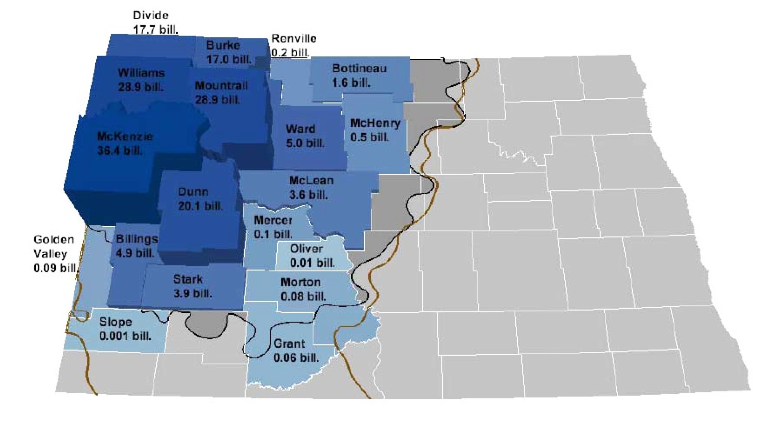
The answer lies in the Bakken and Three Forks with rigs that can drill more than 20,000 ft being the most actively employed. The Bakken has already been discussed in an earlier post at The Oil Drum and I don’t really want to repeat much of that information, and so this presentation will, perhaps, rely a little more on visuals. The Bakken and Three Forks partially lie in Western North Dakota, and the Department of Mineral Resources (DMR) for the state, has shown how the total Original Oil In Place (OOIP) estimates vary from county to county within that region.

OOIP estimates by county (North Dakota DMR)

The state has also produced some three-dimensional models of the formations in the region around Williston, which is where some of the most productive wells are found.

Region of North Dakota that is modeled. (ND DMR ) The sides of the square cover 135 miles.

By developing the model it is possible to look both at the section showing the location of the productive beds in the region. Since the Department covers other valuable minerals beside oil and gas, they are also shown in the section:

Section through the ND geology (ND DMR )

The Bakken lies at a depth of around 11,500 ft with the additional need for rigs to drill 20,000 ft coming from the use of horizontal drilling along the formation, which is typically only around 150 ft thick. One of the advantage of the model is that it can be used to generate a view of the Bakken itself, with the overlying ground removed. This also helps show that, while the above section shows the beds lying in a syncline, where oil might be expected to migrate out and up the sides away from the central dip, there is a central anticline where oil could be trapped, and the structure is not smooth. (Bear in mind also the scale of the model, so that small traps in the field are not picked up at this level. ) The structure of the shale beds themselves also make it less sensitive to geological modifications which drive oil migration, though obviously not completely or else there would be little oil flow to the well.

Model of the Bakken formation around Williston (ND DMR )

The dominant feature that runs relatively North-South through the center helps then explain the location of many wells drilling into the reservoir.

L:ocation of wells in the modeled region of North Dakota (ND DMR )

While the formations have been known for some time it was only with the development of horizontal wells, and fracking capabilities, that the opportunities to extract the oil became viable. To borrow a picture from that earlier post by Piccolo (H/t Gail)

Change in Bakken production with the introduction of horizontal wells and Fracing (TOD)

As the number of horizontal wells has grown one finds, as I noted above, that 20,000 ft of drilling will include perhaps 9,000 ft of horizontal well in the formation itself. Such a well, as for example the Credo Petroleum well that is cited, may initially produce 1,267 bd of oil and 1.24 mcf/day of natural gas.

However one of the concerns that has been expressed, both by Art Berman, and later myself, has to do with the long-term production rate from long horizontal, frac’ed wells in shale, and it is therefore instructive to see the information that is now available on a typical well, which has been compiled by the ND DMR.

Typical Bakken well production (ND DMR )

At the time of the presentation (last year) there was still a large proportion of the gas being flared.

Gas flared as a percentage in ND (ND DMR )

Since then, as I noted at the start of the piece, the amount flared in May of this year has risen to 29%.

There is a more than adequate array of pipelines to handle the fuel that is being produced, at the moment it is the oil that is the critical, and valuable component. But even with a projection that the state will see about 2,000 wells a year being drilled over the next few years, with the expectation that the field will last some 20 years, the overall production is not expected to increase much beyond the levels that it is now attaining. This is because of the relatively rapid drop in well production, for which there is now a considerable data base. That doesn’t stop some from projecting, however, that the field can increase in production to levels as high as 1 mbd or so. That would, of course, include production from Montana and Canadian parts of the Bakken, which I have not discussed here.

One point that should be noted is that the lease rates for Bakken in North Dakota are quoted as being around $7,000 to $8,000 per acre, while those in Montana are reported to be considerably less. To date there has not been that much activity in Montana, though with time this will change. Already permit numbers are rising, and there has been some success to equal that in North Dakota.
Brigham Exploration, one of the most aggressive in Montana, recently unveiled five wells there ranging from 909 boe/d to 2,962 boe/d, the latter volume a "record for the state," Pritchard said. The five wells averaged 1,579 boe/d.

At present, however, most of the rigs (170 to 10) remain on the North Dakota side of the border. That too will change, with time.

Overall the Bakken is likely to see further increases in production as the areas being drilled expand, but with the relatively short life of the well at significant levels of production, it is harder to see the higher levels of production overall that others have cited, and one also has to remember that is often the sweetest spots that get drilled first.

Read more!